-
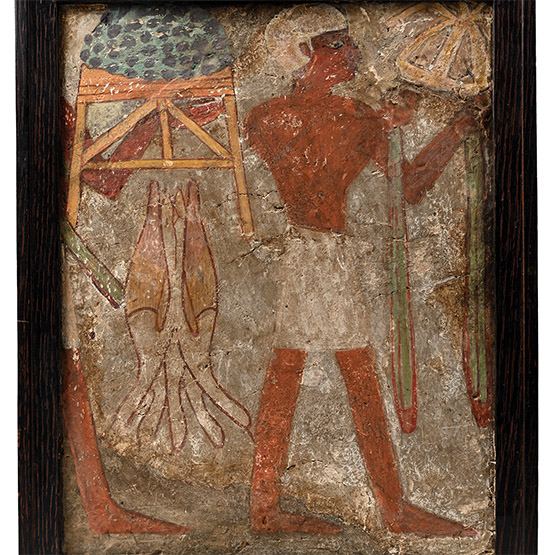
Egyptian Limestone Fresco with Servant Carrying Geese
New Kingdom, 1580-1077 B.C.Sold for (Inc. bp): £9,100
Rectangular frieze fragment with advancing figure in profile wearing a shendyt kilt holding up two poles in his raised hands; to his rear, part of a second figure with an openwork wooden frame (footstool) and other items; mounted in sturdy wooden frame with suspension rings to the reverse; surface has been extensively cleaned, restored, and repainted. 6.8 kg, 40.5 x 32.2 cm
Mounted in an early 20th-century wooden frame bearing a stamped inscription reading “Exposition Paris …” From the collection of L.V. (1950-1960), Paris, France. Collection of Monsieur X. (1931-2017), dispersed for the benefit of the Monaco Red Cross. Private collection, Europe. This lot has been checked against the Interpol Database of stolen works of art and is accompanied by a search certificate number no.13224-249307.
The servant is carrying geese, like in many other representations of the New Kingdom. Many portrayals of ducks and geese in ancient Egyptian art show the importance of the birds as food. Servants plucking geese are visible in the tomb of Nakht, in Luxor (1567-1320 B.C.), and in the famous tomb of Nebamun, at the British Museum, a fresco fragment shows workers standing in front of a gaggle of geese. -
.jpg)
Egyptian Green Glazed Somtous Seated on Lotus Flower
Late Period, circa 664-332 B.C.Sold for (Inc. bp): £780
Modelled in the round, the nude seated figure of the child Somtous, with one hand to his lips and a prominent sidelock, emerging from a lotus flower; mounted on a custom-made stand. 39.76 grams total, 68 mm high including stand
Noriuchi Horiuchi, Tokyo, Japan, 1993. Private collection, London, UK.
The earliest attestations of the cult of Somtous, known as Sematawy in ancient Egyptian, date back to the New Kingdom, although it became particularly popular during the Late Period. Associated with Horus (Horsomtous), the symbol of the child emerging from the lotus represented the (re)birth of the sun god. Thus, Somtous was regarded as a life-giving amuletic symbol, sometimes even referred to as 'Sematawy the child who gives life.' -
.jpg)
Egyptian Faience Bead with Cartouches of Pharaoh Amasis
Late Period, 26th Dynasty, circa 664-525 B.C.Sold for (Inc. bp): £2,340
Square in plan with transverse piercing, obverse with three panels: the left bearing a cartouche surmounted by two plumes containing the pharaoh’s birth name, i͗Ꜥms sꜢ nt (Ahmose, son (of) Neith); the right, a similar cartouche containing his throne name, ẖnm-i͗b-RꜤ (He who embraces the heart of Re); the centre inscription reads, ḥpw Ꜥnḫ sꜢ ḥpt(?) (the living Apis, son [of] Hepet?) two with a cartouche for Amasis, text to the centre. 4.96 grams, 26 mm
Ex private collection, Germany. with Galerie Günter Puhze, Freiburg, Germany, prior to 2003. Private collection, acquired on the German art market, 2004. This lot has been checked against the Interpol Database of stolen works of art and is accompanied by search certificate number no.13186-249203.
The three-column text arrangement closely resembles that of another rectangular spacer bead, engraved with Ahmose II’s cartouches flanking a central inscription, now held at The Walters Art Museum, Baltimore (accession number 42.377). Although the central inscription differs in content, the bead’s connection to the Apis bull is shown on the opposite side, where the sacred animal is depicted. Amasis II (Egyptian: Ahmose II), fifth king of the 26th Dynasty (Saite Period), reigned c. 570–526 BC. Rising to power after overthrowing Apries, Amasis presided over a period of renewed stability and prosperity in Late Period Egypt. His reign is characterised by administrative reform, economic growth, and an active foreign policy, including close diplomatic and commercial relations with the Greek world, evidenced by Greek mercenaries in Egyptian service and the granting of Naukratis as a trading enclave. Amasis undertook extensive temple building and restoration programmes throughout Egypt, particularly at Sais, Memphis, and in Upper Egypt, consciously aligning himself with earlier pharaonic traditions. His royal titulary appears widely on monuments, scarabs, amulets, and architectural elements, often reflecting an emphasis on divine legitimacy and Maʿat. Amasis died shortly before the Persian conquest of Egypt under Cambyses II; his reign represents the final florescence of independent Egyptian kingship before Achaemenid rule. -
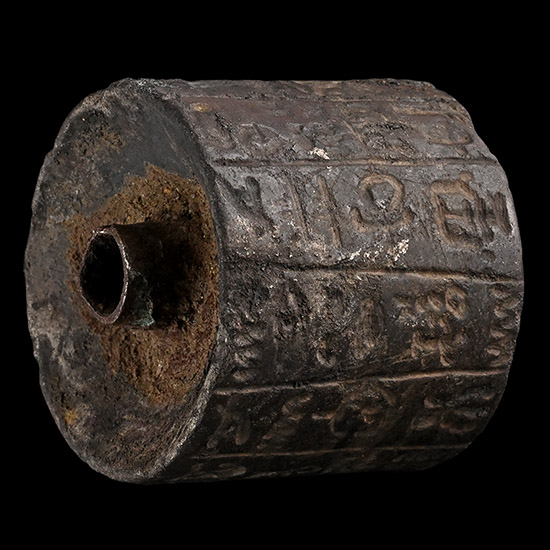
Phoenician Silver Cylinder Seal with Pseudo-Egyptian Hieroglyphs
Levant, 1st millennium B.C.Sold for (Inc. bp): £520
Tubular with concave disc ends pierced by a sleeve to accept the axle; outer face divided by longitudinal straight lines, the resultant panels with shapes and symbols reminiscent of hieroglyphs but not interpretable using the Egyptian system. 97.8 grams, 40 mm
London, UK, art market, 1980s. Private collection, London, UK. -
.jpg)
Egyptian Wooden Stele for Pa-di-Amun-(em)-ipat with Ra-Horakhty
Late Period-Ptolemaic Period, 664-30 B.C.Sold for (Inc. bp): £20,800
Arch-topped and composed of two vertical boards, coated with gesso and skilfully painted on one side; the lunette decorated with a winged sun-disc and two pendant uraei; the central vignette depicting the deceased worshipping the falcon-headed god Ra-Horakhty with the Four Sons of Horus standing behind, each with their name written above; the lower register with six lines of hieroglyphic text providing an offering formula for the benefit of the deceased: Transliteration of the hieroglyphs: 1) ḥtp-dı-͗nsw rꜤ-ḥr-Ꜣḫtı͗nṯr Ꜥ nb pt sḥḏ [.....] wsır͗ ẖntt [ım͗ntt?] 2) nṯr Ꜥ nb Ꜣbḏw dı⸗͗f pr.t-ḫrw t ḥnḳt kꜢ Ꜣpd [....] ḫt nb(t) (n) fr(t) wꜢbt […] 3) ḫt nbt nḏm dı⸗͗f ḥtpw ḏfꜢw [...]f ḫꜢ m t dı⸗͗f ḫꜢ m 4) ḥnḳt dı⸗͗f ẖꜢ ır͗p [...] dı⸗͗f ḫꜢ m ı͗[...] dı⸗͗f ḫꜢ ı(͗Ꜣ)r(r)t dı⸗͗f 5) m snṯr ḥr ḫꜢwt [...] ḳrs nfr ḥr ım͗nt nfr 6) n [..] wsır͗ [......] pꜢ-dı-͗ım͗n(m) ıp͗ Ꜣ.t ms (n) ḫꜢ [....] Translation: 1) An offering that the king and Ra-Horakhty, Great God, Lord of Heaven, the illuminated [...] Osiris Foremost [of the West?] 2) Great God, Lord of Abydos (that) he may give a voice-offering (of) bread, beer, oxen, and fowl […] everything good and pure […] 3) everything sweet, he gives offerings of provisions […] a thousand of bread, he gives a thousand of 4) beer, he gives a thousand of wine […], he gives a thousand of vines, he gives a thousand of 5) incense on the altar […] a good burial in the beautiful West 6) for […] the Osiris[…] Pa-di-Amun-(em)-ipat born (to) Kha[…]; on the verso, an old handwritten collection label reading: 'From Harding & Sm[ith] Collection Sale Sotheby 2 Nov 1922 L.N. 234. A families [sic] stele, arched top, with the deceased worshipping a standing Horus attended by the four Children of Horus and six horizontal lines of inscription in colour. SP/10a'; mounted in a custom-made wooden frame. 1.94 kg, 45 cm high
From the collection of the late W. Harding Smith (1848-1922). with Sotheby, Wilkinson & Hodge, 34 & 35 New Bond Street, 2 November 1922, no.234. Old handwritten label to verso reading 'From Harding & Sm[ith] Collection collection Sale Sotheby 2 Nov 1922 L.N.234...' Accompanied by an academic report by Egyptologist Paul Whelan. Accompanied by a copy of the 1922 Sotheby, Wilkinson & Hodge catalogue pages. This lot has been checked against the Interpol Database of stolen works of art and is accompanied by search certificate number no.13251-253195.
The syncretism of two strong gods, Re and Horus, is one of the most significant events in Egyptian mythology, and it appears to have had a substantial iconographic impact on Egyptian history. Re's power was augmented by this, which consisted of a falcon-headed man crowned with a sun disc; in the mornings, Re was combined with Horus to become Re-Horakhty. -
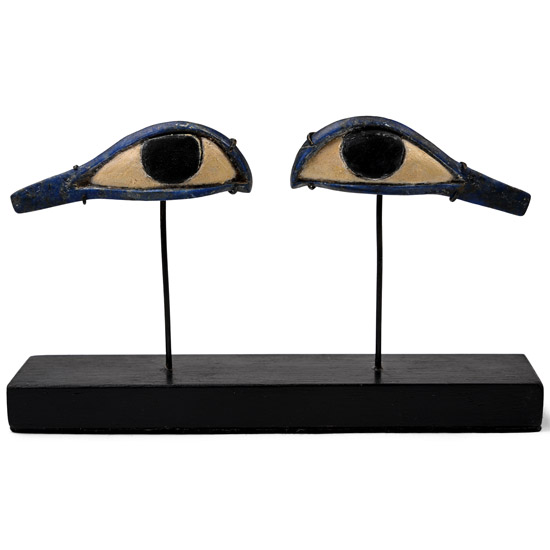
Egyptian Blue Glass Mummy Eye Pair
Late Period, 664-332 B.C.Sold for (Inc. bp): £2,340
Composed of overpainted white sclerae with obsidian irises, set into contoured blue glass lids with extending cosmetic lines; mounted on a custom-made display stand. 44.35 grams total including stand, 56 mm each
Property of a North American gentleman, London, UK, 1990-2010. This lot has been checked against the Interpol Database of stolen works of art and is accompanied by search certificate number no.13254-252260.
The eyes would have been applied to a mummy case. They were carefully bevelled and ground to fit the original mummy case. They could also have been used for the mummy masks. -
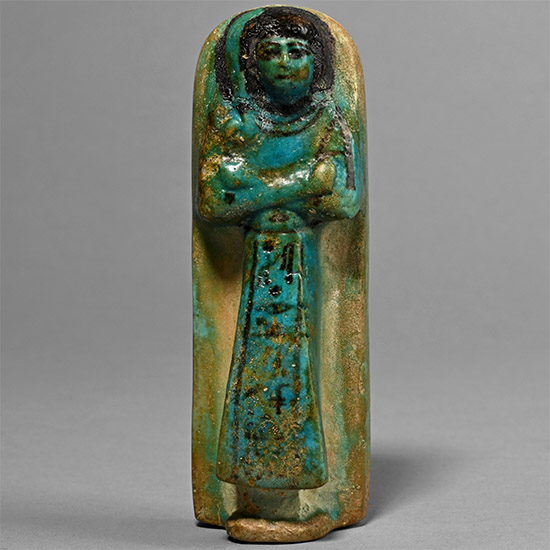
Egyptian Turquoise Faience Shabti of Prince Khaemwaset
New Kingdom, 19th Dynasty, circa 1292-1185 B.C.Sold for (Inc. bp): £6,552
Wearing daily dress and carrying agricultural implements, with dark blue details including his short wig with side-lock, designating him as a Sem-priest of Ptah at Memphis, the text on the kilt naming him as 'Sem-priest and King's son Khaemwaset'; with round-topped back support, the reverse with two columns of hieroglyphs with part of the shabti formula: "He says: O shabti, if one counts, if one is reckoned to do all the works that are to be done there in the God’s land—now indeed obstacles are implanted therewith—as a man at his duties, ‘Here I am,’ you shall say when you are counted off to cultivate the fields, transport by boat the sand of the east to the west and vice versa; ‘Here I am,’ you shall say". 284 grams, 15.1 cm
With Barakat, Beverly Hills: reputed to be from the Omar Pasha Sultan collection, (1806-1871) but unpublished in the 1929 catalogue of the collection, nor in Aubert's 1976 article on the shabtis in the collection. Bonhams, London, 1 May 2013, no.282. Accompanied by copies of the relevant Bonhams catalogue pages. Accompanied by an academic report by Egyptologist Paul Whelan. This lot has been checked against the Interpol Database of stolen works of art and is accompanied by search certificate number no.12938-243536.
Prince Khaemwaset was the fourth-ranked son of Ramesses II and the second born to Queen Isetnofret. More is known about Khaemwaset than any other son of Ramesses II, attested by over 150 objects, ranging from statues to temple reliefs. He is traditionally regarded as the “first Egyptologist” for his restoration of monuments belonging to earlier kings, including the pyramids at Giza and Saqqara. Recent reassessment, however, suggests that some of these activities involved dismantling parts of ancient structures for reuse in his father’s temple constructions. -
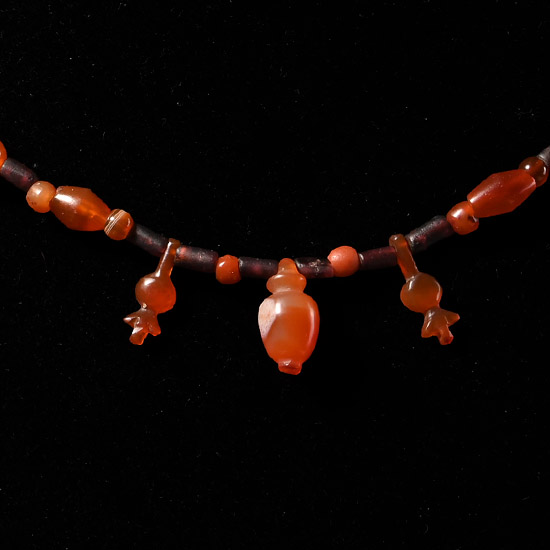
Egyptian Hardstone Necklace with Amulets
New Kingdom, 1550-1295 B.C.Sold for (Inc. bp): £572
Spherical, bicone, and tubular stone beads with a vessel, and two cornflower amulets, restrung with a modern clasp fitting. 17.45 grams, 42 cm
Ex London, UK, collection, 1990s-2000s. -
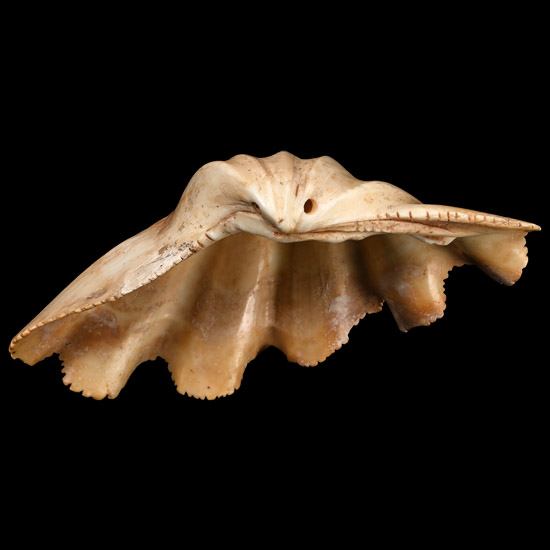
Phoenician Shell Cosmetic Vessel with Carved Eyes
Circa 7th-6th century B.C.Sold for (Inc. bp): £1,170
A tridacna squamosa shell with drilled eyes on the apex, the edges decorated with parallel cuts. 110 grams, 14.6 cm
Acquired before 1983. Ex London gallery, 1990s. Private collection, London, UK. -
.jpg)
Egyptian Green Glazed Faience Amulet of Nephthys
Late Period, 664-332 B.C.Sold for (Inc. bp): £468
Depicting the goddess Nephthys wearing the two hieroglyphic parts of her name (Neb(et)-Hut), with dorsal pillar and base. 2.62 grams, 37 mm
with Bizhan Soumekh, 14 September 1981. Private collection, London, UK. -
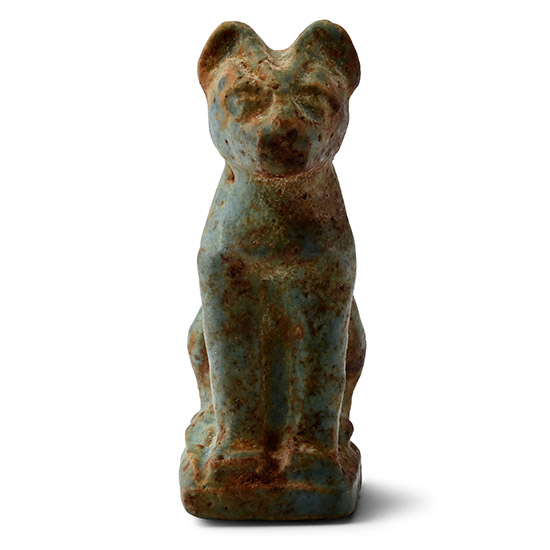
Large Egyptian Faience Cat Amulet
Late Period, 664-332 B.C.Sold for (Inc. bp): £1,105
Modelled seated on a tongue-shaped base, with simple facial detailing and suspension loop to the shoulders. 12.46 grams, 40.75 mm
Ex early 20th century London, UK, collection.
The cat was sacred to Bastet, a protective mother goddess and the daughter of the sun god Re. Amulets were believed to provide the wearer with the goddess's protection. -
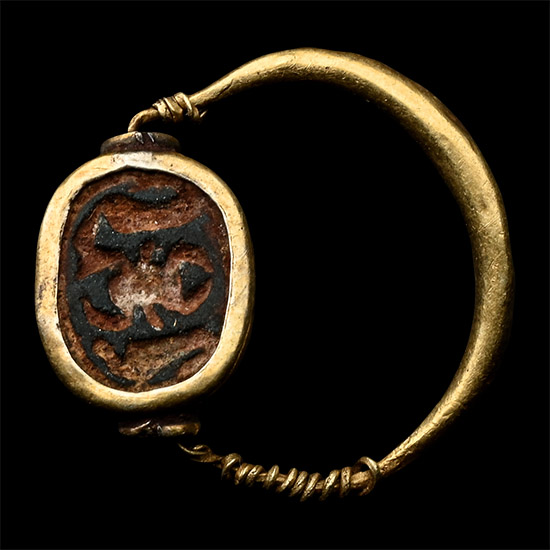
Egyptian Gold Swivel Ring with Green Jasper Hedgehog Scaraboid Engraved with a Scarab Flanked by Two Cobras
New Kingdom, 1570-1070 B.C.Sold for (Inc. bp): £585
Penannular hoop with swivel mount and frame; inset stylised hedgehog scaraboid featuring large, round ears and a protruding snout, with the underside bearing an incuse scarab flanked by rearing snakes. 1.67 grams, 19.01 mm overall, 16.18 mm internal diameter (approximate size British D 1/2, USA 2, Europe 1.78, Japan 1)
UK private collection before 2000. Acquired on the UK art market. Private collection, London, UK.

