-
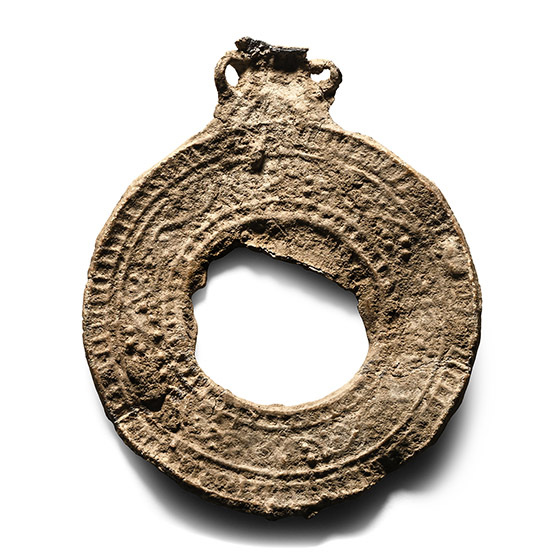
Roman Lead Votive Mirror Frame
1st-4th century A.D.Sold for (Inc. bp): £26
Circular frame with low-relief pellet and linear decoration, two small loops flanking the stem. 21.14 grams, 61 mm
From a retired Lincolnshire, UK, gentleman's collection, a long-time member of the Pewter Society. -
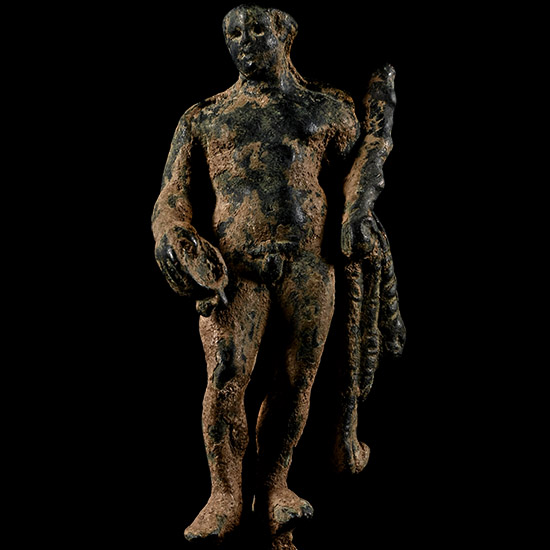
Roman Bronze Figure of Hercules Holding Club and Skyphos
2nd-3rd century A.D.Sold for (Inc. bp): £1,235
Depicted nude in a contrapposto stance with the weight on his left leg, holding a club in the crook of his left hand with a lion-skin draped over the arm, and a cup in his right hand. 115 grams, 86 mm
Acquired in the 1980s. Private collection, Switzerland, thence by descent. Private collection, since the late 1990s. This lot has been checked against the Interpol Database of stolen works of art and is accompanied by search certificate number no.12615-234681.
This well-proportioned bronze statuette, perhaps of Gallo-Roman origin, was likely made for a private lararium, the domestic shrine found in many Roman homes. Although provincial in style, it is carefully modelled and has a strong presence. Unlike many similar figures, Hercules is shown here without a beard, and the upper part of the head was probably once covered by a laurel crown. Known to the Greeks as Herakles, Hercules was one of the most admired heroic figures in the Roman world, celebrated for his strength, endurance, and ability to overcome immense challenges. His famous Twelve Labours made him a lasting symbol of perseverance and triumph, and small bronze figures such as this would have brought not only mythological meaning into the home, but also a sense of protection, resilience, and personal devotion. -
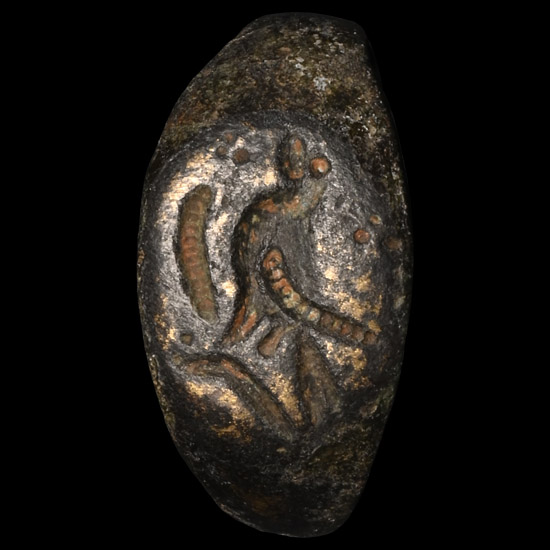
Roman Bronze Ring with Bird
1st-4th century A.D.Sold for (Inc. bp): £59
An interphalangeal ring with a slender hoop and an oval bezel with a stylised bird. 1.69 grams, 17.62 mm overall, 13.08 x 15.34 mm internal diameter (approximate size British F 1/2, USA 3, Europe 4.30, Japan 4)
From the private collection of a European gentleman (1942-2024), formed since the 1970s. -
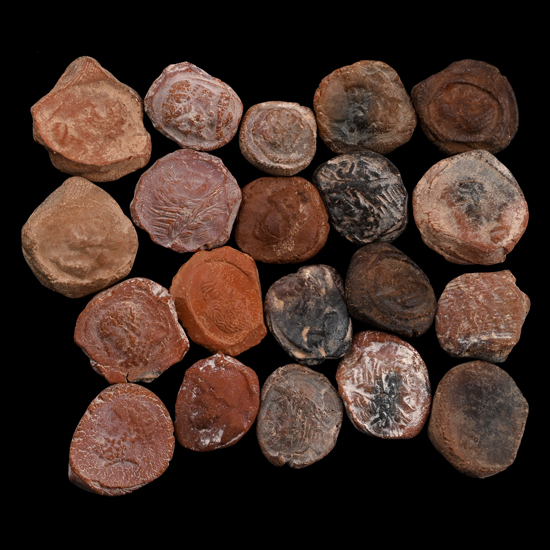
Roman Terracotta Bullae, Tesserae or Token Group
3rd century B.C.-1st century A.D.Sold for (Inc. bp): £7
A mixed group of ceramic bullae, tesserae or theatre tokens bearing low-relief motifs, mainly consisting of profile busts of deities. 34 grams total, 13-19 mm
From the private collection of a European gentleman (1942-2024), formed since the 1970s.
The term 'tessera' was used in Roman times to convey the Greek term σύμβολον (token). Small tiles are known as tokens, often shaped like coins, made of metal (copper, lead, iron), clay, bone, wood, or glass, stamped as well as engraved. The tokens, however, are not exclusively coin-shaped, as the Latin term 'tessera' suggests by etymologically referring to a square or at least a four-sided shape and confirmed in several cases by material remains of the past. Tokens and tesserae seem to have been used both in Athens and Rome for the distribution of goods. According to written sources, the term token is identified with credentials of the official authorities. They have also been interpreted as tokens of identity, as entrance tickets to theatre performances, tribunals or assemblies of citizens, archival material of seal engraving, as pawns in games, Charon’s obols and even as amulets. -
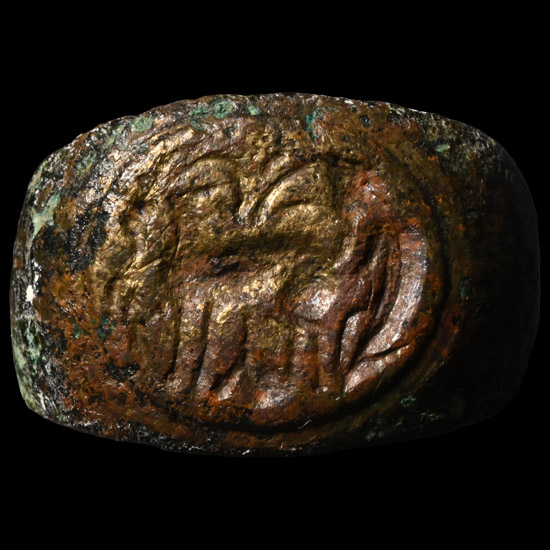
Roman Bronze Ring with an Ibex
1st-4th century A.D.Sold for (Inc. bp): £33
D-section hoop expanding towards the shoulders, oval bezel with a standing ibex amongst vegetation. 6.81 grams, 22.64 mm overall, 14.48 x 18.62 mm internal diameter (approximate size British K, USA 5 1/4, Europe 9.95, Japan 9)
From the private collection of a European gentleman (1942-2024), formed since the 1970s. -
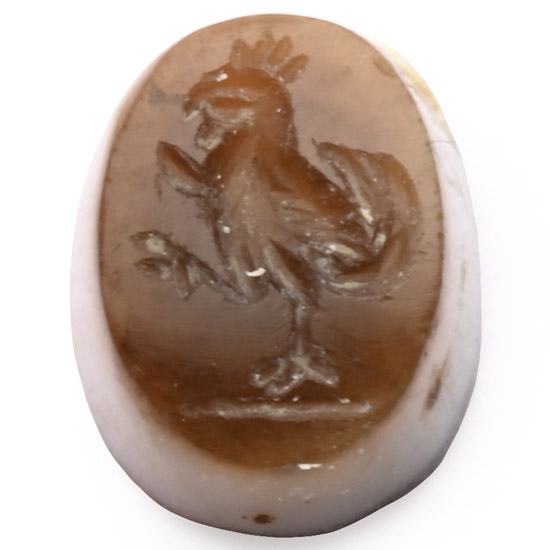
Roman Banded Agate Gemstone with Rooster
2nd-3rd century A.D.Sold for (Inc. bp): £72
With intaglio walking rooster; supplied with a museum-quality impression. 0.11 grams, 6.08 mm
From the private collection of a European gentleman (1942-2024), formed since the 1970s. -
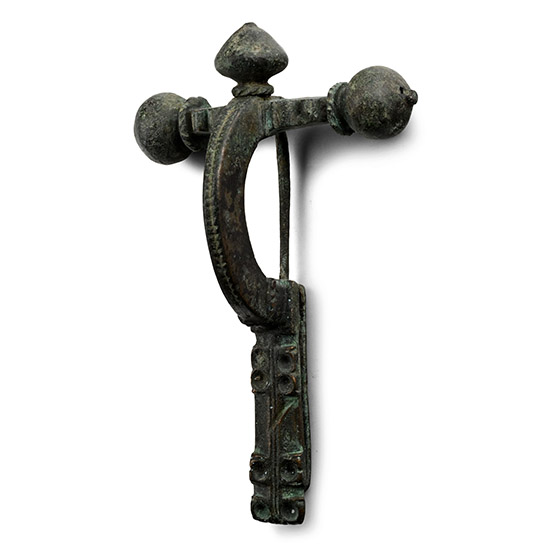
Roman Bronze Crossbow Brooch
4th century A.D.Sold for (Inc. bp): £143
With onion-knop finials, gusset to the bow, chamfered sections to the foot, hinged pin to the reverse. 47.5 grams, 78 mm
Ex German art market, 2000s. Acquired from an EU collector living in London. From the collection of a Surrey, UK, gentleman. -
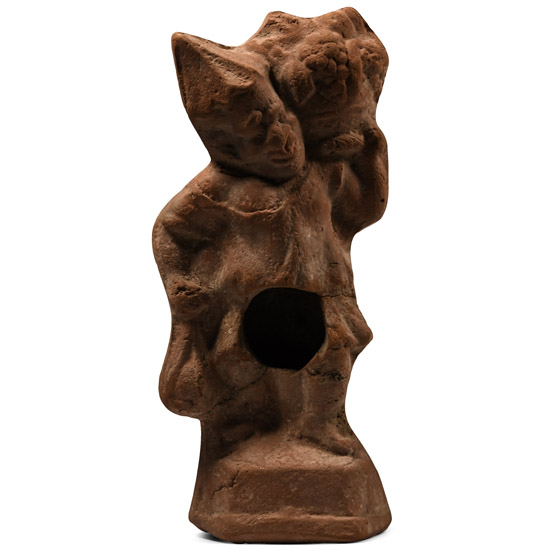
Romano-Egyptian Terracotta Figure of a Slave with Fruit Basket
1st century A.D.Sold for (Inc. bp): £221
Hollow-formed figure of a servant with grotesque facial features, pointed cap and a short tunic, carrying a pouch in the right hand and shoulders an overflowing fruit basket on the left; a large recess between his legs may be for the insertion of an oversized model phallus; pierced lug to rear of neck for suspension. 286 grams, 17.5 cm
Acquired from Galerie Puhze, Freiburg, between 2002 and 2010. From the collection of R. L., Lower Saxony. Ex Gorny & Mosch, auction 300, Munich, no.75. Accompanied by a certificate from Galerie Günter Puhze and a German export licence.
Grotesque and exaggerated figurines were produced in late Hellenistic times, especially in Alexandria. The artisans, fascinated with realism, started to reproduce scenes and figures from daily life, and seemed to have a preference for emphasis on ill and deformed persons. The characters with caricature features are usually referred to as grotesques. -
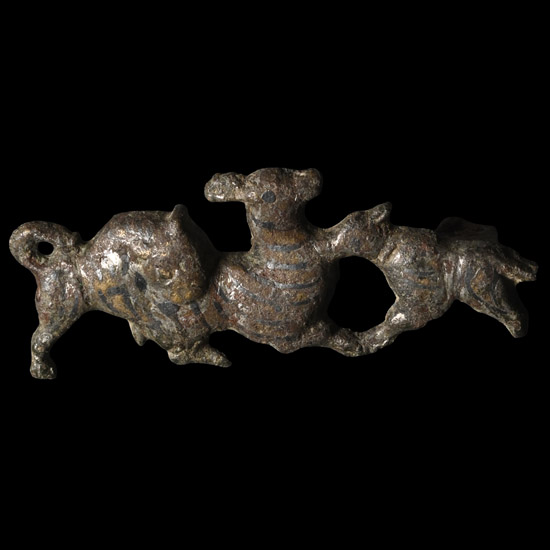
Roman Tinned Bronze Lion Pair Attacking a Deer Plate Brooch
2nd-3rd century A.D.Sold for (Inc. bp): £111
Showing two lions attacking a large deer, one biting the back and the other attacking its jugular, pin and catchplate on the reverse. 3.74 grams, 35 mm
From the private collection of a European gentleman (1942-2024), formed since the 1970s. -
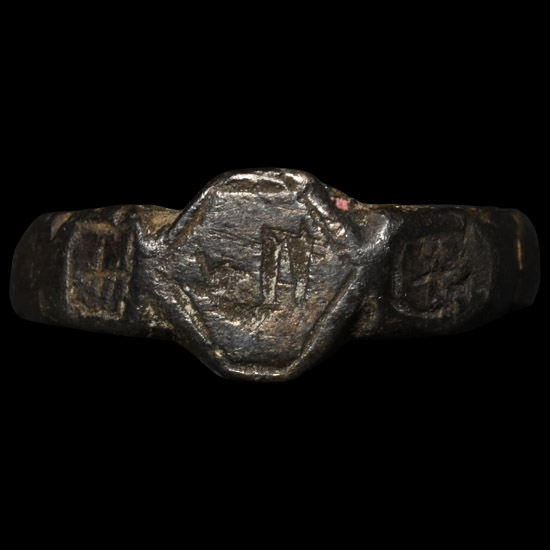
Roman Bronze Child's Ring
1st-4th century A.D.Sold for (Inc. bp): £20
Comprising a thick hoop and a hexagonal bezel flanked by cross motifs within a square. 1.33 grams, 13.40 mm overall, 8.59 mm internal diameter
From the private collection of a European gentleman (1942-2024), formed since the 1970s. -
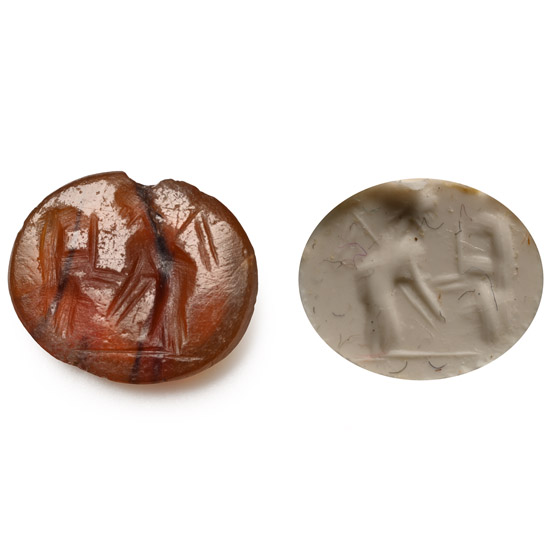
Roman Carnelian Gemstone with Winged Victory
2nd-3rd century A.D.Sold for (Inc. bp): £65
With intaglio winged Victory stooping, holding a wreath; supplied with a museum-quality impression. 0.46 grams, 10.69 mm
From the private collection of a European gentleman (1942-2024), formed since the 1970s. -
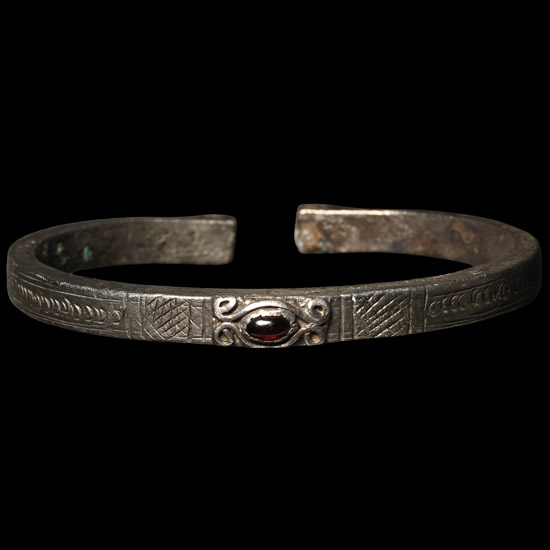
Roman Silver Decorated Bracelet with Cabochon Garnet
1st-4th century A.D.Sold for (Inc. bp): £377
Rectangular-section penannular shank with clubbed ends, bands of impressed crescents to the outer face, hatched panel with applied wire scrolls and cabochon in cell. 22.9 grams, 61 mm
From the private collection of a European gentleman (1942-2024), formed since the 1970s.

