-
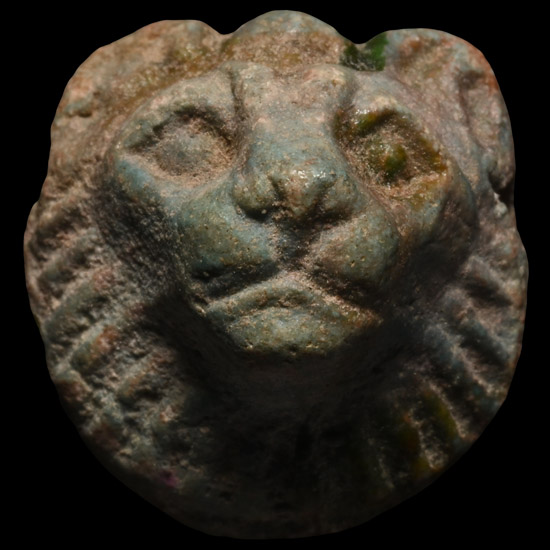
Egyptian Faience Lion's Head Amulet
Roman Period, 30 B.C.-323 A.D.Sold for (Inc. bp): £130
Modelled frontally with a radiating mane framing the face, pierced horizontally. 1.23 grams, 14.8 mm
From the private collection of a European gentleman (1942-2024), formed since the 1970s. -
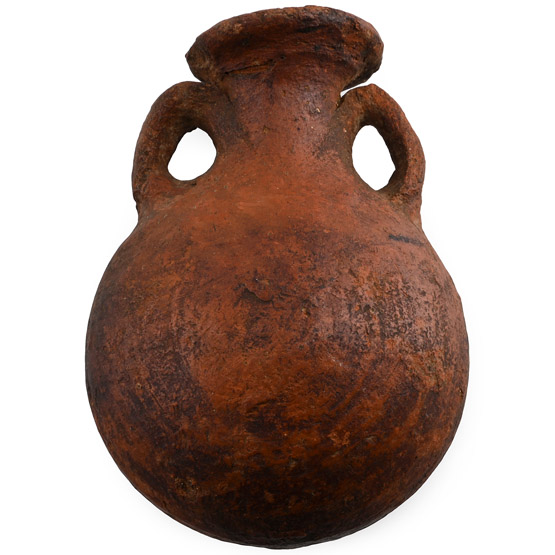
Egyptian Terracotta Flask
New Kingdom, 1550-1069 B.C.Sold for (Inc. bp): £468
Pouch-shaped body with trumpet-shaped mouth and lateral loop handles. 191 grams, 10.5 cm
Acquired at a London antiques fair in the 1990s. From the private collection of a Devon, UK, lady. -
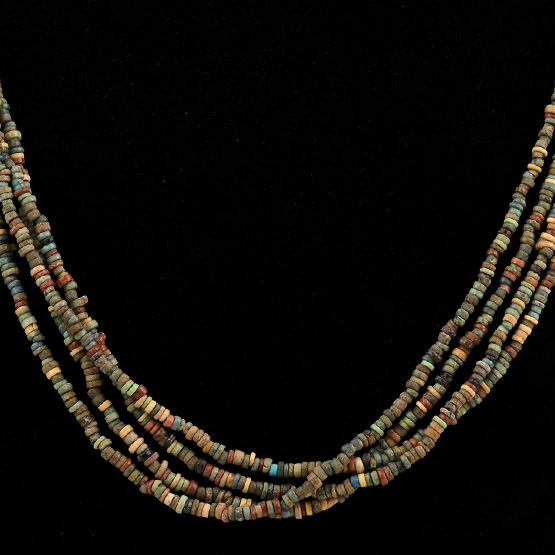
Egyptian Multi-Stranded Mummy Bead Necklace
Late Period, 664-332 B.C.Sold for (Inc. bp): £169
Four-strand designer necklace composed of polychrome beads of mainly disc and cylindrical types. 22.7 grams, 64 cm
Acquired before 1979. From the private collection of Mr F.A., South Kensington, London, UK; thence by descent 2014.
For thousands of years, artisans in Egypt created vibrant ceramics to echo the beauty of rare jewels. These ornaments were created with almost every material, colour, and texture imaginable, and they come from across Egypt and beyond: vibrant blue lapis lazuli from Afghanistan, glossy black obsidian from Turkey, and aqua-green turquoise from the Sinai. They were worn in life and, after death, they served as precious ornamentation for mummies. -
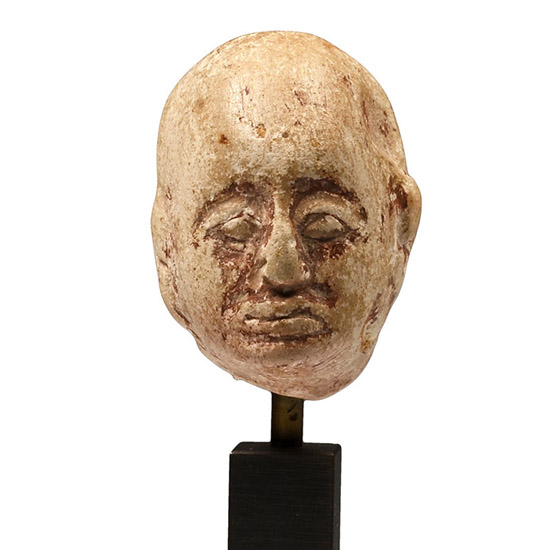
Egyptian Stone Head of a Man
Hyksos Period, circa 1648-1540 B.C.Sold for (Inc. bp): £286
A miniature male head with high eyebrows, large eyes, and protruding nose and mouth; traces of polychrome; inked collector's number '46' on the back; mounted on a custom-made display stand. 76 grams total, 92 mm including stand
Collection of Ambassador G.P., Nr.203, before 1965. with Galerie Rhéa, Zurich, Switzerland. -
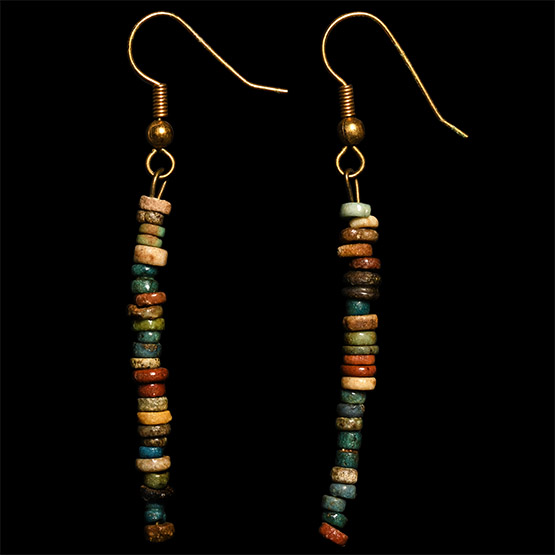
Egyptian Faience Bead Earring Pair
Late Period-Ptolemaic Period, 664-30 B.C.Sold for (Inc. bp): £104
Composed of colourful annular beads threaded to a modern bar with an earring hook. 1.99 grams total, 62 mm each
Acquired from Ancient Art, London, UK. From the collection of a Nottingham, UK, collector, established from the early 2000s. Accompanied by the original Ancient Art certificate of authenticity. -
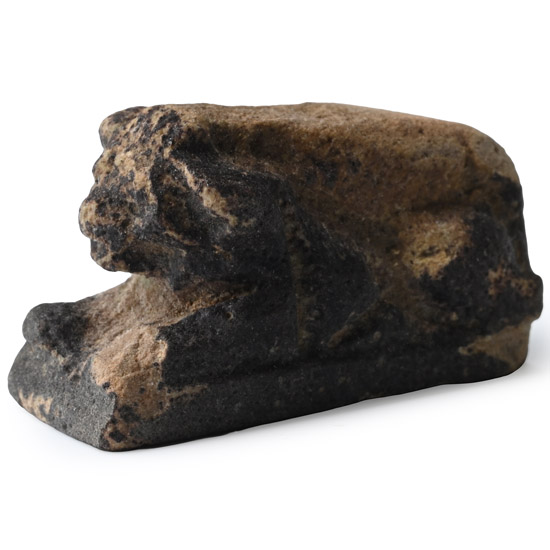
Egyptian Stone Recumbent Lion Amulet
Roman Period, 30 B.C.-323 A.D.Sold for (Inc. bp): £39
Resting on a rectangular base with an erect head. 7.26 grams, 29.4 mm
From the private collection of a European gentleman (1942-2024), formed since the 1970s. -
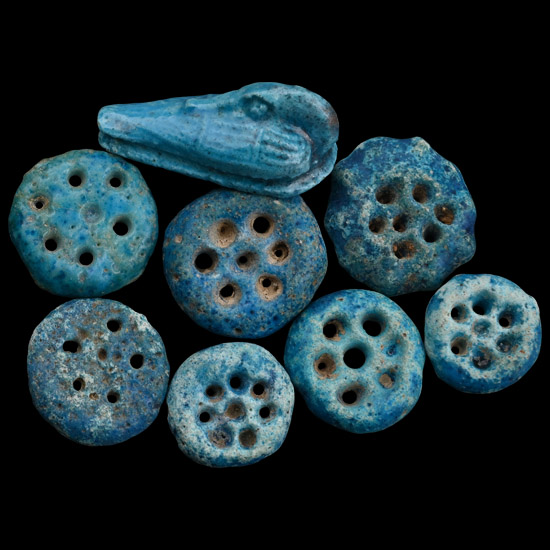
Egypto-Phoenician Faience Amulet Group
4th-2nd century B.C. and laterSold for (Inc. bp): £234
Comprising flat discs with perforations and a trussed duck with its head laid along its spine. 18.74 grams total, 15-30 mm
From the collection of a gentleman, acquired on the London art market in the 1990s. -
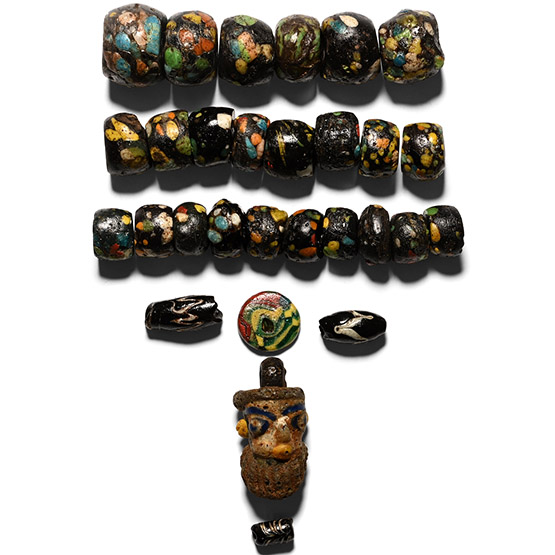
Phoenician Glass Bead Collection
6th-3rd century B.C. or laterSold for (Inc. bp): £910
Comprising a group of crumb-decorated polychrome oblate beads and a centrepiece pendant formed as a stylised bearded head. 179 grams total, 12-42 mm
From the collection of a gentleman, acquired on the London art market in the 1990s.
The Phoenicians, renowned seafarers and traders, were also skilled glassworkers. They produced a wide variety of glass beads using core-forming and winding techniques, with vivid colours and elaborate designs that reflect both technical mastery and cross-cultural influence. Among the most iconic Phoenician beads are glass 'head' beads, crafted in the form of stylised human or mythological faces. Typically, they feature exaggerated facial details like bulging eyes, large noses, beards, and headdresses, often with expressive or comic features. They were possibly worn as amulets to ward off evil or attract protection, though they may also represent deities, ancestors, or foreigners. These beads often incorporate Egyptian, Greek, and Near Eastern stylistic elements, reflecting the Phoenicians’ extensive trade networks. -
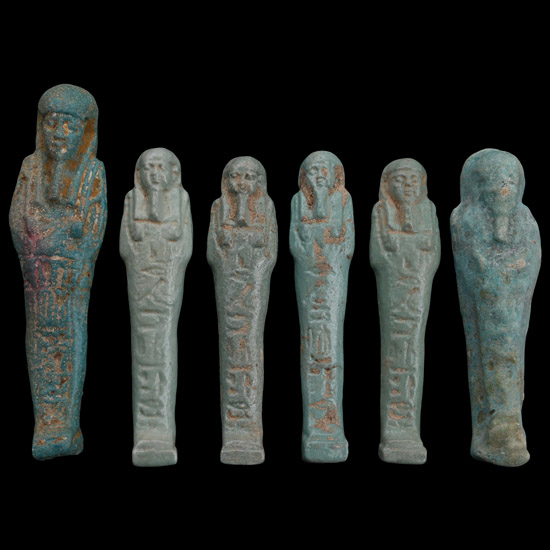
Egyptian Faience Shabti Collection
Late Period-Ptolemaic Period, 664-30 B.C.Sold for (Inc. bp): £754
All are typical mummiform figures, each wearing a lappet wig and false beard, holding a pick, a hoe, and a seed bag, with an impressed column of hieroglyphs on the front and a pillar at the back. 74.88 grams total, 70-85 mm
From the collection of a gentleman, acquired on the London art market in the 1990s. -
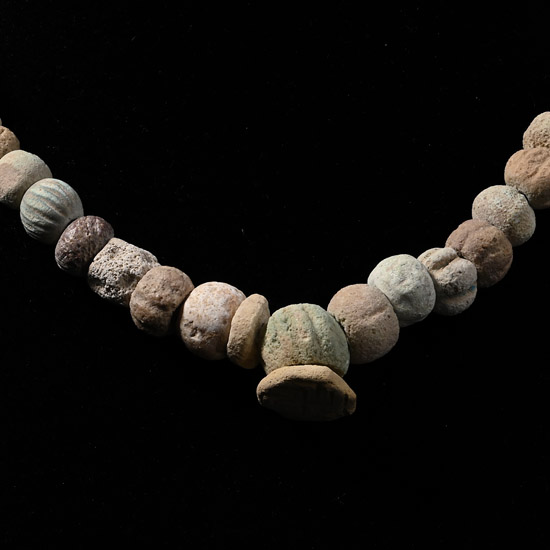
Phoenician Faience Melon Bead Necklace
1st millennium B.C.Sold for (Inc. bp): £98
Composed of graduated melon and other beads, the central feature a discoid pendant with a hooked cross symbol; restrung with a modern clasp. 47.4 grams, 42 cm
Ex London, UK, gallery, 1990s. Accompanied by a previous typed catalogue information card. -
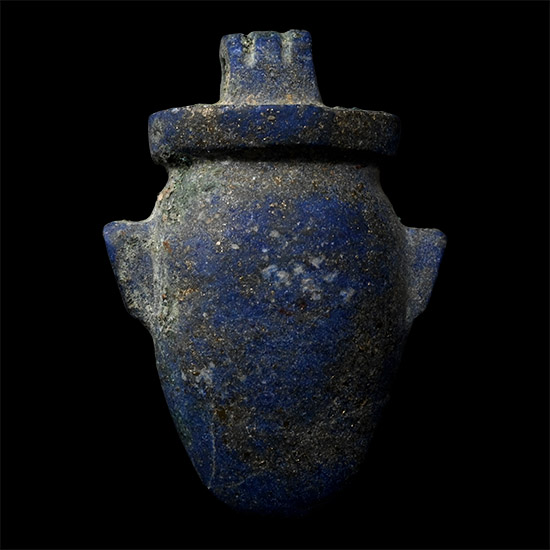
Egyptian Lapis Lazuli Heart Amulet
Late Period, 664-332 B.C.Sold for (Inc. bp): £234
Carved in the round with lateral lugs and integral loop above. 2.05 grams, 19 mm
Ex D collection, 1940. Property of a North London, UK, gentleman. -
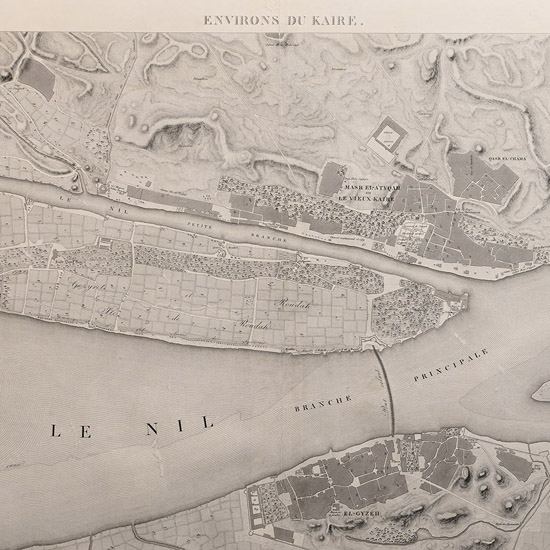
Very Large Egyptian Expedition Lithograph of the 'Environs du Kaire' (Cairo and district)
Early 19th century A.D.Sold for (Inc. bp): £91
Proof etching on laid paper of plate 16 from Vol .I of Description de l'Égypte : ou, Recueil des observations et des recherches qui ont été faites en Égypte pendant l'expédition de l'armée française. entitled Environs du Kaire. Plan particulier de l'île de Roudah, du vieux Kaire et du Gyzeh. 238 grams, 105.5 x 69.5 cm
From the collection of a North American priest. Acquired between 1981-1996. Property of a North American collector.
Produced between February 1802 and 1830 on the orders of Napoleon Bonaparte; published between 1809 and 1828. Just 1,000 copies were distributed to various institutions, printed on laid paper with an 'Égypte ancienne et moderne' watermark. The book is subtitled Recueil des observations et des recherches qui ont été faites en Égypte pendant l’expédition de l’Armée française, publié par les ordres de Sa Majesté l’Empereur Napoléon le Grand (Gathering of observations and discoveries which were made in Egypt during the expedition of the French army, published on the orders of His Majesty the Emperor Napoleon the Great). It was the world's first encyclopedia devoted exclusively to the remains of ancient Egypt. The plates of this book are the first to present the archaeological sites of Thebes (Luxor). The papyrus manuscript was recovered from the underground chambers (hypogea).

