-
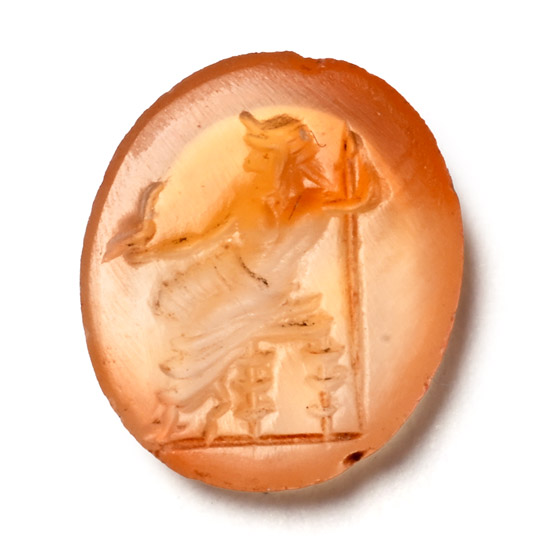
Roman Carnelian Gemstone with God Zeus Seated Holding Eagle
2nd-3rd century A.D.Sold for (Inc. bp): £182
With an intaglio figure of a seated man with a staff, supporting a bird in one hand; supplied with a museum-quality impression. 0.28 grams, 10.16 mm
From the private collection of a European gentleman (1942-2024), formed since the 1970s. -
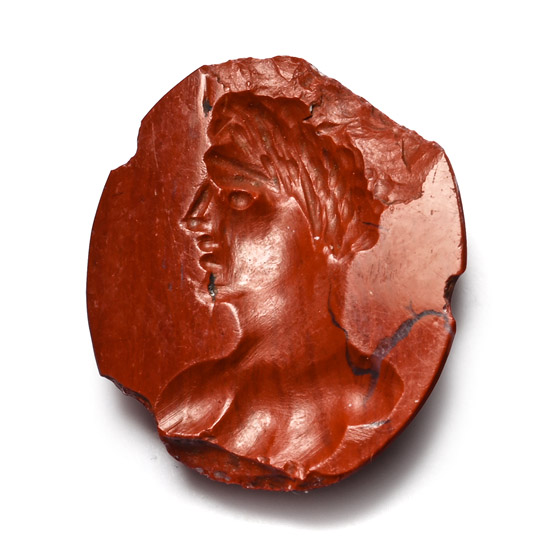
Roman Red Jasper Gemstone with Apollo
2nd-3rd century A.D.Sold for (Inc. bp): £98
With intaglio bust of Apollo; supplied with a museum-quality impression. 0.87 grams, 15.92 mm
From the private collection of a European gentleman (1942-2024), formed since the 1970s. -
.jpg)
Roman Banded Orange Agate Gemstone with Gryllus
2nd-3rd century A.D.Sold for (Inc. bp): £143
With an intaglio figure with a large head advancing left on bird legs, long beard and nose, wearing a curving helmet with a cockerel-head finial with drips falling from its nose; supplied with a museum-quality impression. 0.36 grams, 8.90 mm
From the private collection of a European gentleman (1942-2024), formed since the 1970s. -
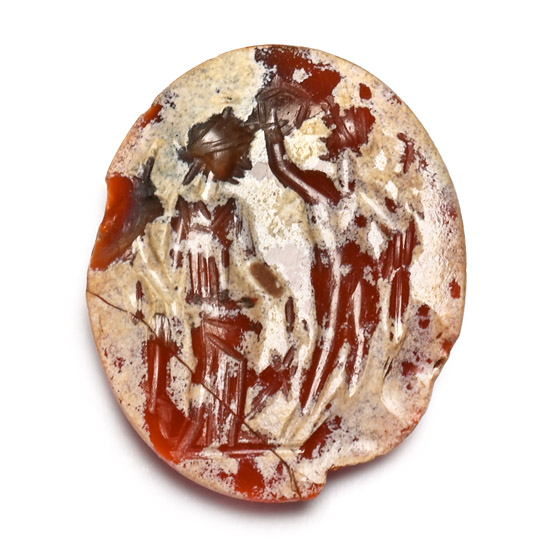
Roman Carnelian Gemstone with Gods Mercury and Minerva
2nd-3rd century A.D.Sold for (Inc. bp): £65
With intaglio scene of two figures in a landscape; supplied with a museum-quality impression. 1.02 grams, 17.11 mm
From the private collection of a European gentleman (1942-2024), formed since the 1970s. -
.jpg)
Roman Carnelian Gemstone with Victory
2nd-3rd century A.D.Sold for (Inc. bp): £72
With intaglio Victory standing with shield and wreath; supplied with a museum-quality impression. 0.34 grams, 10.16 mm
From the private collection of a European gentleman (1942-2024), formed since the 1970s. -
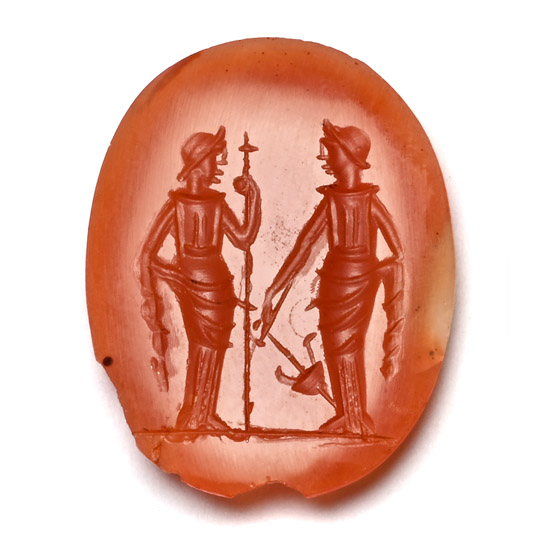
Roman Carnelian Gemstone with Goddesses
2nd-3rd century A.D.Sold for (Inc. bp): £182
Intaglio scene with two standing female figures, Minerva with helmet and spear beside Abundantia with an amphora; supplied with a museum-quality impression. 2.48 grams, 22.32 mm
From the private collection of a European gentleman (1942-2024), formed since the 1970s. -
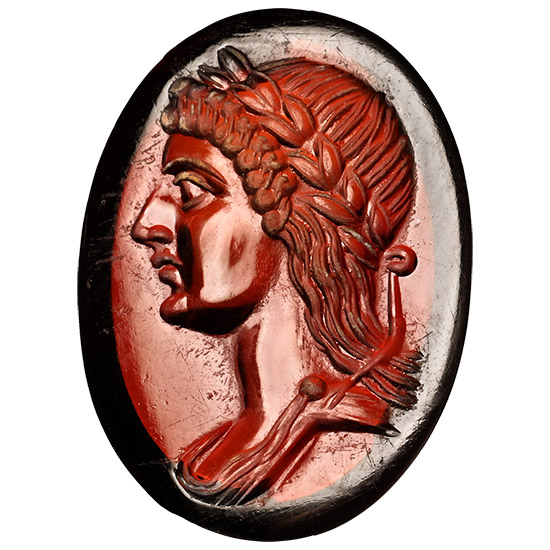
Roman Garnet Gemstone with Apollo
2nd-3rd century A.D.Sold for (Inc. bp): £1,820
Ellipsoid in plan with intaglio profile bust of Apollo with long cascading hair on the shoulders, braided wreath to the brow. 1.59 grams, 18 mm
Private collection, 1990s-early 2000s. -
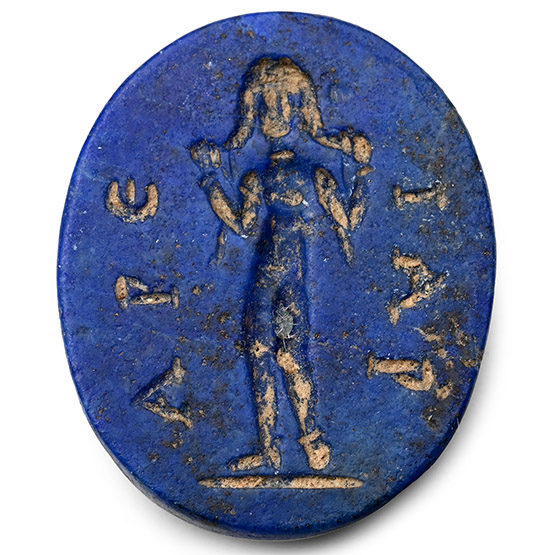
Roman Lapis Lazuli Gnostic Gemstone with Aphrodite Anadyomene
4th-5th century A.D.Sold for (Inc. bp): £715
Ellipsoid in plan with enigmatic Greek legend 'BPE/IMW' to underside, facing figure of Aphrodite Anadyomene to obverse on baseline with Greek legend 'APE IAP', possibly an abbreviation for ΑΡ[ΌΡΙΦ]ΡΑ[Σ]Ι[Σ]. 1.38 grams, 17 mm
Private collection, acquired on the German art market in 1993; thence by descent.
The gemstone belongs to a series of blue gemstones, usually of lapis lazuli or blue glass, showing the famous image of Aphrodite Anadyomene ('rising from the sea'). In some of these gemstones, we find the magical word arôriphrasis, which transliterates an Egyptian title of the goddess Hathor as 'The Lady of the Blue Stone'. Since Hathor and Aphrodite were assimilated in Graeco-Roman Egypt, there is some logic to the appearance of the name and Aphrodite on these stones. -
.jpg)
Roman Amethyst Gemstone of the Goddess Minerva
1st-2nd century A.D.Sold for (Inc. bp): £975
Plano-convex in section with incuse bust of Minerva wearing a Corinthian-style crested helmet; supplied with a museum-quality impression. 0.48 grams, 11 mm
Private English collection, formed between the late 1970s and early 1990s. Private collection, London, UK. -
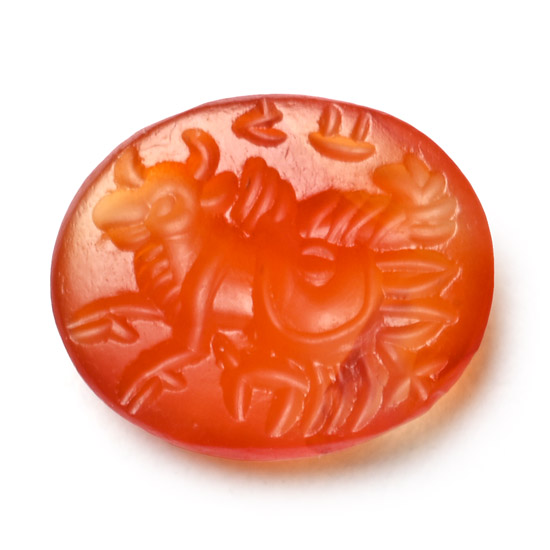
Sasanian Carnelian Gemstone of a Fantastic Creature with Pahlavi Legend
4th-5th century A.D.Sold for (Inc. bp): £494
Plano-convex in section with advancing winged and horned beast, Pahlavi legend to the border; supplied with a museum-quality impression. 0.32 grams, 10 mm
Private English collection, formed between the late 1970s and early 1990s. Private collection, London, UK.
Fanciful combinations of various human and animal heads, sometimes with the addition of other elements, are generally called grylloi. These fantastic devices were more than mere artists' fancies and were worn by the ancient Romans and others for their supposed efficacy in averting the evil eye. -
.jpg)
Egyptian Bronze Figure of Khnum, the Creator God
Late Period, 664-332 B.C.Sold for (Inc. bp): £11,700
A substantial figure of the ram-headed god Khnum advancing, wearing a tripartite wig with low central modius drilled for a separately cast headdress and finely pleated kilt, with ram's horns and eyes recessed for inlay, raised left hand, the right arm along the side; mounted on a custom-made stand. 466 grams, 22 cm high (803 grams total, 23.8 cm high including stand)
Bronze H: 19.6 cm, W: 5.4 cm, D: 6.9 cm Condition Surface has been extensively cleaned, in fair condition.
With Stendahl Art Gallery, Los Angeles, by at least circa 1950s, accompanied by an inventory card #39, with a matching number on the original base, and a photograph. Private collection, Hollywood, California, acquired from the above, circa 1950s. Accompanied by a copy of an Art Loss Register certificate, no.S00256888. This lot has been checked against the Interpol Database of stolen works of art and is accompanied by search certificate no. 13240-251804.
The god Khnum (or Khnemu), the 'Moulder', was one of the earliest gods of Egypt, worshipped especially at Philae and Elephantine, both in Nubia. He was thought to have made mankind out of clay on a potter's wheel. It was Khnum who helped Isis to gather the severed fragments of the body of the god Osiris and reassemble them. He was considered the father of the gods, along with Amun-Ra and Ptah. -
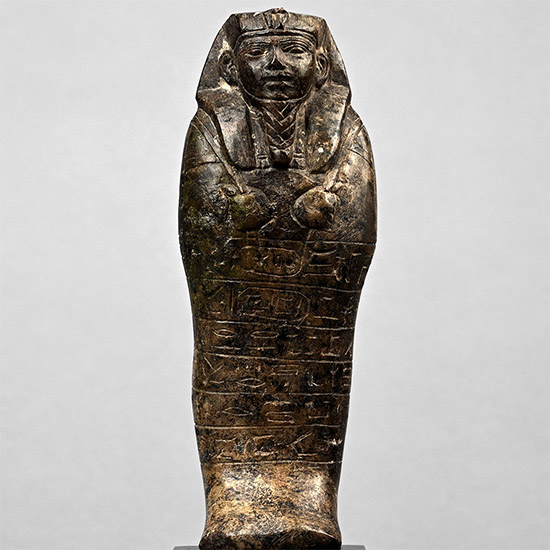
Egyptian Serpentine Shabti for King Senkamenisken
Nubia, Napatan Period, 643-623 B.C.Sold for (Inc. bp): £21,450
Mummiform figure wearing a braided beard with chin-straps in relief, broad collar visible between the lappets of the nemes headdress adorned with a double uraeus, the crossed hands holding a hoe and pick, with a seed bag over the left shoulder, his broad face with straight nose, wide-set eyes and large ears, six horizontal lines of inscription, giving a version of Chapter 6 from the Book of the Dead; mounted on a custom-made display stand. 659 grams total, 21 cm including stand
J.J. Klejman, Madison Avenue, New York, USA, 1960s. UK private collection, acquired from the above, 1960s. Bluett and Sons, London, 1979. Sheppard & Cooper, UK, private collection, 1980s. Sheikh Saoud Al-Thani, the 'Princely' private collection, UK. Acquired from the above in 2017. with Sotheby's, London, 5 July 2024, no.126. Accompanied by a copy of the Bluett and Sons invoice, 22 January 1979. This lot has been checked against the Interpol Database of stolen works of art and is accompanied by search certificate number no.13273-254064.
Of the 1277 shabtis of Senkamenisken found in the king's burial chamber of his pyramid tomb at Nuri (Pyramid 3), 410 are made of serpentine, the remaining 867 of faience. The inscription reads: 'The illuminated one, the Osiris, the good god, lord of the two lands, Sekheper[en]re, true of voice, He says: "O this shabti, if anyone summons the Osiris Senkamenisken, true of voice, in order to do any work which is to be done in the God's Land (i.e. necropolis), to cultivate the fields, to irrigate the canals, to carry sand from the east to the west and vice versa, 'Here I am', you shall say".

