-
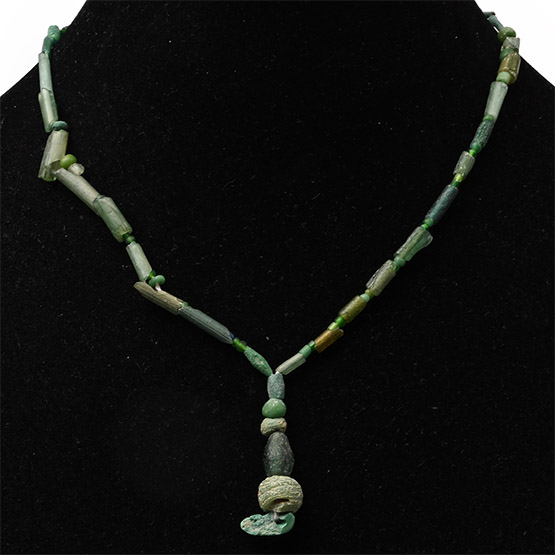
Roman Green Glass and Other Bead Necklace String
1st-4th century A.D. and laterSold for (Inc. bp): £52
Composed of small oblate beads interspersed with reused bangle fragments, the central feature with larger beads, restrung. 11.2 grams, 35 cm
Ex London, UK, collection, 1990s. -
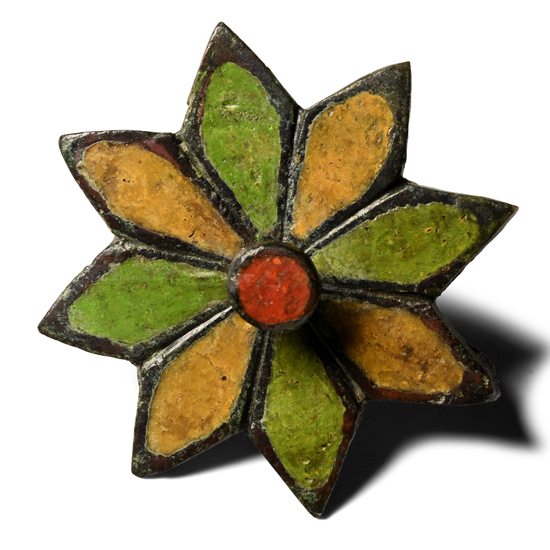
Roman Enamelled Bronze Plate Brooch
Circa 2nd century A.D.Sold for (Inc. bp): £416
Comprising eight radiating enamelled lanceolate cells with central stud; pin-lugs, pin and catch to reverse; the enamel restored. 9.21 grams, 32 mm
Ex German art market, 2000s. Acquired from an EU collector living in London. From the collection of a Surrey, UK, gentleman. -
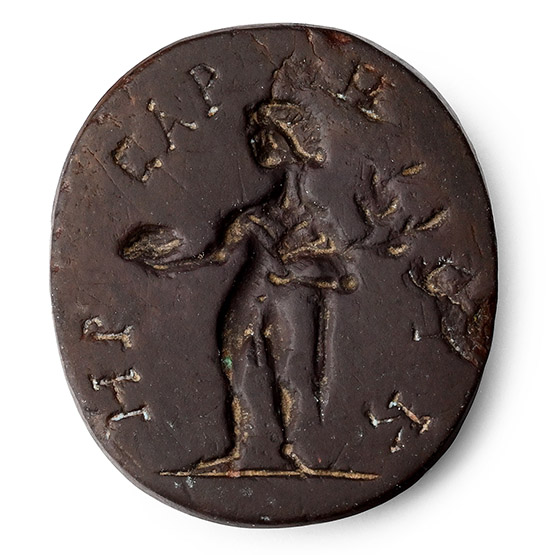
Roman Gnostic Hematite Gemstone with Standing Figure
3rd century A.D.Sold for (Inc. bp): £780
Discoid with chamfered edge, standing youth on a baseline with patera in one hand, sword at his hip, enigmatic legend above 'HICAPH[.]K'. 3 grams, 20 mm
Acquired in 1994. Private collection, thence by descent. Private collection, since the late 1990s. This lot has been checked against the Interpol Database of stolen works of art and is accompanied by a search certificate number no.12867-241734. -
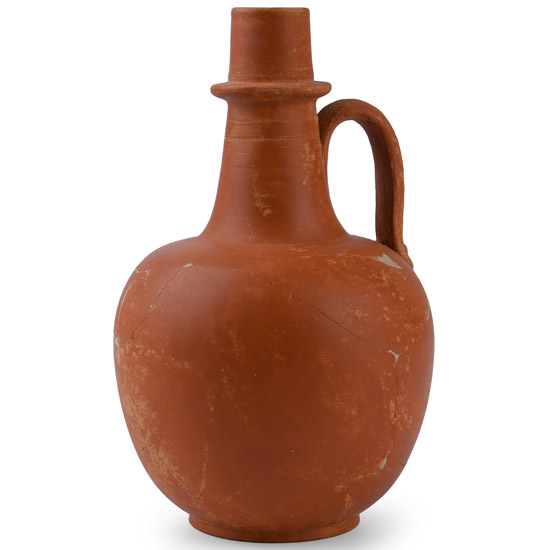
Roman Red Ware Amphora-Shaped Handled Flask
Circa 3rd-4th century A.D.Sold for (Inc. bp): £221
Comprising a bulbous body with a low basal ring, a tapering tubular neck with a flanged collar, and a strap handle to the rear. 312 grams, 19.5 cm
From the private collection of Mr Brian Edwards, New Malden, Surrey, UK, formed from the late 1970s-early 1980s; thence by descent. Accompanied by the original collector's data sheet with reference no.A60. -
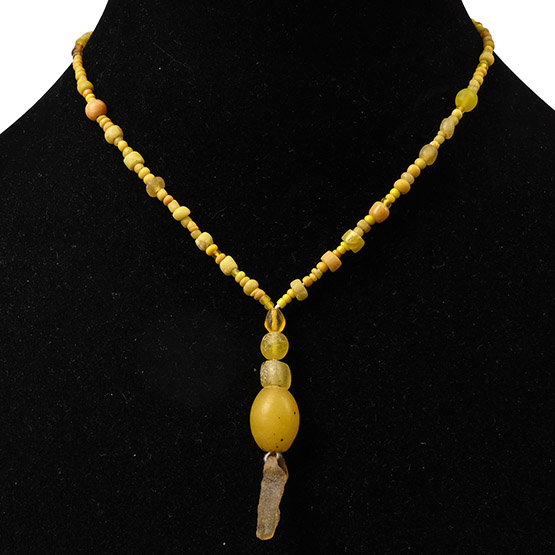
Roman Yellow Glass and Other Bead Necklace String
1st-4th century A.D. and laterSold for (Inc. bp): £91
Composed mainly of oblate and annular beads, the central feature with larger beads, restrung. 12.7 grams, 30 cm
Ex London, UK, collection, 1990s. -
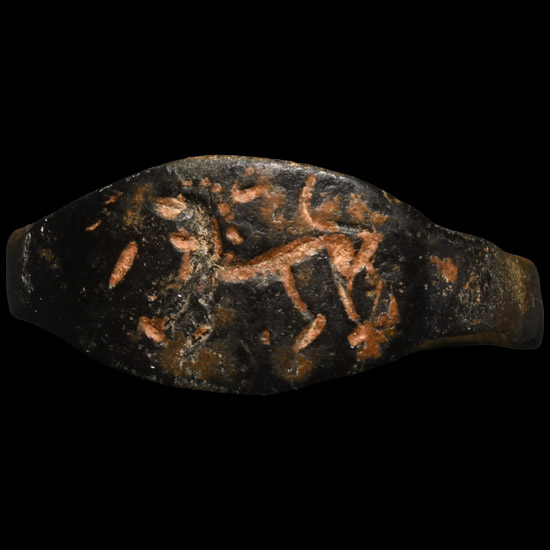
Roman Bronze Ring with Lion
3rd-4th century A.D.Sold for (Inc. bp): £39
Featuring a flat-section hoop and an oval bezel with a standing lion. 1.13 grams, 17.18 mm overall, 16.46 mm internal diameter (approximate size British J 1/2, USA 5, Europe 9.32, Japan 9)
From the private collection of a European gentleman (1942-2024), formed since the 1970s. -
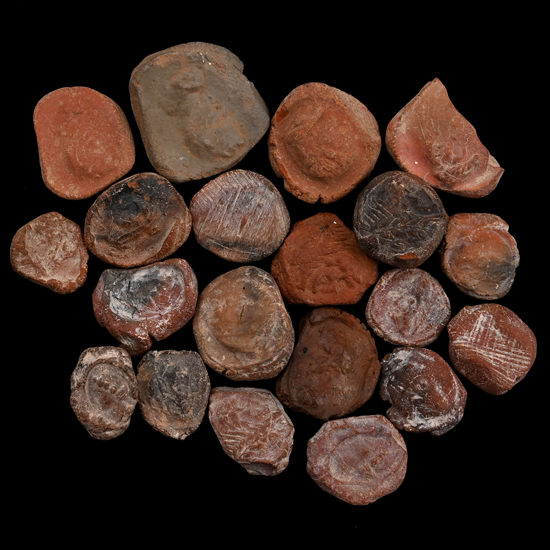
Roman Terracotta Bullae, Tesserae or Token Group
3rd century B.C.-1st century A.D.Sold for (Inc. bp): £130
A mixed group of ceramic bullae, tesserae or theatre tokens bearing low-relief motifs, mainly consisting of profile busts of deities. 29 grams total, 14-25 mm
From the private collection of a European gentleman (1942-2024), formed since the 1970s.
The term 'tessera' was used in Roman times to convey the Greek term σύμβολον (token). Small tiles are known as tokens, often shaped like coins, made of metal (copper, lead, iron), clay, bone, wood, or glass, stamped as well as engraved. The tokens, however, are not exclusively coin-shaped, as the Latin term 'tessera' suggests by etymologically referring to a square or at least a four-sided shape and confirmed in several cases by material remains of the past. Tokens and tesserae seem to have been used both in Athens and Rome for the distribution of goods. According to written sources, the term token is identified with credentials of the official authorities. They have also been interpreted as tokens of identity, as entrance tickets to theatre performances, tribunals or assemblies of citizens, archival material of seal engraving, as pawns in games, Charon’s obols and even as amulets. -
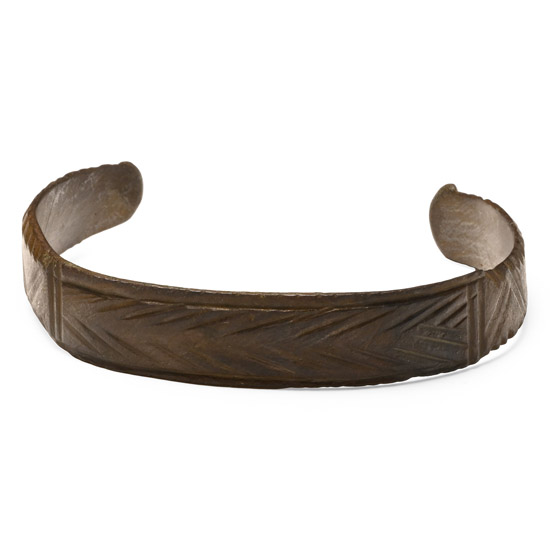
Late Roman Bronze Bracelet
4th-6th century A.D.Sold for (Inc. bp): £85
Penannular flat-section body with chevron decoration. 13.7 grams, 55 mm
Ex German art market, 2000s. Acquired from an EU collector living in London. From the collection of a Surrey, UK, gentleman. -
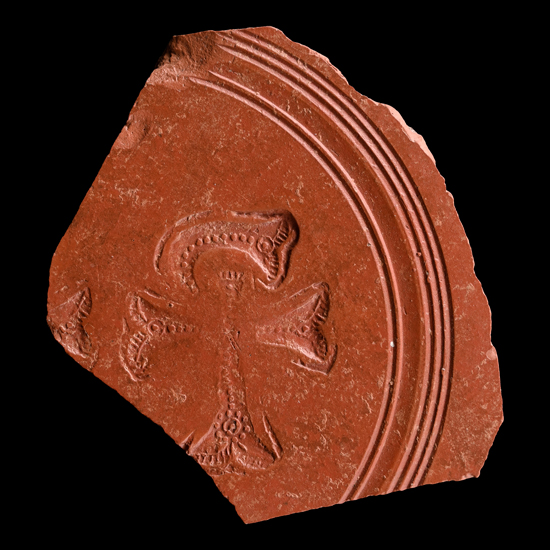
Roman Redware Plate Fragment with Chi Rho
4th century A.D.Sold for (Inc. bp): £85
An irregular fragment showing concentric banding and a stylised Christogram motif. 49 grams, 83 mm
Acquired on the UK art market from the 1990s. From the private collection of a Lincolnshire, UK, gentleman. -
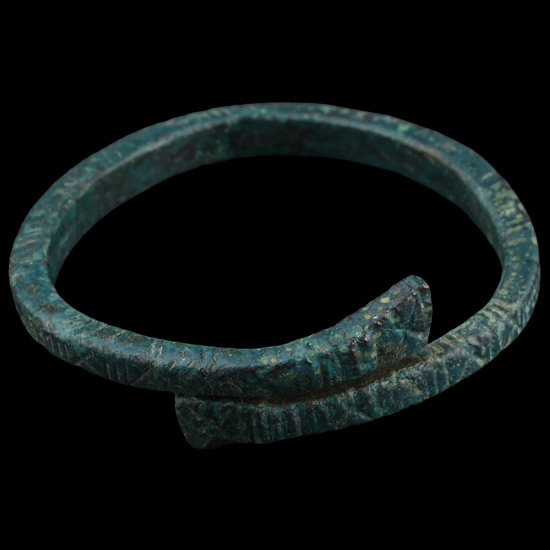
Roman Bronze Decorated Bracelet
1st-4th century A.D.Sold for (Inc. bp): £46
Formed of rectangular-section bar with overlapping, flared terminals, hatched decoration. 30.5 grams, 56 mm
Ex German art market, 2000s. Acquired from an EU collector living in London. From the collection of a Surrey, UK, gentleman. -
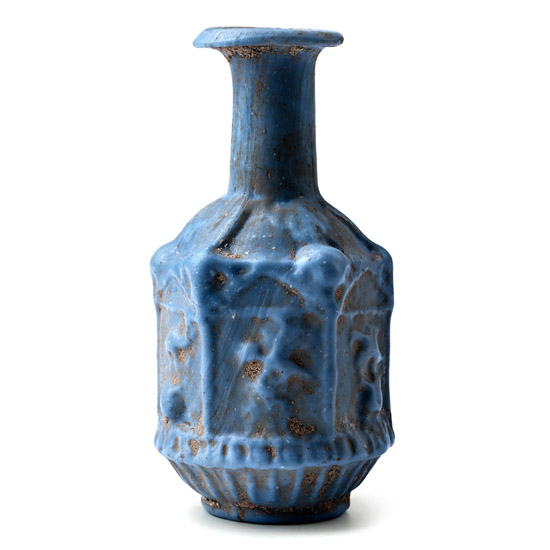
Roman Sidonian Opaque Light Blue Glass Flask
1st century A.D.Sold for (Inc. bp): £3,640
Hexagonal in plan with tall tubular neck and flared and folded rim, disc base with moulding seams; broad sloping shoulder above a sidewall of panels each with a low-relief avian image (bird in flight, bird perching on a branch, etc.). 31 grams, 80 mm
Ex private collection, Israel. Acquired from Archaeological Center, Auction 60, no.204. Private collection. Accompanied by a copy of the relevant Archaeological Center online catalogue page. This lot has been checked against the Interpol Database of stolen works of art and is accompanied by a search certificate number no.12530-232177.
Roman opaque glass attributed to the Sidonian workshops represents one of the most technically sophisticated achievements of early Imperial glassmaking. Produced in the Levant, long a centre of innovation, the workshops at Sidon were renowned for their mastery of colour chemistry, using controlled additions of antimony-and-tin-based opacifiers to create surfaces resembling fine stone or enamel. These vessels were not merely utilitarian objects but markers of status, admired in antiquity for their vibrant hues and precision of manufacture. Examples such as the present piece illustrate the transition of glass from a luxury comparable to carved hardstone to an art form that could be shaped, coloured, and refined with unprecedented freedom, underscoring the pivotal role of Sidon in the evolution of Roman glass technology. -
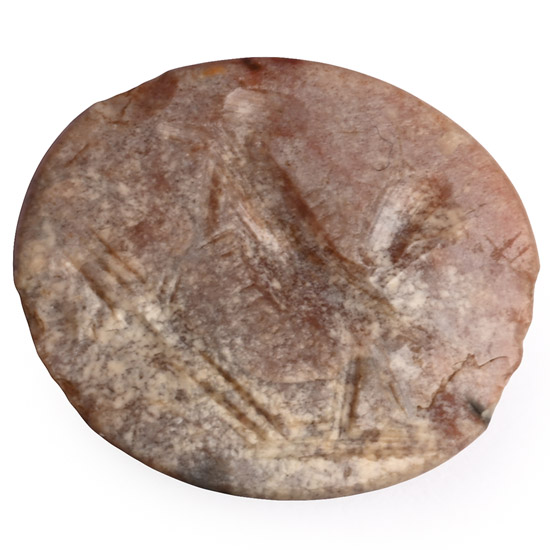
Roman Agate Gemstone with Bird
2nd-3rd century A.D.Sold for (Inc. bp): £46
Intaglio perching bird motif with frond. 0.46 grams, 11.29 mm
From the private collection of a European gentleman (1942-2024), formed since the 1970s.

