-
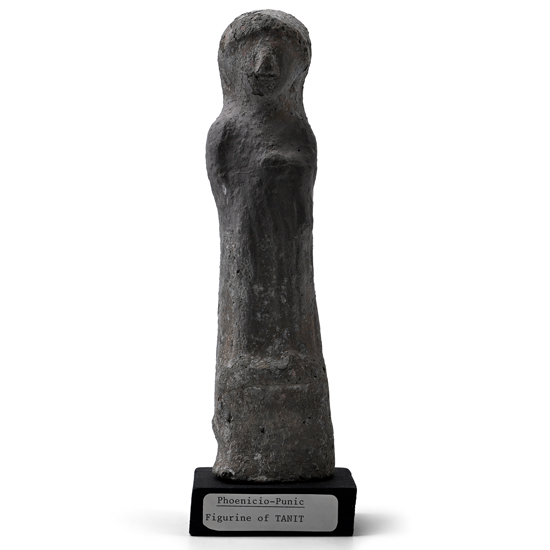
Phoenicio-Punic Terracotta Goddess Tanit Figure
Late 1st millennium B.C.Sold for (Inc. bp): £208
Modelled in the round, wearing a long dress and a veil, standing on a pedestal with her arms raised at her chest; mounted on a custom-made display stand with an old collector's sticker. 275 grams, 19.2 cm
From the private collection of Mr Brian Edwards, New Malden, Surrey, UK, formed from the late 1970s-early 1980s; thence by descent. Accompanied by a collector's data information card with collection reference no.113. -
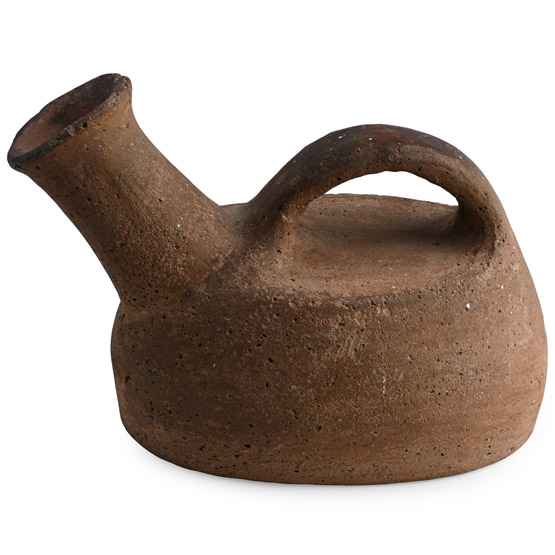
Greek Terracotta Askos
Circa 5th-3rd century B.C.Sold for (Inc. bp): £156
With an arching strap handle and a wide spout with everted rim; ellipsoid in plan with a long flat base. 400 grams, 16 cm wide
From a late Hampshire gentleman's collection, formed from the 1960s.
The askos was an ancient Greek vessel used for pouring small quantities of oily liquids, used as an ointment container or to fill oil lamps. The modern name for this vessel is conventional; it was originally used for animal-skin wine bottles, as often seen on Dionysian-themed vase paintings, and is used in modern times to designate this vessel shape based on some morphological similarity. -
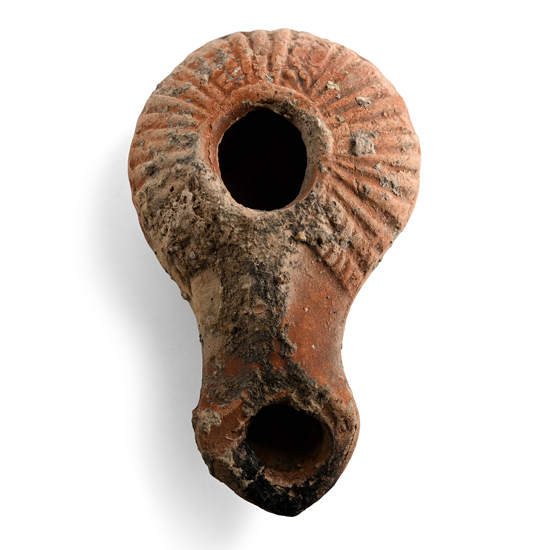
Greek Terracotta Oil Lamp
Hellenistic, late 2nd-1st century B.C.Sold for (Inc. bp): £78
Piriform body with volute nozzle, radiating linear decoration to the shoulder. 38.5 grams, 89 mm
From a collection of lamps from a late Scottish gentleman, 1970-1990s. -
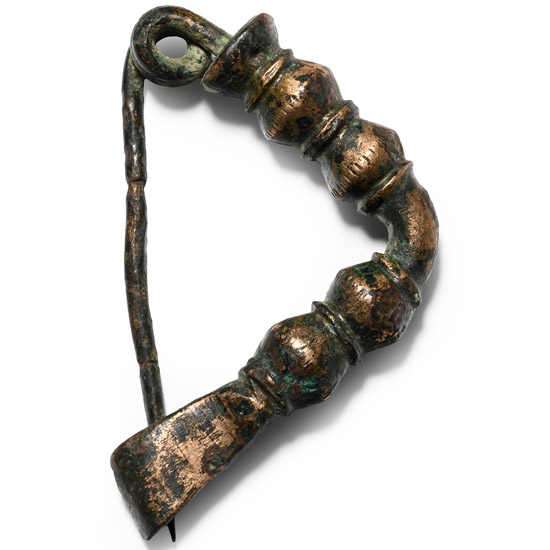
Phrygian Bronze Elbow Brooch
Iron Age, circa 7th-6th century B.C.Sold for (Inc. bp): £98
A right-angled body with collared bulbs, spring pin and catchplate. 14.6 grams, 45 mm
From the private collection of a European gentleman (1942-2024), formed since the 1970s. -
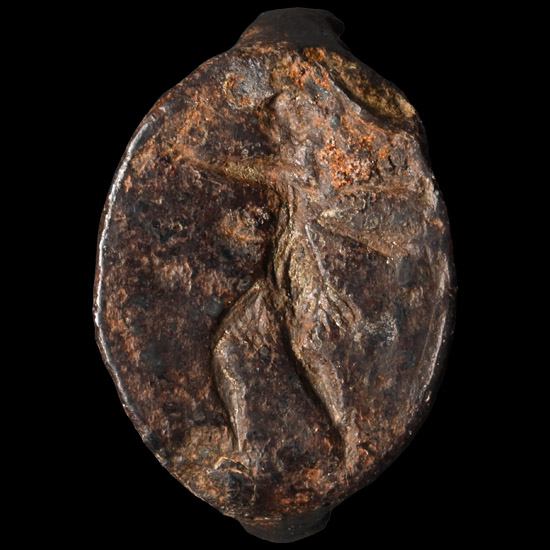
Large Greek Bronze Ring with Nike
Circa 4th-2nd century B.C.Sold for (Inc. bp): £65
Featuring a substantial D-section hoop and a lentoid bezel with goddess Nike in a dynamic pose with her arms outstretched. 6.74 grams, 25.43 mm overall, 21.81 mm internal diameter (approximate size British U 1/2, USA 10 1/4, Europe 23.15, Japan 22)
From the private collection of a European gentleman (1942-2024), formed since the 1970s. -
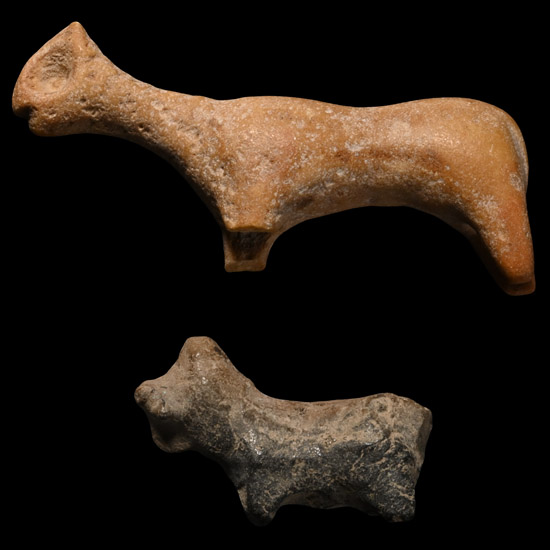
Etruscan Stone Animal Figure Group
Circa 6th century B.C.Sold for (Inc. bp): £65
Comprising two stylised figures, one with an elongated body and one with a stocky body. 11.3 grams total, 26.3-46 mm
From the private collection of a European gentleman (1942-2024), formed since the 1970s. -
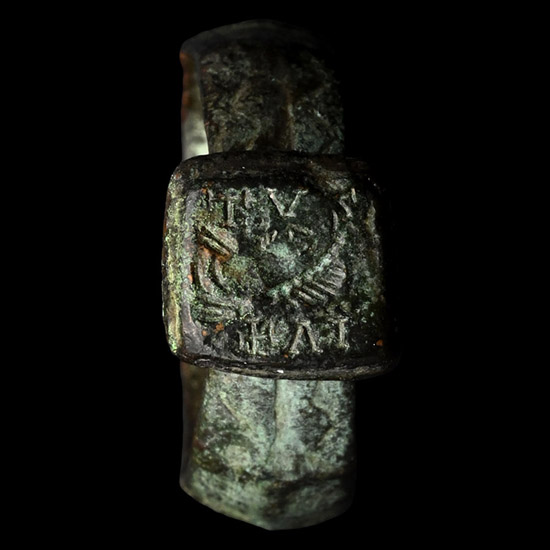
Late Roman Bronze Ring with Bust
5th-6th century A.D.Sold for (Inc. bp): £143
Substantial hoop with a raised rectangular bezel bearing a profile bust facing left, flanking inscription '+VI[R]TVS' (Value) 8.85 grams, 29.60 mm overall, 17.30 x 20.72 mm internal diameter (approximate size British O, USA 7, Europe 14.98, Japan 14)
Ex German art market, 2000s. Acquired from an EU collector living in London. From the collection of a Surrey, UK, gentleman.
The ring seems to underline military virtue (virtus), and it can be assumed that it was given as a gift to a soldier for an act of courage, or as a reward for an undertaking of a certain value. The bust could represent an imperial figure. -
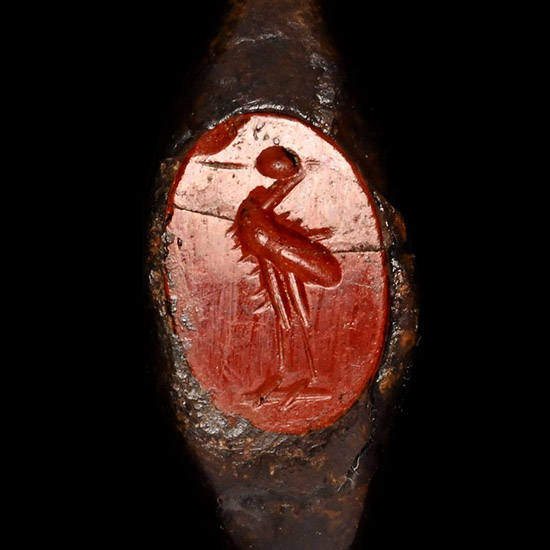
Roman Bronze Ring with Stork Gemstone
2nd-3rd century A.D.Sold for (Inc. bp): £98
Slender round-section hoop with red jasper intaglio engraved with a standing stork. 2.57 grams, 23.68 mm overall, 19.66 mm internal diameter (approximate size British O, USA 7, Europe 14.98, Japan 14)
Ex Prof. Dr Emil Vogt (1906-1974), the former Director of the Swiss National Museum, Zürich, in his collection before 1970. with Galerie Rhéa, Zurich, Switzerland. -
.jpg)
Roman Carnelian Gemstone with Altar
2nd-3rd century A.D.Sold for (Inc. bp): £72
With intaglio altar; supplied with a museum-quality impression. 0.37 grams, 10.15 mm
From the private collection of a European gentleman (1942-2024), formed since the 1970s. -
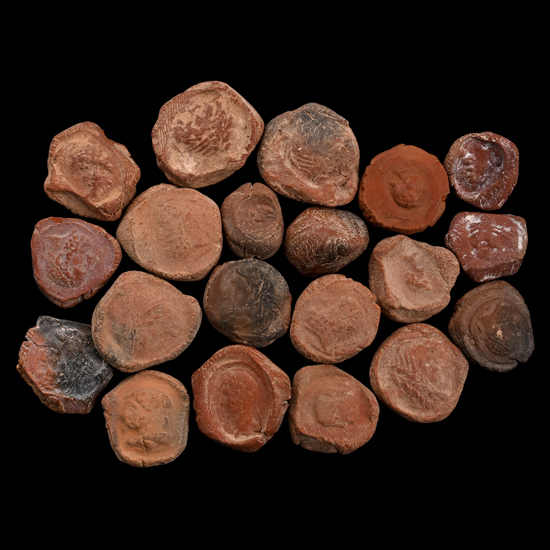
Roman Terracotta Bullae, Tesserae or Token Group
3rd century B.C.-1st century A.D.Sold for (Inc. bp): £78
A mixed group of ceramic bullae, tesserae or theatre tokens bearing low-relief motifs, mainly consisting of profile busts of deities. 38 grams total, 15-22 mm
From the private collection of a European gentleman (1942-2024), formed since the 1970s.
The term 'tessera' was used in Roman times to convey the Greek term σύμβολον (token). Small tiles are known as tokens, often shaped like coins, made of metal (copper, lead, iron), clay, bone, wood, or glass, stamped as well as engraved. The tokens, however, are not exclusively coin-shaped, as the Latin term 'tessera' suggests by etymologically referring to a square or at least a four-sided shape and confirmed in several cases by material remains of the past. Tokens and tesserae seem to have been used both in Athens and Rome for the distribution of goods. According to written sources, the term token is identified with credentials of the official authorities. They have also been interpreted as tokens of identity, as entrance tickets to theatre performances, tribunals or assemblies of citizens, archival material of seal engraving, as pawns in games, Charon’s obols and even as amulets. -
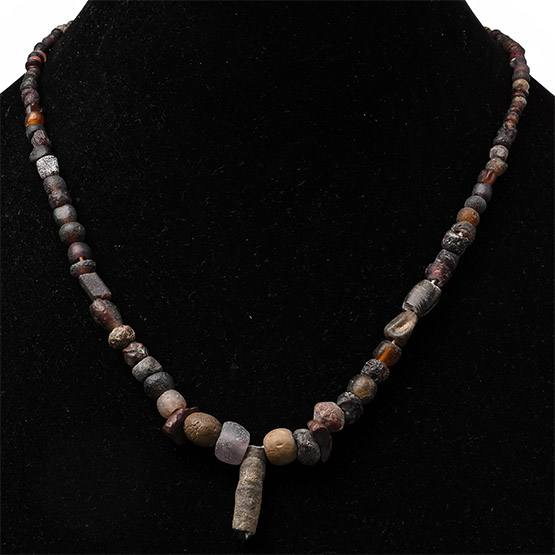
Roman Aubergine Glass and Other Bead Necklace String
1st-4th century A.D. and laterSold for (Inc. bp): £72
Composed of graduated dark beads, the central feature a large tubular bead, restrung. 25 grams, 38.5 cm
Ex London, UK, collection, 1990s. -
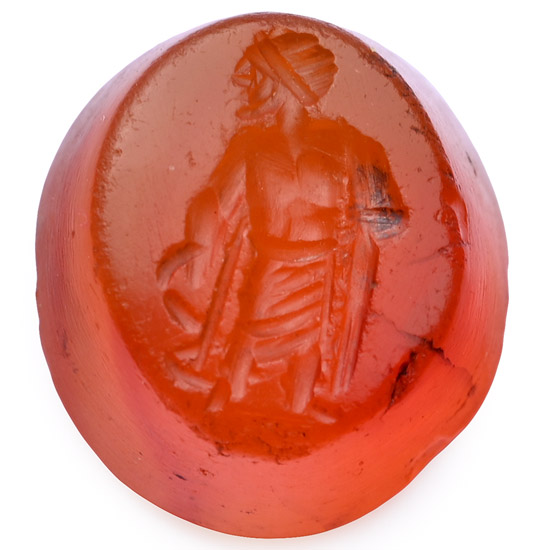
Roman Carnelian Gemstone with Aesculapius
2nd-3rd century A.D.Sold for (Inc. bp): £130
With the god in three-quarter view, with a cloak and staff; supplied with a museum-quality impression. 1.40 grams,12.64 mm
From the private collection of a European gentleman (1942-2024), formed since the 1970s.

