-
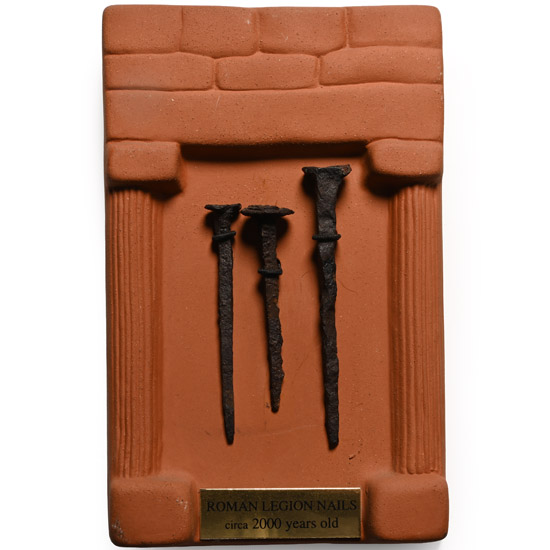
Romano-Scottish Legion XX Valeria Victrix 'Inchtuthil Fort' Boxed Educational Roman Iron Nail Hoard Display
Circa 83-87 A.D.Sold for (Inc. bp): £33
Group of three iron clout-nails mounted in a terracotta display with information panel 'ROMAN LEGION NAILS / circa 2000 years old'. 185 grams, 13.3 x 8.3 mm
From excavations started by Richmond in Perthshire, Scotland, from the 1950s, and discovered in the summer of 1960. Selected and displayed by David Colville & Sons by 1963. Acquired on the UK art market before 2000. Property of an Essex, UK, gentleman.
The fortress at Inchtuthil was a fortified headquarters and forward supply depot for the forces led by the Roman governor, Gnaeus Julius Agricola, when he undertook a lengthy campaign against the Caledonian tribes in the north of Britain. The campaign is mentioned in the biographical work written by his son-in-law, the historian Tacitus, which has been studied in order to understand the Roman plan for the subjugation of the island. The troops chosen for the campaign were drawn from the 20th Legion (Legio XX Valeria Victrix). While the construction of Inchtuthil and other strongholds took place, the troops lived in temporary encampments, which were also fortified and formed a chain of defensive sites from which domination of the surrounding territory could be achieved. Subsequently, once the site was abandoned late in the 1st century A.D. (around 86 A.D.), no further building took place there or in the area. Excavation in the 20th century by Sir Ian Richmond (begun in 1952) revealed a pristine site with its complete plan recoverable, unique in the Roman Empire. The defences were a broad ditch and turf wall with stone facing, with watchtowers and gatehouses. The site was thought to have been abandoned due to the relocation of troops to counter an invasion from Eastern Europe into the province of Dacia, although this is no longer certain. A huge quantity of iron nails (more than 875,000) was recovered from a pit in the fort as well as other ironware; the goods had been buried in order not to let them fall into the hands of the Caledonians. The excavated nails and other items were sorted and sold in small parcels, which was completed by 1963. The nails range in size from small nails between thirty-eight and seventy millimetres long, up to the massive spikes three hundred and seventy-two millimetres long. These kinds of long nails were also used for crucifixions. -
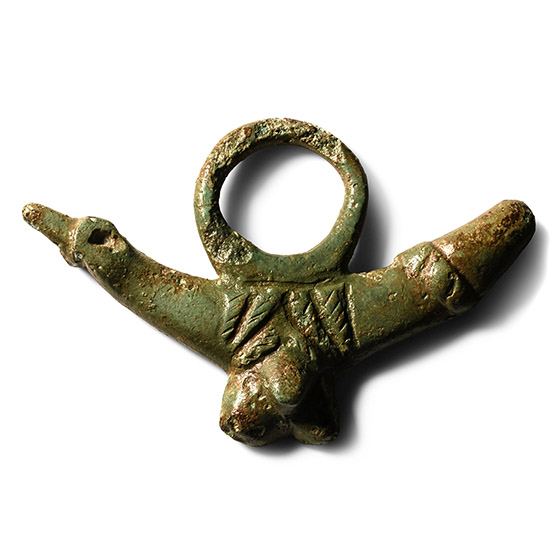
Roman Bronze Phallic Pendant
1st-4th century A.D.Sold for (Inc. bp): £293
Crescentic body with one arm formed as a phallus and the other as a fist, making the 'fica' gesture, male genitalia at the centre with a large loop above. 39 grams, 73 mm
Ex German art market, 2000s. Acquired from an EU collector living in London. From the collection of a Surrey, UK, gentleman. -
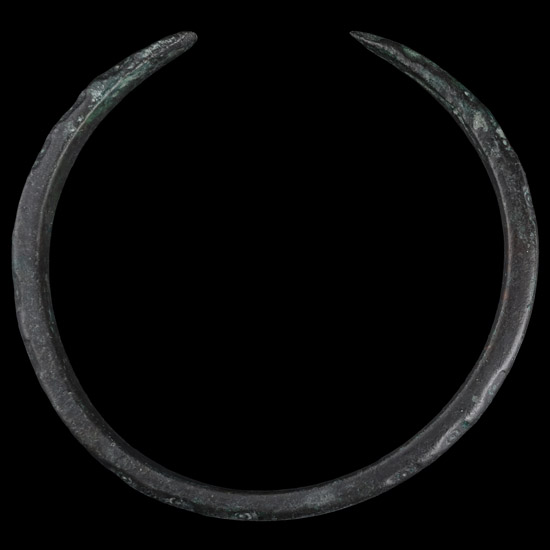
Roman Bronze Decorated Armilla Bracelet
1st-4th century A.D.Sold for (Inc. bp): £98
Penannular, rectangular-section body with rounded finials and linear decoration. 31.33 grams, 60 mm
Ex German art market, 2000s. Acquired from an EU collector living in London. From the collection of a Surrey, UK, gentleman. -
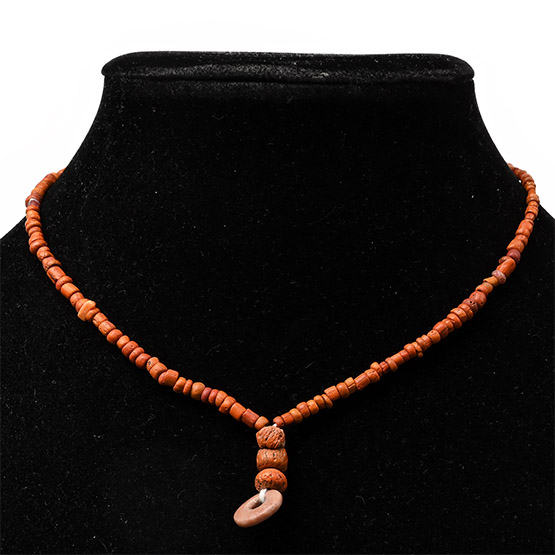
Roman Orange Glass Bead Necklace String
1st-4th century A.D. and laterSold for (Inc. bp): £85
Composed mainly of oblate and annular beads with larger beads as a central feature, restrung. 7.51 grams, 34 cm
Ex London, UK, collection, 1990s. -
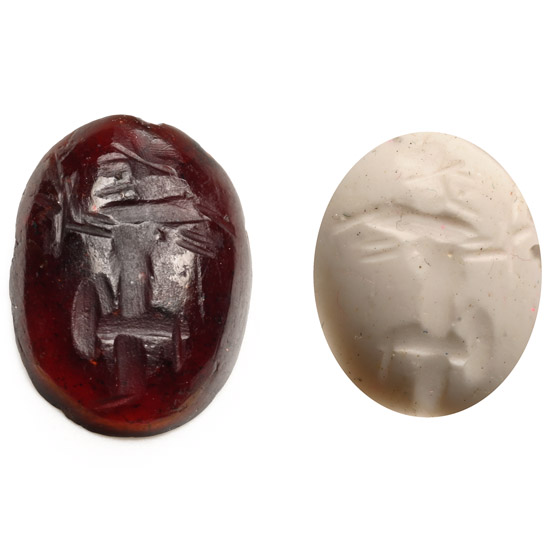
Roman Glass Gem with Hercules
2nd-3rd century A.D.Sold for (Inc. bp): £46
With intaglio Hercules with club in his extended hand; supplied with a museum-quality impression. 0.62 grams 12.02 mm
From the private collection of a European gentleman (1942-2024), formed since the 1970s. -
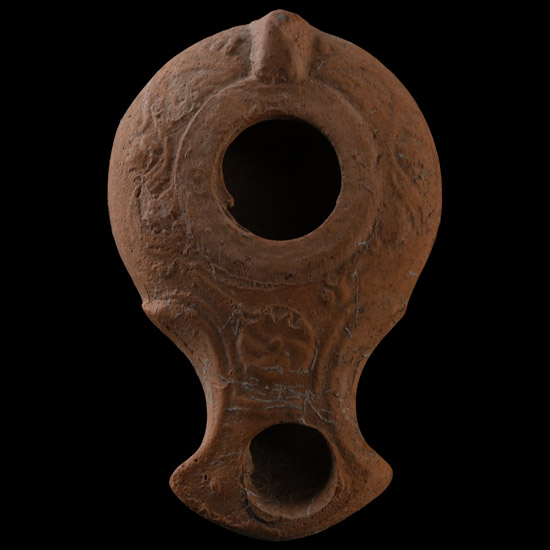
Roman Terracotta Oil Lamp with Rosette
Circa 1st-2nd century A.D.Sold for (Inc. bp): £85
Round body with volute nozzle and a small stub handle at the rear, low-relief vine-leaf wreath encircling the filler hole, a large rosette at the base of the nozzle, base with concentric circles and a rosette. 38.1 grams, 83 mm
From the collection of a Yorkshire, UK gentleman, items collected in the Holy Land in the 1960s. -
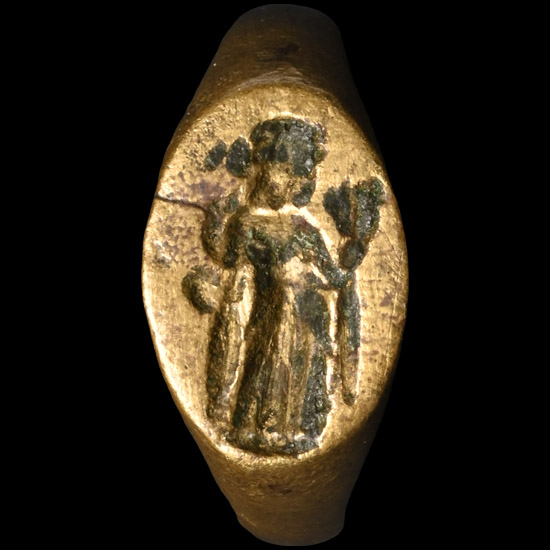
Roman Bronze Ring with Standing Figure
1st-4th century A.D.Sold for (Inc. bp): £104
Comprising a slender hoop and an oval bezel with a standing robed figure, possibly a goddess. 2.08 grams, 17.41 mm overall, 15.25 mm internal diameter (approximate size British I, USA 4 1/4, Europe 7.44, Japan 7)
From the private collection of a European gentleman (1942-2024), formed since the 1970s. -
.jpg)
Roman Banded Agate Gemstone with Eagle
2nd-3rd century A.D.Sold for (Inc. bp): £234
With intaglio eagle standing with head turned, wreath in its beak; supplied with a museum-quality impression. 0.76 grams, 10.76 mm
From the private collection of a European gentleman (1942-2024), formed since the 1970s. -
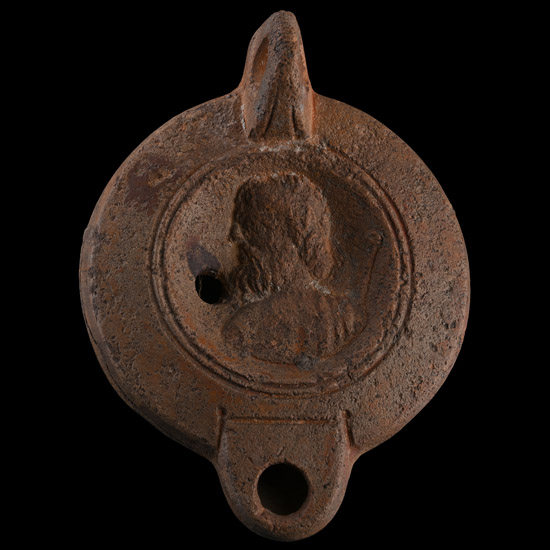
Roman Terracotta Oil Lamp with Bearded Philosopher
Circa 2nd century A.D.Sold for (Inc. bp): £312
Comprising a circular body with a short nozzle and a loop handle, the discus with a profile bust of a mature man holding a staff; base with concentric circles. 98 grams, 10.8 cm
From the private collection of Mr Brian Edwards, New Malden, Surrey, UK, formed from the late 1970s-early 1980s; thence by descent. Accompanied by the original collector's data sheet with reference no.A36. -
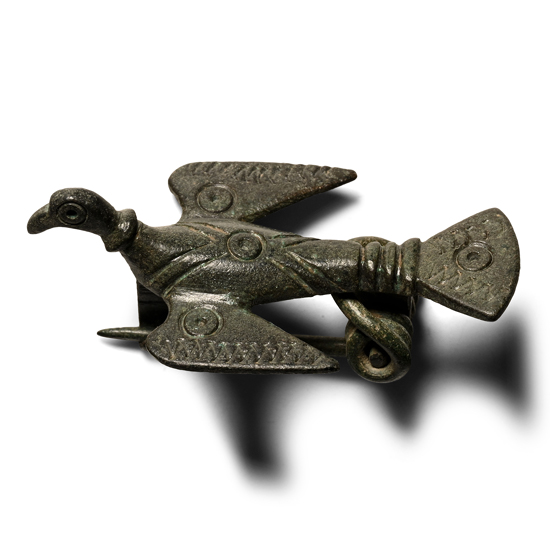
Late Roman Bronze Bird Plate Brooch
Circa 6th century A.D.Sold for (Inc. bp): £221
Depicting a bird in flight with triangular wings and spread tail, collar around the neck and punched ring-and-dot eyes; pin and catchplate on the reverse. 7.38 grams, 38 mm
Ex German art market, 2000s. Acquired from an EU collector living in London. From the collection of a Surrey, UK, gentleman. -
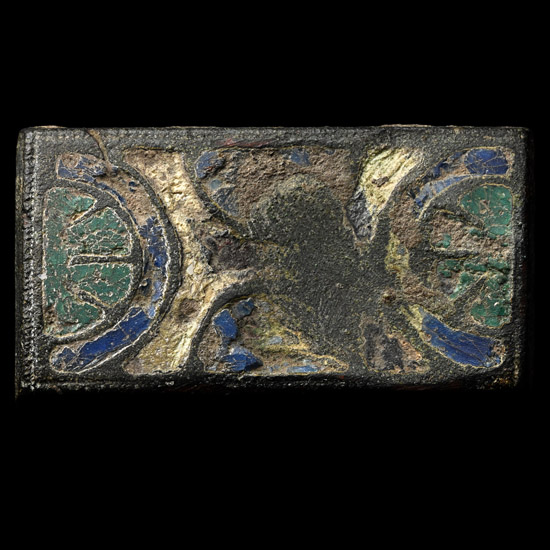
Roman Enamelled Bronze Belt Plaque
Circa 2nd century A.D.Sold for (Inc. bp): £98
Rectangular in plan with cloisonné enamelled cells with palmettes at the shorter sides; mounting lugs to reverse. 14.7 grams, 39.7 mm
From the private collection of a European gentleman (1942-2024), formed since the 1970s. -
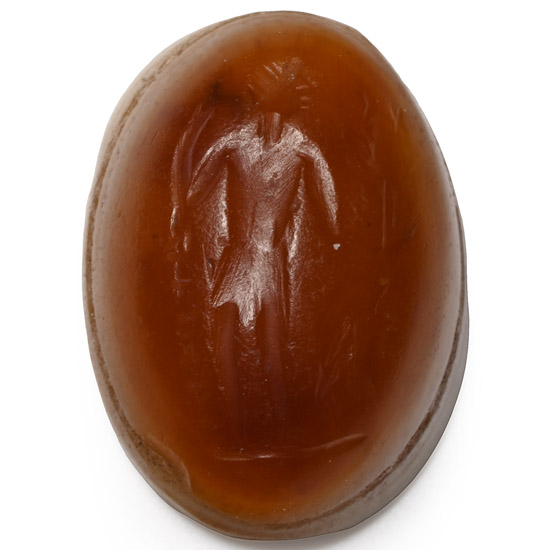
Eastern Roman Chalcedony Gemstone with Standing Figure
Circa 2nd-3rd century A.D.Sold for (Inc. bp): £111
Plano-convex in section with incuse standing figure with arms raised, objects in the field, legend beside the lower leg. 1.88 grams, 15.98 mm
From the private collection of a European gentleman (1942-2024), formed since the 1970s.

