-
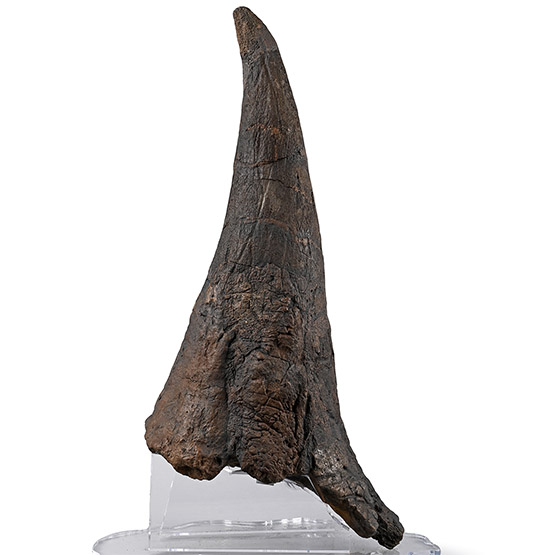
Adult Triceratops Dinosaur Fossilised Brow Horn
Cretaceous Period, circa 68-65 million years B.P.Sold for (Inc. bp): £16,250
A robust supraorbital brow horn from an adult individual, exhibiting the natural surface detail of the bone, the shaft clearly showing the numerous deep branching grooves and pits (nutrient canals and foramina), which supplied blood to the outer horn sheath; preserved in fragmentary condition, restored, and mounted on a custom-made display stand. 25 kg total, 76 cm including stand
Discovered in USA.
With its three-horned head, the Triceratops is one of the most famous species of dinosaur that roamed the Earth. Scientists have recently discovered that horned dinosaurs, including the famous Triceratops, lived in Europe, as well as Asia and North America, at the very end of the Cretaceous Period before the fatal mass extinction triggered by the asteroid that caused the Chicxulub crater 65 million years ago. Triceratops means ‘three-horned face,’ a group characterised by their large size, frills, and horns. Adults could grow up to 9 meters (30 feet) in length and weigh between 6 and 12 tons. The most striking features are its two long, forward-pointing horns, which were located above the eyes. These ‘brow horns’ were likely used for display, combat, and defence against predators like Tyrannosaurus rex. A smaller horn resided on the nose. -
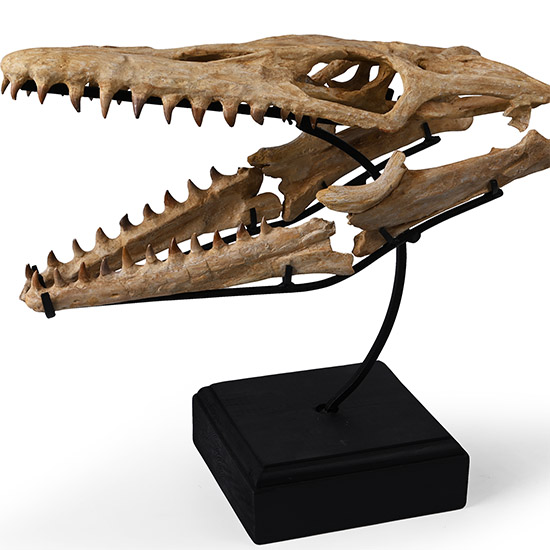
Mosasaur 'Marine Dinosaur' Fossil Skull
Cretaceous Period, circa 145-65 million years B.P.Sold for (Inc. bp): £6,500
A magnificent, full three-dimensional fossil skull of a juvenile Mosasaur Prognathodon with upper and lower mandibles, eye sockets and brain cavity; including jaw teeth and throat teeth; some restoration; with custom-made display stand. 8.35 kg total including stand and box, 46 cm wide
From Morocco, West Africa. From a Cambridgeshire, UK, collection.
The Mosasaur is an extinct, large marine reptile dinosaur with an elongated body, long snout and paddle-like limbs. Found worldwide, they competed with other well-known sea predators of the Late Cretaceous, such as plesiosaurs and ichthyosaurs, for food, existing primarily on a diet of ammonoids, cuttlefish and fish. -
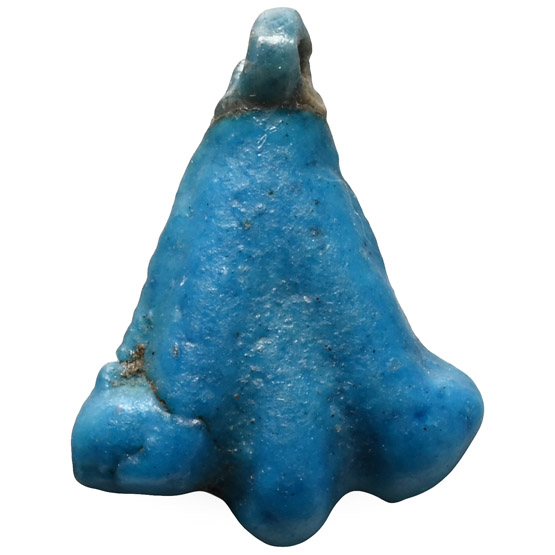
Egyptian Faience Lotus Flower Amulet
18th Dynasty, Amarna Period, 1353-1336 B.C.Sold for (Inc. bp): £59
A blue glazed composition pendant in the form of a lotus, with some repair to the suspension loop. 0.26 grams, 14 mm
Repaired.
Ex early 20th century London collection. -
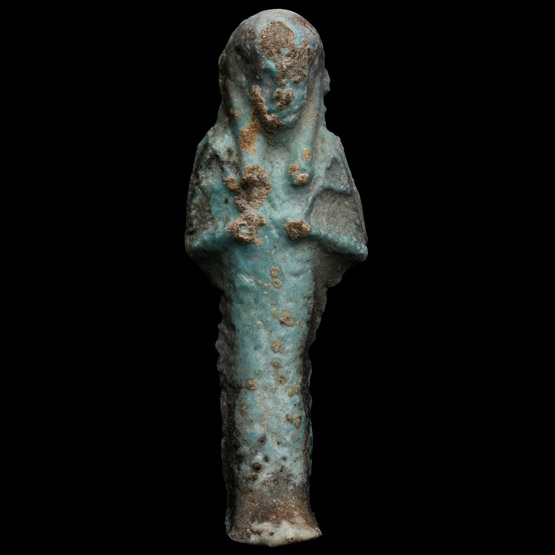
Egyptian Blue-Glazed Faience Shabti
Ptolemaic Period, 332-30 B.C.Sold for (Inc. bp): £117
Plano-convex in section with plain back, mummiform type with agricultural tools. 9.43 grams, 70 mm
Acquired on the UK art market before 2000. Property of an Essex, UK, gentleman. -
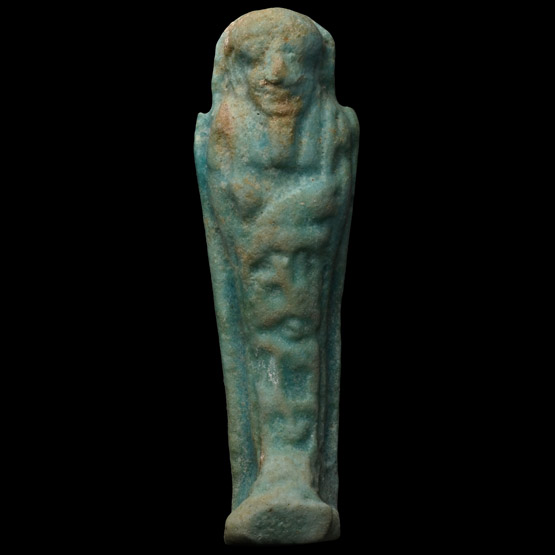
Egyptian Blue-Glazed Faience Shabti with Hieroglyphs
Late Period-Ptolemaic Period, 664-30 B.C.Sold for (Inc. bp): £144
Plano-convex in section with dorsal plaque, impressed hieroglyphs to lower body. 22.14 grams, 72 mm
Acquired on the UK art market before 2000. Property of an Essex, UK, gentleman. -
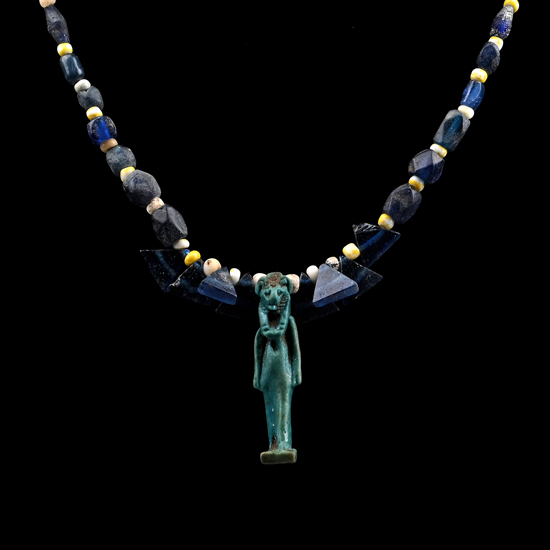
Egyptian Glass Bead Necklace with Large Sekhmet Faience Amulet
Late Period, 664-332 B.C.Sold for (Inc. bp): £1,170
Restrung group of polyhedral and tubular beads in fusiform, biconvex, tubular and other types; triangular dangles and pendant of cat-headed Sekhmet. 26 grams, 44 cm, amulet: 50 mm
From the collection of a gentleman, acquired on the London art market in the 1990s. -
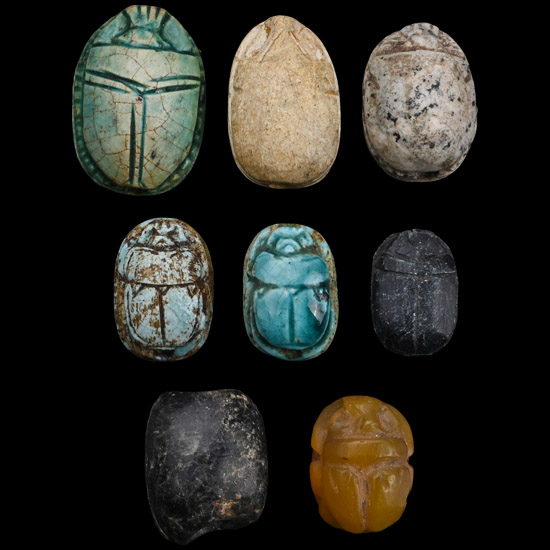
Egyptian Steatite and Other Scarab Collection
New Kingdom-Late Period, 1550-332 B.C.Sold for (Inc. bp): £585
Including carnelian, faience and other materials, some with hieroglyphs to underside. 17.1 grams total, 13-19 mm
From the collection of a gentleman, acquired on the London art market in the 1990s. -
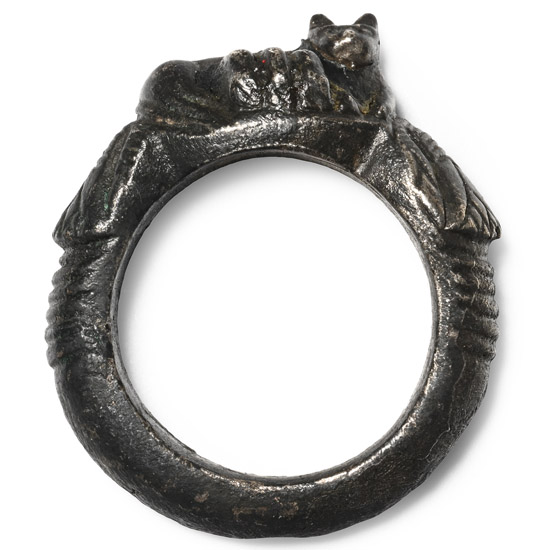
Romano-Egyptian Silver Ring with Cat and Kittens
Roman Period, 30 B.C.-323 AD.Sold for (Inc. bp): £468
D-section hoop with ribbed shoulder, papyrus-stem detailing and reclining cat with suckling kittens. 14.92 grams, 28.49 mm overall, 17.35 mm internal diameter (approximate size British M1/2, USA 6 1/4, Europe 13.09, Japan 12)
Ex Essex, UK, gentleman's collection, 1990s. -
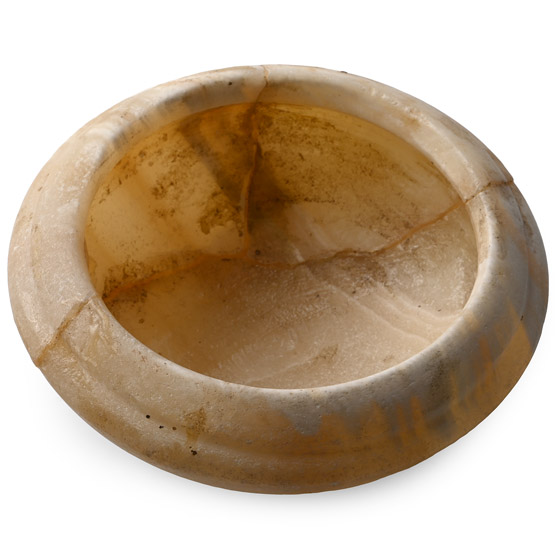
Egyptian Alabaster Bowl
2nd-1st millennium B.C.Sold for (Inc. bp): £260
Of conical profile with flattened base, carinated shoulder and stepped rounded rim. 369 grams, 11 cm wide
From a West Country, UK, collection, 1980-2020s. -
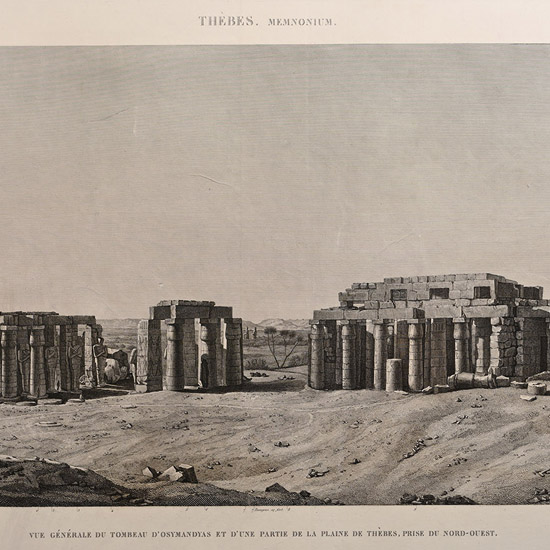
Very Large Egyptian Expedition Lithograph of the Memnonium at Thebes
Early 19th century A.D.Sold for (Inc. bp): £91
Proof etching on laid paper of plate 23 from Vol.II of Description de l'Égypte : ou, Recueil des observations et des recherches qui ont été faites en Égypte pendant l'expédition de l'armée française. entitled Thèbes. Memnonium. Vue générale du tombeau d'Osymandyas et d'une partie de la plaine de Thèbes prise du ord-ouest. 226 grams, 105 x 69.5 cm
From the collection of a North American priest. Acquired between 1981-1996. Property of a North American collector.
Produced between February 1802 and 1830 on the orders of Napoleon Bonaparte; published between 1809 and 1828. Just 1,000 copies were distributed to various institutions, printed on laid paper with an 'Égypte ancienne et moderne' watermark. The book is subtitled Recueil des observations et des recherches qui ont été faites en Égypte pendant l’expédition de l’Armée française, publié par les ordres de Sa Majesté l’Empereur Napoléon le Grand (Gathering of observations and discoveries which were made in Egypt during the expedition of the French army, published on the orders of His Majesty the Emperor Napoleon the Great). It was the world's first encyclopedia devoted exclusively to the remains of ancient Egypt. The plates of this book are the first to present the archaeological sites of Thebes (Luxor). The "Memnonium" is the Greek name for the mortuary temple of Ramesses II, now known as the Ramesseum. -
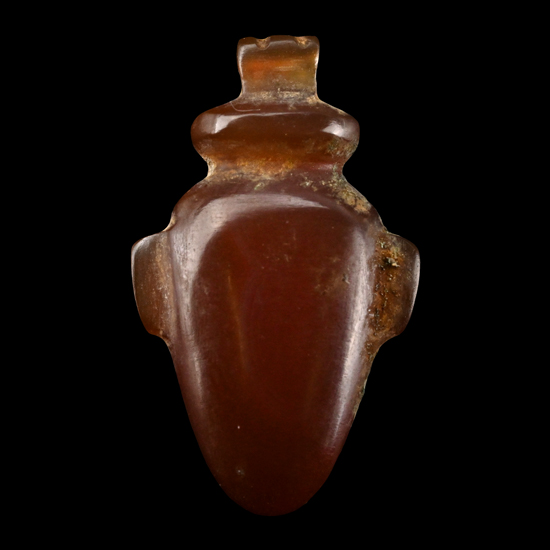
Egyptian Carnelian Bifacial Heart Amulet
Late Period, 664-332 B.C.Sold for (Inc. bp): £156
Carved with lateral triangular lugs and a ribbed bale. 1.43 grams, 19 mm
Ex early 20th century collection. -
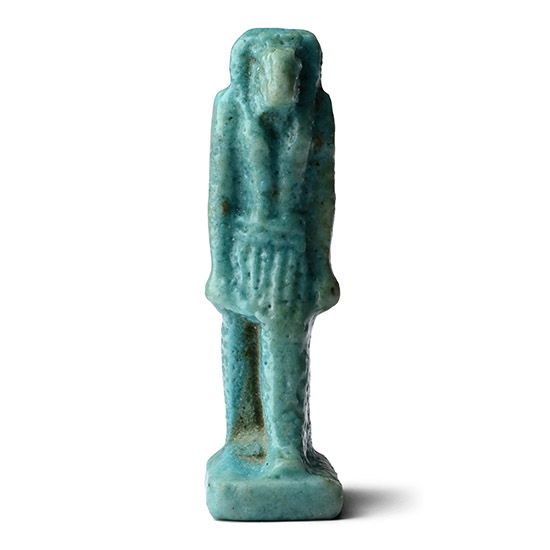
Egyptian Faience Thoth Amulet
Late Period, 664-332 B.C.Sold for (Inc. bp): £351
Modelled in the round as the ibis-headed human figure of Thoth, with a plain dorsal pillar, pierced at the top for suspension. 8.71 grams, 48.29 mm
Ex early 20th century London, UK, collection.
The ibis-headed form of Thoth is particularly significant in funerary contexts, as this depiction of the god frequently appears in Weighing of the Heart scenes, where the dead are judged before a divine tribunal for entry into the Hereafter. Thoth's role was to record the final judgement, which determined whether the deceased had led a virtuous life.

