-
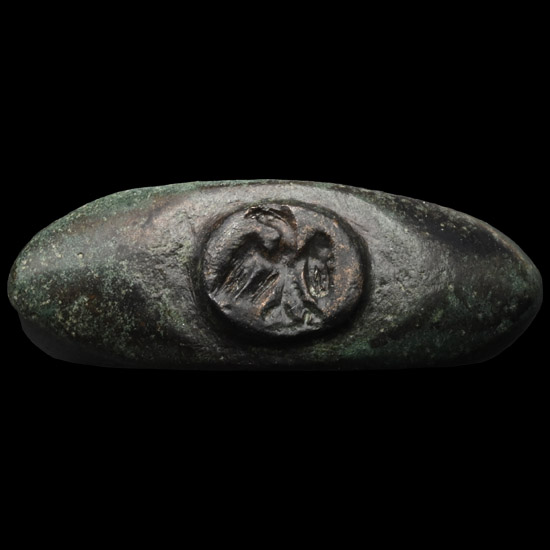
Roman Bronze Military Ring with Spread Eagle
1st-2nd century A.D.Sold for (Inc. bp): £124
D-section hoop with expanding, angled shoulders, a small oval bezel with an eagle with open wings and its head turned to the left. 8.70 grams, 26.46 mm overall, 17.25 x 12.82 mm internal diameter (approximate size British G, USA 3 1/4, Europe 4.92, Japan 4)
Ex German art market, 2000s. Acquired from an EU collector living in London. From the collection of a Surrey, UK, gentleman. -
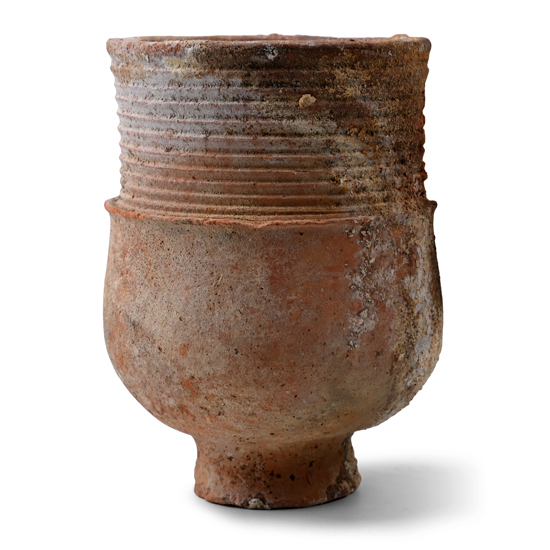
Roman Terracotta Ribbed Drinking Cup
Circa 1st-2nd century A.D.Sold for (Inc. bp): £234
Comprising a tall body with a ribbed upper part and a narrow flaring foot. 206 grams, 11.2 cm
From the private collection of Mr Brian Edwards, New Malden, Surrey, UK, formed from the late 1970s-early 1980s; thence by descent. Accompanied by the original collector's data sheet with reference no.A115. -
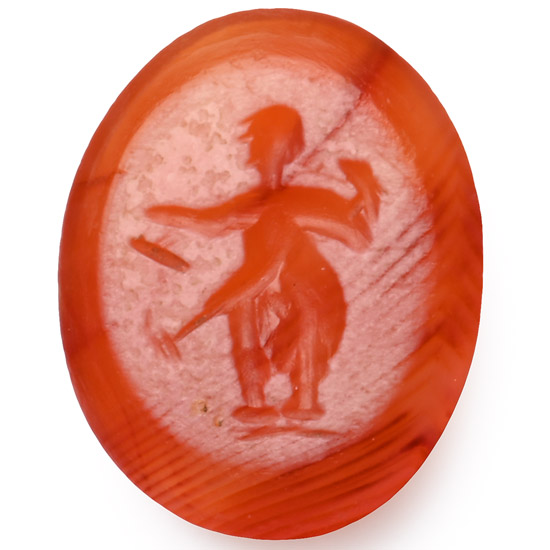
Roman Carnelian Gemstone Standing Figure
2nd-3rd century A.D.Sold for (Inc. bp): £72
With intaglio figure facing with one arm extended; supplied with a museum-quality impression. 0.21 grams, 8.86 mm
From the private collection of a European gentleman (1942-2024), formed since the 1970s. -
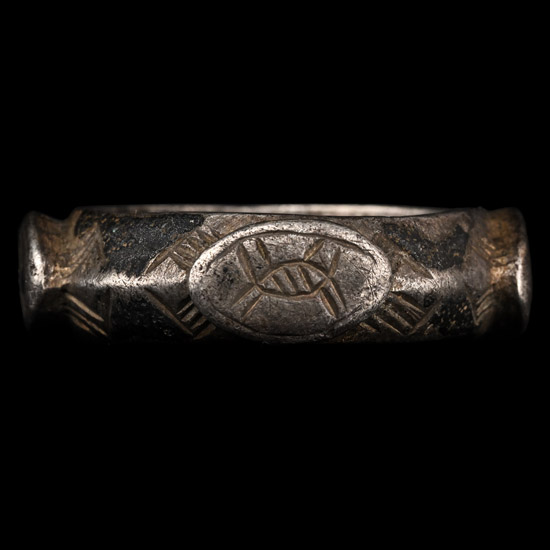
Eastern Roman Silver Ring with Four Bezels
Circa 3rd-4th century A.D.Sold for (Inc. bp): £143
Of a carinated section with four radiating ellipsoid plaques; incised hatchings to the hoop and plaques. 12.77 grams, 28.71 mm overall, 20.85 mm internal diameter (approximate size British V, USA 10 1/2, Europe 23.77, Japan 22)
From the collection of a gentleman, acquired on the London art market in the 1990s. -
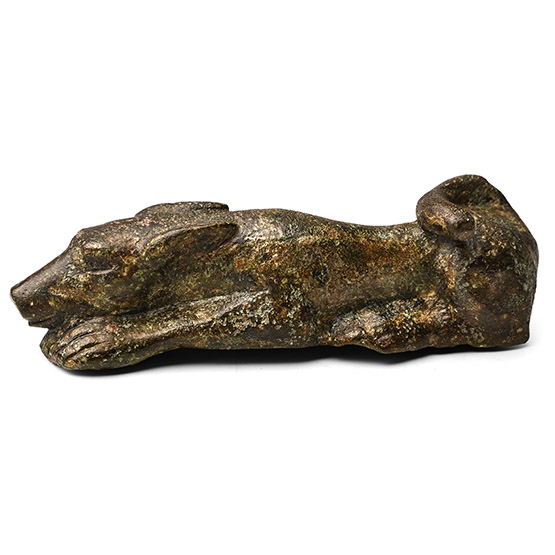
Roman Bronze Lying Dog Statuette
1st-4th century A.D.Sold for (Inc. bp): £364
Modelled in the round with its head resting on the extended forelegs, tail curled on the back, and long ears pulled back along the neck. 138 grams, 77 mm
Ex German art market, 2000s. Acquired from an EU collector living in London. From the collection of a Surrey, UK, gentleman. -
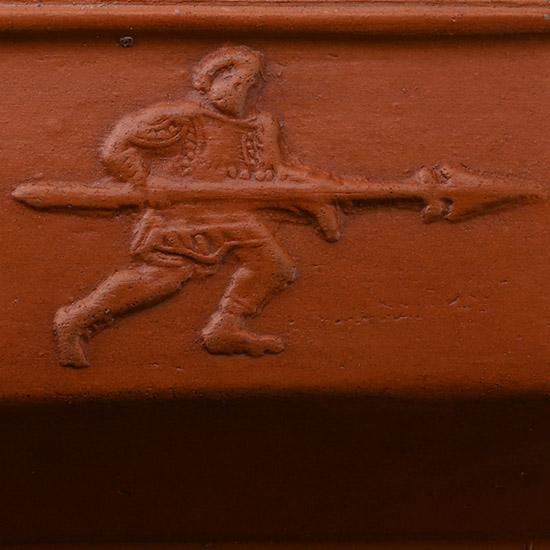
Large Roman Red Ware Rectangular Platter Fragment with Bestiarius Gladiator and Lion
North Africa, circa 4th-5th century A.D.Sold for (Inc. bp): £286
A thick rim fragment with a section of the raised foot underneath, raised lip to the rim, at the centre, a bestiarius gladiator holding a large spear and advancing towards a large lion with its head lowered and teeth exposed; behind the bestiarius, a large figure of a fallen warrior wearing a short tunic, a sword scabbard suspended from his belt. 308 grams, 19 cm
From the private collection of Mr Brian Edwards, New Malden, Surrey, UK, formed from the late 1970s-early 1980s; thence by descent. Accompanied by the original collector's data sheet with reference no.A85. -
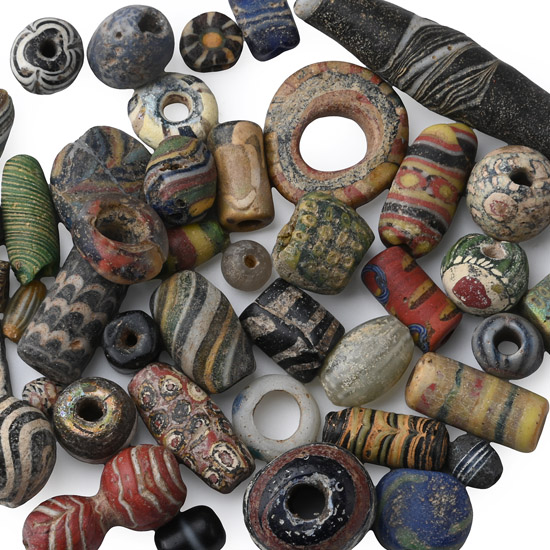
Roman Glass Bead Group
1st-4th century A.D.Sold for (Inc. bp): £364
Mixed group of polychrome beads, some with trails, some with eye motifs and some imitating banded agate. 48.28 grams total, 5.02-42.42 mm
From the private collection of a European gentleman (1942-2024), formed since the 1970s. -
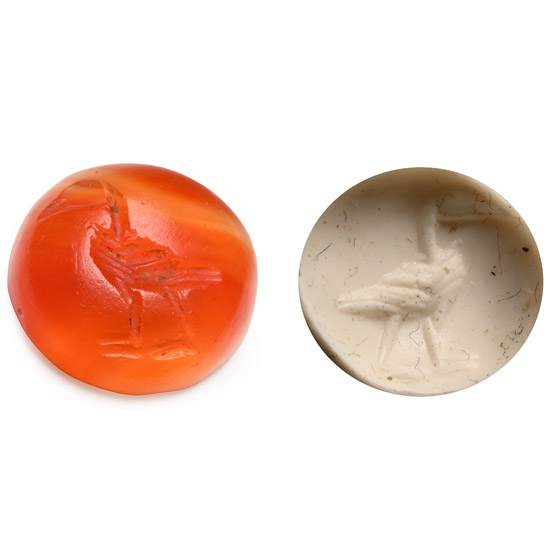
Roman Carnelian Gemstone with Goose
2nd-3rd century A.D.Sold for (Inc. bp): £65
With intaglio goose standing on a baseline; supplied with a museum-quality impression. 0.54 grams, 10.3 mm
From the private collection of a European gentleman (1942-2024), formed since the 1970s. -
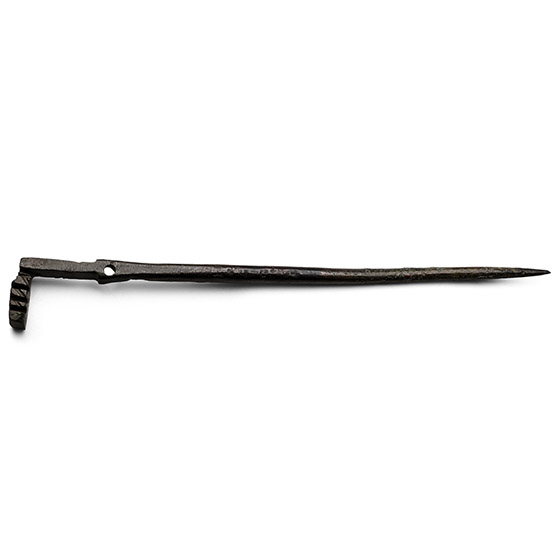
Roman Hair Pin Key
1st-4th century A.D.Sold for (Inc. bp): £78
Comprising a tapering shaft with a perpendicular key terminal with piercing. 6.36 grams, 98 mm
Ex German art market, 2000s. Acquired from an EU collector living in London. From the collection of a Surrey, UK, gentleman. -
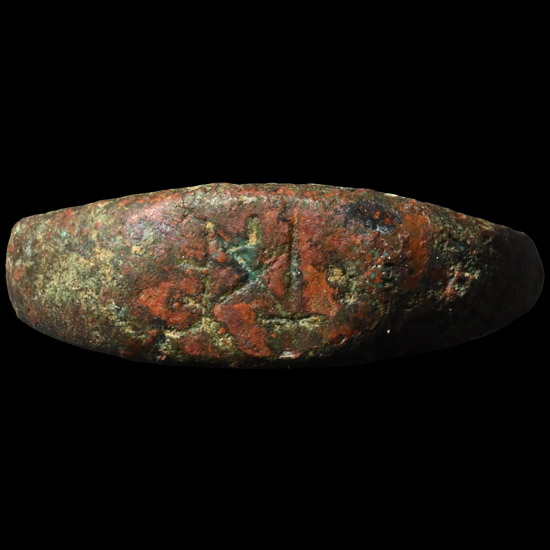
Roman Bronze Ring with Monogram
1st-4th century A.D.Sold for (Inc. bp): £26
Comprising a D-section hoop and an oval bezel with faint outlines of a monogram. 4.43 grams, 24.44 mm overall, 16.69x21.20 mm internal diameter (approximate size British P 1/2, USA 7 3/4, Europe 16.86, Japan 16)
From the private collection of a European gentleman (1942-2024), formed since the 1970s. -
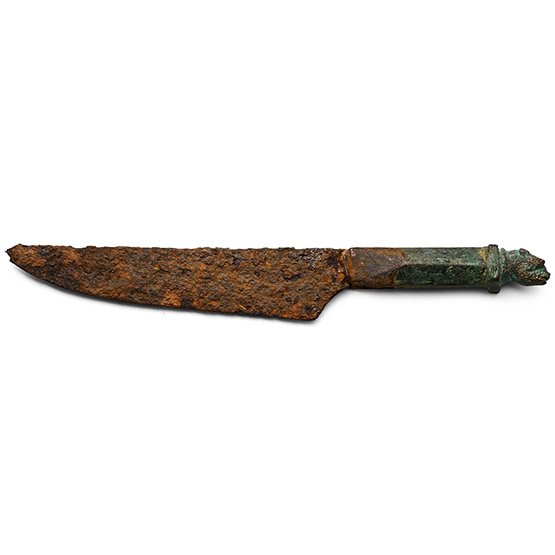
Roman Iron Knife with Bronze Dog's Head Handle
1st-4th century A.D.Sold for (Inc. bp): £260
Comprising a single-edged iron blade with a short facetted bronze handle, the pommel formed as a stylised dog head. 36.2 grams, 14.1 cm
Ex German art market, 2000s. Acquired from an EU collector living in London. From the collection of a Surrey, UK, gentleman. -
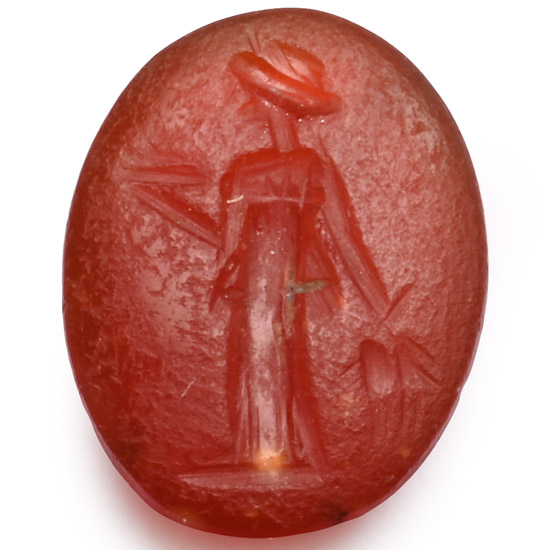
Roman Carnelian Gemstone with Standing Female
2nd-3rd century A.D.Sold for (Inc. bp): £72
With intaglio standing female holding a patera in her extended hand; supplied with a museum-quality impression. 0.48 grams, 11.05 mm
From the private collection of a European gentleman (1942-2024), formed since the 1970s.

