-
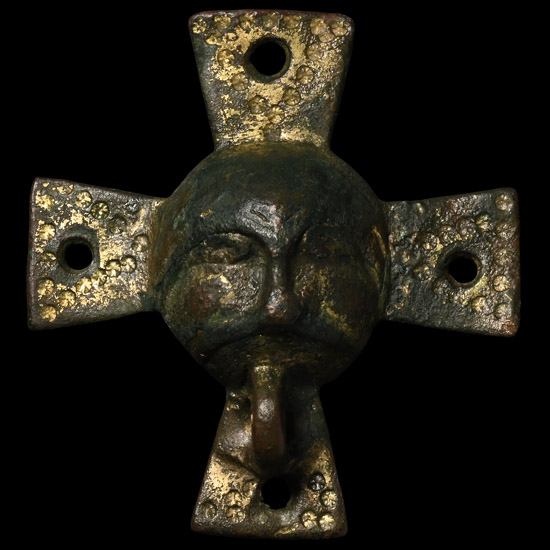
Viking Gilt Bronze Horse Harness Mount with Face
Circa 10th century A.D.Sold for (Inc. bp): £182
Comprising a hollow central dome with four radiating trapezoidal arms, each with central piercing and bands of punched roundel decoration; dome with male face detailing, thick brow (or helmet) over two piriform eyes, rounded nose and wide-flaring moustache; suspension loop beneath the chin. 17.31 grams, 47.67 mm
From the private collection of a London gentleman, from his grandfather's collection formed before the early 1970s. -
.jpg)
Scandinavian Viking Age Silver Inlaid Iron Hilt Guard
Circa 10th-11th century A.D.Sold for (Inc. bp): £546
Hollow-formed with a deep curved profile; rectangular slot in the upper face for the tang; bands of applied silver ropework ornament on a sheet-silver field. 70 grams, 72 mm
Private collection formed in Europe in the 1980s. Westminster collection, central London, UK.
The guard is too narrow to have been used on a sword, but it may have been part of the hilt furniture of a high-status seax or knife. The form is approximately consistent with Petersen's Type Z of late-10th century date. -
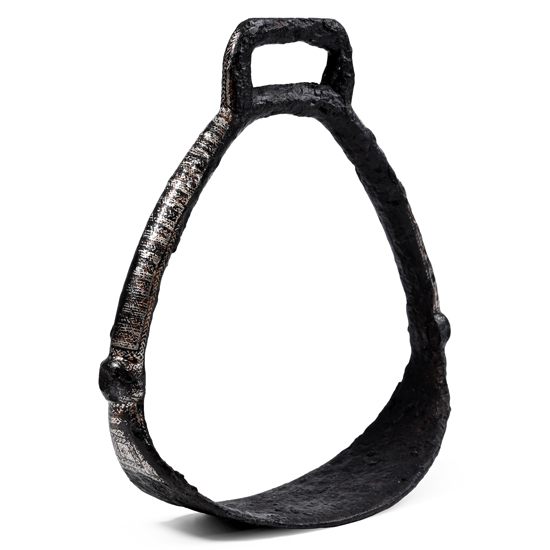
Scandinavian Viking Age Silver Inlaid Iron Stirrup
Circa 10th-11th century A.D.Sold for (Inc. bp): £5,460
With inlaid silver ropework bands to the loop and frame. 172 grams, 13.2 cm
Private collection formed in Europe in the 1980s. Westminster collection, central London, UK. -
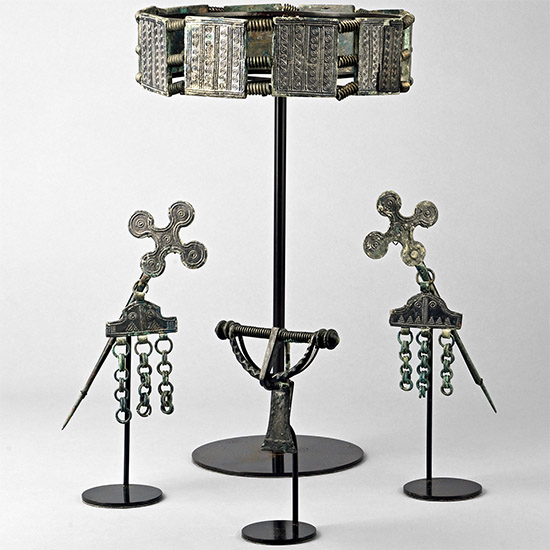
Viking Period Ornate Crown with Brooch and Pin Set
Circa 8th-9th century A.D.Sold for (Inc. bp): £12,350
Comprising: a restrung headdress formed as ten square panels, each with vertical bands of pellets framing four columns of ring-and-dot ornament, with interstitial groups of three tubular spacer beads with corrugated profile; two dress-pins each with a lobed cruciform head and appliqué panel, pierced lug at the top of the shank to mount a transverse cocked-hat panel with three pendant chains of double links, faced with an appliqué tinned sheet with stamped motifs of hatched triangles, ring-and-dot and billets to the border; bow-brooch with transverse spring and header with knop finials ornamented with beaded collars, stepped bow with coiled wire collar and semicircular bar with notched upper face, trapezoidal footplate with catch and pin to reverse; each mounted on a custom-made stand. 2.3 kg total, crown: 36 cm high including stand, brooches: 15-22.5 cm high including stand
Acquired on the UK art market, 1995-2000s. Private collection, London. This lot has been checked against the Interpol Database of stolen works of art and is accompanied by search certificate number no.13242-252258. -
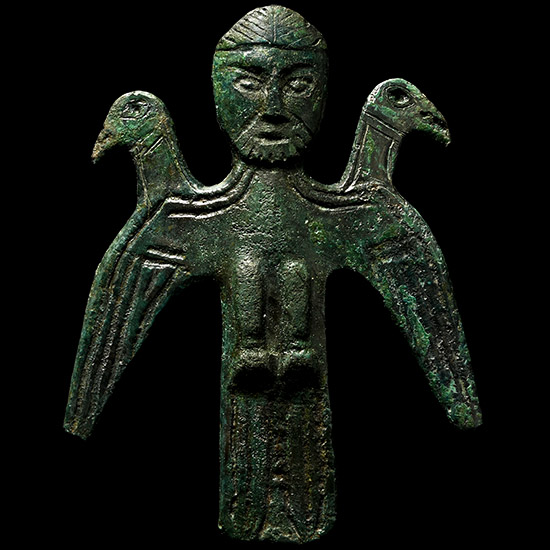
Pre-Viking Age Bronze Shaman Pendant
Circa 6th-8th century A.D.Sold for (Inc. bp): £2,340
Flat in section with spread wings and talons to the lower body, feather detailing to tail and wings; male mask above, flanked by profile bird-heads at the pinions; loop to reverse; Samoyed type. 18.58 grams, 66.13 mm
From the private collection of a London gentleman, from his grandfather's collection formed before the early 1970s. This lot has been checked against the Interpol Database of stolen works of art and is accompanied by search certificate number no.13290-253202.
The pendant likely represents the soul of the shaman in bird form on a spirit journey. -
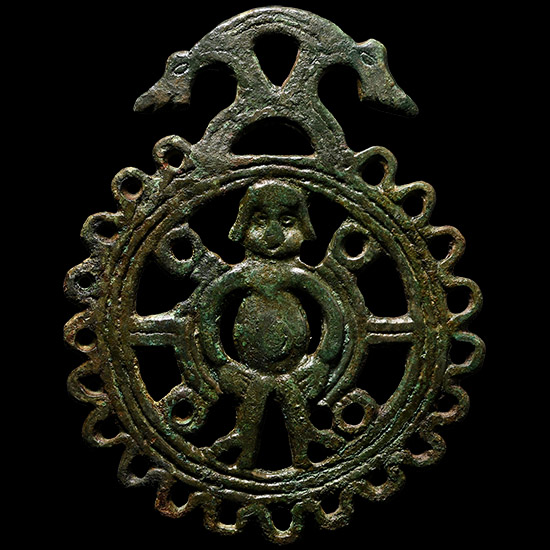
Pre-Viking Bronze Openwork Pendant with Bound Figure and Dragons
Circa 6th-10th century A.D.Sold for (Inc. bp): £416
Openwork Zierscheibe with triple-band ring surrounding a facing female figure with flexed arms, annulets and arcs flanking her body, annulets to the outer rim of the enclosing ring, suspension loop above flanked by addorsed beasts. 83.77 grams, 10.7 cm
From the private collection of a London gentleman, from his grandfather's collection formed before the early 1970s.
These openwork discs are often found at the waist and may have formed an ornamental lid to a belt-pouch. -
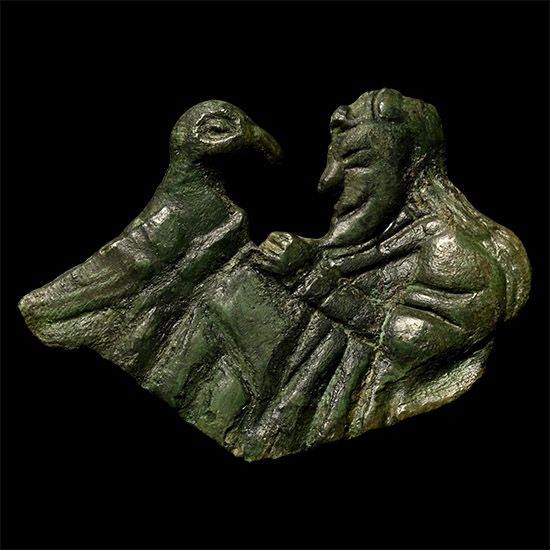
Viking Bronze 'Wayland the Smith' Mount
Circa 10th century A.D.Sold for (Inc. bp): £1,170
Depicting a male figure with almond-shaped eye, pointed curved chin, small nose, long hair with a curl above the forehead; dressed in a loose short-sleeve tunic(?), with hands and neck tied together; facing a bird with large almond-shaped eye, curved beak and prominent crest or feather(?) on the top of its head, finely incised feather decoration; a pin to the reverse. 8.66 grams, 43.14 mm
From the private collection of a London gentleman, from his grandfather's collection formed before the early 1970s.
The design on this mount is inspired by Scandinavian and British Isles Viking art, but the style of execution points towards foreign workmanship, possibly continental European. Some features are very distinctive for Viking art, such as a curl on the top of the head and almond-shaped eyes, which can be found also on small mounts of female figures holding a shield, found both in Scandinavia (Vrejlev, Denmark) and England (Ipswich, Suffolk). The face style, with distinctive curved chin, is typical of those on picture stones from Gotland, Sweden, especially the ones from Stora Hammar and Sanda. The style of bird is unusual, but the closest parallel can be found on the Franks Casket, which could have served as an inspiration for the style of the mount. The story is most likely that of Wayland (also known as Volundr or Weland), the most famous blacksmith from Germanic mythology, attested both in Viking and Anglo-Saxon mythology. The poem Volundarkviða from the Poetic Edda tells how Volundr and his two brothers married swan maidens (valkyries) and lived with them for eight winters, after which their wives abandoned them. Unlike his brothers, Volundr decided to stay at home waiting for his wife to return, but was captured by King Niðuðr and imprisoned on an island. A ring, which was given to Volundr by his wife, was taken from him and Niðuðr gave it to his daughter, Boðvildr. In revenge, Wayland killed the king's sons when they visited him in secret, and fashioned goblets from their skulls, jewels from their eyes, and a brooch from their teeth. He sent the goblets to the king, the jewels to the queen and the brooch to the king's daughter. To humiliate the king even more, he raped princess Boðvild when she visited him to mend the ring given to her. He then escaped with artificial wings he created from birds' feathers. The suffering of a blacksmith is attested also in the Old English poem Deor, in which there is also a mention of his imprisonment by King Niðhad. His story can be also found on artefacts, notably the Franks Casket and the Ardre picture stone. Some of the most famous swords and armour was said to have been forged by this legendary blacksmith. The other interpretation of a bound figure might imply it to be Loki, imprisoned after his betrayal of the Æsir gods and bound with the entrails of his own son. The bird, in this case most likely a raven, can represent a messenger of Odin. We know from the Norse poem Baldrs draumar that Odin visited a volva (seeress or wise woman) in the realm of the dead, Helheim. After an exchange of words, in the end he accuses her not to be a wise woman, but rather the mother of three giants to which she responds that no one will visit her until Loki will be free. Some scholars' (e.g. Ursula Dronke) interpretation is that the volva was Loki disguised, imprisoned in Helheim, who fathered three world monsters with giantess Angrboda (Fenrir, Jormungandr, Hel) and the mount can point to the scene of conversation between bound Loki and the raven, the messenger of Odin. -
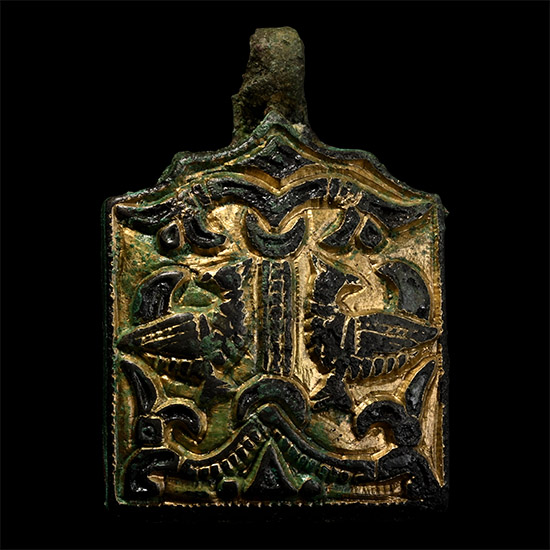
Viking Gilt Bronze Horse Harness Pendant with Birds
Circa 10th century A.D.Sold for (Inc. bp): £910
Square in plan with hollow body, repoussé motif of a tree with flanking birds at the sides and serpents below; integral suspension loop. 19.42 grams, 44.78 mm
From the private collection of a London gentleman, from his grandfather's collection formed before the early 1970s. -
.jpg)
Viking Age Gilt Bronze Military Horse Harness Pendant Set
Circa 10th-11th century A.D.Sold for (Inc. bp): £3,900
Comprising fourteen openwork pendants, each a piriform openwork plaque with pelleted bands and hinged hollow bulb finial, hinged at upper edge to a trefoil plate with mounting pins to reverse. 194 grams total, 71.11-71.89 mm
From the private family collection of a lady, UK; acquired in Germany mid 20th century. This lot has been checked against the Interpol Database of stolen works of art and is accompanied by search certificate number no.13270-253197.
Such horse harness pendants were common to the culture of the Alan, Kabarian and Hungaro-Magyar warriors, and also in use among the Eastern Viking (Rus) warriors. -
.jpg)
Stuart Period Gold Memento Mori Ring with Skull and Crossed Bones for Ian Shepherd
Dated 1724 A.D.Sold for (Inc. bp): £3,900
Comprising a D-shaped hoop with foliate and floral decoration, rectangular bezel set with a facetted rock crystal(?) gemstone with a skull and crossed bones beneath the gem; engraved to the inner face 'In˚ Shepherd Obt 20 Jan 1724 æt 62' and a worn maker's mark. 4.60 grams, 22.48 mm overall, 18.44 mm internal diameter (approximate size British Q 1/2, USA 8 1/4, Europe 18.12, Japan 17)
Acquired from a London, UK, auction house. From a private Bristol, UK, collection. This lot has been checked against the Interpol Database of stolen works of art and is accompanied by search certificate number no.13213-249807.
The memento mori jewellery of the 16th-18th centuries served as wearable ‘reminders of mortality’. Typical motifs within this genre included skulls, skeletons, crossbones, hourglasses, coffins, the gravedigger’s pick and shovel, and various other emblems of death and decay. -
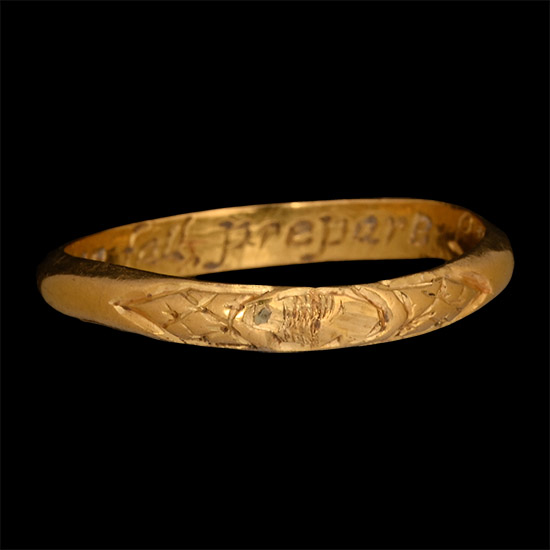
Post Medieval Gold 'Death calls man falls, prepare' Decorated Memento Mori Ring
Late 17th-early 18th century A.D.Sold for (Inc. bp): £910
D-section hoop with oval cartouche flanked by elongated mouldings with pointed ends; cartouche with a skull, the mouldings on each side decorated with double rows of incised cross hatching; inscription on the internal surface with a maker's mark reading: 'Death calls man falls, prepare L..D.' followed by the maker's mark, a heater shield with indistinct liner design. 1.95 grams, 18.94 mm overall, 16.39 mm internal diameter (approximate size British K 1/2, USA 5 1/2, Europe 10.58, Japan 10)
Found whilst searching with a metal detector in Lewes, West Sussex, UK, on Wednesday, 9th October 2024. Declared as treasure under the Treasure Act with reference no.2024T1242, subsequently disclaimed and returned to the finder. Accompanied by a copy of the British Museum's Portable Antiquities Scheme (PAS) report no.SUSS-1D0CDB.
See examples with similar style script and moulded skulls flanked with cross-hatched mouldings on the PAS website :SF-223B48 (2021T585) dated to 1697; DEV-200F91 (2019T823) with black niello inlay surviving dating 1676; LON-A96750 (2010T192) also with niello inlay dating 1703/4 and DUR-4FC118 (2015T249) dating 1673. -
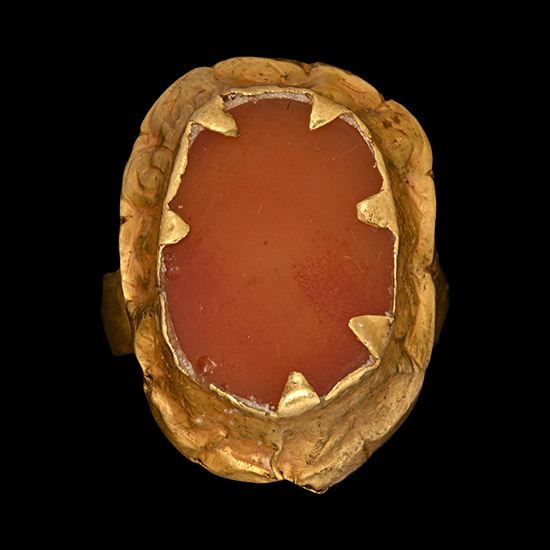
Stuart Period Engraved Gold Ring with Carnelian Gemstone
17th-18th century A.D.Sold for (Inc. bp): £416
Hoop with knop to the underside; elongated bezel, ellipsoid in plan with carinated profile, reserved foliage on a pounced field, plain shoulder and claw setting for a carnelian cloison. 5.49 grams, 25.50 mm overall, 15.41 x 13.82 mm internal diameter (approximate size British H 1/2, USA 4, Europe 6.81, Japan 6)
Acquired in the late 1980s-early 1990s. Private collection, London, UK.

