-
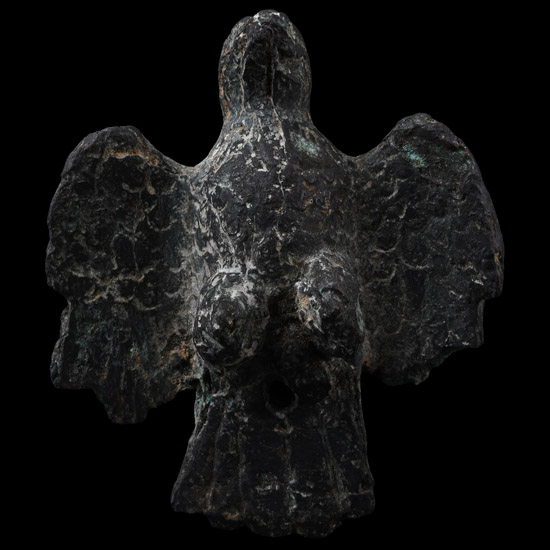
Large Roman Bronze Eagle Staff Finial
3rd-4th century A.D.Sold for (Inc. bp): £208
Modelled with open wings and an erect head, tail feathers spread with a small piercing through the base, and feather detailing throughout. 104 grams, 65.5 mm high
From the private collection of a European gentleman (1942-2024), formed since the 1970s. -
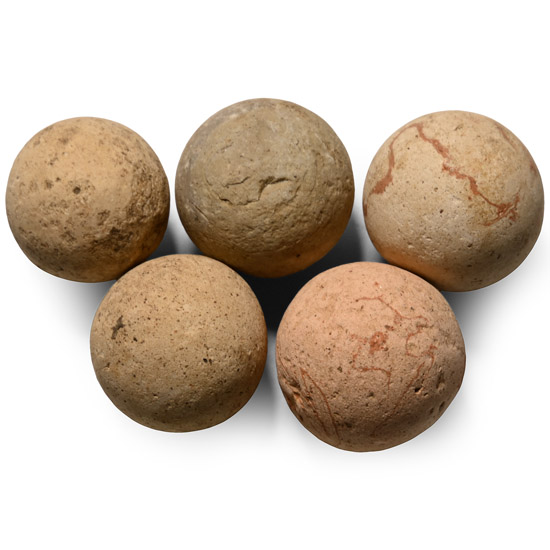
Roman Terracotta Marble Group
Circa 1st-4th century A.D.Sold for (Inc. bp): £169
Comprising five spherical marbles. 17 grams total, 13.6-15.7 mm
From the collection of a Buckinghamshire, UK, collector established from the earlier 1960s. -
.jpg)
Roman Agate Gemstone with Female Bust
2nd-3rd century A.D.Sold for (Inc. bp): £78
With intaglio profile female bust; supplied with a museum-quality impression. 0.61 grams, 11.38 mm
From the private collection of a European gentleman (1942-2024), formed since the 1970s. -
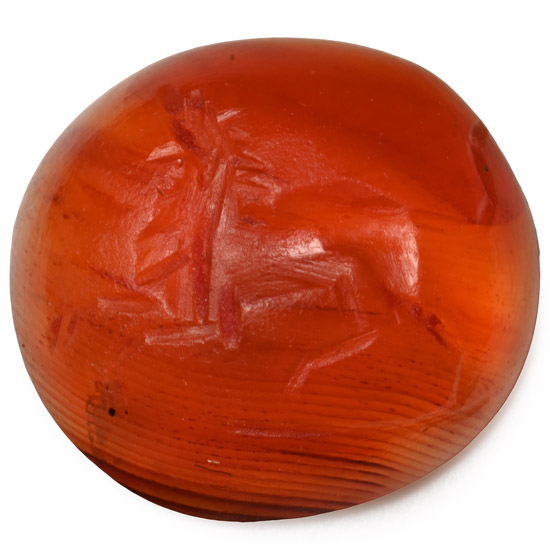
Roman Carnelian Gemstone with Lion
2nd-3rd century A.D.Sold for (Inc. bp): £78
With intaglio lion resting with forepaws extended. 0.44 grams, 10.16 mm
From the private collection of a European gentleman (1942-2024), formed since the 1970s. -
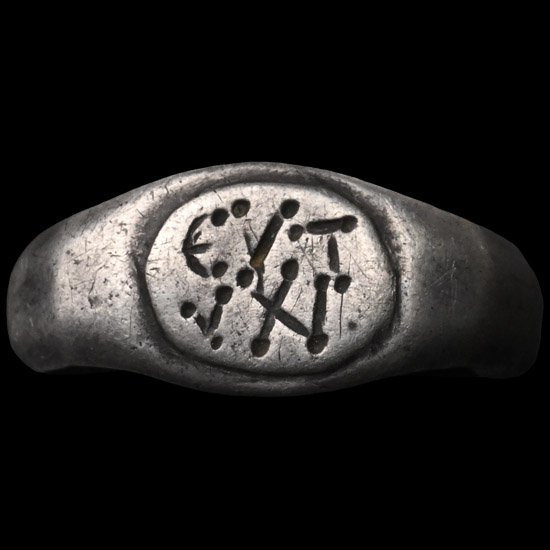
Roman Silver Ring with Inscription
1st century A.D.Sold for (Inc. bp): £130
With broad plaque, incised border to the raised bezel, incised legend 'EVTVN', each line ending with an impressed point; small size suitable for a child. 2.63 grams, 18.62 mm overall, 15.21 mm internal diameter (approximate size British F, USA 2 3/4, Europe 3.67, Japan 3)
From the collection of a gentleman, acquired on the London art market in the 1990s. -
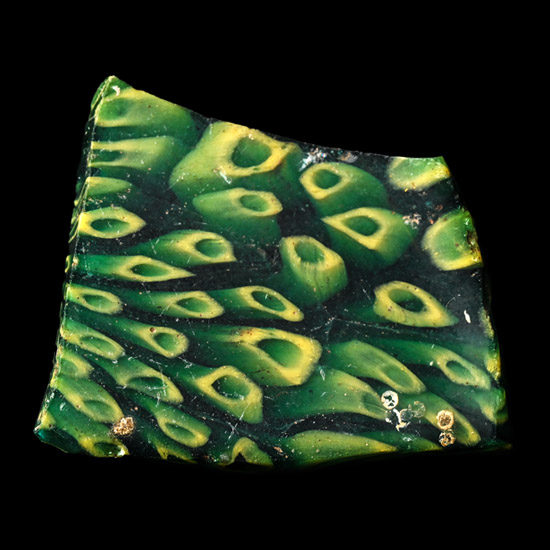
Roman Green Mosaic Glass Fragment
Late 1st century B.C.-early 1st century A.D.Sold for (Inc. bp): £221
A roughly rectangular section of green and black mosaic glass with yellow annulets. 5.69 grams, 34.3 mm
From the late collection of a Cornish couple, formed from the early 1990s. -
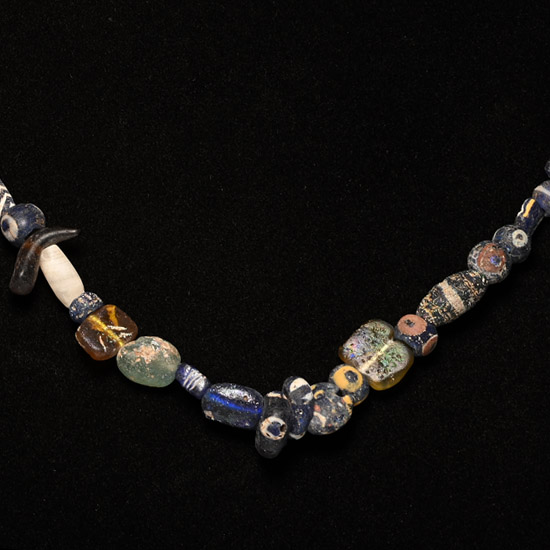
Roman and Earlier Glass Bead Necklace String
Circa 4th century B.C.-4th century A.D.Sold for (Inc. bp): £195
Composed of mixed beads, including 'eye' beads, glass beads with drawn decorations, pendant beads, and others, restrung. 64 grams, 64 cm
From an English private collection, 1980s. Property of a London, UK, antiquarian. -
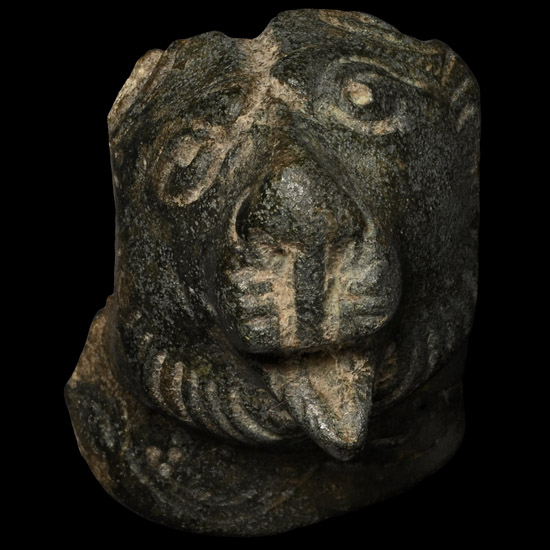
Roman Bronze Lion's Head Fragment
1st-4th century A.D.Sold for (Inc. bp): £546
Modelled in the round with open jaws and lolling tongue, furrowed eyebrows and large lentoid eyes, mane detailing framing the face. 59.4 grams, 45.3 mm
From the private collection of a European gentleman (1942-2024), formed since the 1970s. -
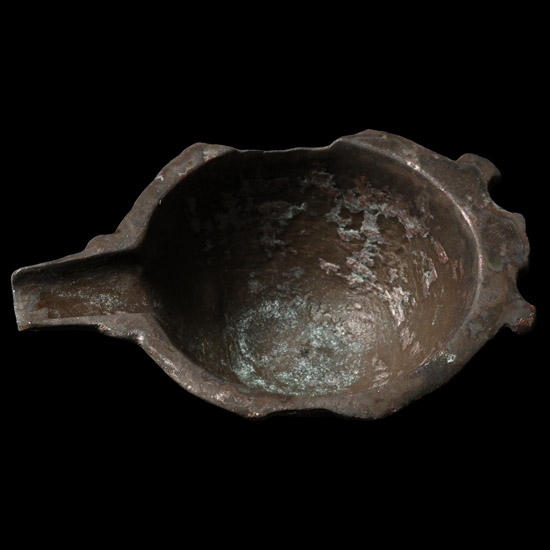
Late Roman Bronze Oil Lamp Filler
Circa 5th-7th century A.D.Sold for (Inc. bp): £46
Comprising a deep body with shallow foot, flared rim with a U-shaped spout. 34.5 grams, 74.4 mm
From the private collection of Mr Brian Edwards, New Malden, Surrey, UK, formed from the late 1970s-early 1980s; thence by descent. Accompanied by the original collector's data sheet with reference no.A92. -
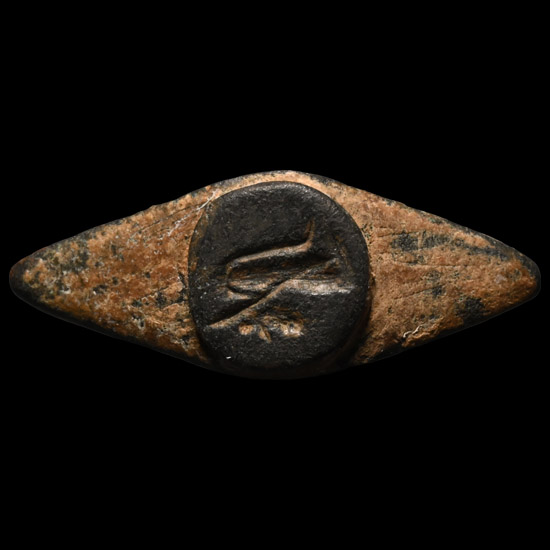
Roman Bronze Ring
3rd century A.D.Sold for (Inc. bp): £72
Featuring a D-section hoop with wide, angled shoulders, a round bezel with a quiver(?) and an arrow. 6.34 grams, 27.81 mm overall, 14.31x18.22 mm internal diameter (approximate size British I 1/2, USA 4 1/2, Europe 8.07, Japan 7)
From the private collection of a European gentleman (1942-2024), formed since the 1970s. -
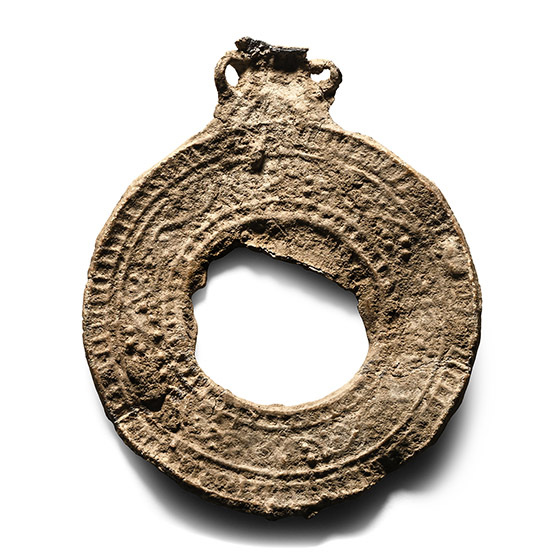
Roman Lead Votive Mirror Frame
1st-4th century A.D.Sold for (Inc. bp): £26
Circular frame with low-relief pellet and linear decoration, two small loops flanking the stem. 21.14 grams, 61 mm
From a retired Lincolnshire, UK, gentleman's collection, a long-time member of the Pewter Society. -
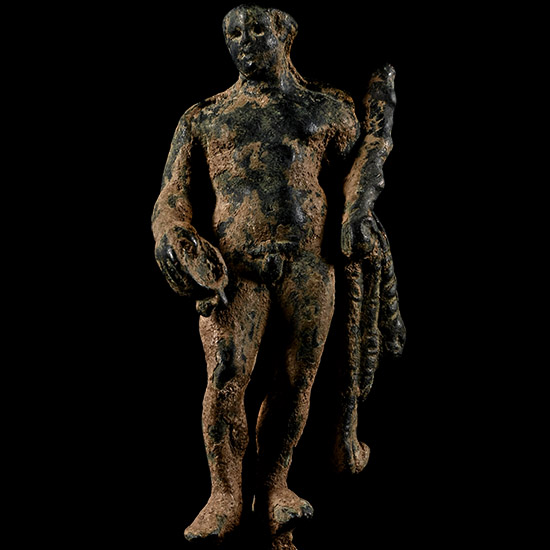
Roman Bronze Figure of Hercules Holding Club and Skyphos
2nd-3rd century A.D.Sold for (Inc. bp): £1,235
Depicted nude in a contrapposto stance with the weight on his left leg, holding a club in the crook of his left hand with a lion-skin draped over the arm, and a cup in his right hand. 115 grams, 86 mm
Acquired in the 1980s. Private collection, Switzerland, thence by descent. Private collection, since the late 1990s. This lot has been checked against the Interpol Database of stolen works of art and is accompanied by search certificate number no.12615-234681.
This well-proportioned bronze statuette, perhaps of Gallo-Roman origin, was likely made for a private lararium, the domestic shrine found in many Roman homes. Although provincial in style, it is carefully modelled and has a strong presence. Unlike many similar figures, Hercules is shown here without a beard, and the upper part of the head was probably once covered by a laurel crown. Known to the Greeks as Herakles, Hercules was one of the most admired heroic figures in the Roman world, celebrated for his strength, endurance, and ability to overcome immense challenges. His famous Twelve Labours made him a lasting symbol of perseverance and triumph, and small bronze figures such as this would have brought not only mythological meaning into the home, but also a sense of protection, resilience, and personal devotion.

