-
.jpg)
Very Large British Museum Recorded Palaeolithic Handaxe from the Happisburgh Area
Palaeolithic Period, circa 600,000 B.P.Sold for (Inc. bp): £1,560
Handaxe of Wymer's type D, slightly buff patinated rolled flint. 773 grams, 16.1 cm
Found by Mr P. Macro in the Parish of Walcott (via GPS location), which is directly next to the Parish of Happisburgh, where this stretch of beach adjoins. The discovery was made in 2019 after the ‘Beast from the East’ storm, which stripped the beach of the sand and helped to erode the Palaeolithic artefacts from the ancient Thames river bed. During the time the artefacts were dropped, the Thames ran through North Norfolk and what is now Happisburgh before it was pushed down to its current position in London via the Ice Age glacial melts. Accompanied by a copy of the British Museum's Portable Antiquities Scheme (PAS) report no.NMS-8D526A.
The site of Happisburgh in Norfolk has helped to push the history of inhabitation of the British Isles back by 200,000, making it a site of special importance. -
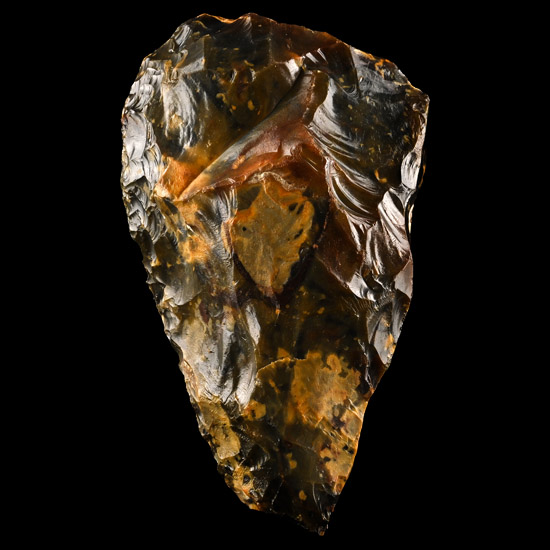
Stone Age Acheulean Knapped Flint Handaxe
Lower Palaeolithic, circa 700,000-300,000 B.P.Sold for (Inc. bp): £468
Triangular in profile with chipped point; bifacial type. 459 grams, 14.4 cm
Northern France. Collection of Jean-Claude Debenne (1936-2020), formed between the 1950s and 1990s. Accompanied by an original French Ministry of Culture export certificate no.CBC 242920. -
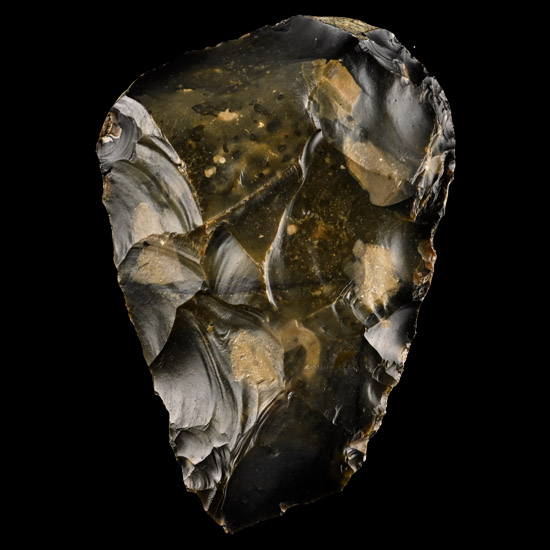
Stone Age Acheulean Knapped Flint Handaxe
Lower Palaeolithic, circa 700,000-300,000 B.P.Sold for (Inc. bp): £572
Ovate in profile with broad base; inked legend to cortex at base 'Longeuil Ste Marie / Oise et [...]'; point absent. 540 grams, 14.5 cm
Longueil, Seine-Maritime, Oise. Collection of Jean-Claude Debenne (1936-2020), formed between the 1950s and 1990s. Accompanied by an original French Ministry of Culture export certificate no.CBC 242901. -
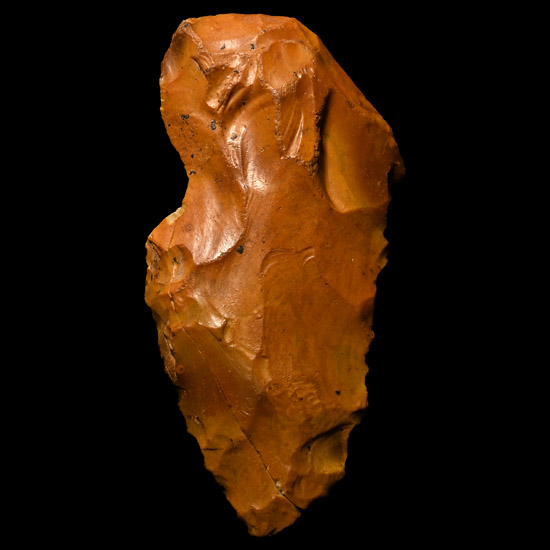
British Stone Age Knapped Flint Handaxe from Farnham, Greenhill
Middle Palaeolithic Period, circa 150,000-60,000 B.P.Sold for (Inc. bp): £1,300
Lanceolate in profile with broad point; inked findspot 'Farnham 1901'; repaired. 301 grams, 15.6 cm
Found in 1901. From the collection of Captain Streatfield who helped to fund the archaeology excavations at Farnham, Kent. After Captain Streatfield passed away in the 1940s, his collection was sold at auction to a gentleman in Kent. The collection was then sold again in the 2020’s via a UK auction house.
This handaxe is one of a group of 23 handaxes originally collected by Captain Gerald Streatfield and marked with ‘’Farnham 1901’’. The discovery of these 23 handaxes is noted by Bury (1935, 68–69) as being on “the west side of the Tilford Road (Greenhill)” where Streatfield found them. Roe (1968, 286) includes them in his gazetteer under Farnham, Greenhill with general reference SU 850 457, citing Bury’s report. Greenhill is shown on the 1873 and 1898 OS maps as a wooded area, just north of the River Bourne, at c.110 m OD, centred on SU 850 456. This location lies on the south-eastern edge of Terrace A of the River Wey sequence. References for context: Bury, H. (1935). The Farnham Terraces and their sequence. Proceedings of the Prehistoric Society, 1, 60– 69. Roe, D. (1968). A Gazetteer of British Lower & Middle Palaeolithic Sites. CBA Research Report 8. Taylor, C. (2017). Five Palaeolithic handaxes from Farnham, with a comment on the Huband flint collection. Surrey Archaeological Collections, 100, 213–221. -
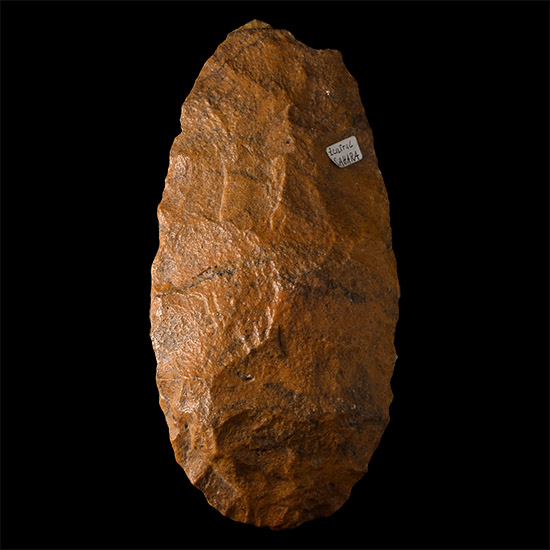
Very Large African Stone Age Homo Erectus Knapped Quartzite Handaxe
Palaeolithic Period, circa 1,000,000-500,000 B.P.Sold for (Inc. bp): £845
Lentoid in section and leaf-shaped in profile with old collector's label 'Zentral Sahara'; point absent. 1.5 kg, 26.5 cm
From the central Saharan area. Ex old German collection formed in the 1970s. Purchased on the European art market. -
.jpg)
Very Large African Stone Age Homo Erectus Knapped Red Stone Handaxe
Palaeolithic Period, circa 1,000,000-500,000 B.P.Sold for (Inc. bp): £780
Piriform in plan with broad, rounded butt; old inked findspot 'Nr Guezzam'; 1.2 kg, 24.9 cm
From Guezzam, Sahara. Ex old German collection formed in the 1970s. Purchased on the European art market.
Made from a material with quartzite inclusions. -
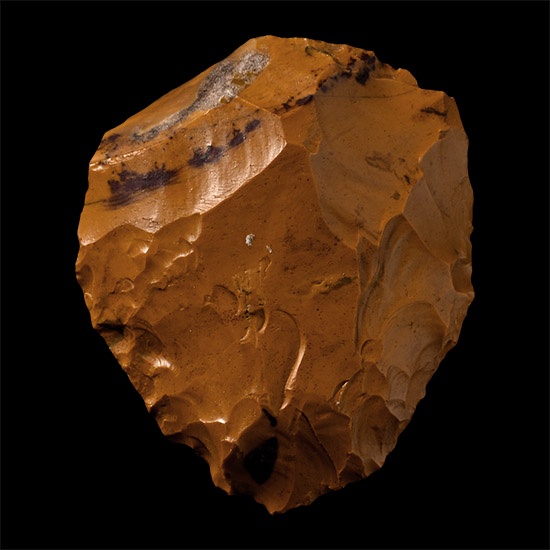
Stone Age Mousterian Knapped Fontmaure Jasper Neanderthal Bifacial Handaxe
Middle Palaeolithic Period, circa 150,000-60,000 B.P.Sold for (Inc. bp): £468
Ovate in plan with a squared butt. 38.54 grams, 52.43 mm
Fontmaure, Vienne department, France. Acquired in the 1970s-1990s. From the collection of the famous UK musician and amateur archaeologist, Victor Brox (1941-2023). Acquired on the UK art market at auction after being sold by Mr Brox’s family. From the private collection of an East Anglian, UK, specialist collector.
Made by a Neanderthal; from the well-regarded area of Fontmaure, the jasper has vibrant colours and traces of chalcedony running through it. -
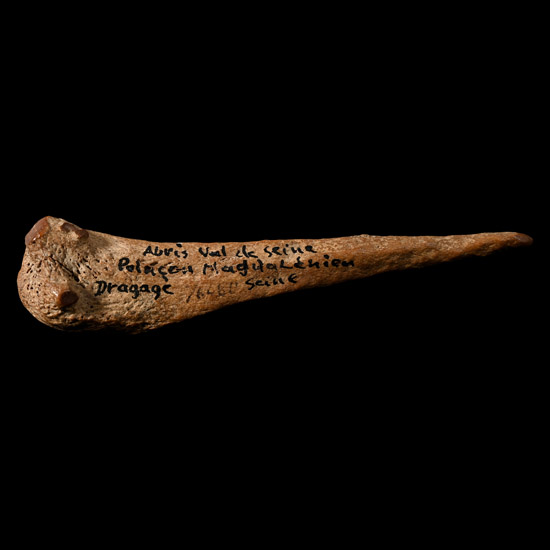
French Stone Age Magdalenian Bone Awl
Magdalenian Period, circa 21,000-13,000 B.P.Sold for (Inc. bp): £494
Well-preserved bone awl from ‘’Abris Val De Seine’’. 9.05 grams, 94.4 mm
From an auction with Art Remy Le Fur. Acquired on the European art market in the 2020s. Accompanied by a copy of French export licence no.257541.
The Magdalenian is a technocomplex of the Late Upper Palaeolithic. It dates from around 21,000 to 13,000 years BP. It is named after the type site of Abri de la Madeleine, a rock shelter located in the Vézère valley of Tursac in Dordogne, France. -
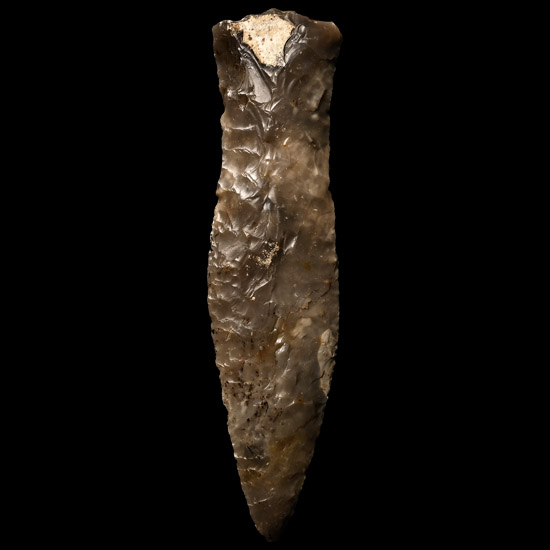
Stone Age Danish Type Knapped Flint Dagger
Neolithic Period, circa 3950-3600 B.P.Sold for (Inc. bp): £468
With mottled grey patina and fossil inclusions, a waisted profile and a rounded tip. 52.65 grams, 12.8 cm
From the Jutland area. Ex old German collection formed in the 1970s. -
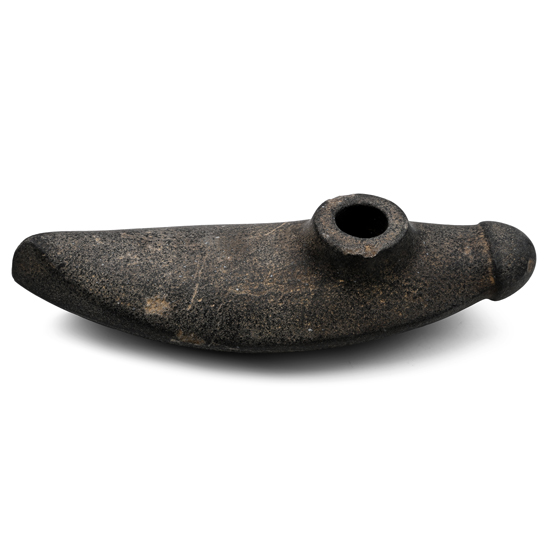
Large Stone Age Corded Ware Boat-Shaped Axehead
6th-5th millennium B.P.Sold for (Inc. bp): £650
A large and finely formed boat-shaped axe with asymmetric convex cutting edge, with pronounced ridge to upper surface copying a bronze casting seam, rounded hammer-butt, pierced to receive handle with a projecting socket to underside. 843 grams, 21 cm
From the private family collection of a lady, UK; acquired in Germany mid-20th century. This lot has been checked against the Interpol Database of stolen works of art and is accompanied by search certificate number no.13250-253195.
These axes, usually of black fine-grained rock, are mostly of Swedish or Norwegian origin. The asymmetrical lentoid cross-section is flattened towards the cutting edge. -
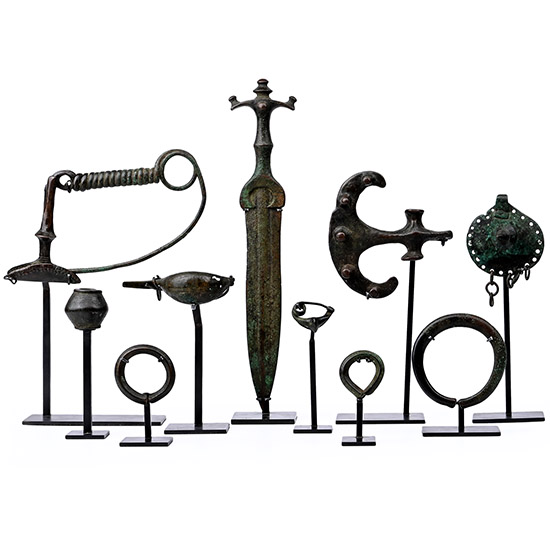
Corsican Bronze Age Hoard from the Ajaccio Area, Discovered c. 1880–1890
Late Bronze Age, circa 900 B.C.Sold for (Inc. bp): £97,500
Including: a) a dagger or short sword in bronze, with grooves on the blade and semicircular guard, oval pommel with a large, two-tiered button in the centre, two smaller buttons at the ends, and two other buttons on the sides; b) the pommel of a second dagger; c) a small axe in crescent shape ornamented by bosses; d) a harness element shaped like a bronze disc fitted with a spike; e) a large violin bow fibula; f) a small boat fibula, decorated on the surface with lines forming a cross; g) a small arched fibula; h) a large bronze ring, with shape and dimensions of a bracelet; i-j) two smaller rings of rhomboid shape. 2 kg total, 7.4-29 cm including stands
Discovered c.1880-90 near Ajaccio, Corsica. Private collection of Mr Ducasse. Thence by descent to Jean Dimitri Ducasse (b.1883), Sarrebourg. Thence by descent. Belle Vente Meuble et Objets d’Art, Cortot et Associés, 26 November 2022, no.133. Acquired from the above sale. Accompanied by a copy of French cultural export passport no.237816. Accompanied by a copy of an Art Loss Register certificate, no.S00228228. This lot has been checked against the Interpol Database of stolen works of art and is accompanied by a search certificate number no.13241-251803.
According to the examination of R. Forrer, the hoard belonged to the culture of the Shardana, who colonised Sardinia and part of Corsica at the end of the first millennium B.C. Forrer dated the hoard to 900 B.C., a period in which the culture of the Nuraghes of Sardinia was at its zenith. The hoard possibly represents a votive treasure, because the axe is without a hole for insertion in a shaft, although the dagger and the other elements could be perfectly usable in the everyday life of the ancient Sardinian people. -
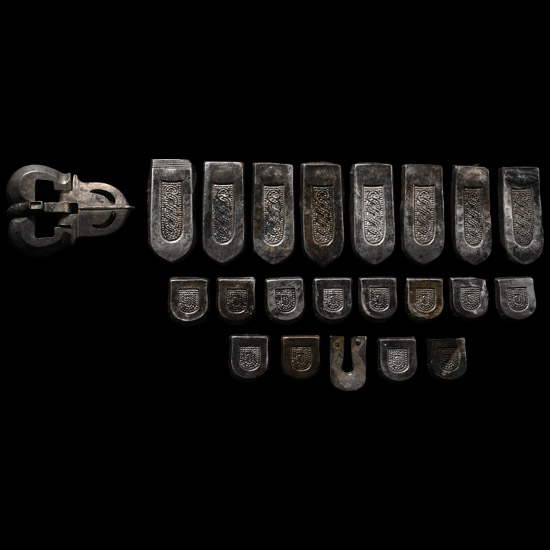
Langobardic Silver Sword Belt Set
Circa 5th-7th century A.D.Sold for (Inc. bp): £572
Comprising: twelve D-shaped appliqué plates each with a central panel of repoussé pellets; eight appliqué strap ends, each tongue-shaped with central repoussé guilloche and pellets motif; U-shaped chape or strap end with mounting rivets at the mouth; buckle formed as a kidney-shaped loop and D-section tongue with rectangular cell to the apex, D-shaped plate to rear with crescent voids and medial rib, rivet and folded counterplate to reverse. 74 grams total, 26.10-62.53 mm
From the private collection of a London gentleman, from his grandfather's collection formed before the early 1970s.

