-
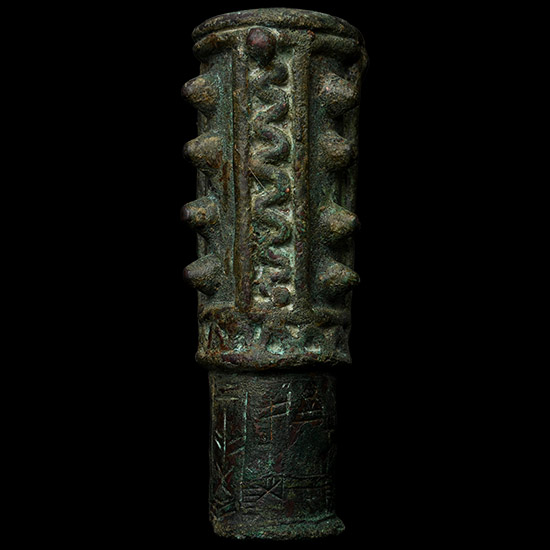
Elamite Bronze Macehead Inscribed 'To Nin’azu, Bala, son of Lugal-kare-si'
Early Dynastic IIIB Period, circa 2500-2340 B.C.Sold for (Inc. bp): £2,340
Comprising a cylindrical shaft with a narrow flanged base, the upper section with three vertical relief panels decorated by round spikes alternated with a wavy pattern, divided and bordered by parallel ridges, engraved with five lines of Sumerian cuneiform text around the socket, a votive inscription translating to: 'To Nin’azu, Bala, son of Lugal-kare-si, the merchant, has presented (it)'. 350 grams, 11.6 cm
Acquired before 1983. Ex London gallery, 1990s. Private collection, London, UK. This lot has been checked against the Interpol Database of stolen works of art and is accompanied by search certificate number no.13257-253385.
This gorz mace head belongs to the category of truncheon-shaped mace heads, a type developed on the Iranian plateau during the Bronze Age, used by Elamite and Luristan warriors since the 3rd millennium B.C. This category of objects was also interpreted as a part of a shaft or cudgel, but most scholars agree on the interpretation of use as a mace. -
.jpg)
Urartian Bronze Helmet with Embossed Decoration
9th-7th century B.C.Sold for (Inc. bp): £6,500
A Caucasian or Urartian helmet of domed profile, hammered from a single sheet of metal; radiating rows of small repoussé bosses with interstitial rows connecting larger examples; shallow recess at the forward edge; old accession label to inner face 'AG334'; later pseudo-inscription; some restoration. 1.5 kg total, 41 cm including stand
Ex Axel Guttmann Collection of Ancient Arms and Armour, Germany [1944-2001], AG 334, 1990. with Hermann Historica, Munich, Germany, 2008. Private collection, New York, USA. Accompanied by an academic report by Dr Raffaele D’Amato. This lot has been checked against the Interpol Database of stolen works of art and is accompanied by search certificate number no.13262-254403.
The Urartian craftsmen were especially famous for their metalworking skills. However, the shape of this helmet differs considerably from the usual pointed Urartian examples, and shows a strong influence from the Scythian and Moeotic military headgear, which is not surprising if we consider that Urartu had been at war with the Scythian tribes of Caucasus since the 7th century B.C. The remainder of the helmet is its bowl, embossed and decorated, and an unusual recess on the front part. The helmet was used with a padded cap, which probably formed an integral part of the same headgear. -
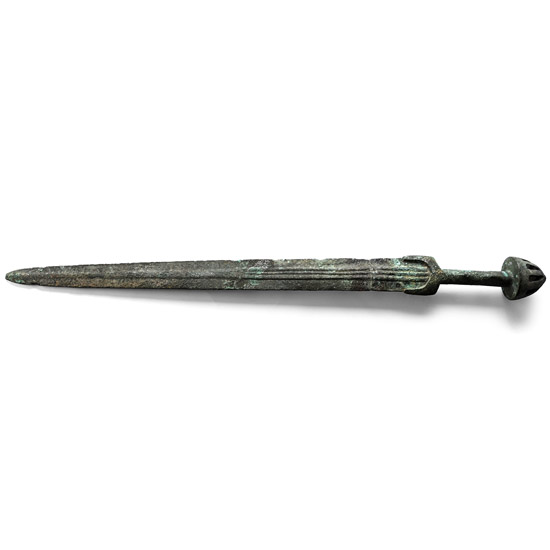
Luristan Bronze Long Sword with Double-Edged Blade and Domed Pommel
Circa 1200 B.C.Sold for (Inc. bp): £1,560
With a tapering, double-edged, triangular blade and three-column midrib; crescent-shaped guard at the shoulder; cylindrical hilt with grips, domed pommel with recesses for inlay. 1.12 kg, 65.5 cm
Ex German collection. with Hermann Historica, Munich, Germany, 2008. Private collection, New York, USA. -
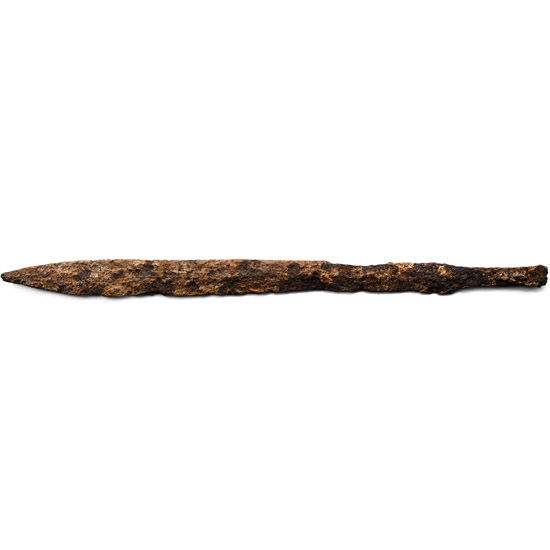
Greek Iron Short Sword
Hellenistic, 2nd-1st century B.C.Sold for (Inc. bp): £468
Lentoid in section with two cutting edges and narrow point; slight flare towards the tip; small shoulder and rectangular-section tang. 400 grams, 56 cm
Ex German art market, 2000s. Acquired from an EU collector living in London. From the collection of a Surrey, UK, gentleman.
This style of straight, parallel-sided weapon is referred to in Greek sources of the time as a xiphe. It was a secondary battlefield armament after the spear and javelin. It is associated with the revolutionary developments in armour, weaponry and tactics between the Classical and Iron Age periods. -
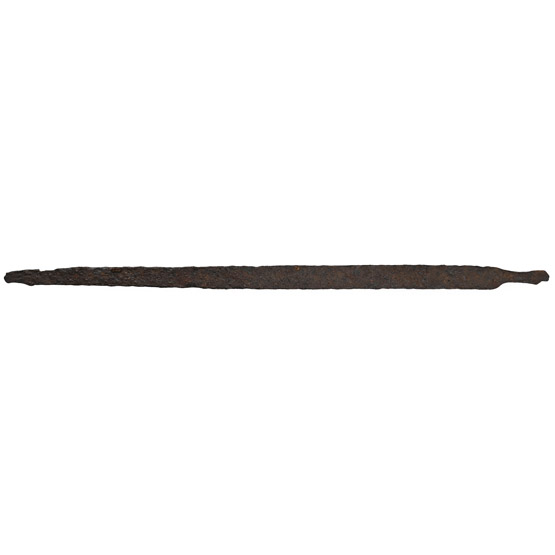
'Bourton-on-the-Water' Celtic Sword-Shaped Iron Currency Ingot
Iron Age, circa 200 B.C.-1st century A.D.Sold for (Inc. bp): £338
A substantial long iron bar in the shape of a sword with the original short folded-over handle to one end. 561 grams, 82 cm
Found Bourton-on-the-Water, Gloucestershire, UK, during the period between WWI and WWII. Property of the finder's family until sold by regional auction house, Tayler & Fletcher in Bourton-On-The-Water. From the private collection of a Stratford-upon-Avon, UK, gentleman.
Currency bars were standardised units used to trade in Iron Age Britain between circa 200 B.C.-1st century A.D. They were often sword-shaped and were used as a form of early currency or trade commodity in Iron Age Britain before coinage became widespread, serving as a store of wealth and medium of exchange. These high-status objects, requiring significant labour (25 man-days/kg), often featured a socket or hilt, possibly to show quality. Types including spit, sword, plough, and bay-leaf shapes have been found in hoards at hillforts like Hod Hill and Danebury. -
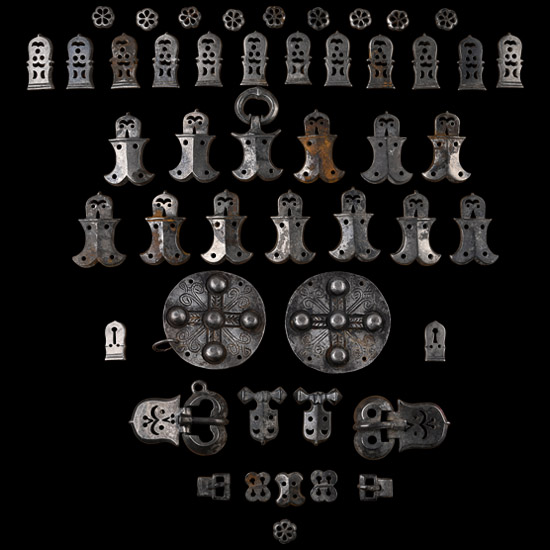
Eastern Roman Military Silver Belt Element Set
6th-7th century A.D.Sold for (Inc. bp): £2,860
A complete set of military belt fittings of Martinovka type, comprising forty-eight elements: two massive shield-shaped buckles, the buckle plate with a central chip-carved mask-shaped decoration, the hinged prong of rectangular form with rounded terminal; twelve shield-shaped belt pendants with wavy edges and the bottom ending in a sharp angle; ten decorative rosettes; twelve belt pendants in the form of a double crescent, with mask-shaped decoration on the oval head, decorated with chip-carved comma and dot ornaments; one pendant of the same typology fitted with a circular massive ring for the suspension; two massive circular phalerae, decorated with a double cross, one ornamented with volutes at the end of the arms, the other with five massive bosses at the sides and centre; two shield-shaped pendants with projections for the fastening of elements; two small rectangular buckles; three trapezoidal openwork pendants and two further small drop-shaped pendants. 722 grams total, 16.08-79.52 mm
From the private family collection of a lady, UK; acquired in Germany mid-20th century. Accompanied by an academic report by Dr Raffaele D’Amato. This lot has been checked against the Interpol Database of stolen works of art and is accompanied by search certificate number no.13249-253196.
These belt elements, which form the fittings of at least two belts, are typical of the Roman garrisons of Black Sea and the Balkans, for the late 6th and the 7th century A.D. They were connected especially with Gothic and Alan soldiers militating in the Roman army, and considered part of the Martinovka typology by the academics. Numerous finds of these multi-part belt sets have been found in the area between the Balkans, the north-northeastern Pontus region, the Kama region in the northeast, and the Caspian Sea in the east. The range of the type includes areas controlled by the Avars and the Roman Empire, the south-Danubian region (Moesia II: Beroe, Callatis, Tropaeum Traiani, Ibida, Argamum), the Carpathian area, the northern Black Sea, the Caucasus and up to the Euphrates and other areas of Europe; these elements should therefore be seen as a ‘multi-ethnic’ or ‘international’ element. They were used to hold two types of offensive weapons: a quiver with arrows, and bladed weapons such as the spatha, and the shorter culter venatorius. -
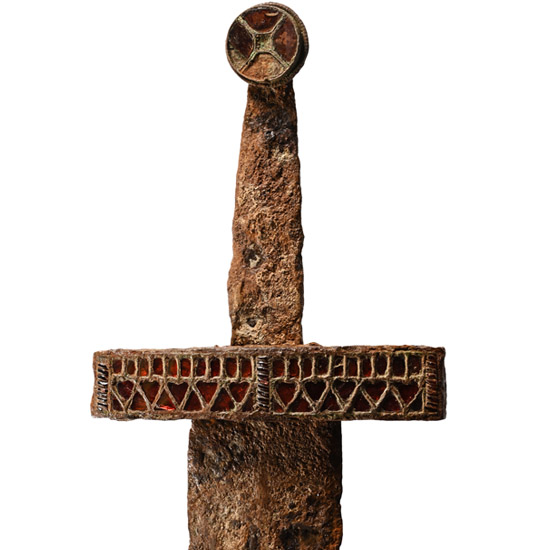
Migration Period Iron Sword with Jewelled Hilt
5th-6th century A.D.Sold for (Inc. bp): £5,980
Comprising: a spatha-type two-edged tapering blade, lentoid in section with sloped shoulders and short tang pierced by an attachment rivet for the grip; traces to both faces of the blade of wooden fibre from the scabbard; edges lightly notched but substantially complete; the lower guard rectangular in plan and scaphoid in section with inset garnet cloisons, triangular along the lower row and heart-shaped above, rectangular at the top, with small rectangular slivers at each end; accompanied by the upper roundel of the pommel, set with four garnet cloisons. 954 grams, 84.5 cm
From the private collection of a London gentleman, from his grandfather's collection formed before the early 1970s. Accompanied by an academic report by Dr Raffaele D’Amato. This lot has been checked against the Interpol Database of stolen works of art and is accompanied by search certificate no. 12357-225921. This lot has been cleared against the Art Loss Register database, and is accompanied by an illustrated lot declaration signed by the Head of the Antiquities Department, Dr Raffaele D’Amato.
These ‘ceremonial’ swords (in reality widely used in battle) with an inlaid guard are, according to Kazanski, Late Roman in origin. The cloisonné decoration was probably linked with the production of particularly ornamented swords in the ateliers of the Roman capital of Constantinople. This typology of weapon was not only produced as a gift for foreign chiefs allied to the empire, but it was also adopted by the Imperial army, and reserved for the Imperial officers, who were often of Germanic or Asiatic origin. -
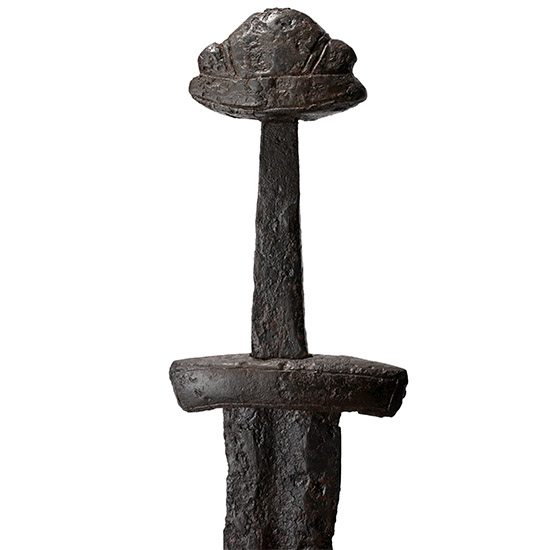
Viking Iron Sword of Petersen Type L
10th century A.D.Sold for (Inc. bp): £3,900
Double-edged cutting sword with tapering blade showing battle nicks along the length, tapering fullers showing shallow traces of pattern-welding, long tang, a boat-shaped lower guard and a three-lobed pommel. 775 grams, 86.5 cm
From the private collection of a London gentleman, from his grandfather's collection formed before the early 1970s. Accompanied by an academic report by Dr Raffaele D'Amato. This lot has been checked against the Interpol Database of stolen works of art and is accompanied by search certificate number no.13261-254356.
This type, considered as Anglo-Saxon in origin, is usually dated to 850-975 A.D., and is considered to form a distinctive group of Viking Age swords. Although used by the Vikings, it is probable that these swords were of English manufacture or inspiration. Swords of Type L are remarkable for their crosspieces and pommel bases curved away from the grip and lobed pommels. -
.jpg)
Viking Iron Sword Pommel and Lower Guard
10th-11th century A.D.Sold for (Inc. bp): £702
Comprising: lower guard, lentoid in plan with recessed underside, slot to accept the tang; pommel with integral upper guard, Petersen's Type X with semicircular profile and raised upper section, slot for tang in the underside. 480 grams total, 77-92 mm
London, UK, collection, formed in the late 1990s. -
.jpg)
Viking Iron Sword Pommel, Upper Guard and Lower Guard
Later 10th century A.D.Sold for (Inc. bp): £910
Comprising: lower guard, lentoid in plan and slightly curved in profile with recessed underside, slot to accept the tang; upper guard, lentoid in plan with scooped long edges; pommel with large median lobe and lateral shoulders, Petersen's Type S. 520 grams total, 77-91 mm
London, UK, collection, formed in the late 1990s. -
.jpg)
Viking Iron Sword Pommel, Upper Guard and Lower Guard
Later 11th century A.D.Sold for (Inc. bp): £1,170
Comprising: lower guard, parallel-sided in plan with rounded ends and slightly curved in profile with recessed underside, slot to accept the tang; upper guard, lentoid in plan with scooped long edges and section of tang in situ; pommel with large median lobe and lateral shoulders, Petersen's Type Z. 522 grams total, 6.7-11.5 cm
London, UK, collection, formed in the late 1990s. -
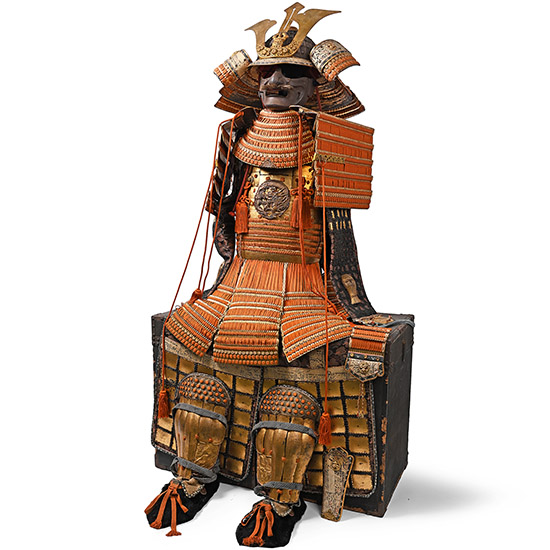
Japanese Edo Period Samurai Suit of Armour with Wooden Storage Boxes
Edo Period, 1603–1867 A.D. and laterSold for (Inc. bp): £13,000
Comprising: an iron and copper-alloy old style Gomai kabuto ridged helmet with suji-kabuto bowl, suji-tate raised ridges, terminating in a small four-stage tehen kanamono hole, fitted with a crossed plate; gilt-copper maedate (frontal ornament) with high raised datemono, antennae; mabizashi, (integral peak visor), lined with silk; fukigaeshi, (steel wings); the neck of the helmet is protected by a laminated shikoro (neck guard with solid plates), made of five steel plates (hachi tsuke- not-ita, ni-no-ita, san-no-ita, yon-no-ita), with red braid sugake-odoshi spaced lacing; the helmet with internal lining (ushibari); behind the nape of the bowl attached a kasa jirushi no kan ring for the red tuft; a fine mempō iron face mask, black lacquered on the outside, red on the inside, with high cheekbones engraved with deep wrinkles on either cheek, detachable nose with simple hooked nails odayori no kugi, flared nostrils and open mouth, moustache, to which is attached a laminated yodare-kake, (throat guard), made of four numbered iron gilded plates with red braid sugake-odoshi spaced lacing; a hybrid armour, composed of a okegawa-do type, constructed with large gilded iron solid horizontal plates joined by the lacing system known as sugake-odoshi in the upper part and kebiki-odoshi in the lower part; composing two valves (ni-mai) attached on the right side and over the shoulders by strings (aibiki no o), attached to it a kusazuri protection made from hardened leather plates hanging from the front and back of the dō to protect the lower body and upper leg; fastening lace agemaki-bow suspended from a ring on the back upper plate and on the sides of a central bronze dragon plaque; oda gote vambraces, arm protection with gilded lacquered splint iron plates (shino) connected with chain armour gusari fitted with tekkō gauntlets, the shino and tekkō decorated with gilded rosette motifs; mogani-sode, slightly curved shoulder guards, composed from six gilded raw-hide plates, fitted with red kake-o (suspending cords) and uke-o (securing cord), bordered by kesho-no-ita (strips of wood covered with leather) and a silk-lined kamuri-ita; Ita-haidate, thighguards, faced with fusa-gusari mail and connected with gilded rawhide splint armour, the upper part lined with silk; O-tateage no-suneate, with gilded iron splint armour (shino), fitted with small round armour plates (kikko) protecting the knees; in two metal-bound wooden transport cases. 29.95 kg total, 157 cm high (assembled)
Private collection, UK. Accompanied by a certificate issued by Chairman Hitoshi Nagata of the Japan Armour and Weapons Research Preservation Association, certificate no. Qing 1309. Accompanied by an academic report by Dr Raffaele D'Amato. This lot has been checked against the Interpol Database of stolen works of art and is accompanied by search certificate number no.13254-252260.

