-
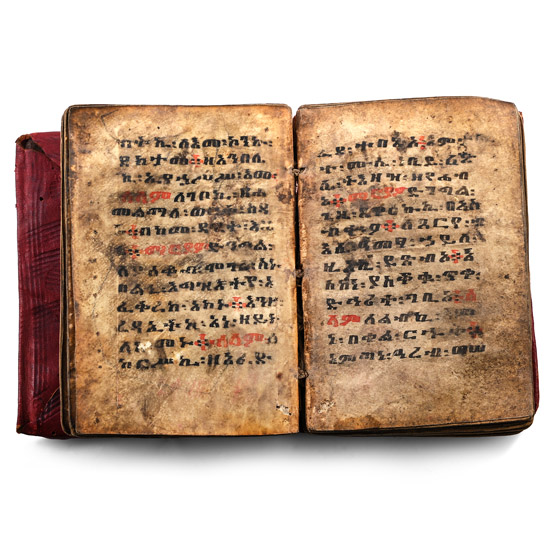
Ethiopian Leather Bound Vellum Manuscript
19th century A.D.Sold for (Inc. bp): £312
Hand-bound vellum gathering with cotton cords; approximately 60 leaves, each with thirteen lines of Ge'ez script to both faces in black ink with red punctuation and emphasis; inked knotwork panel, guilloche and other decorations; thin red leather cover on hide boards with punched cruciform pattern to outer faces, lattice to inner faces; spine separated from gathering, some wormholes. 134 grams, 10.1 x 7.3 cm
From an English private collection, 1980s. Property of a London, UK, antiquarian. -
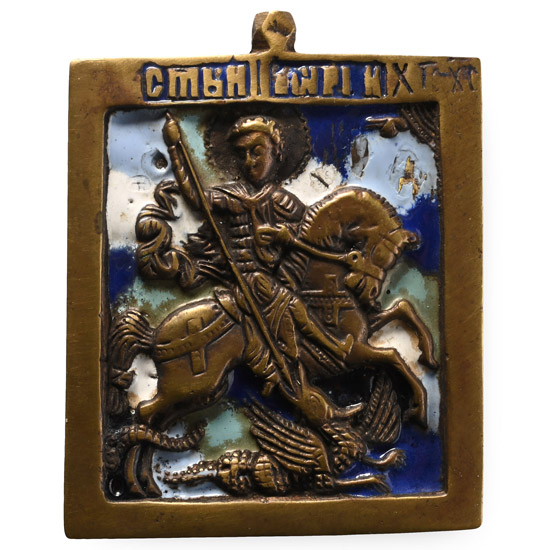
Russian Orthodox Enamelled Bronze Travel Icon with Saint George
19th century A.D.Sold for (Inc. bp): £98
Saint George on horseback, dispatching the dragon with a spear; the saint dressed in lamellar Roman cuirass and seated on a high-ended saddle secured by breast, rump, and belly straps; Old Slavic inscription on the top, reciting Saint George (Свято́й Гео́ргий ). 90 grams, 65 mm
Acquired from Chris Martin-Zakheim, Iconastas, 5 Piccadilly Arcade, London SW1. From the private collection of a West London, UK, gentleman, formed since the early 2000s.
According to the Christian tradition, Saint George would have lived between the end of the 3rd century and the beginning of the 4th century: born into a noble Christian family, he became an officer in the Roman army and was then named a praetorian by Diocletian. But when the same emperor decided to resume the persecutions, Saint George became a victim despite his important political rank. His role in the development of the faith is so important that he is included among the Great Martyrs of the Eastern Church and his fight against the dragon becomes a symbol par excellence of the fight for good which defeats evil. -
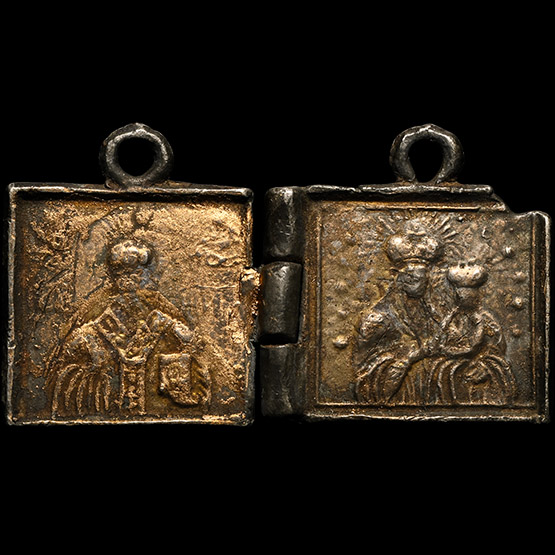
Russian Orthodox Pewter Travelling Icon
Circa 19th century A.D.Sold for (Inc. bp): £20
A folding diptych with suspension loops, the outer faces with an Orthodox cross and a robed figure holding a long staff; the inner faces with a similar robed figure on the left and Mary holding the infant Jesus on the right. 14.73 grams, 55 mm
From a retired Lincolnshire, UK, gentleman's collection, a long-time member of the Pewter Society. -
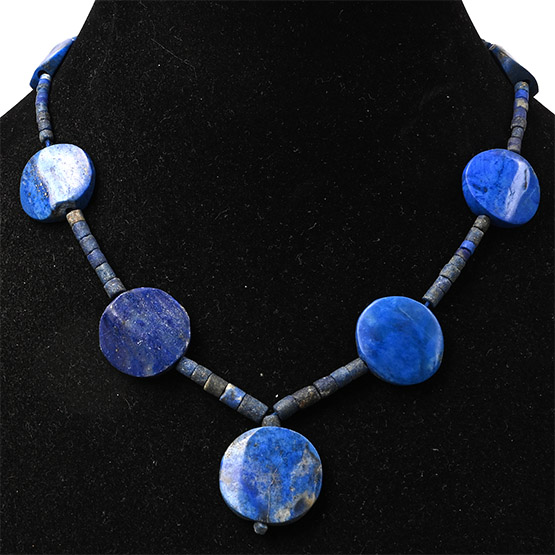
Western Asiatic Style Lapis Lazuli Bead Necklace String
20th century A.D.Sold for (Inc. bp): £72
Composed of large coin-shaped feature beads interspersed with cylindrical beads; restrung. 37 grams, 33 cm
Ex London, UK, art market 1990s. -
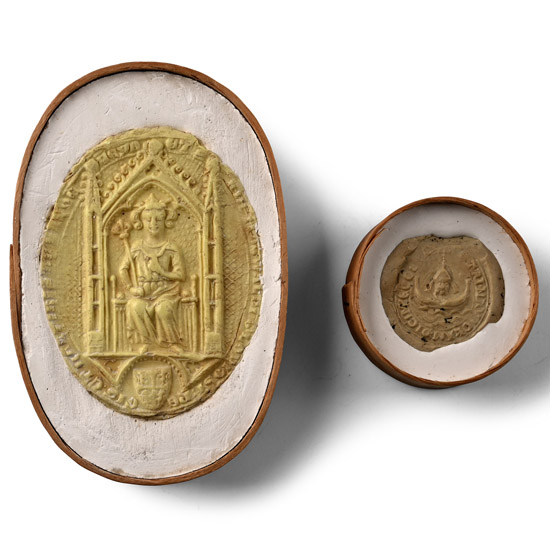
Seal Matrix Casting Group
19th century A.D.Sold for (Inc. bp): £20
Comprising: two castings from moulds taken from a medieval seal, possibly of Edward I, set in plaster in a wooden frame: the smaller with a facing mask in a boat surmounted by a cross, the larger with a seated figure holding orb and sceptre within a lancet arch with a heater shield below. 165 grams total, 34-79 mm
From the collection of a West London, UK, collector. -
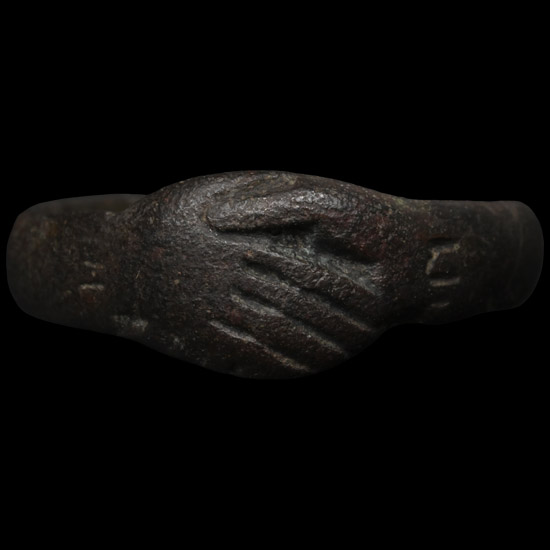
Tudor Bronze Ring with Clasped Hands
16th-17th century A.D.Sold for (Inc. bp): £286
D-section hoop with the bezel formed as clasped hands. 2.39 grams, 19.63 mm overall, 16.40 mm internal diameter (approximate size British K, USA 5 1/4, Europe 9.95, Japan 9)
Ex German art market, 2000s. Acquired from an EU collector living in London. From the collection of a Surrey, UK, gentleman. -
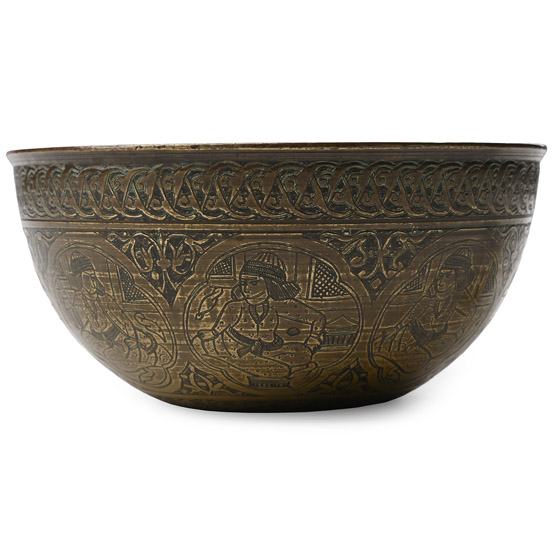
Indian Engraved Brass Bowl
20th century A.D.Sold for (Inc. bp): £7
With tendrils below the rim and quatrefoil panels with seated figures. 195 grams, 11.9 cm wide
Acquired by the vendor's father on the UK art market before 1990. Acquired on the UK art market. -
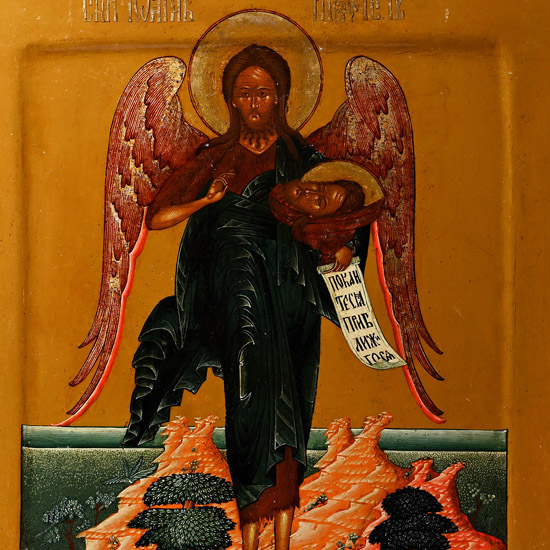
Russian Wooden Icon with St John the Baptist
19th century A.D.Sold for (Inc. bp): £1,430
Comprising a painted board with mounting panel and slots to the reverse, gessoed surface with painting of St John the Baptist standing nimbate with wings spread behind him, left hand supporting a bowl containing his severed head and holding an unfurled scroll with Cyrillic text 'Repent ye, for the Kingdom of Heaven is at hand,' (Matthew 3:2); right hand raised in blessing; landscape with sand-dunes and trees; gilded title above; the upper border with gilt Slavonic inscription reading 'Holy John the Forerunner'; from the Palekh Icon School, probably made in Mstera circa 1890. 1.02 kg, 31 cm high
Fine condition.
Ex property of a London lady, part of her family's collection. This lot has been checked against the Interpol Database of stolen works of art and is accompanied by a search certificate no.11546-196366.
The Palekh icon school emerged in the 17th century, inspired by the Moscow and Suzdal traditions of icon painting. Although preserving many features of traditional Russian iconography, the school created its own style that remained active into the 18th century. The hallmarks of the school include the frequent use of gold on the clothes of the saints and a rich palette. Bodies are shown as tall and slender and abrupt transitions between light and shadow are distinctive features of Palekh icons. The wings of Saint John derive from the double meaning of the Greek word used to describe him in Mark 1:2 - Angelos, meaning both messenger and angel. John is often called a 'Heavenly Man' and 'Earthly Angel' in Orthodoxy. At his feet is shown a small tree with an axe cutting into it, illustrating Luke 3:9, 'And now also the axe is laid unto the root of the tree...' -
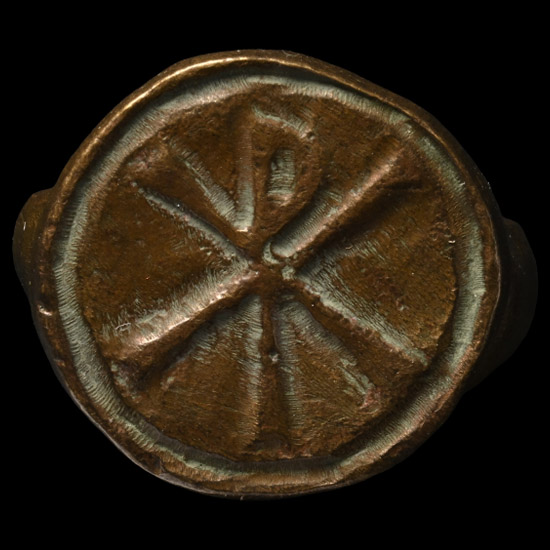
Post Medieval Bronze Christogram Ring
19th-early 20th century A.D.Sold for (Inc. bp): £78
With facetted, D-section shank, disc bezel with low-relief chi-rho Christogram. 14.17 grams, 26.69 mm overall, 20.08 x 20.77 mm internal diameter (approximate size British U 1/2, USA 10 1/4, Europe 23.15, Japan 22)
From an important artefact collection, North London, UK. -
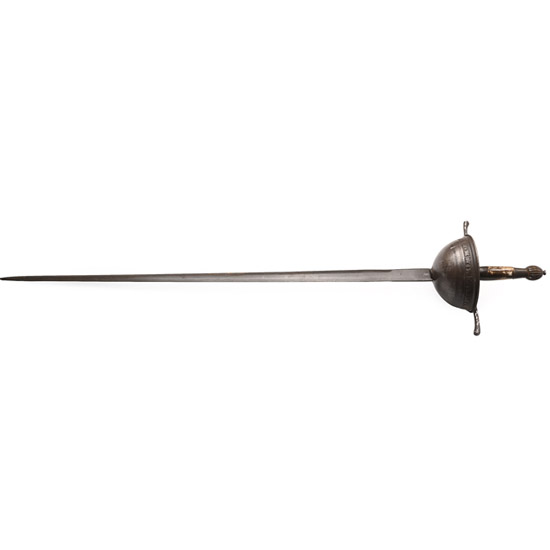
Iron Rapier Sword Reproduction
20th century A.D.Sold for (Inc. bp): £65
Comprising a narrow triangular blade with ricasso; cup with band of foliage ornament below the everted rim; slightly S-curved quillons with finger-ring; barrel grip with ribbed pommel. 1.09 kg, 105 cm
From a private Tyneside collection, formed since the early 2000s. -
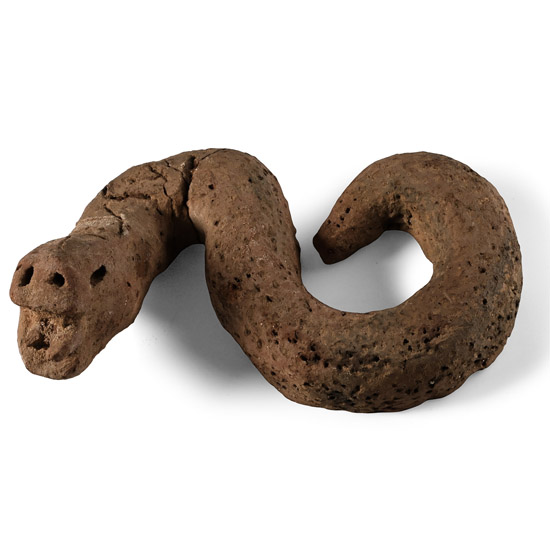
Egyptian Style Terracotta Snake
20th century A.D. or earlierSold for (Inc. bp): £59
With D-section body and S-curved coils, head raised and mouth gaping to reveal a forked tongue; repaired. 456 grams, 18 cm
Acquired 1970s-1996. Property of a North American collector. London collection, 2016. -
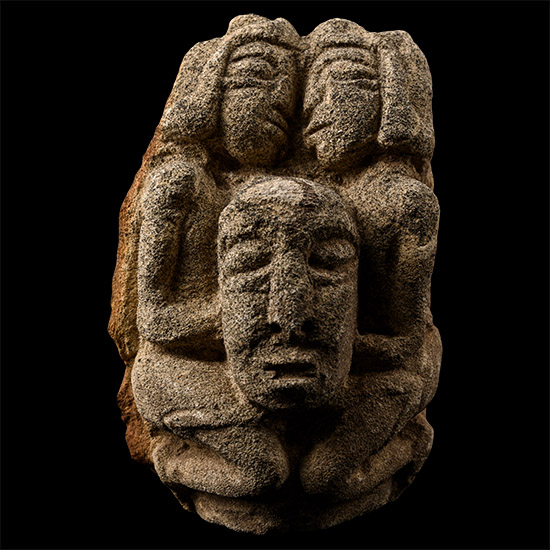
Stone Figural Carving
20th century A.D.Sold for (Inc. bp): £105
A high-relief carving of two kneeling figures dressed in loincloth, holding a large bald head; each with wide almond-shaped eyes, wide mouth and flat nose. 923 grams, 15.2 cm
From a collection acquired on the UK art market from various auction houses and collections mostly before 2000. From an important Cambridgeshire estate; thence by descent. Private collection, London, UK.

