-
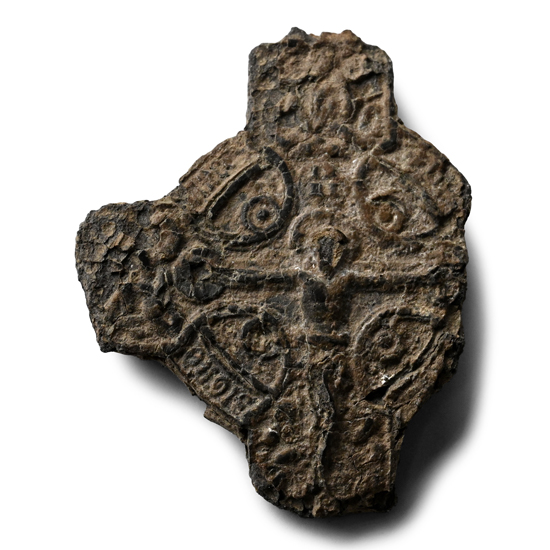
Tudor Period Pewter Pilgrim's Pendant with Bishop
16th-17th century A.D.Sold for (Inc. bp): £46
Bifacial low-relief design; obverse: Corpus Christi amid scrolls on foliate cross; reverse: nimbate bishop in three-quarter view with crozier, legend to the circular band. 6 grams, 33 mm
From a retired Lincolnshire, UK, gentleman's collection, a long time member of the Pewter Society. -
.jpg)
Large Renaissance Stone Statue of Standing Male
Northern Italy, 16th-17th century A.D.Sold for (Inc. bp): £1,300
Modelled in the round wearing a long tunic and a palla draped over his left shoulder, leather sandals with straps on his exposed feet. 87 kg, 100 cm
Private collection, France. Private collection, London. This lot has been checked against the Interpol Database of stolen works of art and is accompanied by search certificate number no.13083-246798.
The statue, certainly intended for ecclesiastical decoration, most likely represents one of the apostles or prophets, or an Evangelist. These are Mannerist statues, executed with great sculptural skill, intended to adorn the large tomb complexes of wealthy families housed in the Catholic cathedrals of Renaissance Europe. -
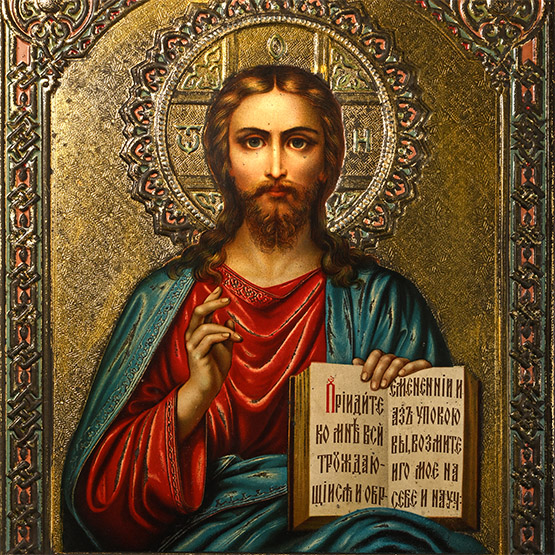
Russian Orthodox Icon with Christ Pantocrator
19th century A.D.Sold for (Inc. bp): £52
On a wooden board with elaborate riza, nimbate Christ shown facing and holding an open book on his lap, the right hand raised and making the sign of blessing; by Jacob & Co in Moscow; printing to the lower edge of the brass panel states "PRINTING IS APPROVED BY THE MOSCOW RELIGIOUS COMMITTEE DECEMBER 6 DAY 1896 YEAR. CENSOR ARCHPRIEST ALEXANDER SMIRNOV. A JACOB&C MOSCOW." 436 grams, 26.3 x 22 cm
Acquired from Derby Antiques Fair, 2004. Ian Wilkinson collection, Nottinghamshire, UK, formed since 1985. -
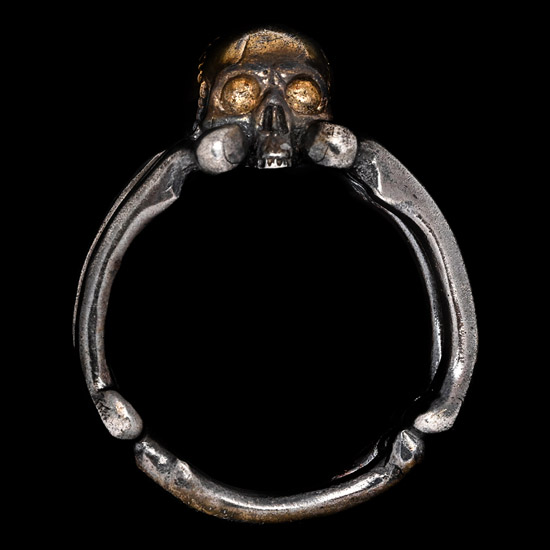
Victorian Silver Memento Mori Ring with Skull and Crosses Bones
Late 19th-early 20th century A.D.Sold for (Inc. bp): £416
The hoop formed as two parallel sets of long bones set end-to-end; hollow-formed gilded bezel of a skull. 9.15 grams, 31.27 mm overall, 20.77 mm internal diameter (approximate size British T, USA 9 1/2, Europe 21.26, Japan 20)
Acquired from a Staffordshire, UK, antiques fair. Ex Buckinghamshire, UK, collection. -
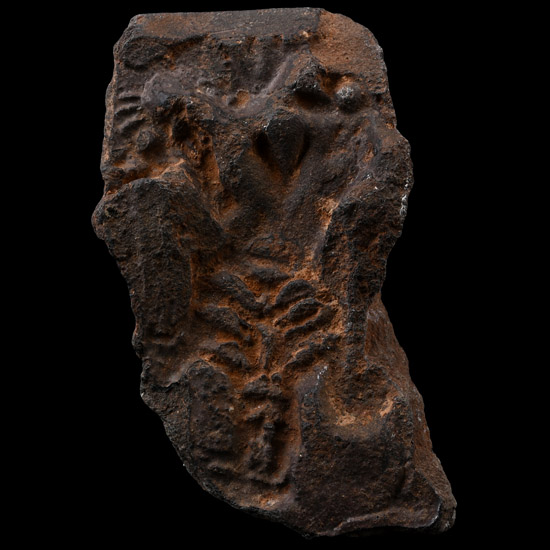
Post Medieval Pottery Sherd with Christ
Circa 16th-17th century A.D.Sold for (Inc. bp): £7
Rim fragment with high-relief Corpus Christi. 54 grams, 85.11 mm
From the private collection of a European gentleman (1942-2024), formed since the 1970s. -
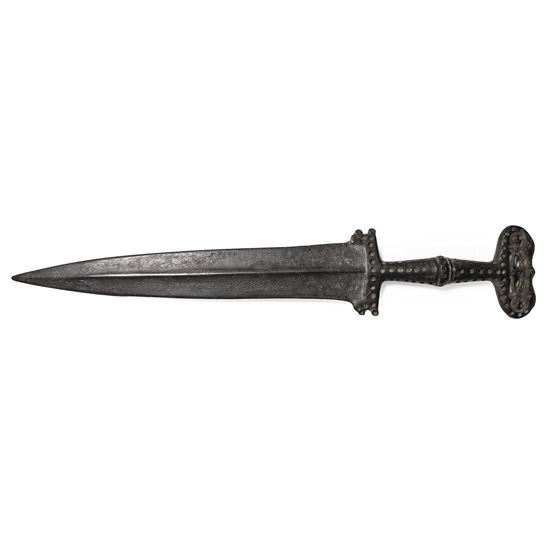
Ancient Style Bronze Dagger
20th century A.D.Sold for (Inc. bp): £52
Comprising a triangular blade with a raised midrib, a biconical handle with pellet decoration, and an openwork pommel. 301 grams, 31.5 cm
Acquired London Coin Fair. From a Buckinghamshire private collection. This item is for collection from our premises only. -
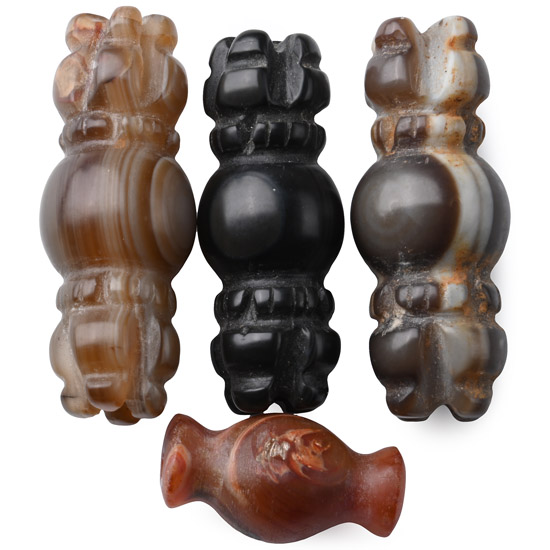
Tibetan Carved Agate Amuletic Bead Group
20th century A.D. or earlierSold for (Inc. bp): £26
Comprising three agate beads formed as the vajra, and one red agate collared globular bead. 39.15 grams total, 24-41 mm
Ex UK gallery, early 2000s. Property of a West Northamptonshire, UK, gentleman. -
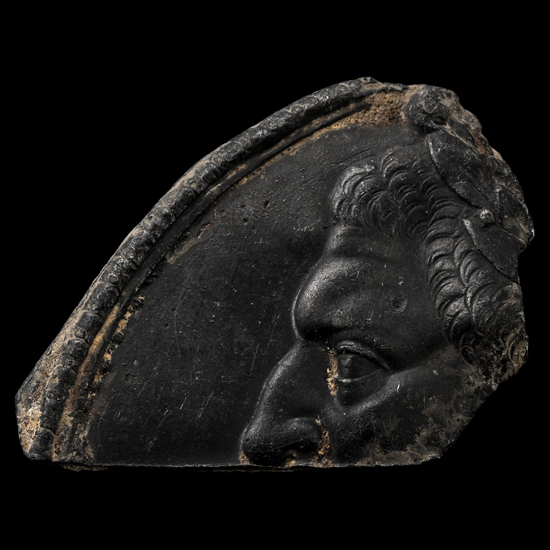
Renaissance Lead Vitellius Roundel Fragment
16th century A.D.Sold for (Inc. bp): £65
With a rounded and stepped rim; wreath, forehead, nose and eye. 19.69 grams, 57.11 mm
From the private collection of a European gentleman (1942-2024), formed since the 1970s. -
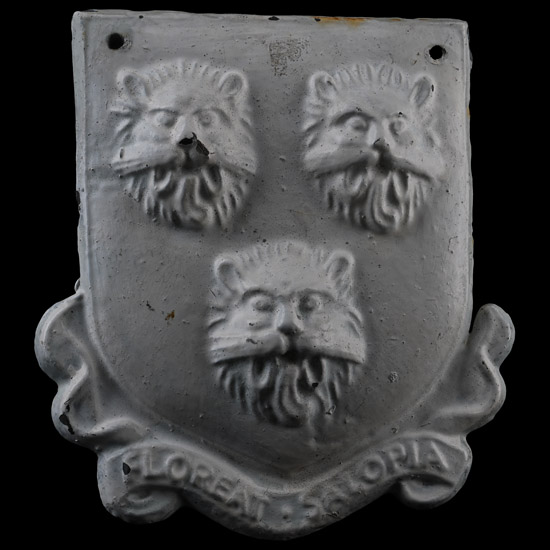
Arms of Shrewsbury Heraldic Architectural Mount
20th century A.D.Sold for (Inc. bp): £13
Heater-shaped shield in iron-alloy with three leopard heads, banner below reading 'FLOREAT SALOPIA', 795 grams, 16.5 cm
Acquired on the UK art market pre 2000. Property of Nottinghamshire, UK, gentleman. -
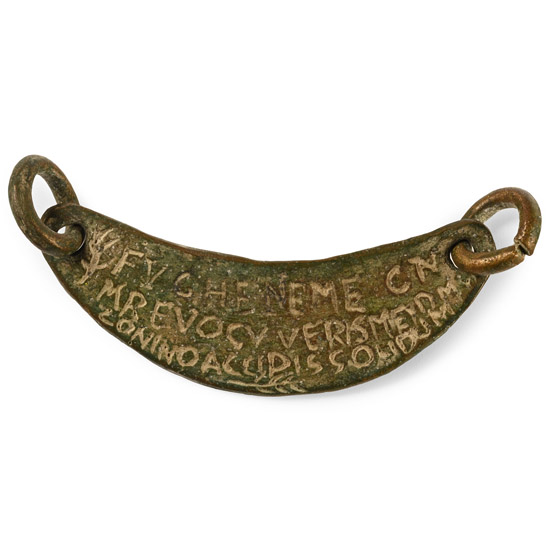
Roman Style Bronze Dedicatory Plaque
20th century A.D.Sold for (Inc. bp): £7
Crescent-shaped plaque pierced at each end to accept a mounting ring: enigmatic inscription in three lines following the curve of the edges, in capitals: 'fvcheme cn / mrevocv verismeidm / zonino accidis solidunt'. 12.4 grams, 54 mm
From a collection acquired on the UK art market from various auction houses and collections mostly before 2000. From an important Cambridgeshire estate; thence by descent. -
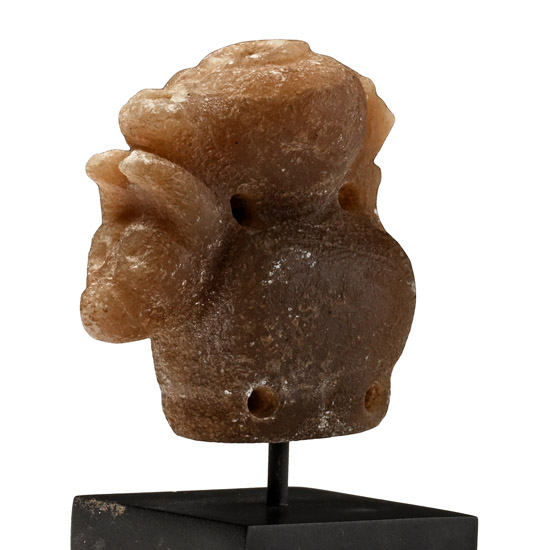
Western Asiatic Style Stone Bull Statue
20th century A.D. or earlierSold for (Inc. bp): £26
Carved in the round figure of a bull supporting an oil lamp on its back pierced for suspension; mounted on a custom-made stand. 47 grams total, 55 mm including stand
Acquired 1970s-1996. Property of a North American collector. London collection, 2016. -
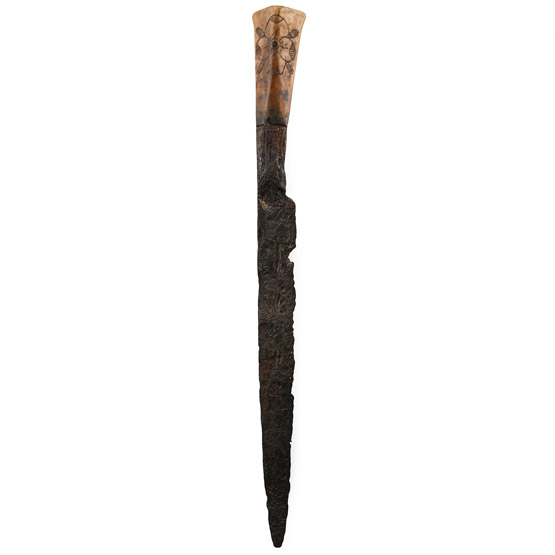
Stuart Period Iron Knife with Decorated Bone Handle
17th century A.D.Sold for (Inc. bp): £111
Slender single-edged iron blade with socket, lozenge-section bone handle with incised quatrefoil motifs. 31.8 grams, 19.8 cm
Acquired on the UK art market before 2000. Property of an Essex, UK, gentleman.

