-
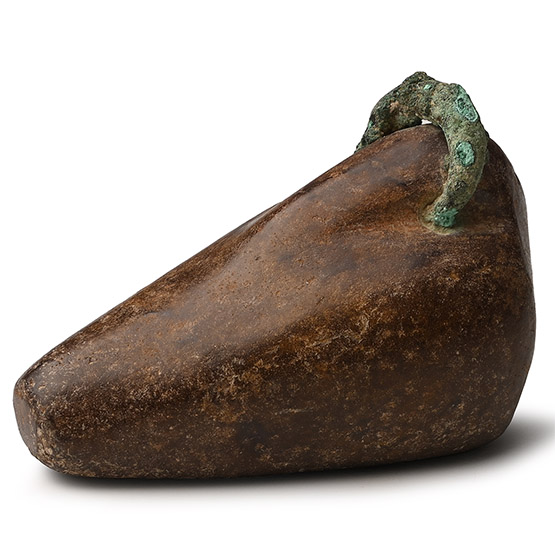
Neo-Babylonian Stone Duck Weight with Loop
Circa 700-600 B.C.Sold for (Inc. bp): £650
Carved in the round as a duck with its head laid back along its spine; pierced and set with a bronze suspension loop. 153 grams, 68 mm
Private collection, USA and Switzerland, acquired in 1994; thence by descent. -
.jpg)
Neo-Babylonian Black Stone Duck Weight with Cuneiform Inscription
Circa 600-500 B.C.Sold for (Inc. bp): £1,300
Carved in the round as a duck with its head laid back along its spine; pierced and inscribed on one flank. 9.30 grams, 27 mm
UK private collection before 2000. Acquired on the UK art market. Private collection, London, UK. -
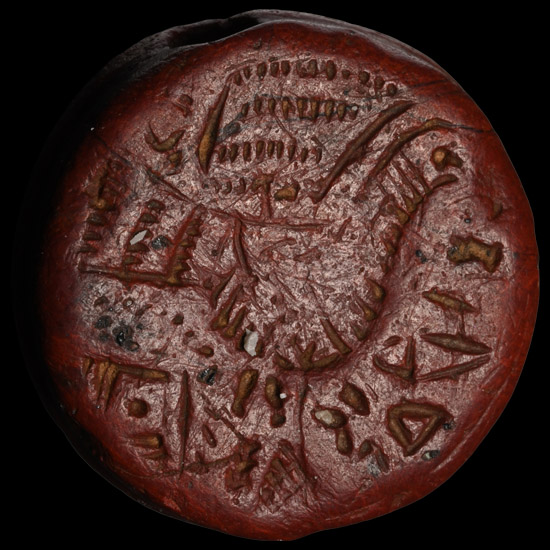
Hittite Red Jasper Stamp Seal with Bird
Circa 1500-1300 B.C.Sold for (Inc. bp): £117
Domed seal with transverse piercing, upper face with a floral border and schematic motifs, underside with a standing bird with an inscription(?) below; supplied with a museum-quality impression. 12.8 grams, 24 mm
From an English private collection, 1980s. Property of a London, UK, antiquarian. -
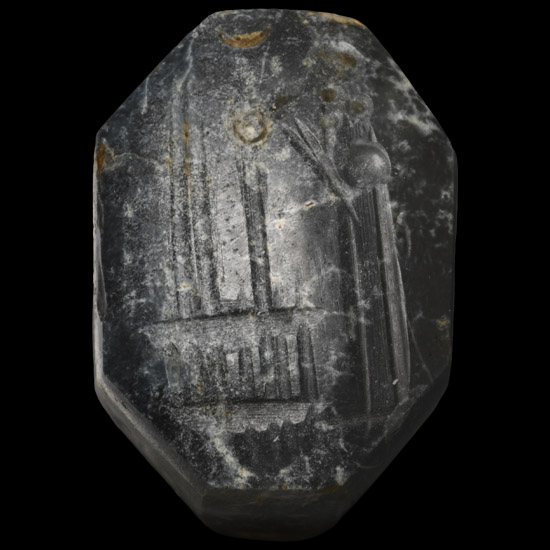
Large Neo-Babylonian Chalcedony Stamp Seal with King
Circa 7th-6th century B.C.Sold for (Inc. bp): £260
Standing robed figure in profile with hands raised towards a stepped dais with vertical stems. 22.04 grams, 31.72 mm
From the private collection of a European gentleman (1942-2024), formed since the 1970s. -
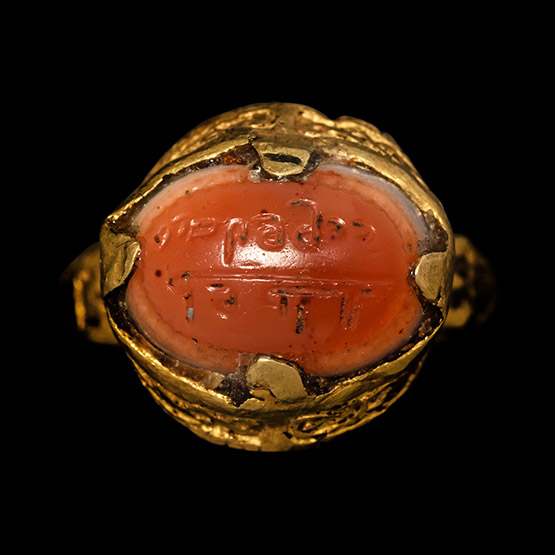
Western Asiatic Gold Ring with Inscribed Sardonyx Gemstone
10th-12th century A.D.Sold for (Inc. bp): £2,340
With stepped shoulders supporting a cell bezel with a claw setting. 7.33 grams, 27.65 mm overall, 13.76 x 14.32 mm internal diameter (approximate size British E 1/2, USA 2 1/2, Europe 3, Japan 3)
Private collection, acquired on the German art market in 1993; thence by descent. This lot has been checked against the Interpol Database of stolen works of art and is accompanied by search certificate number no.13183-249300.
Rings from the 9th-13th centuries represent a variety of artistic achievements; the techniques were elaborate, and the rings show rich decoration. The rings were set with cabochons, table-cut oval or rectangular stones such as turquoise, rubies, garnets or other precious stones. The Arabic inscription, engraved with early Kufic characters, contains the expression “AL__LLH”, which could be interpreted as “il-la-lah”, i.e. “For/to Allah”. -
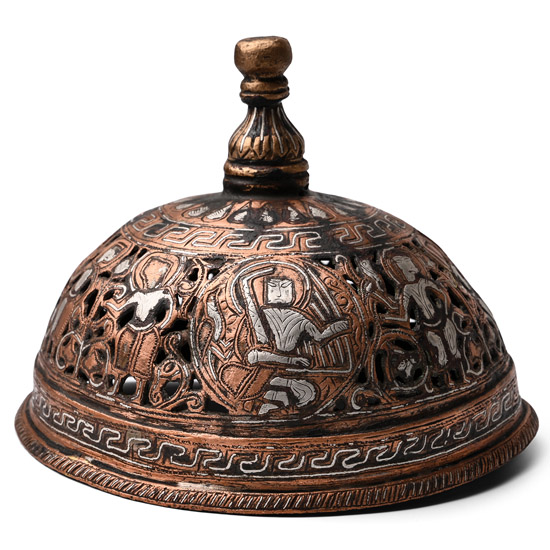
Seljuk Bronze Incense Burner with Silver Inlays
12th century A.D. or laterSold for (Inc. bp): £819
Domed openwork cover with inlays, the knop surrounded by a band of inlaid leaves, a band of Greek key motifs below and above the basal rim enclosing a series of figures in dynamic poses, three of the figures enclosed within a medallion and depicting a seated male with crossed legs and a bird on his right side. 345 grams, 14 cm
with a London, UK gallery 1971-early 2000s. -
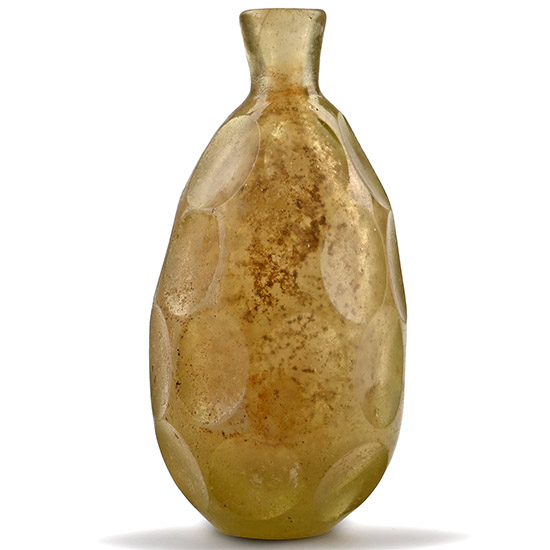
Sasanian Cut-Glass Vessel
3rd-7th century A.D.Sold for (Inc. bp): £819
With a piriform body with three rows of cut facets or dimples and a slender flared neck. 103 grams, 91 mm
Private collection, 1990s-early 2000s. -
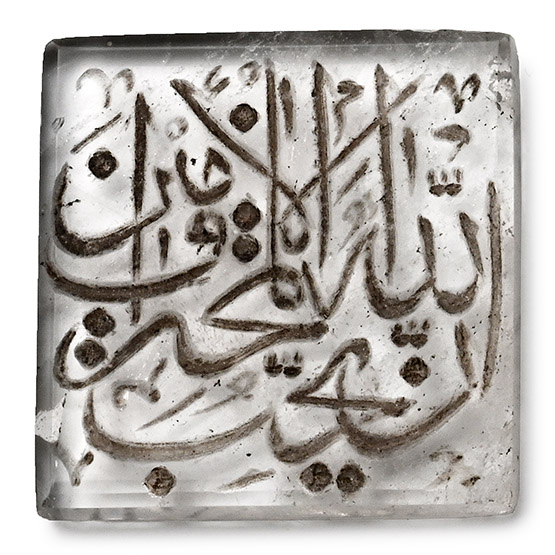
Western Asiatic Rock Crystal Gemstone
Safavid Dynasty, 1501-1722 A.D.Sold for (Inc. bp): £1,300
Square in plan with finely engraved Nastaliq calligraphic text. 2.75 grams, 20 mm
Private collection, Germany. Anonymous sale, Agora Numismatik, Woerden, Netherlands, 2015, no.333. Private collection, Europe. -
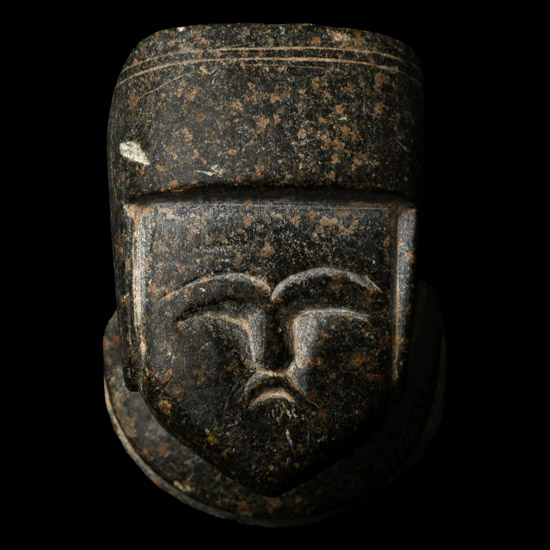
Seljuk Carved Stone Head of a Prince
12th century A.D.Sold for (Inc. bp): £338
Comprising a shield-shaped finial with a stylised human head wearing a tall headdress with a double-band at the top, U-shaped neck with a crescentic plaque; accompanied by a custom-made display stand. 50.5 grams, 60 mm
with a London, UK gallery 1971-early 2000s. -
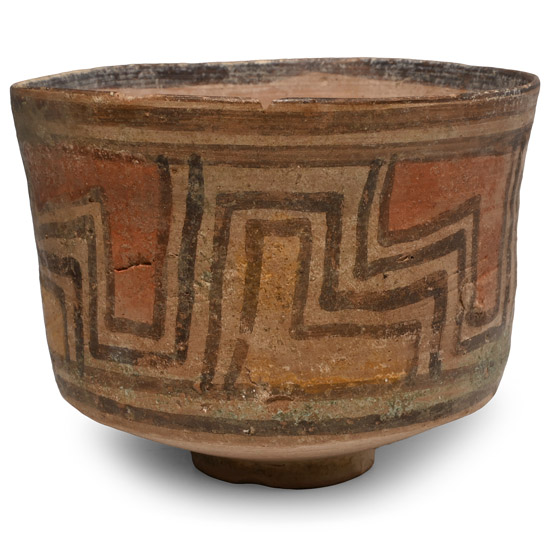
Indus Valley Painted Geometric Pottery Bowl
3rd millennium B.C.Sold for (Inc. bp): £416
Drum-shaped with gently carinated base and narrow foot, the outer body displaying polychrome painted L-shaped panels. 130 grams, 95 mm
with Balakh Carpets, 2003. Private collection, Europe. -
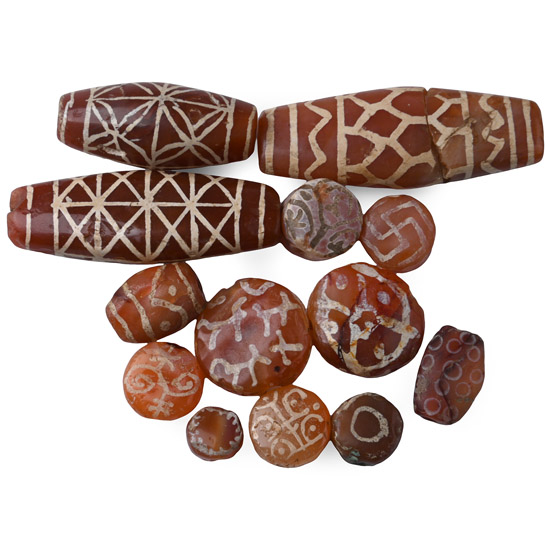
Large Indus Valley Etched Orange Carnelian Necklace Bead Collection
Circa 2nd millennium B.C.Sold for (Inc. bp): £624
Comprising: a barrel-shaped bead with floral decoration, two flattened barrel-shaped beads with geometric motifs, one discoid bead with crux gammata, and other beads with geometric decoration. 61.03 grams total, 9.84-49.06 mm
From the private collection of a European gentleman (1942-2024), formed since the 1970s.
Etched carnelian beads are characteristic of the Indus Valley culture and have been produced since the third millennium B.C. They are a typical product of the Harappa culture, but they are also attested in later millennia and produced elsewhere in Southeast Asia. The oldest specimens come from the Indus Valley and from Mesopotamia. A few specimens were found in the so-called royal cemetery of Ur, where they were identified in the excavation publication as coming from India. -
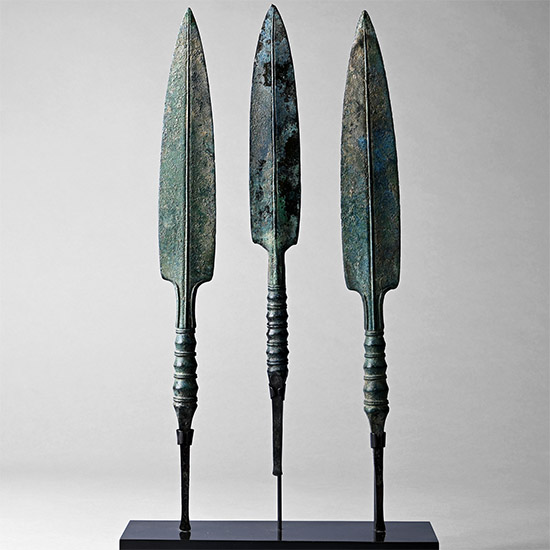
Luristan Bronze Spearhead Collection
Circa 1000-700 B.C.Sold for (Inc. bp): £6,500
Group of three tanged spearheads, each with a slender leaf-shaped two-edged blade and midrib, tiered ribbing to the neck, square-section tang with chisel tip; mounted on a custom-made stand. 1.65 kg total, blades: 34.5-38.6 cm
Ex London, UK, gallery, 1971-early 2000s. London, UK, collection. This lot has been checked against the Interpol Database of stolen works of art and is accompanied by search certificate number no.13245-252972.
Spearheads of this kind were realised by mould casting. They were of different lengths and used by Luristan, Hamadan, early Median and Achaemenid warriors.

