-
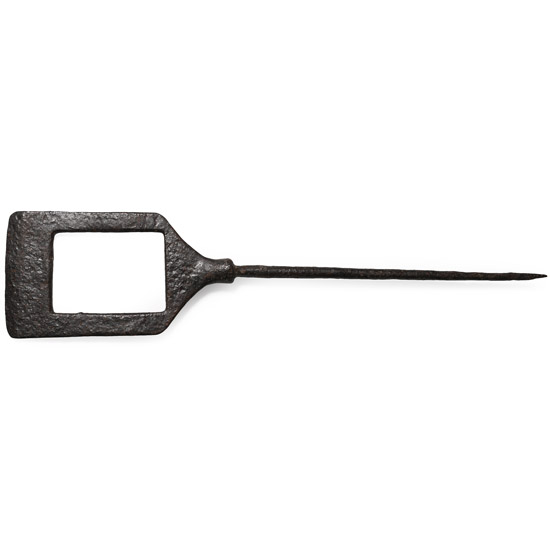
Very Large Medieval Tanged Iron Incendiary Fire Arrowhead
Circa 13th-15th century A.D.Sold for (Inc. bp): £247
An openwork rectangular blade with a long tapering tang. 70 grams, 23 cm
Acquired USA in the 1990s. From a Buckinghamshire private collection. -
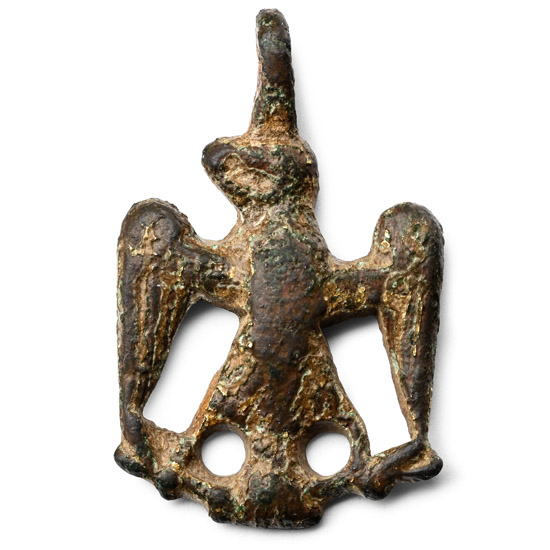
Medieval Knight's Eagle Gilt Bronze Heraldic Horse Harness Pendant
Circa 14th-15th century A.D.Sold for (Inc. bp): £85
An openwork pendant formed as a splayed eagle gripping a thunderbolt(?) in its talons. 4.85 grams, 30 mm
Acquired on the UK art market from the 1990s. From the private collection of a Lincolnshire, UK, gentleman. -
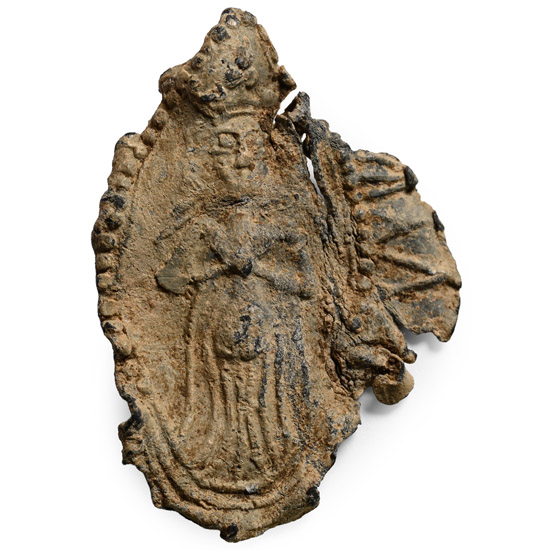
Medieval Pewter Thomas Beckett Pilgrim's Badge
Circa 14th-15th century A.D.Sold for (Inc. bp): £130
Vesica-shaped frame enclosing a standing figure of Becket wearing a mitre, with hands clasped in prayer. 3.03 grams, 28 mm
From a retired Lincolnshire, UK, gentleman's collection, a long time member of the Pewter Society. -
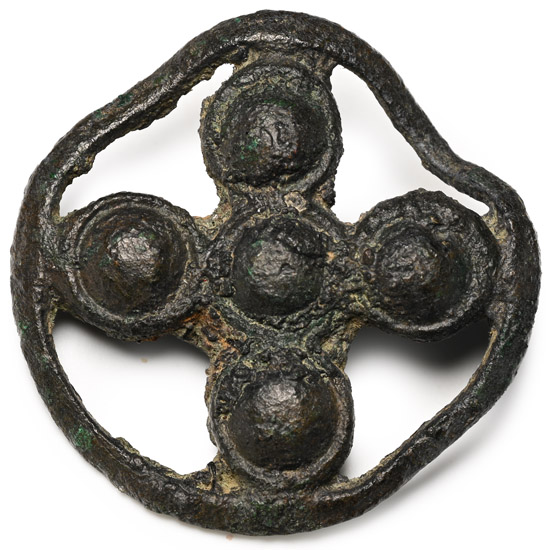
Medieval Pewter Five Pellet Cross Pilgrim's Badge
Circa 14th-15th century A.D.Sold for (Inc. bp): £26
Cluster (quincunx) of five bosses in cells connected by an outer ring; stud to reverse. 9.44 grams, 28 mm
From a retired Lincolnshire, UK, gentleman's collection, a long time member of the Pewter Society. -
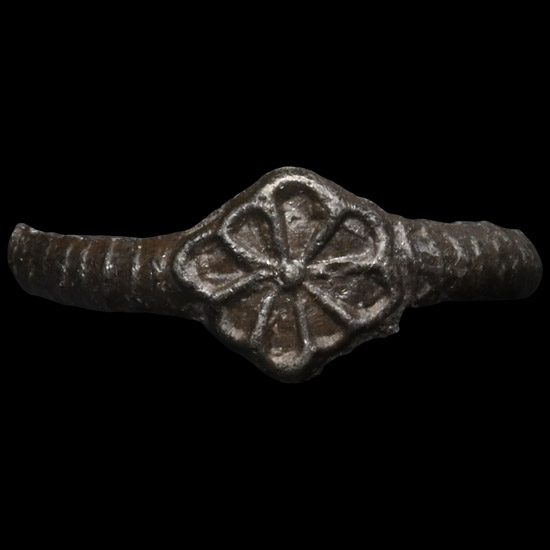
Medieval Pewter Ring
Circa 15th-16th century A.D.Sold for (Inc. bp): £33
Comprising a slender hoop with ribbed shoulders, the bezel a four-petalled flower. 0.71 grams, 18.49 mm overall, 16.62 mm internal diameter (approximate size British J 1/2, USA 5, Europe 9.32, Japan 9)
From a retired Lincolnshire, UK, gentleman's collection, a long time member of the Pewter Society. -
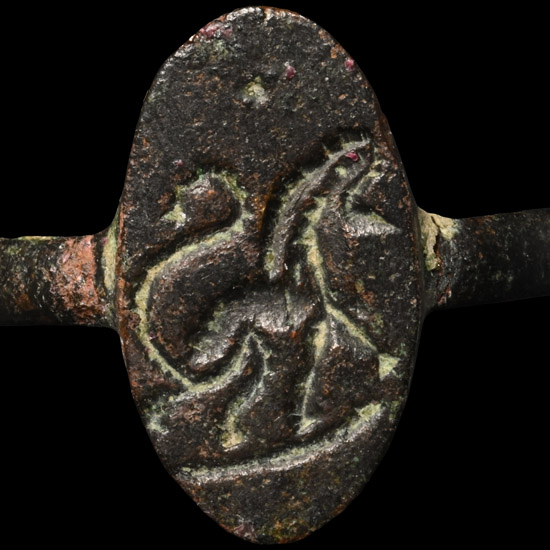
Medieval Bronze Ring with Heraldic Lion
Circa 14th-15th century A.D.Sold for (Inc. bp): £72
Ellipsoid bezel with incuse advancing lion on a baseline, raised tail in 'S' configuration; accompanied by a museum-quality impression. 2.94 grams, 23.82 mm overall, 20.07 mm internal diameter (approximate size British T 1/2, USA 9 3/4, Europe 21.89, Japan 21)
From an old English collection, Bournemouth, UK. Ex Parthenon Gallery, London, UK, 2001. Property of a North London, UK, private collector.
The prominent curved tail may have been deliberately so formed to show the owner's initial 'S'. -
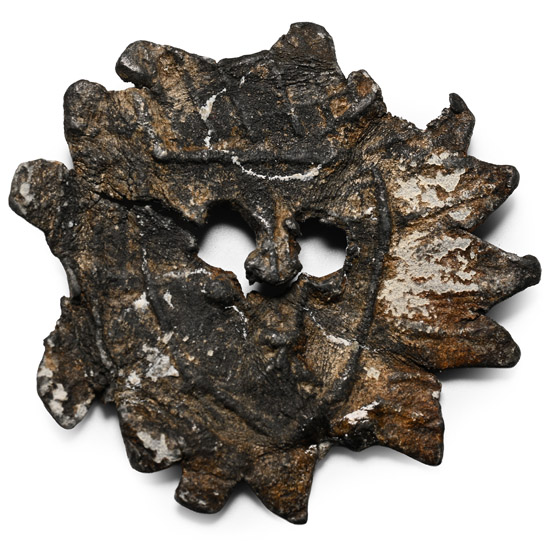
Medieval Pewter Pilgrim's Badge with Sun in Splendour
Circa 14th-15th century A.D.Sold for (Inc. bp): £13
Disc with radiating flames to the rim and face (Sun in Splendour); reverse with heater shield. 8.48 grams, 38 mm
From a retired Lincolnshire, UK, gentleman's collection, a long time member of the Pewter Society.
Bifacial badges are a rarity and it seems likely that this may have been a test-piece. -
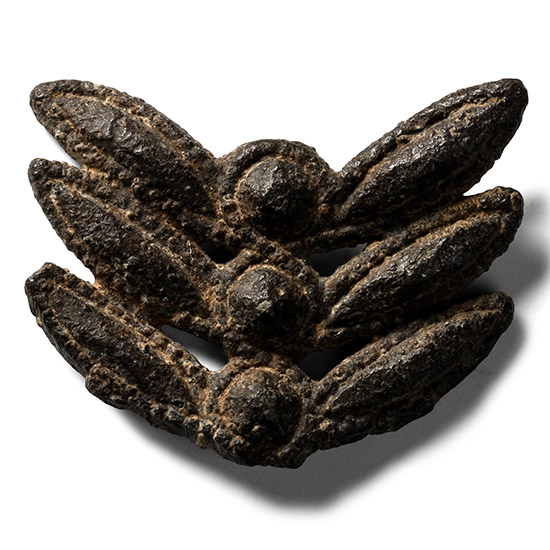
Medieval Lead Pilgrim's Badge with Plant
Circa 14th-15th century A.D.Sold for (Inc. bp): £46
Formed as a group of three sycamore keys, modelled in the round. 2.14 grams, 21 mm
From a retired Lincolnshire, UK, gentleman's collection, a long time member of the Pewter Society. -
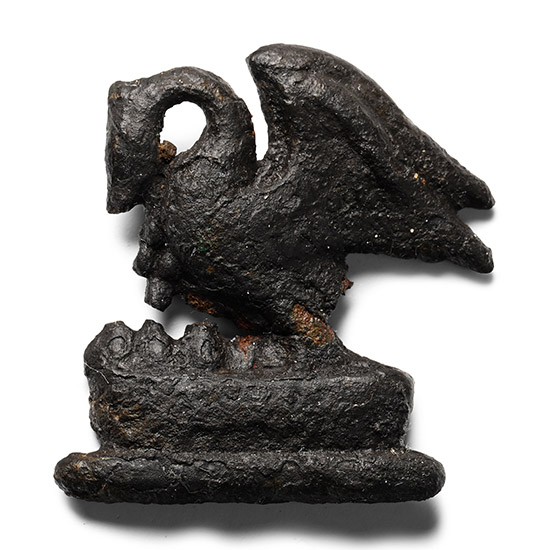
Medieval Pewter Pelican Badge
Circa 1400 A.D.Sold for (Inc. bp): £182
Modelled in the half-round, 'pelican in her piety' motif of a bird with one wing extended pecking her chest to release blood dripping into the beaks of her brood in their nest. 9.44 grams, 31 mm
From a retired Lincolnshire, UK, gentleman's collection, a long time member of the Pewter Society. -
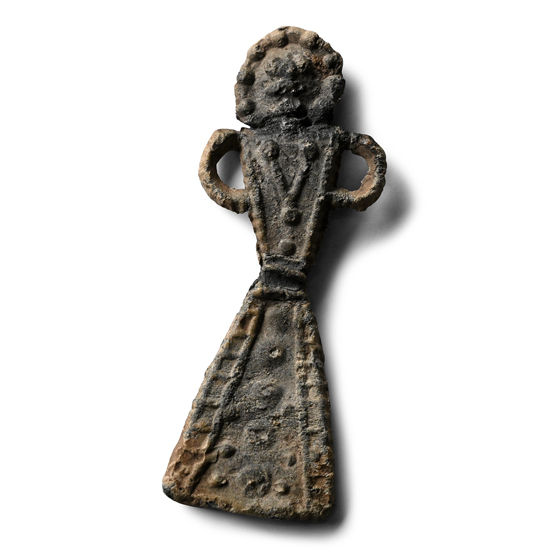
Medieval Pewter Pilgrim's Badge with St. Sitha
14th-15th century A.D.Sold for (Inc. bp): £85
Bifacial low-relief figure of a female in floor-length robe with line of bosses to the front, triangular panel to chest, stylised halo. 15.6 grams, 64 mm
From a retired Lincolnshire, UK, gentleman's collection, a long time member of the Pewter Society.
The Cult of St. Sitha (Italian 'Zita da Lucca') was celebrated at the church of St. Benet Sherehog in the City of London. -
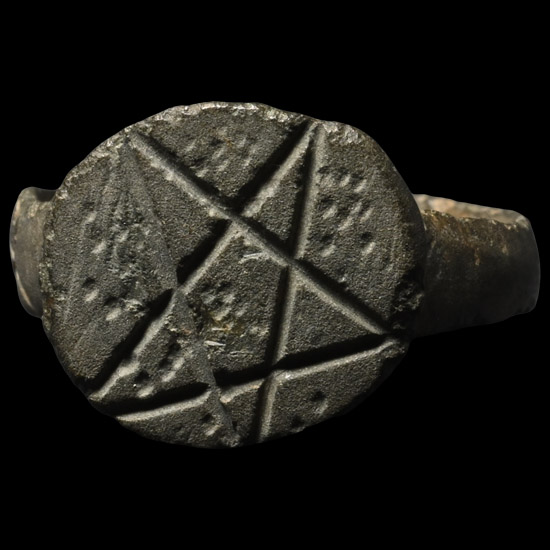
Medieval Bronze Ring with Pentagram
Circa 14th-15th century A.D.Sold for (Inc. bp): £111
The hoop with a sunburst motif on one side and a large oval bezel with a pentagram motif. 3.73 grams, 21.93 mm overall, 17.18 mm internal diameter (approximate size British M 1/2, USA 6 1/4, Europe 13.09, Japan 12)
Acquired on the UK art market from the 1990s. From the private collection of a Lincolnshire, UK, gentleman. -
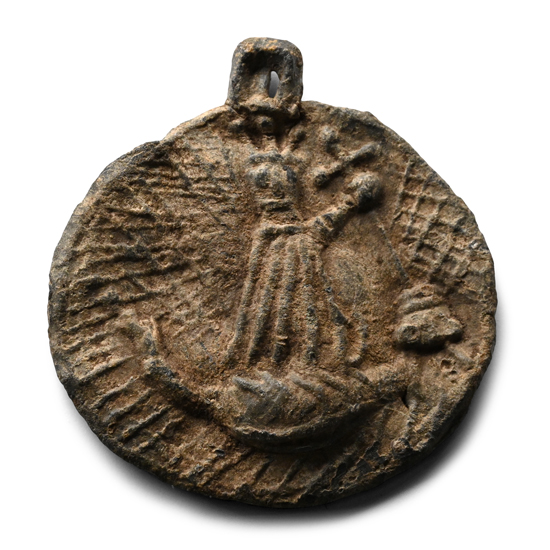
Medieval Lead Pilgrim's Pendant with Calvary and Dragon-Slaying
14th-15th century A.D.Sold for (Inc. bp): £85
Discoid in plan with bifacial low-relief imagery: Obverse - Calvary scene with Corpus Christi and flanking mourners; Reverse - hatched field with supine dragon, triumphant robed and crowned figure holding aloft a cross piercing the dragon's mouth. 5.63 grams, 28 mm
From a retired Lincolnshire, UK, gentleman's collection, a long time member of the Pewter Society.
The imagery may represent St George slaying the dragon, although he is usually pictured nimbate and on horseback. Alternatively, it may show Christ overcoming Satan in the form of a dragon in the Harrowing of Hell episode.

