-
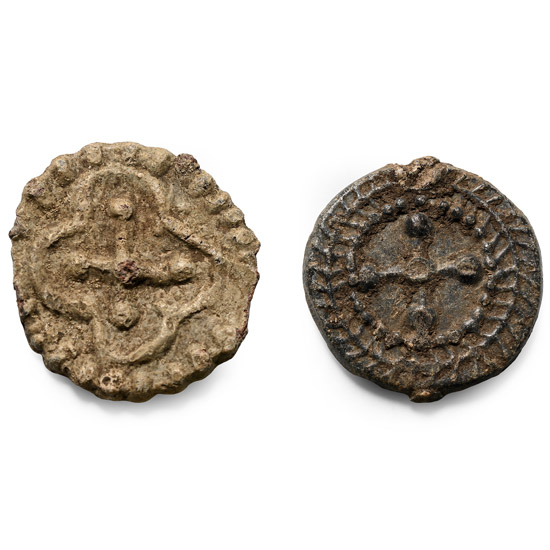
Medieval Pewter Pilgrim's Badge
Circa 14th-15th century A.D.Sold for (Inc. bp): £13
Comprising: disc with herringbone border, cross pommy to centre; disc with beaded border, voided cross with cross pommy to centre. 8.03 grams total, 19 - 21 mm
From a retired Lincolnshire, UK, gentleman's collection, a long time member of the Pewter Society. -
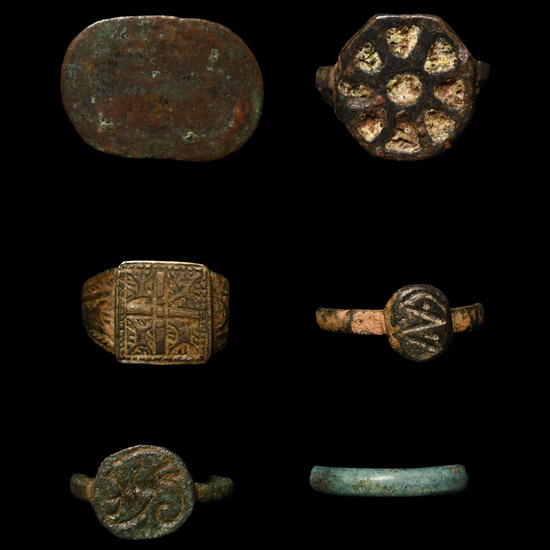
Medieval and Later Bronze Ring Collection
12th-18th century A.D.Sold for (Inc. bp): £117
Comprising six rings with various motifs, including one with a cross motif, one with remains of enamel, and one with a simple D-section band. 20 grams total, 17.7-23.2 mm
From the private collection of a European gentleman (1942-2024), formed since the 1970s. -
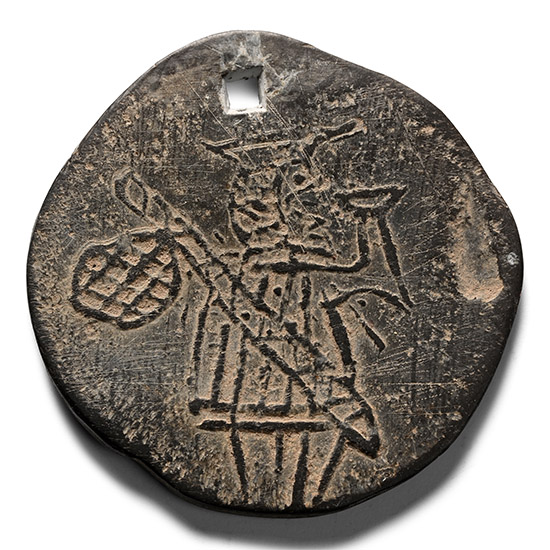
Medieval Lead Pilgrim's Badge
Circa 14th-15th century A.D.Sold for (Inc. bp): £234
Low-relief standing figure with staff and bundle, hatched detailing. 13.94 grams, 33 mm
From a retired Lincolnshire, UK, gentleman's collection, a long time member of the Pewter Society. -
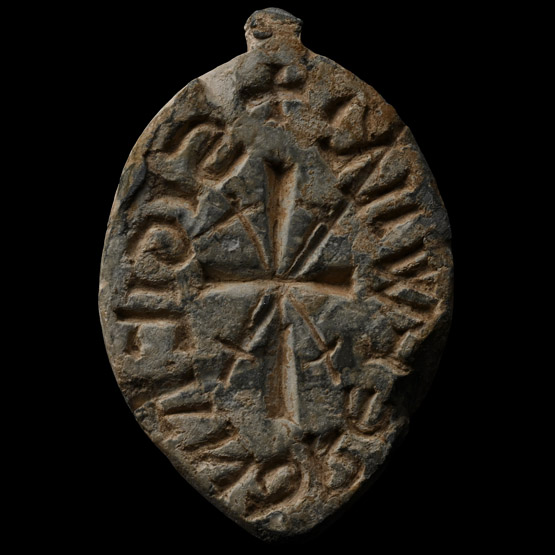
Large Medieval Lead Seal Matrix for Andrew, son of William
14th-15th century A.D.Sold for (Inc. bp): £39
Lentoid in plan with spur to the apex; obverse with cross and four swords, legend to border in Lombardic script '+ SIGIL’ ANDRE .F’ WILL’ (seal of Andrew [son of] Will[iam]). 59 grams total, 50 mm
Found Lincolnshire, UK. -
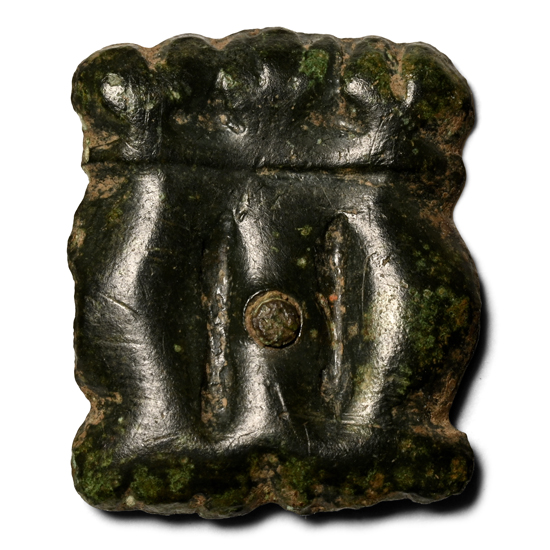
Medieval Bronze Belt Mount with 'M' for Maria
Circa 14th-15th century A.D.Sold for (Inc. bp): £13
Impressed plaque formed as a capital 'M' with crown above, mounting stud to centre. 1.15 grams, 17 mm
From a retired Lincolnshire, UK, gentleman's collection, a long time member of the Pewter Society. -
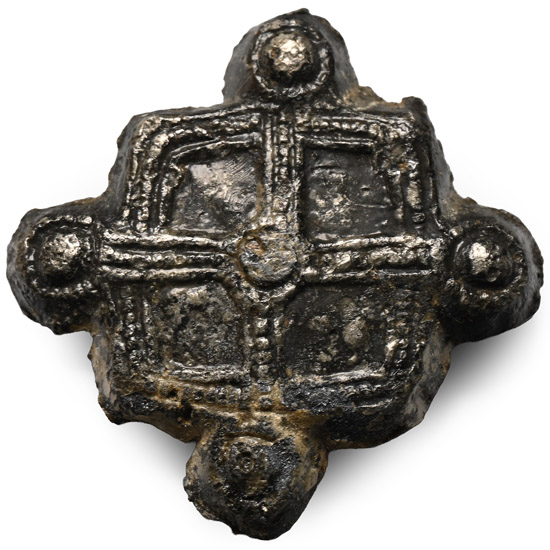
Medieval Pewter Pilgrim's Badge with Cross with Square Borders
Circa 14th-15th century A.D.Sold for (Inc. bp): £20
Lozengiform body with fret detailing, five bosses (for the five wounds of Christ); stud to reverse. 5.90 grams, 26 mm
From a retired Lincolnshire, UK, gentleman's collection, a long time member of the Pewter Society. -
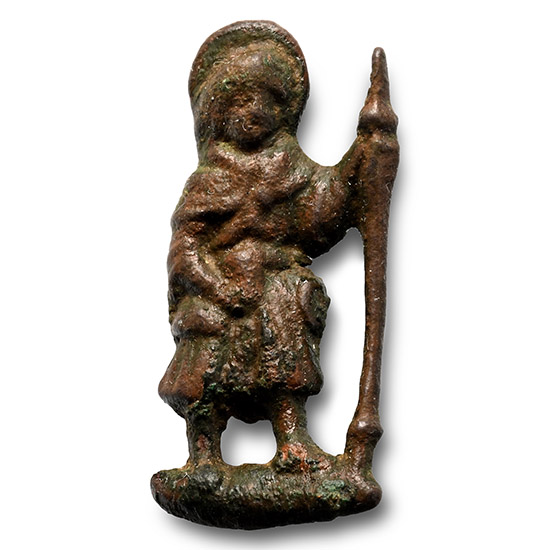
Medieval Pewter Pilgrim with Staff Pilgrim's Badge
Circa 14th-15th century A.D.Sold for (Inc. bp): £416
Modelled in the half-round, standing figure with staff and scrip. 3.84 grams, 30 mm
From a retired Lincolnshire, UK, gentleman's collection, a long time member of the Pewter Society. -
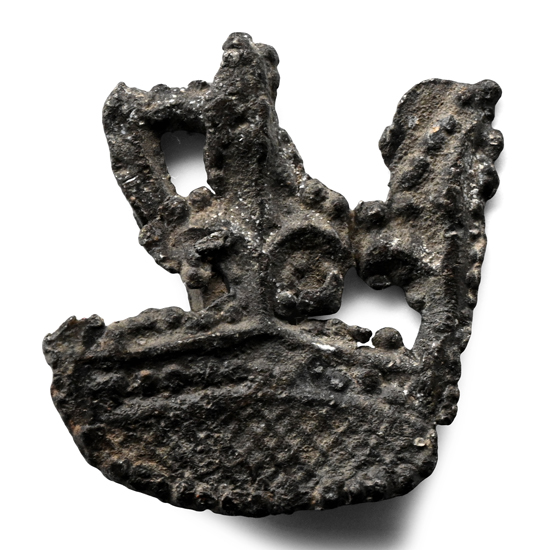
Medieval Pewter Saint Edward the Confessor's Crown Pilgrim's Badge
Circa 14th-15th century A.D.Sold for (Inc. bp): £91
Formed as an ellipsoid base with three fleur-de-lys above, hatched inner and beaded border; with pin to reverse. 2.17 grams, 26 mm
From a retired Lincolnshire, UK, gentleman's collection, a long time member of the Pewter Society. -
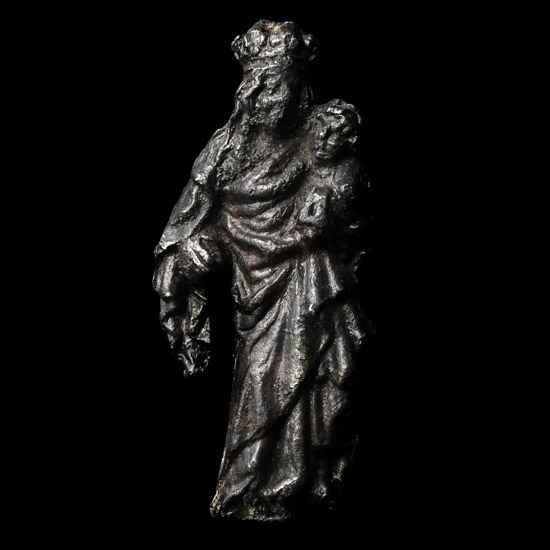
Medieval Madonna and Child Pilgrim's Pendant
Circa 14th-15th century A.D.Sold for (Inc. bp): £156
Showing the crowned Madonna in three-quarter view, holding the infant Jesus on her lap, loop on the reverse. 12.87 grams, 45.4 mm
Ex European collection, 1990s. Accompanied by a previous typed catalogue information card. -
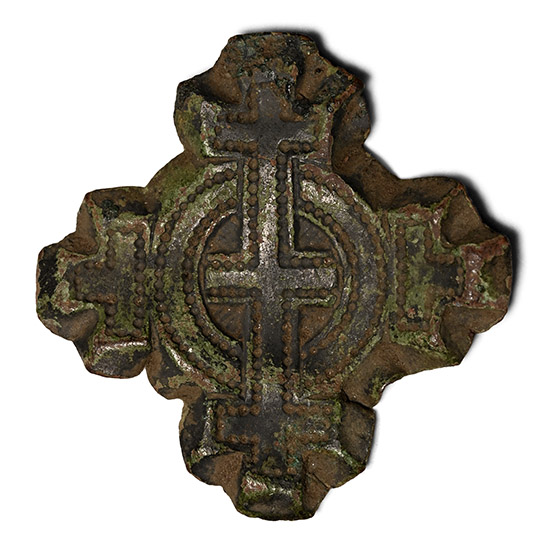
Medieval Bronze Knight's Holy Sepulchre Badge
Circa 13th-14th century A.D.Sold for (Inc. bp): £78
Stamped plate with cross potent motif and enmeshed ring. 1.08 grams, 25 mm
From a retired Lincolnshire, UK, gentleman's collection, a long time member of the Pewter Society.
The 'Equestrian Order of the Holy Sepulchre of Jerusalem' was an order of knighthood under the protection of the Pope, formed around 1099 AD by Duke Godfrey of Bouillon, the leader of the First Crusade. It was established for the protection of pilgrims travelling to the Holy Land and was recognised by a Papal Bull in about 1113 AD. -
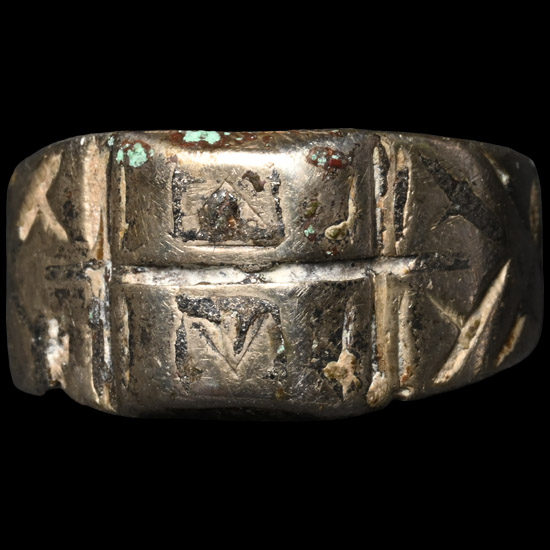
Medieval Silver Ring with Niello
12th-14th century A.D.Sold for (Inc. bp): £52
Flat-section hoop expanding at the shoulders, X-motifs on the shoulders, raised bezel divided into two sections, each side with a chevron motif. 2.29 grams, 17.23 mm overall, 14.24 mm internal diameter (approximate size British F 1/2, USA 3, Europe 4.30, Japan 4)
From the private collection of a European gentleman (1942-2024), formed since the 1970s. -
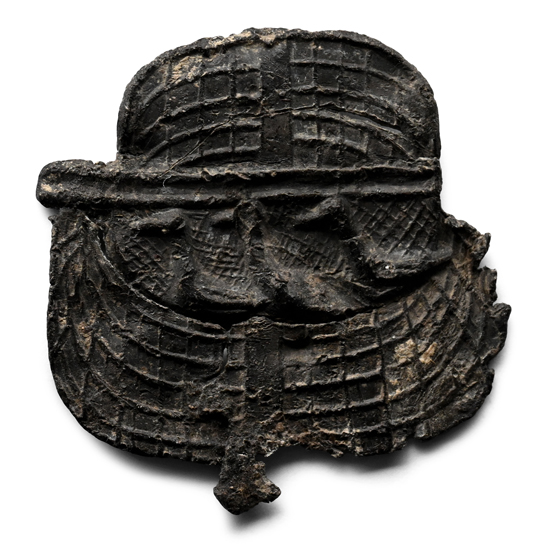
Medieval Pewter Pilgrim's Badge of Saint Werburgh
14th-15th century A.D.Sold for (Inc. bp): £169
Formed as a low-relief image of three geese on a field with wattle hurdle fence panels; inked collector's mark to the reverse 'BILL.' (Billingsgate, London). 2.71 grams, 30 mm
From a retired Lincolnshire, UK, gentleman's collection, a long time member of the Pewter Society.
St Werburgh (also Werburga in Latin documents) was an abbess, daughter of King Wulfhere of Mercia (died 675 AD ), whose emblem was geese. One of the best-known miracles was the command given by St Werburgh to a flock of geese causing havoc in the cornfields of Weedon. One version of the legend is that St Werburgh had been interested in a flock of geese that visited the convent meadow and bathed in the pond in Weedon. St Werburgh named her favourite goose with a black ring around his neck as Grayking. Subsequently, Grayking was eaten by the convent steward, Hugh, as the flock ruined his field of corn and he felt that they had not been punished enough by St Werburgh. When St Werburgh found out this she was furious with the steward. She found the bones of the goose Grayking and ordered him to arise. The bones reformed and Grayking the goose stood before her.

