-
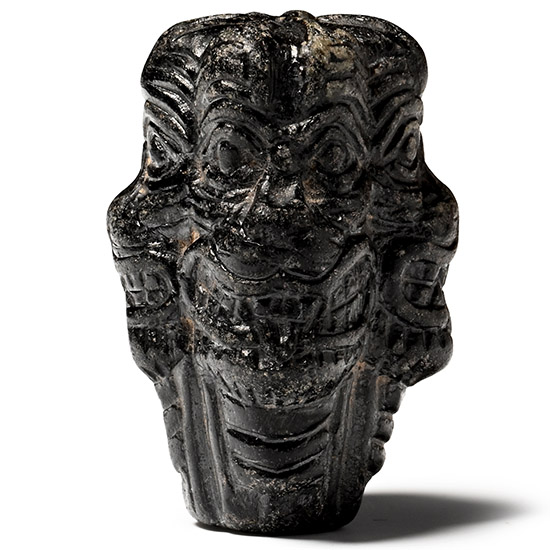
Neo-Assyrian Black Stone Multifacetted Pazuzu Head
Circa 600 B.C.Sold for (Inc. bp): £2,860
Modelled in the round, four addorsed heads, each with snarling mouth and furrowed brow; pierced vertically. 19.94 grams, 34.28 mm
From the 'S' collection, London, UK, 1970-1990s. This lot has been checked against the Interpol Database of stolen works of art and is accompanied by search certificate number no.13286-253337.
Pazuzu, in the Mesopotamian mythology, is described as ‘the son of Hanbu and king of wind demons’. Amulets with images of his full body or, more often, just his head, were common in the early first millennium B.C. Pazuzu was most popular in the Neo-Assyrian and Neo-Babylonian periods, from about the late 8th century B.C. through the 6th century B.C. -
.jpg)
Western Asiatic Bronze Statuette of a Horned Demon
1st millennium B.C.Sold for (Inc. bp): £221
Columnar in form with stub to base, arms bent, bearded face surmounted by a conical cap with lateral lugs. 43.4 grams, 87.5 mm
From the private collection of a European gentleman (1942-2024), formed since the 1970s. -
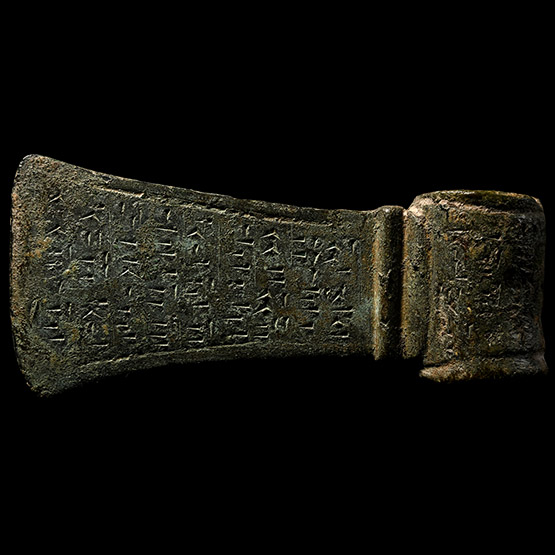
Assyrian Bronze Axehead with Cuneiform Inscription
8th century B.C.Sold for (Inc. bp): £3,120
Comprising a barrel-shaped socket with rounded collars and a hole to the rear to accept a mounting peg, a wedge-shaped blade with a stepped neck; incised cuneiform text on both faces of the blade and the socket; votive type. 141 grams, 94 mm
Private collection, acquired on the European art market in 2002. This lot has been checked against the Interpol Database of stolen works of art and is accompanied by search certificate number no.13206-249182.
The royal inscriptions on weapons were common in Mesopotamia. Our blade, although younger, finds a parallel with an Assyrian cuneiform-inscribed bronze axe blade bearing the name of the Assyrian king Adad-nirari I, dating back to the reign of King Adad-Nirari I (1307-1275 BC) from Assyria, currently on display at the Louvre Museum in Paris. -
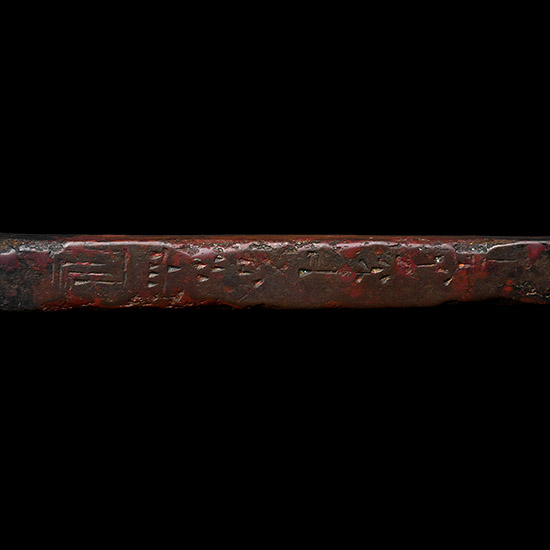
Large Mesopotamian Bronze Spearhead Inscribed: 'Belonging to the Palace of Ipiq-Adad' a King of the city Eshnunna
2nd millennium B.C.Sold for (Inc. bp): £3,380
Rectangular-section tapering body with a short tang with cuneiform text to one side translating to: '(belonging to) the Palace of Ipiq-Adad'. 260 grams, 36 cm
UK private collection before 2000. Acquired on the UK art market. Private collection, London, UK. This lot has been checked against the Interpol Database of stolen works of art and is accompanied by search certificate number no.13259-253470.
There were three kings of the name Ipiq-Adad, kings of the city Eshnunna in the Diyala region of Mesopotamia in the early Old Babylonian period. Eshnunna was an ancient Sumerian (and later Akkadian) city and city-state 12.6 miles northwest of Tell Agrab. Although situated in the Diyala Valley northwest of Sumer proper, the city nonetheless belonged securely within the Sumerian cultural milieu. Ipiq-Adad II was the son of Ibal-pi-el I, king of Eshnunna. Upon his ascent, he used the title ensi; later in his reign, he shifted to describing himself as lugal (king). He was the first ruler of Eshnunna to use the term lugal since Shu-iliya. Inscriptions also refer to him as 'king who enlarges Eshnunna', 'shepherd of the black-headed people', and 'king of the universe'. He oversaw a great expansion of the state and laid the foundation for Eshnunna to become a regional power. The spearhead belongs to the category of bipartite pikes (Gernez classification L 1.A.a). It is the simplest category of spearheads. The butt consisted solely of a widening located at the junction between the point and the tang. The tang was inserted into the handle up to the butt. The wood, split and/or hollowed out to allow for the passage of the tang, was then secured with a cord or strap wrapped around it, probably up to the base of the blade, thus ensuring its stability. -
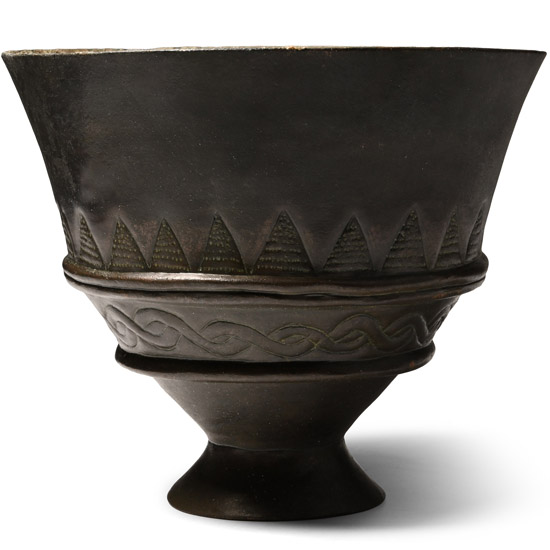
Urartu Decorated Bronze Chalice
Early 1st millennium B.C.Sold for (Inc. bp): £780
With pedestal foot and rib above, bowl with repoussé collar to the equator, guilloche below; mouth with hatched vandykes at the shoulder. 255 grams, 14.6 cm wide
Ex property of a London, UK, gentleman, Mayfair gallery, 1990s. -
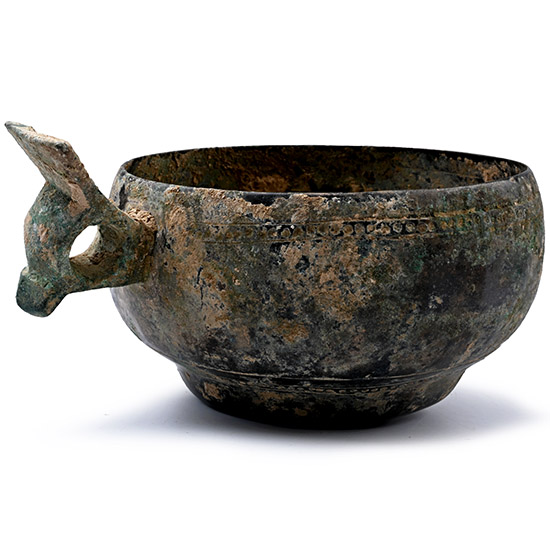
Western Asiatic Bronze Vessel with Animal Handle
1st millennium B.C.Sold for (Inc. bp): £169
Squat in profile with drum-shaped body and repoussé base; circumferential bands of pellets beneath rim and above foot; applied loop handle with thumb-pad and spur beneath. 533 grams, 16.5 cm wide
Ex Abelita family collection, 1980s-2000s. -
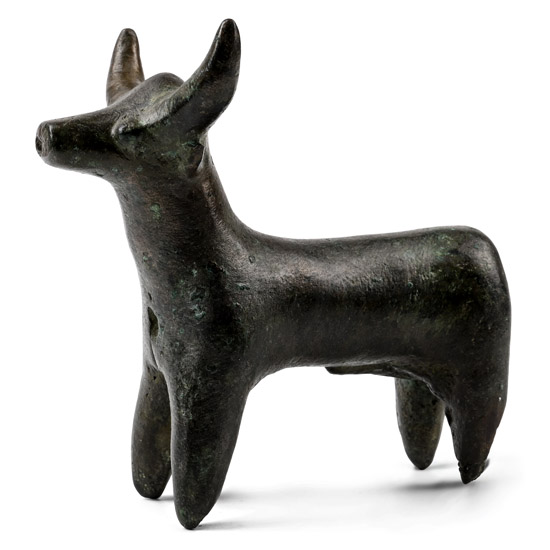
Urartu Bronze Standing Bull
8th-7th century B.C.Sold for (Inc. bp): £1,040
Modelled standing with an erect head, large curving horns and bulbous eyes, male genitals underneath. 732 grams, 10.5 cm wide
Acquired before 1983. Ex London gallery, 1990s. Private collection, London, UK. -
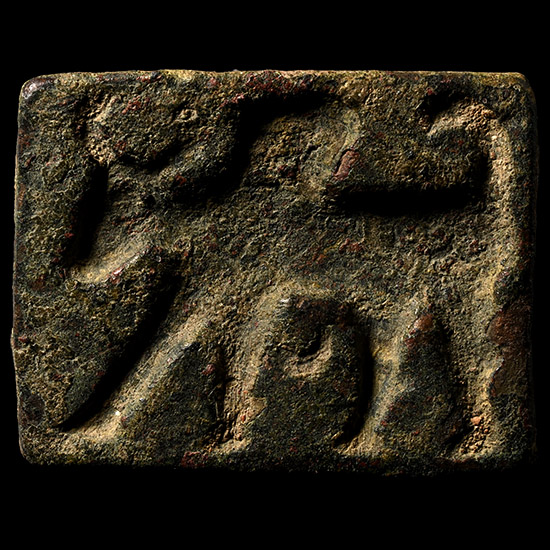
Bactrian Bronze Stamp Seal with Zebu
2nd millennium B.C.Sold for (Inc. bp): £111
Substantial rectangular block with loop handle; incuse image of an advancing zebu in profile. 153 grams, 55 mm
UK private collection before 2000. Acquired on the UK art market. Private collection, London, UK. -
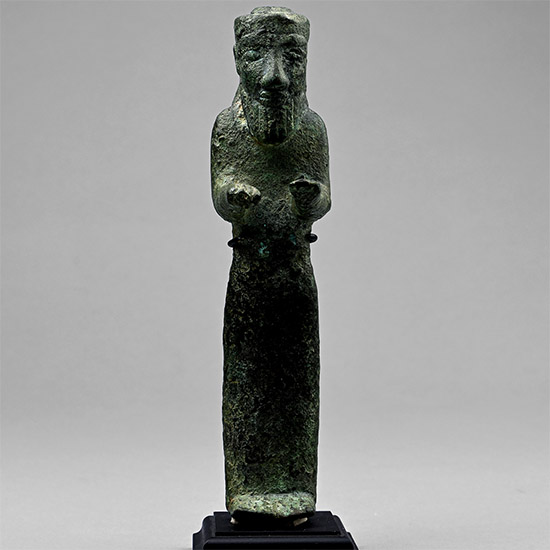
Old Babylonian Tall Copper Statuette of a Priest
Circa 1894-1595 B.C.Sold for (Inc. bp): £5,980
Modelled in the round standing figure wearing a floor-length robe; the head surmounted by a pillbox hat with thick shoulder-length hair to the rear, prominent triangular nose flanked by incised lentoid eyes, thick lips and a strong segmented bead; the arms bent forwards at the elbow to support a dish or patera; ellipsoid-section body and D-shaped flange for the feet; small lug to the underside; mounted on a custom-made stand. 540 grams total, 20.5 cm including stand
Moussaieff collection, Israel, formed from 1948. This lot has been checked against the Interpol Database of stolen works of art and is accompanied by search certificate number no.13287-251143. -
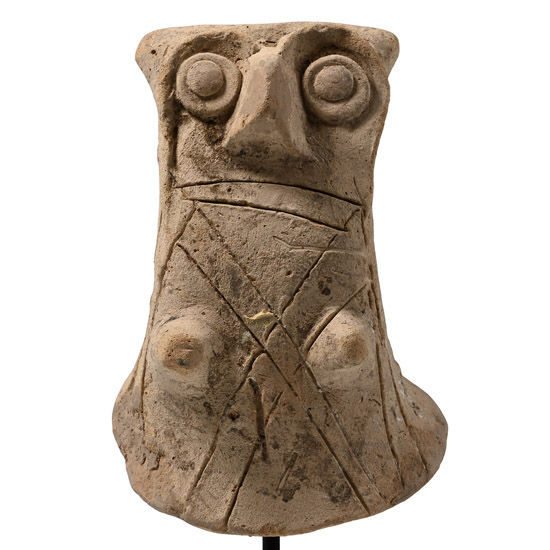
Western Asiatic Terracotta Vessel Attachment
1st millennium B.C.Sold for (Inc. bp): £572
Hollow-formed with flared conical base and rectangular upper end; applied facial features, incised saltire, domed breasts; mounted on a custom-made stand. 351 grams total, 10.96 cm including stand
Property of a North American gentleman, London, UK, 1990-2010. -
.jpg)
Old Babylonian Terracotta Head of a Demon
Circa 1900-1800 B.C.Sold for (Inc. bp): £650
Modelled in the round, depicting the (severed?) head of a Mesopotamian demon, with iconic facial features in relief; hollow with a vent to the neck; produced from a two-piece mould, with a median seam through the facial features. 191 grams, 87 mm
Private collection, Israel. with Holy Land House of Antiquities, Jerusalem, 1980s. Acquired by the current owner from the above, 2001. This lot has been checked against the Interpol Database of stolen works of art and is accompanied by a search certificate number no.12878-241678.
Within traditional Mesopotamian religion, Humbaba was a creature regarded as the guardian of the cedar forest and the brother of Pazuzu. He was represented as a giant who had been raised by the sun god, Shamash. However, this head could also refer to another deity or demon, like one of the heads found in the Kish excavations. -
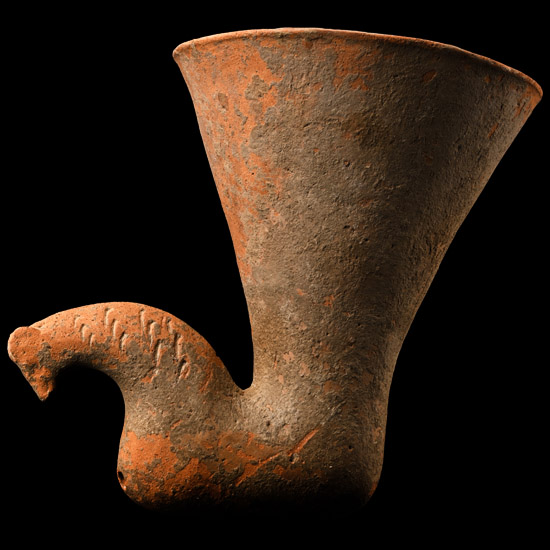
Western Asiatic Zoomorphic Terracotta Rhyton
3rd-1st millennium B.C.Sold for (Inc. bp): £650
With a flaring neck and zoomorphic spout, possibly a horse's head with a circular opening in its chest. 670 grams, 18 cm
with a London, UK gallery, 1971-early 2000s. Accompanied by an original thermoluminescence analysis report no.281z11 from Oxford Authentication, 16 June 1981.

