-
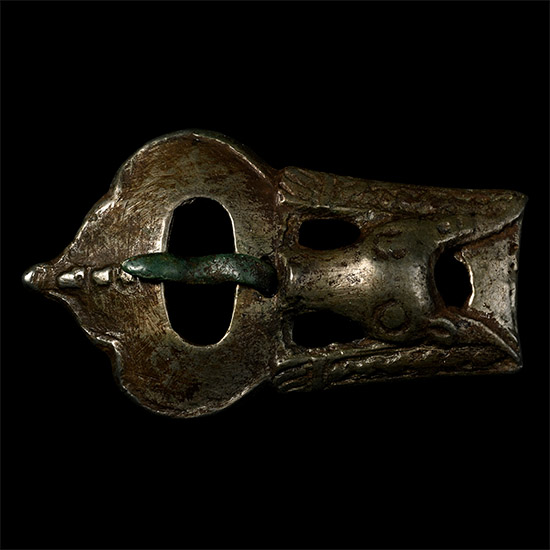
Viking Bronze Buckle with Wolf's Head
Circa 8th-10th century A.D.Sold for (Inc. bp): £195
Comprising a trapezoidal openwork plate and integral buckle loop; the loop domed in section with triangular extension to the forward edge and raised billets, flat-section coiled tongue; the plate formed as a facing lupine head with reserved running zigzag to each flanking foreleg attached to the rear of the loop; Western Baltic type. 26.89, 65.98 mm
From the private collection of a London gentleman, from his grandfather's collection formed before the early 1970s. -
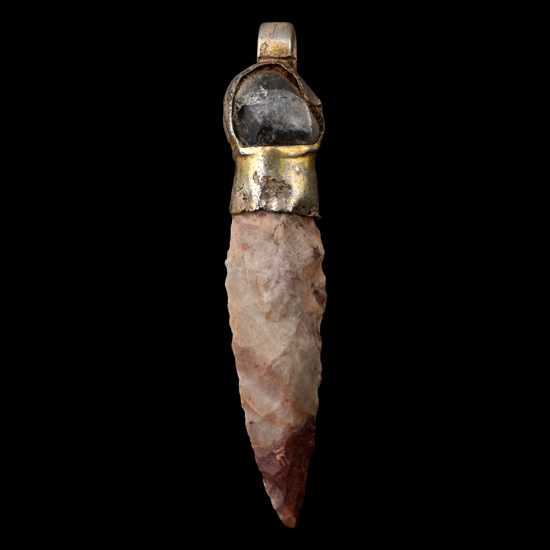
Viking Silver-Gilt Elfshot Pendant with Stone Arrowhead
9th-11th century A.D. and earlierSold for (Inc. bp): £845
Comprising a silver sleeve with a knapped flint arrowhead, a circular cell set with a clear glass cabochon above. 3.46 grams, 44.84 mm
From the private collection of a London gentleman, from his grandfather's collection formed before the early 1970s.
This amulet was believed to offer protection against 'Elfshot'. The attack of elves was believed responsible for mysterious suffering in men and livestock: sudden shooting pains localised to a particular area of the body, such as in rheumatism, arthritis, or muscle stitches or cramps. Elves were thought to shoot darts or arrows where such pains had no obvious external cause. Belief in elfshot persisted into the 20th century in rural areas, and as proof, country folk would sometimes find small arrowheads (the remains of Neolithic or Mesolithic flints, or naturally-occurring spear-shaped stones) that were believed to be the magical weapons that caused the afflictions. Belief in elfshot began in the Pagan Germanic period. -
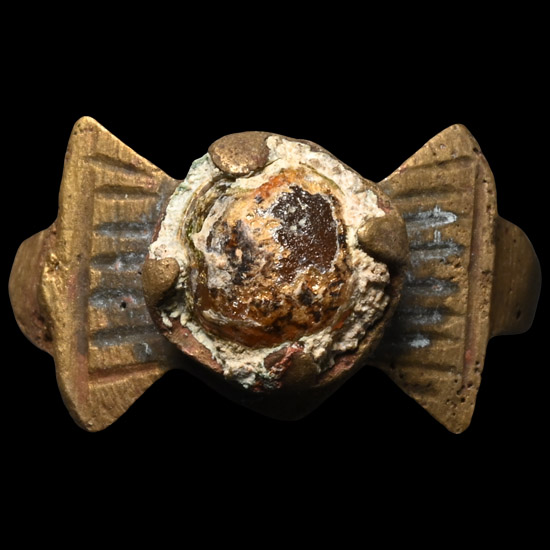
Viking Age Bronze Ring with Cabochon
Circa 9th-12th century A.D.Sold for (Inc. bp): £65
Comprising a D-section hoop with flared plaques on the shoulders, a circular bezel with claws, set with an amber-coloured glass cabochon. 3.12 grams, 23.33 mm overall, 16.63 mm internal diameter (approximate size British I 1/2, USA 4 1/2, Europe 8.07, Japan 7)
From the private collection of a European gentleman (1942-2024), formed since the 1970s. -
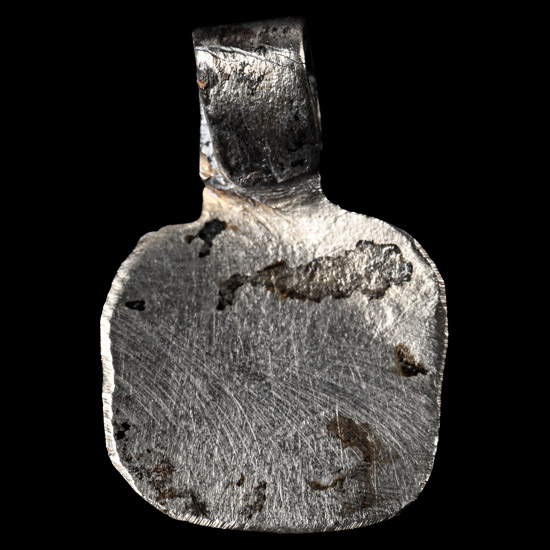
Viking Age Silver Amuletic Pendant
Circa 900-1100 A.D.Sold for (Inc. bp): £65
Flat-section rectangular disc with a large loop. 0.57 grams, 17 mm
From an ancient art collection, formerly acquired in the UK, European, and USA art markets, from pre-2000 collections. Property of a West Northamptonshire, UK, gentleman. -
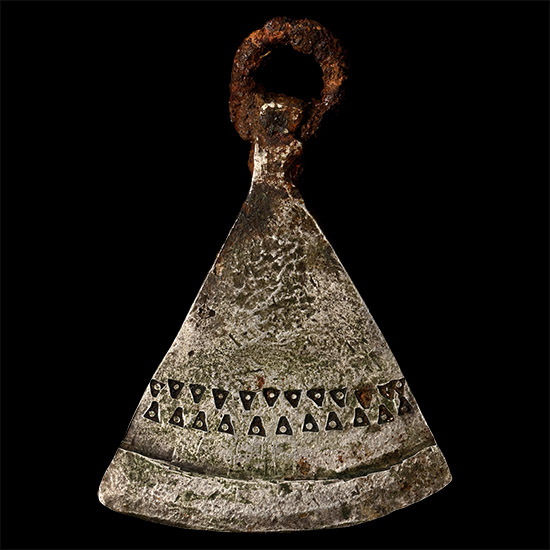
Viking Silver Stamped Broad Axe Pendant
Circa 9th-11th century A.D.Sold for (Inc. bp): £208
Wire hoop; free-running triangular pendant decorated with two bands of stamped opposed pellet-in-triangle motifs to each face. 10.71 grams, 52.11 mm
From the private collection of a London gentleman, from his grandfather's collection formed before the early 1970s. -
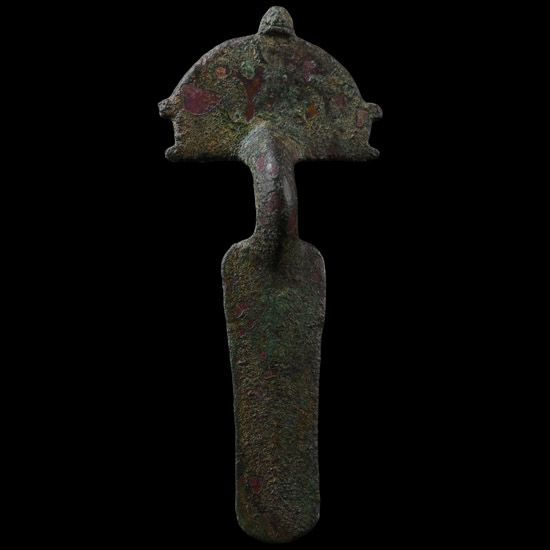
Visigothic Radiate-Headed Bronze Bow Brooch
Circa late 5th-6th century A.D.Sold for (Inc. bp): £91
D-shaped headplate with lateral spurs and lobe above, D-section bow, tongue-shaped foot plate; ferrous remains of pin and catch to reverse. 41 grams, 10.2 cm
Acquired on the UK art market before 2000. Property of an Essex, UK, gentleman. -
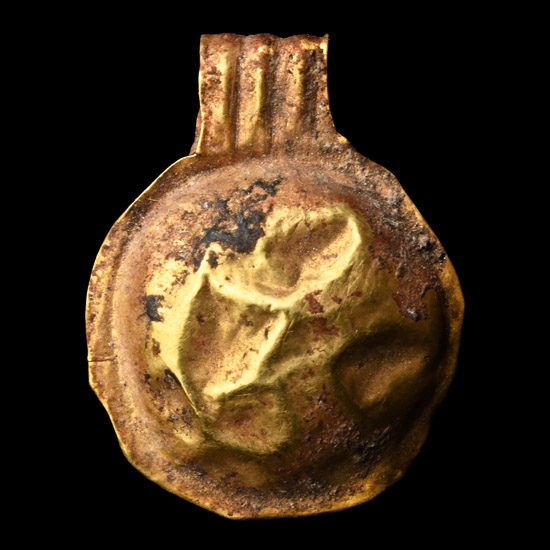
Saxon Gold Bulla-Shaped Pendant
Circa 6th century A.D.Sold for (Inc. bp): £117
A hollow-form pendant with a ribbed suspension loop. 0.41 grams, 15.5 mm
From the private collection of a European gentleman (1942-2024), formed since the 1970s. -
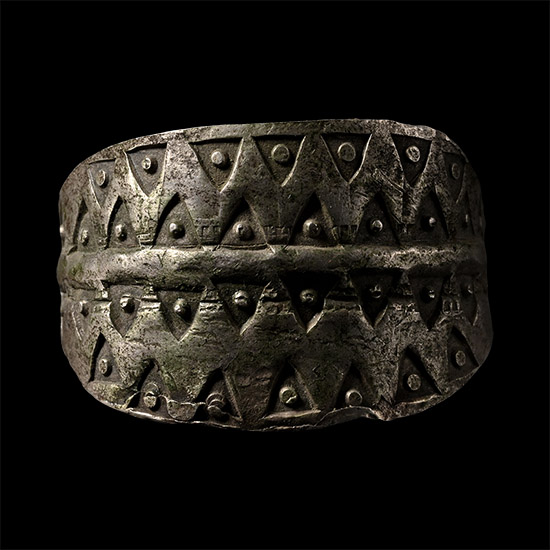
Viking Silver Stamped Ring
Circa 9th-11th century A.D.Sold for (Inc. bp): £780
Penannular type with the ends wound around the shank; median rib separating two rows of punched triangles. 7.55 grams, 27.75 mm overall, 24.61 x 22.53 mm internal diameter (approximate size British Z 1/2, USA 12 1/2, Europe 29.43, Japan 28)
From the private collection of a London gentleman, from his grandfather's collection formed before the early 1970s. -
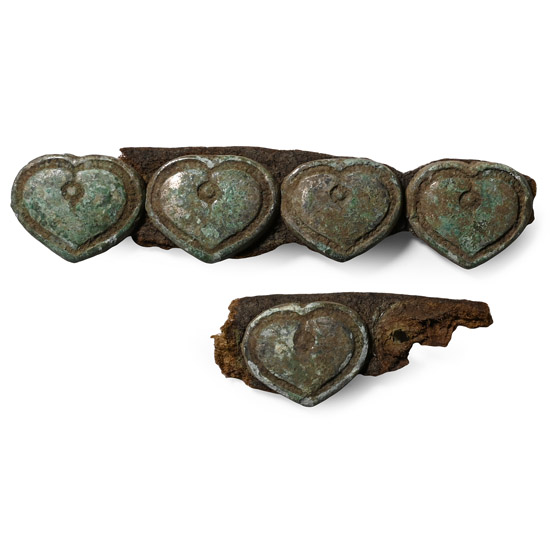
Viking Age Leather Belt Fragments with Tinned Bronze Heart-Shaped Mounts
Circa 9th-11th century A.D.Sold for (Inc. bp): £111
Comprising five heart-shaped mounts with a grooved edge. 10.2 grams total, 39-74.6 mm
From the private collection of a European gentleman (1942-2024), formed since the 1970s. -
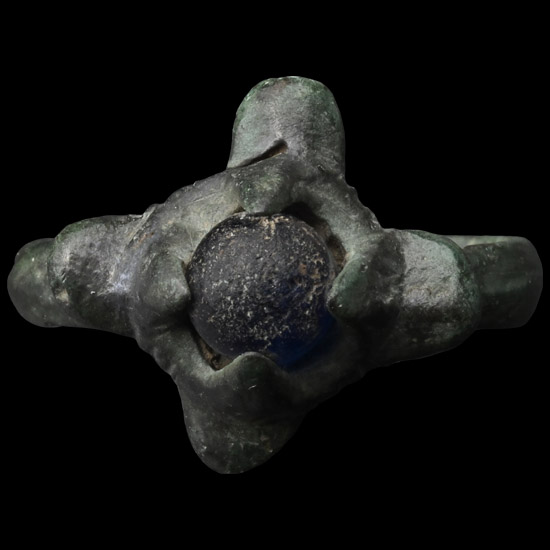
Migration Period Bronze Ring with Cabochon
6th-8th century A.D.Sold for (Inc. bp): £65
D-section hoop with four-lobed bezel set with dark blue glass cabochon. 5.91 grams, 27.35 mm overall, 19.70 mm internal diameter (approximate size British Q 1/2, USA 8 1/4, Europe 18.12, Japan 17)
Ex German art market, 2000s. Acquired from an EU collector living in London. From the collection of a Surrey, UK, gentleman. -
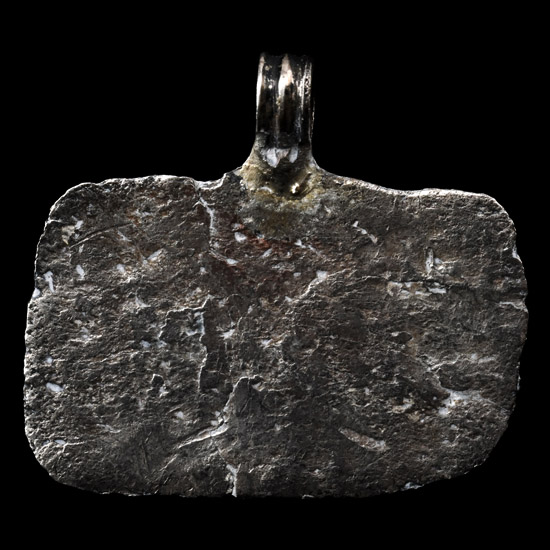
Viking Age Silver Amuletic Pendant
Circa 900-1100 A.D.Sold for (Inc. bp): £46
Rectangular plaque with a ribbed suspension loop. 0.75 grams, 20 mm
From an ancient art collection, formerly acquired on the UK, European, and USA art markets from pre-2000 collections. Property of a West Northamptonshire, UK, gentleman. -
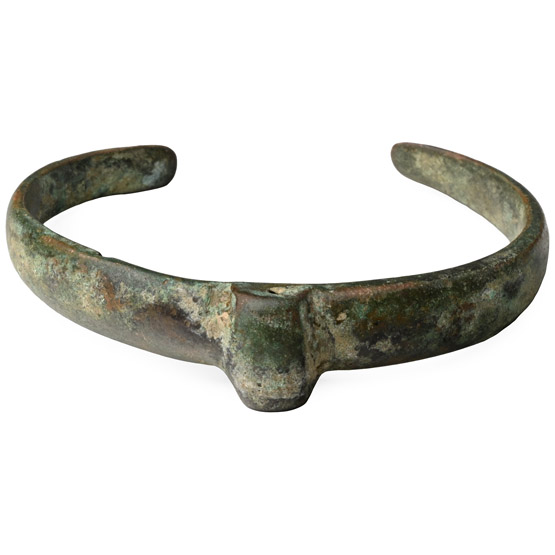
Viking Age Bronze Bar Bracelet
Circa 9th-11th century A.D.Sold for (Inc. bp): £65
Crescentic in profile and plano-convex in section with tapering ends, median transverse block with lateral hole for an attachment. 31.4 grams, 60 mm
Ex Arundel, East Sussex, UK, private collection, 1970s-2000.

