-
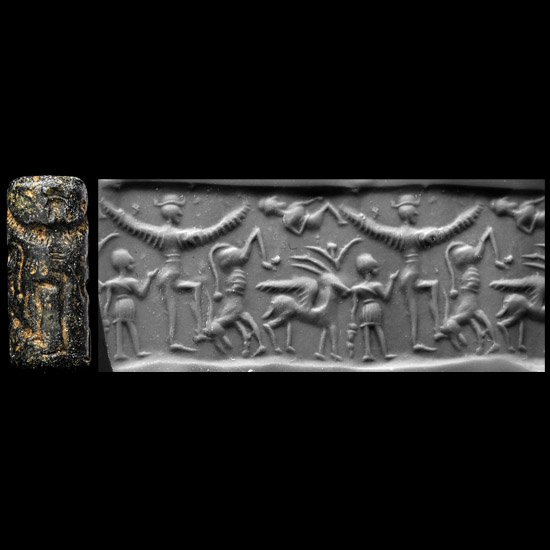
Western Asiatic Black Stone Cylinder Seal with Winged God
2nd-1st millennium B.C.Sold for (Inc. bp): £468
Frieze depicting a standing winged deity advancing above a hunting dog perpendicular, small attendant to the rear holding a vessel beside a standing gryphon, second crouching figure above; supplied with a museum-quality impression. 3.43 grams, 21.97 mm
From the private collection of a European gentleman (1942-2024), formed since the 1970s. -
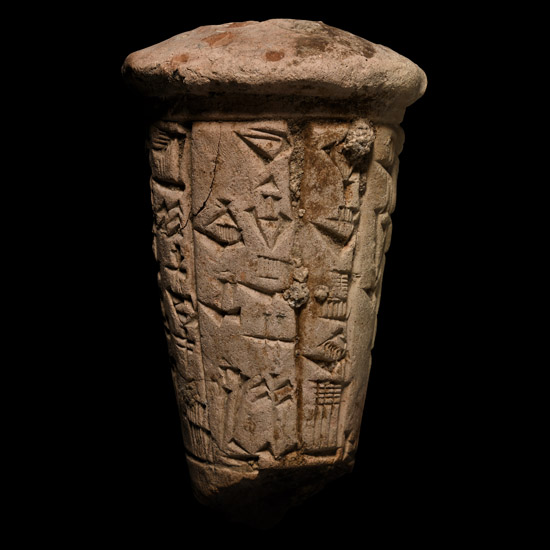
Sumerian Terracotta Cuneiform Foundation Cone
Circa 2000 B.C.Sold for (Inc. bp): £1,170
With domed upper face, conical body; incised vertical lines dividing the surface into segments, with impressed cuneiform text; tip absent. 288 grams, 10.26 cm
From the private collection of the late Mr W. Magee, Hartlepool, County Durham, UK, 1960s-1990s, thence by descent. Accompanied by a previous catalogue information card.
Votive cones are one type of royal foundation deposit, objects that were buried in the walls and beneath the floors of important buildings during construction to sanctify the site and to create a historical memory of the ruler and his achievements. -
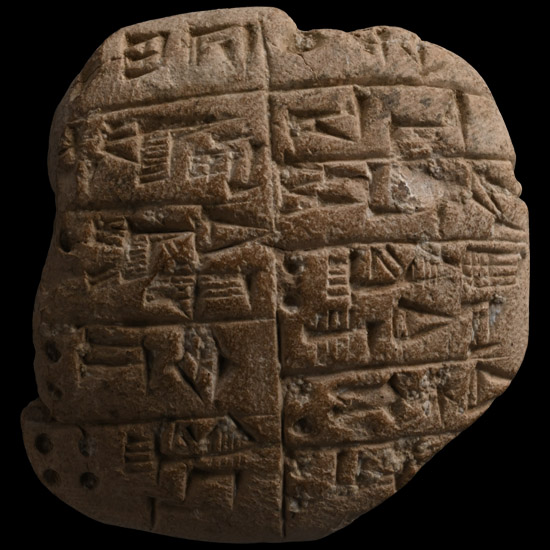
Mesopotamian Terracotta Cuneiform Tablet
2nd millennium B.C.Sold for (Inc. bp): £975
A discoid tablet with cuneiform text covering one side, the other side divided into three sections, with one section containing cuneiform text. 42.9 grams, 45 mm
From the private collection of a European gentleman (1942-2024), formed since the 1970s. -
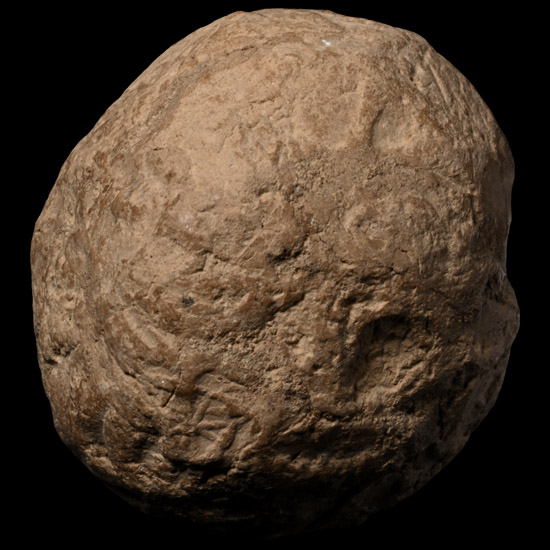
Mesopotamian Clay Bulla with Clay Tokens
Uruk, 3rd millennium B.C.Sold for (Inc. bp): £975
Spherical, undecorated bulla envelope containing clay tokens. 74 grams, 50 mm
Specialised collection of cuneiform texts, the property of a London gentleman and housed in London before 1992. Thence by descent to family members. Examined by Professor Wilfrid George Lambert FBA (1926-2011), historian, archaeologist, and specialist in Assyriology and Near Eastern archaeology, in the late 1980s and early 1990s. This small collection is exceptional for the variety of types, including some very rare and well-preserved examples. Accompanied by a previous cataloguing slip.
Small globular and hollow clay balls are defined as 'bulla'. They are also known as ‘bulla-envelopes', some of which are plain and some displaying epigraphic, zoomorphic and/or figural decoration, impressed by either cylinder or stamp seals. Bullae first emerged in Mesopotamia, and their earliest occurrence can be traced to circa 8000 B.C. Most known decorated bullae come from the Uruk area and offer an insight into its culture. -
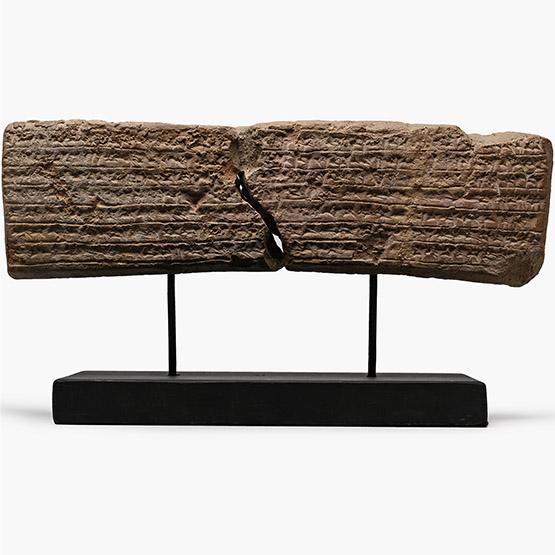
Royal Elamite Cuneiform Brick for King Shihak-Insusinak I
1150-1120 B.C.Sold for (Inc. bp): £4,420
A fired clay brick with seven lines of cuneiform text referring to King Shihak-Insusinak I; accompanied by a scholarly note by Dr Manuel Ceccarelli, PhD earned at the University of Tübingen, Germany, which states: 'Brick with Elamite cuneiform inscription of Shilhak-lnshushinak, king of Elam (South-West Iran), ca. 1150-1120 BCE. This royal inscription celebrates the restoration of the temple of the goddess Kirisha. The inscription can be reconstructed thanks to similar bricks.'I, Shilhak-lnshushinak, son of Shutruk-Nahhunte, beloved servant of Kiririsha and Inshushinak, King of Anzan and Susa: Humbanumena built the temple of Kiririsha-of-Liyan with unbacked mudbricks, and, as it threatened ruin, I restored it to its original state: with backed bricks, I (re)built it, and for my life, for the life of Nahhunte-Utu, of Hutelutush-lnshushinak, of Shilhina-hamru-Lakamar, of Kutir-Huban, of lshnikarab-huhun, of Urutuk -EI-halahu and of Utu-ehihi-Pinigir, with this intention,for our sake(?), I gave it to Kiririsha, my goddess.''; mounted on a custom-made stand. 2.96 kg total, 34.5 cm wide including stand
Private UK collection. with Bonhams, London, 22 September 1998, no.140. Private collection, UK. Acquired on the UK art market. Accompanied by copies of the relevant Bonhams catalogue pages and Dr Manuel Ceccarelli's notes. This lot has been checked against the Interpol Database of stolen works of art and is accompanied by a search certificate number no.13233-250320.
The name of this king, like that of many kings of Elam, was linked to a deity. Inshushinak was one of the major gods of the Elamites and the protector of the city of Susa in the state of Elam. He played an important role as a deity associated with royal power in the official ideology of many Elamite dynasties. King Atta-Hushu of the Sukkalmah dynasty called himself 'the shepherd of the god Inshushinak’. Many rulers dedicated new building projects to Inshushinak, using the formula 'or his (i.e., the king's) life.' The Shutrukids commonly used the title '(king) whose kingdom Inshushinak loves.' -
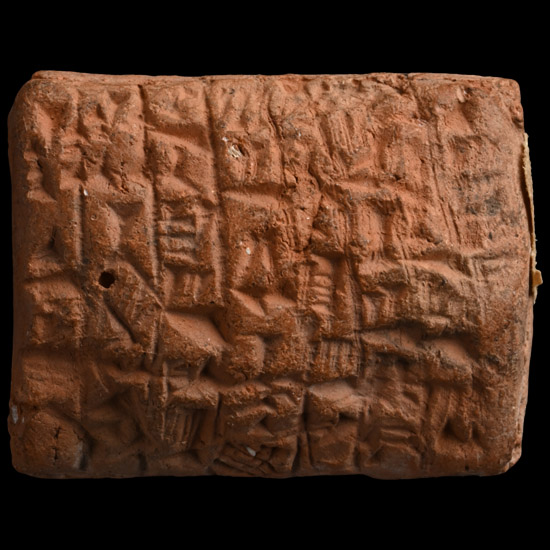
Mesopotamian Terracotta Cuneiform Tablet
2nd millennium B.C.Sold for (Inc. bp): £1,105
A small pillow-shaped tablet, with dense lines of cuneiform on both sides. 13.8 grams, 30.7 mm
From the private collection of a European gentleman (1942-2024), formed since the 1970s. -
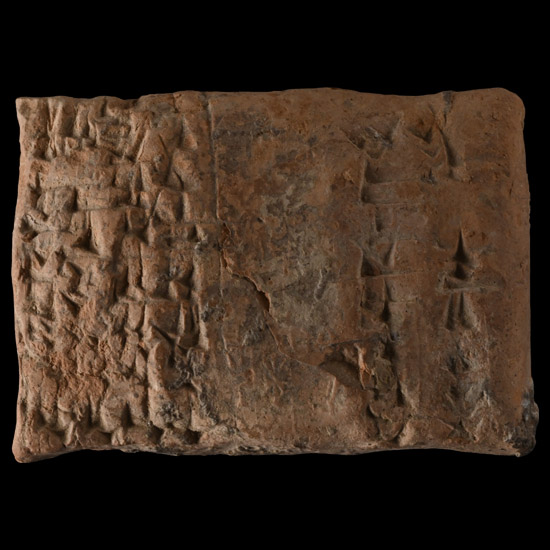
Old Babylonian Terracotta Cuneiform Tablet
2nd millennium B.C.Sold for (Inc. bp): £416
Pillow-shaped tablet with rows of cuneiform text on one side. 74.4 grams, 57.5 mm
From the private collection of a European gentleman (1942-2024), formed since the 1970s. -
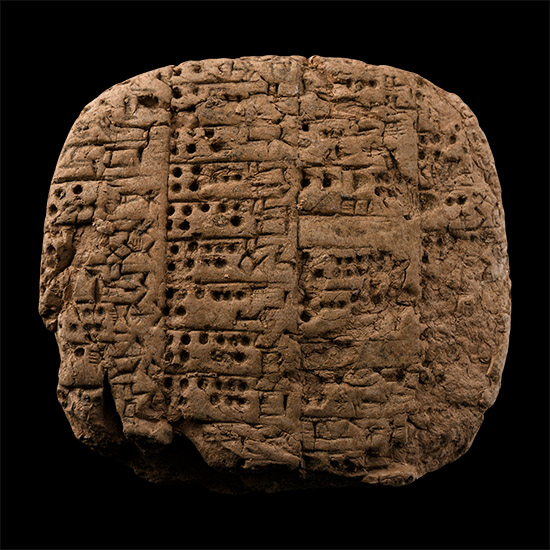
Large Proto-Sumerian Terracotta Cuneiform Tablet
4th-3rd millennium B.C.Sold for (Inc. bp): £5,200
Pillow-shaped with incised grid to the broad faces, dense cuneiform text in the columns with impressed pellet numerals. 236 grams, 89 mm
Private collection, acquired in the late 1980s-early 1990s; thence by descent. This lot has been checked against the Interpol Database of stolen works of art and is accompanied by search certificate number no.13179-249318.
Various collections of cuneiform tablets form a corpus of texts mainly of an administrative nature, from the Uruk III and Ur III periods. The proto-cuneiform, as a system of proto-writing, emerged in Mesopotamia ca.3500-3200 BC, during the Uruk period. -
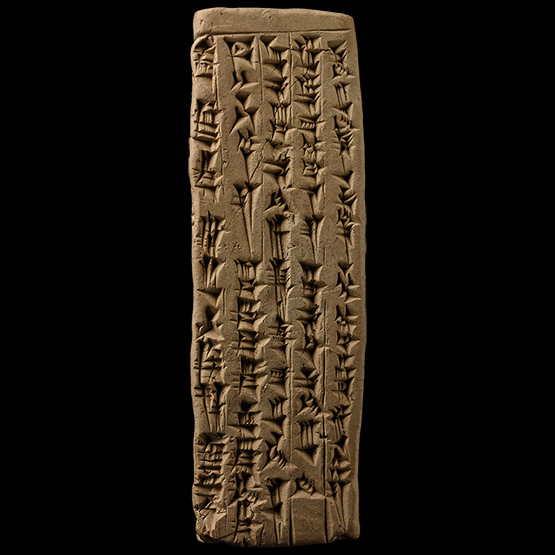
Middle Assyrian Brick-Shaped Tablet with Funerary Inscription for Adad-Shumu-lesir’s Tomb
1363-912 B.C.Sold for (Inc. bp): £5,200
A rectangular brick-shaped tablet, inscribed in cuneiform script across three vertical faces, with a single column to the fourth and a continuation of text across the top surface; the inscription a funerary curse relating to the tomb of Adad-šumu-lešir, warning against interference with the burial, reading in part: 'As for a stranger, or somebody who would approach that tomb, or would bring up a corpse out of it and bury his own within, or would touch the silver inside - Adad, Šamaš, or Nergal will fill his house and field with shortage, collapse, and murder. He will repay the property of that tomb sevenfold, dedicating it to Šuriha. For the offspring of Adad-šumu-lešir he shall be undone for taking out and bringing down objects in the tomb, and for burying another body within it. Month Kalmartu, third day, eponymy of Aššur-mušezib.' 333 grams, 14.3 cm
Acquired in 1996. Private collection, Switzerland, thence by descent. Private collection, since the late 1990s. This lot has been checked against the Interpol Database of stolen works of art and is accompanied by a search certificate number no.12872-241667.
This Middle Assyrian brick-shaped tablet bears a funerary inscription for the tomb of Adad-shumu-lesir, a name that reflects devotion to the storm god Adad, an important deity in the Assyrian pantheon. Tablets of this kind were often placed within or near tombs as a lasting record of the individual and to mark ownership or dedication of the burial space. The brick-like form reflects the architectural traditions of Mesopotamia, where inscribed bricks were commonly used in both building and commemorative contexts. Such inscriptions not only honoured the deceased but also served to preserve their name and memory, which was believed to be essential for the afterlife. Objects like this provide valuable insight into Assyrian funerary practices and the importance placed on remembrance and identity beyond death. -
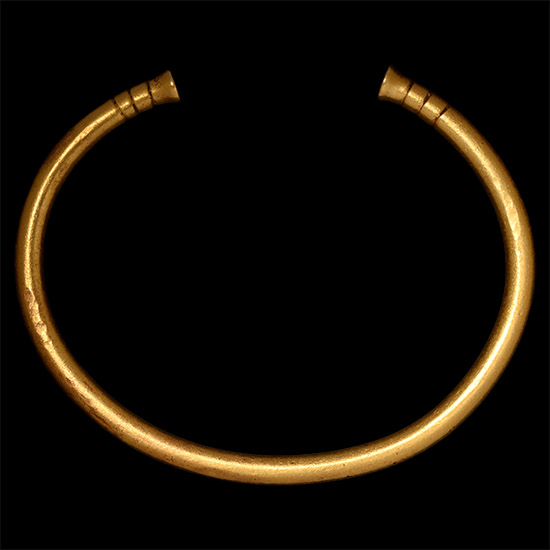
Achaemenid Solid Gold Bracelet
5th-4th century B.C.Sold for (Inc. bp): £5,980
Penannular in form and round in section with clubbed ends, three incised gussets below each finial. 42.88 grams, 73 mm
From the collection of Contessa L.G., assembled in the 1980s. Private collection, acquired in Switzerland in 1999. This lot has been checked against the Interpol Database of stolen works of art and is accompanied by search certificate number no.13200-249217.
The bracelet resembles a specimen found in Persepolis, in the Treasury, room 65, made from plain bronze wire. If the Achaemenid bracelets are characterised by their extremities shaped like goats or other wild animals, simpler gold bracelets existed, used abundantly by children and women, and also by royal courtiers and even slaves. -
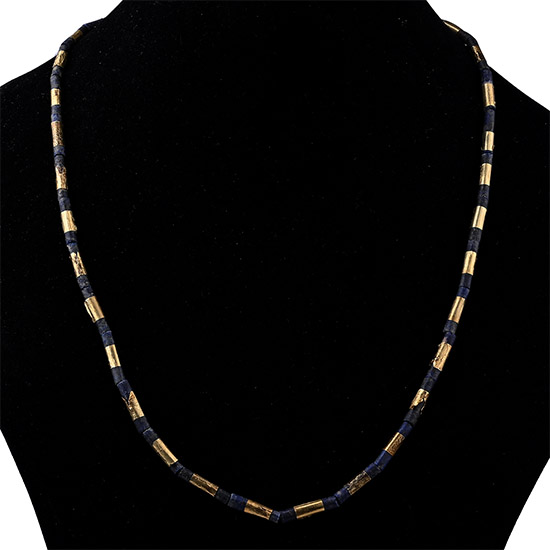
Bactrian Lapis Lazuli Bead Necklace with Later Gold Foil
1st millennium B.C.Sold for (Inc. bp): £650
Restrung group of tubular lapis lazuli beads, each with a sheet-gold sleeve; modern clasp. 22 grams, 61 cm
Acquired on the London art market. Private collection, UK. -
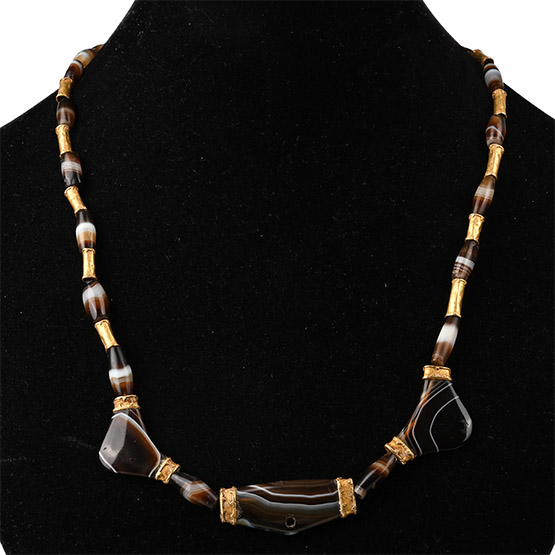
Babylonian Agate Bead Necklace with Gold Beads
9th century B.C.Sold for (Inc. bp): £7,150
Restrung necklace of tubular and fusiform beads with interstitial gold tubular beads, three D-shaped plaques with granulated gold caps, one pierced to accept a pendant. 43.24 grams, 31 cm
Private collection, acquired in the late 1980s-early 1990s; thence by descent. This lot has been checked against the Interpol Database of stolen works of art and is accompanied by search certificate number no.13207-249239.
Texts from Neo-Babylonian times in various archives, such as that of Eanna, concern the smelting of metals for the construction or repair of specific objects, including necklaces. One example from the archive (NCBT 184 - Npl 9 III 1) obv. 3 recites: '3 minas 26 shekels of gold (were) put into the kiln for the necklace of dubkåtu (beads) of Nanåya. It (the gold) is (now) at the disposal of Sadûni. (It was weighed) according to the 3 mina weight of bronze and (smaller) weights of iron.' The jewellers were responsible for cutting the precious stones and beads that were set in the jewellery and other ornamentation produced by the goldsmiths. In this capacity, they were issued beads and unworked pieces (takkassu, sibirtu) of various semiprecious stones, including agate (pappardilû), carnelian (samtu), eye stones (na igiII.mes), lapis lazuli (uqnû), and turquoise (asgikû).

