-
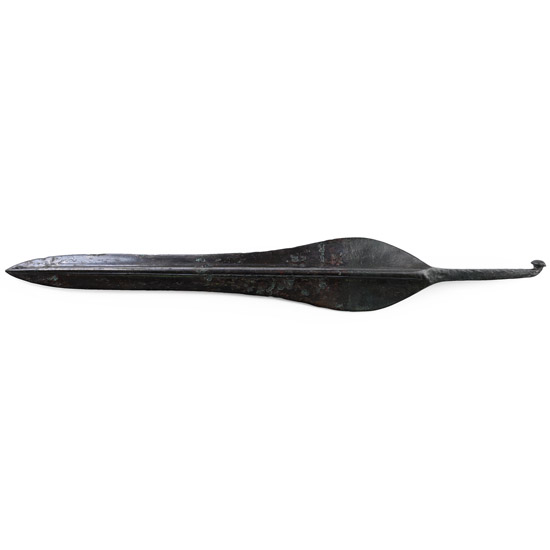
Luristan Bronze Spearhead
Early 2nd millennium B.C.Sold for (Inc. bp): £442
Foliate blade with a central rib and slender shoulders, short rectangular shaft and tang with a bent finial. 643 grams, 42.2 cm
Ex Abelita family collection, 1980s-2000s.
A number of similar blades, some considered to be spearheads and others to be daggers, all with a bent tang, derived from Tepe Hissar Culture III. Some of them, like our specimen, have a button terminal, and some others have a plain, pointed terminal. The general dating of these specimens is fixed to the early 2nd millennium B.C. -
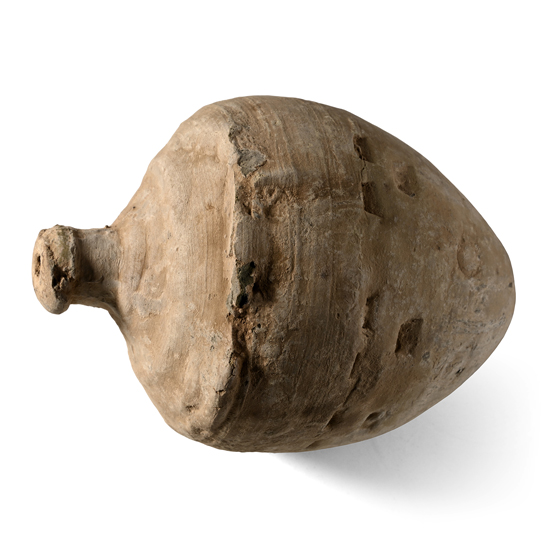
Byzantine 'Greek Fire' Ceramic Fire Bomb or Hand Grenade
9th-11th century A.D.Sold for (Inc. bp): £65
Large ovoid body with impressed decoration and raised shoulder on one side; intended to be filled with explosive liquid and a wick, and used as a hand grenade. 970 grams, 16 cm
From an important specialist collection, London, UK, 1990s. Accompanied by an academic paper by military specialist Dr Raffaele D'Amato, dated 15 July 2019 and titled 'Eastern Roman Empire - Greek Fire Bomb or Hand Grenade (μεσαίον kακάβιον) 9th-11th century AD'.
Apart from the use of siphons or manual flame-throwers called cheirosiphona, special corps of Roman soldiers employed terracotta grenades, in the form of small jars, abundantly evidenced in archaeological excavations. They were called μεσαία kακαβιά or κυτροκακάβια where the former had a bulbous shape and the latter a more cylindrical form. -
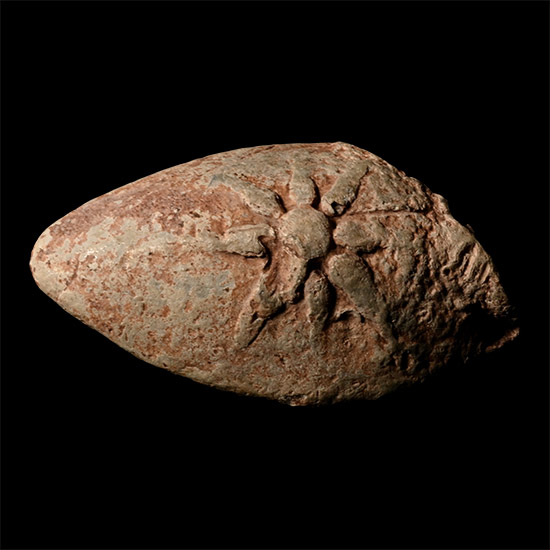
Greek Lead Slingshot of Alexander the Great
336-323 B.C.Sold for (Inc. bp): £312
Biconical in profile with casting seam and reserved monogram 'AB = ΑΛΕΞΑΝΔΡΟΥΒΑΣΙΛΕΩΣ' (Αlexandrou basileos), a rayed solar symbol, the so-called Argead Star, on the other side; extremely rare, first known specimen of this type. 28.6 grams, 30 mm
From a German private collection, formed since the 1980s.
The Argeads were an important Greek dynasty ruling over ancient Macedonia, with Alexander as the most prominent member of the royal house of the Argeads. The rayed solar symbol (Argead Star, Vergina Star) is interpreted as the historical royal symbol of the ancient Macedonian Dynasty of the Argeads, with its most famous member, Alexander the Great. Cf. a similar slingshot in the Musée du Louvre (INV 1497), acquired by the museum in 1825. -
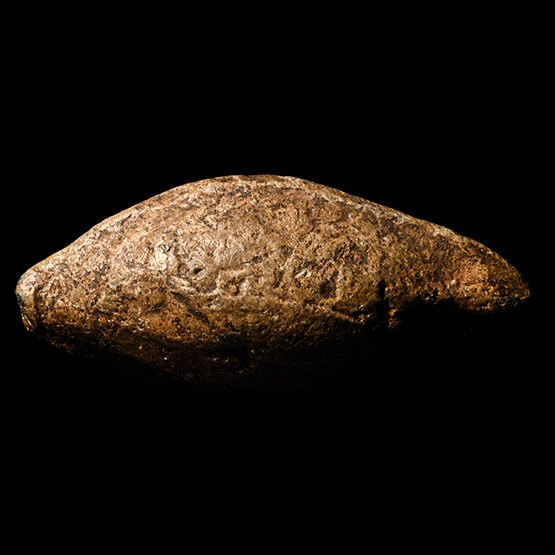
Greek Lead Slingshot with X
4th-3rd century B.C.Sold for (Inc. bp): £72
Biconical in profile with casting seam and Greek legend '...X...' to one face. 30.4 grams, 37 mm
Ex German art market, 2000s. Acquired from an EU collector living in London. From the collection of a Surrey, UK, gentleman.
Greek bullets were cast in two-part moulds. Clay and stone moulds survive; metal moulds are much rarer in the archaeological records. The mould halves carry the negative of the bullet’s shape, often in rows, so that multiple bullets can be made at once. A narrow gate at the tip of each negative lets molten lead run into the cavity. After cooling, the caster opens the mould and breaks the sprue that links the bullets. -
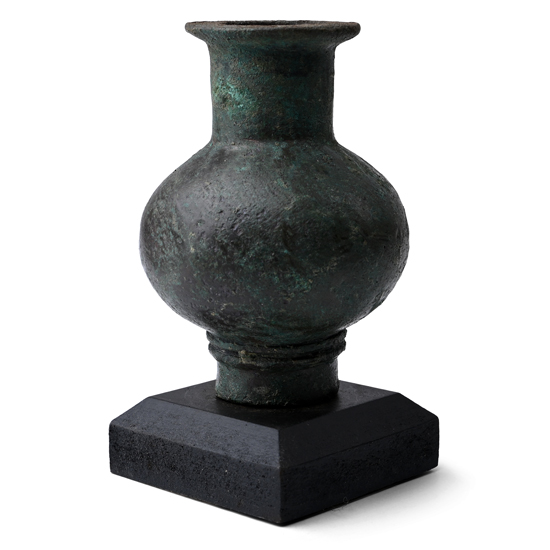
Luristan Bronze Macehead
2nd-1st millennium B.C.Sold for (Inc. bp): £286
With a globular body and tubular socket with two raised collars above and a flaring base; accompanied by a custom-made display stand. 329 grams total, mace: 83 mm
From the collection of the late Sir Clinton Charles Donald Cory, 5th Baronet of Coryton. Ex Philip Auction House, 24 September 1985. -
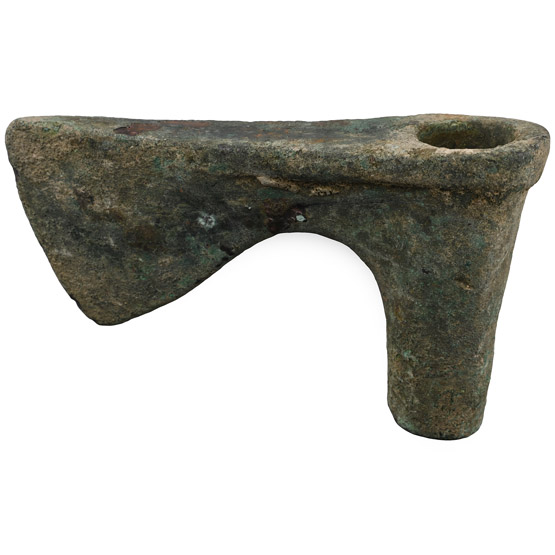
Luristan Bronze Socketted Axehead
2nd-1st millennium B.C.Sold for (Inc. bp): £91
With a short socketted shaft and flange to the mouth, broadening blade towards the cutting edge. 367 grams, 12 cm
Ex Abelita family collection, 1980s-2000s. -
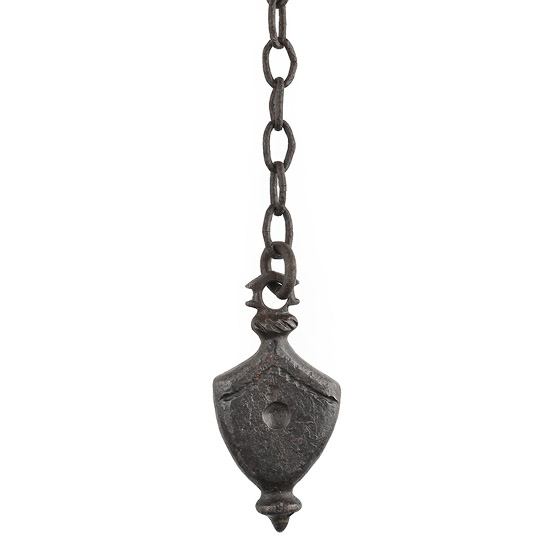
Medieval Socketted Iron Tournament Flail
Circa 15th century A.D.Sold for (Inc. bp): £676
Comprising: tubular socket with segmented lower ends pieced to accept attachment pins, decorative ring above; short length of chain with butted iron links; heater shield-shaped striker with knop finial and torque to the neck, punched design of a chevron and central pellet; one face with possible maker's mark above the pellet. 364 grams, 52.1 cm
Ex North American private collection, 1970s-1990s. -
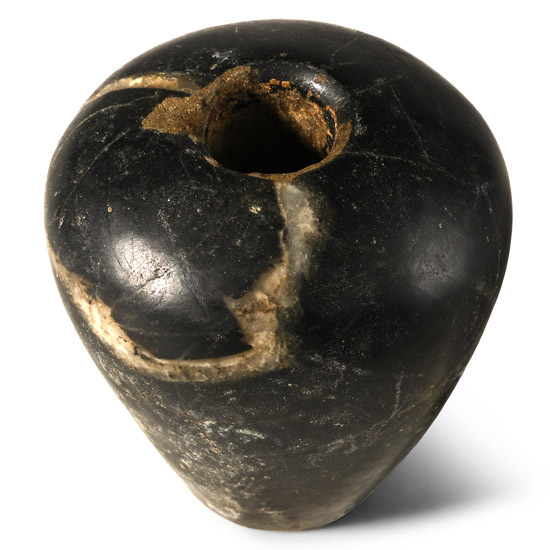
Western Asiatic Polished Stone Macehead
3rd-2nd millennium B.C.Sold for (Inc. bp): £117
Ovoid body with a round socket. 233 grams, 63 mm
From the collection of a London, UK, gentleman, 1990s. -
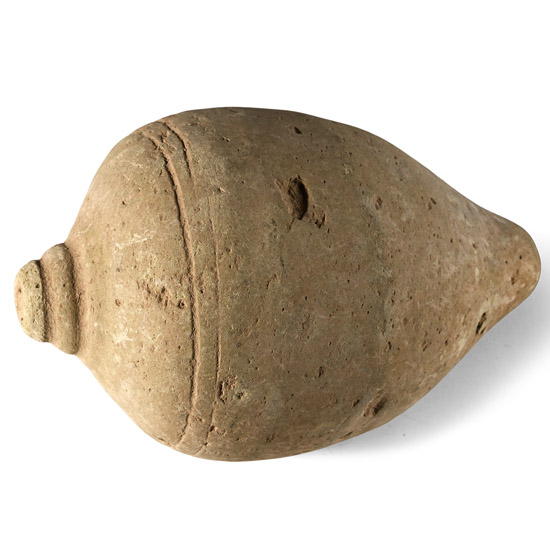
Byzantine 'Greek Fire' Ceramic Fire Bomb or Hand Grenade
9th-11th century A.D.Sold for (Inc. bp): £156
Piriform body with domed filler hole, impressed circumferential bands on the shoulder; intended to be filled with explosive liquid and a wick, and used as a hand grenade. 718 grams, 16 cm
From an important specialist collection, London, UK, 1990s. Accompanied by an academic paper by military specialist Dr Raffaele D'Amato, dated 15 July 2019 and titled 'Eastern Roman Empire - Greek Fire Bomb or Hand Grenade (μεσαίον kακάβιον) 9th-11th century AD'.
Apart from the use of siphons or manual flame-throwers called cheirosiphona, special corps of Roman soldiers employed terracotta grenades, in the form of small jars, abundantly evidenced in archaeological excavations. They were called μεσαία kακαβιά or κυτροκακάβια where the former had a bulbous shape and the latter a more cylindrical form. -
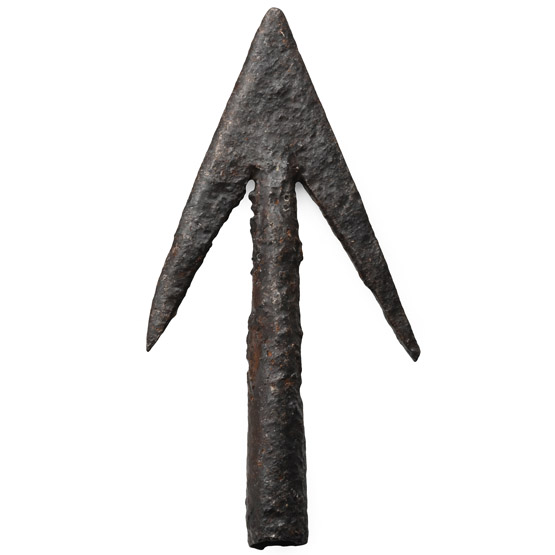
Large Medieval Socketted Iron Arrowhead
Circa 13th-15th century A.D.Sold for (Inc. bp): £208
With swept lateral barbs and deep conical socket. 20.66 grams, 88 mm
Acquired from a USA private collector in the 1990s. Ex Buckinghamshire, UK, collection. -
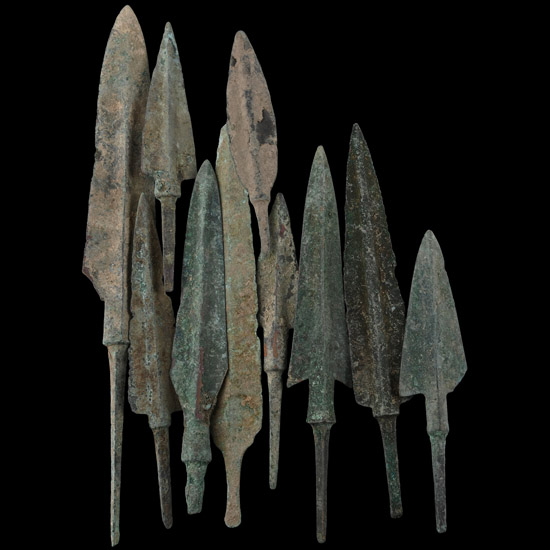
Western Asiatic Bronze Arrowhead Collection
2nd-1st millennium B.C.Sold for (Inc. bp): £312
Comprising leaf-shaped and triangular tanged arrowheads, most with a raised midrib. 238 grams total, 8.1-18.7 cm
London, UK, collection, 1990s.
All these bronze typologies of arrowheads were cast in moulds. Similar specimens have been found in Northwest and West Iran, Azerbaijan, Luristan and Amlash. Most of these blades are bipartite, but the definition of the bipartite type is not absolute, as it brings together weapons of very different and unrelated designs. In fact, some weapons do not have a sufficiently characteristic shape to be interpreted as a javelin or long arrowhead. -
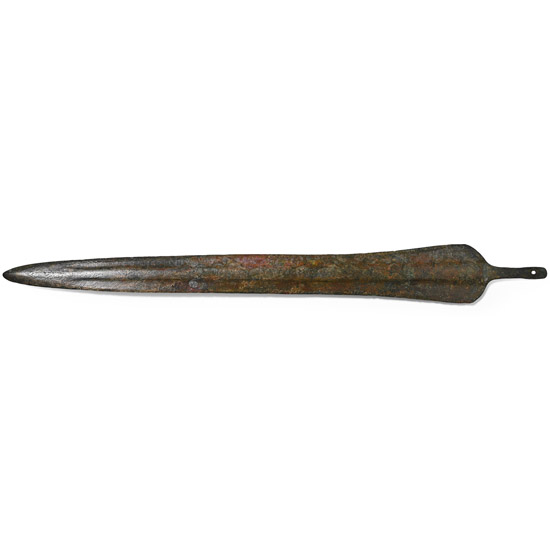
Western Asiatic Bronze Spear Blade
2nd-1st millennium B.C.Sold for (Inc. bp): £234
Triangular in plan with a broad, flat-section midrib, broad tip; rounded shoulders with a short pierced tang. 310 grams, 40.5 cm
Ex Abelita family collection, 1980s-2000s.

