-
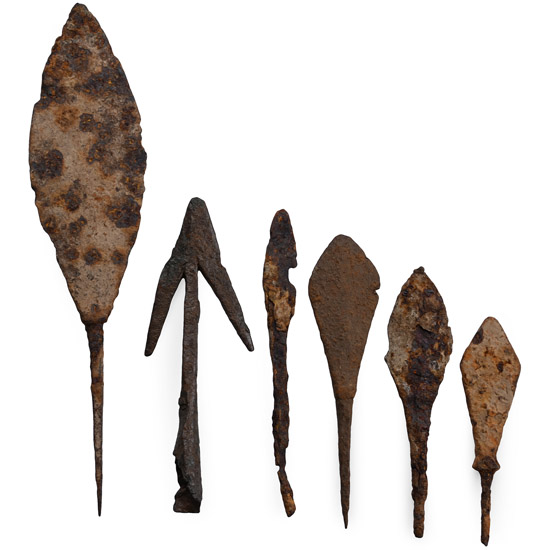
Roman to Medieval Iron Arrowhead Collection
3rd-14th century A.D.Sold for (Inc. bp): £208
Mixed group of tanged arrowheads, one a swallowtail type. 72 grams total, 6.8-14.9 cm
Ex German art market, 2000s. Acquired from an EU collector living in London. From the collection of a Surrey, UK, gentleman. -
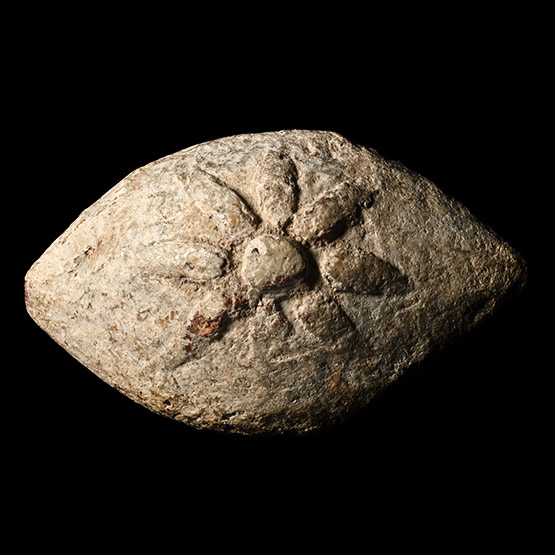
Greek Lead Slingshot with Macedonian Star
4th-3rd century B.C.Sold for (Inc. bp): £195
Biconical in profile with casting seam and the Macedonian Star on one side. 27.8 grams, 28 mm
Ex German art market, 2000s. Acquired from an EU collector living in London. From the collection of a Surrey, UK, gentleman.
In Greek warfare, slingers appear as psiloi, lightly equipped troops who skirmished ahead of a phalanx or alongside peltasts. Some city-states likely trained their own slingers; others were specialists. Rhodian slingers became famous in the 4th century B.C. because the islanders had a tradition of practice. In the Peloponnese, in mainland Greece, and along the Aegean coast, slingers fought in both field operations and sieges. The practice survived into the Roman period, during which specialist mercenaries, like the Rhodians or the Balearic slingers, were still in use. -
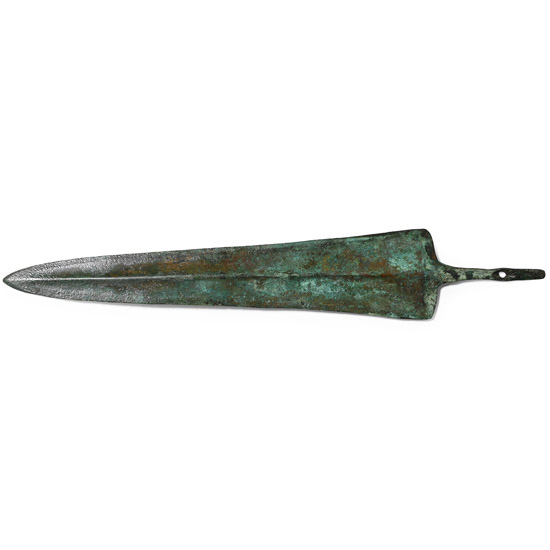
Greek Bronze Tanged Spearhead
1st millennium B.C.Sold for (Inc. bp): £234
With straight shoulders and lozengiform mid-rib running to the blade tip; short tang with fastening hole. 154 grams, 31 cm
Ex Abelita family collection, 1980s-2000s. -
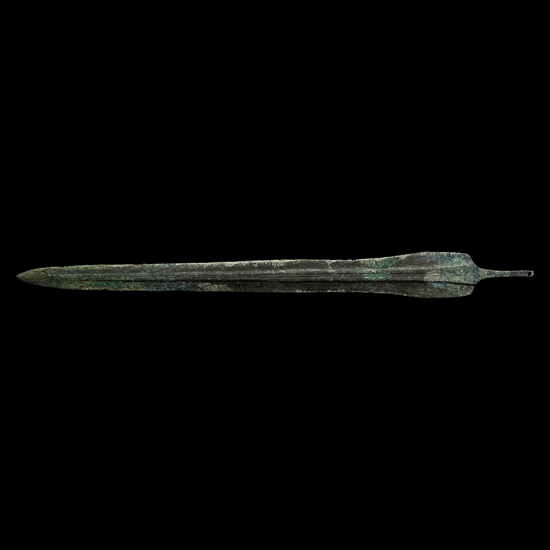
Luristan Bronze Tanged Dirk
Early 1st millennium B.C.Sold for (Inc. bp): £208
Comprising a slender blade with a raised midrib with grooves, a short rectangular-section tang pierced at the end. 200 grams, 41.5 cm
Ex Abelita family collection, 1980s-2000s.
The Luri people produced a quantity of fine metalwork, which, according to Dr Khorasani, could be due to a settled period arising as a result of the defeat of the Elamites by the Babylonians, leaving the Luristani people in relative peace for a period of time after 1200 BC. According to Khorasani, 'A culture of innovation and experimentation flourished, and the repertoire of the Luristan smiths expanded in the period between 1150-1050 B.C.' -
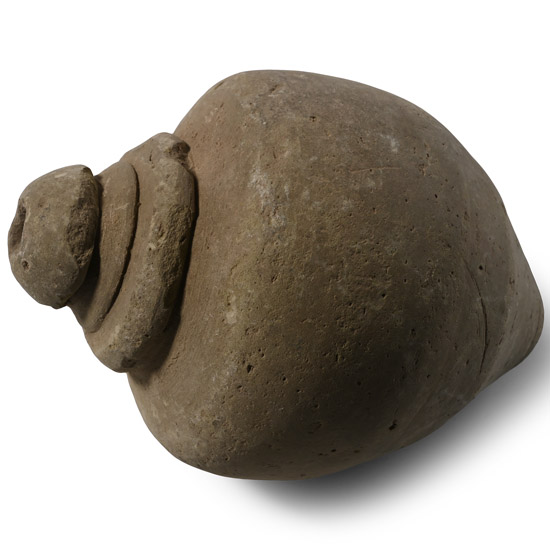
Byzantine 'Greek Fire' Ceramic Fire Bomb or Hand Grenade
9th-11th century A.D.Sold for (Inc. bp): £85
Ovoid in profile with a domed tiered filler hole; intended to be filled with explosive liquid and a wick, and used as a hand grenade. 700 grams, 13.8 cm
From an important specialist collection, London, UK, 1990s onwards. Accompanied by an academic paper by military specialist Dr Raffaele D'Amato, dated 15 July 2019 and titled 'Eastern Roman Empire - Greek Fire Bomb or Hand Grenade (μεσαίον kακάβιον) 9th-11th century AD'.
Apart from the use of siphons or manual flame-throwers called cheirosiphona, special corps of Roman soldiers employed terracotta grenades, in the form of small jars, abundantly evidenced in archaeological excavations. They were called μεσαία kακαβιά or κυτροκακάβια, where the former had a bulbous shape and the latter a more cylindrical form. -
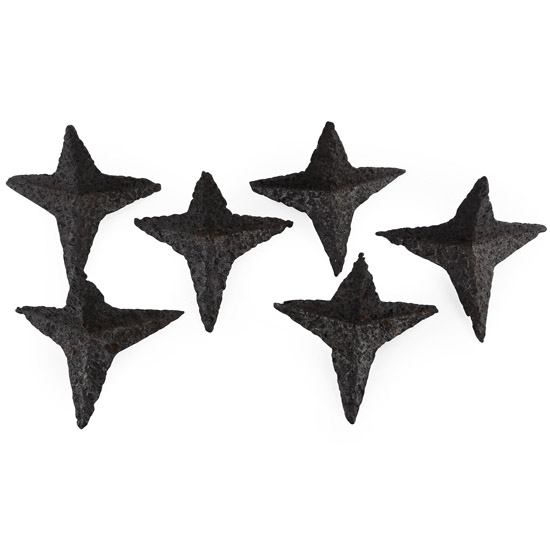
Medieval Iron Caltrop Anti-Cavalry Group
15th century A.D.Sold for (Inc. bp): £208
Comprising six caltrops, hand-forged with square-section spikes. 195 grams total, 85-87 mm
From the private collection of a London gentleman, from his grandfather's collection formed before the early 1970s.
P. Žákovský has been able to classify medieval caltrops, mainly from the 13th to 15th centuries A.D., based on their morphology, into four main typologies, each with different variants. Caltrops with single-pointed spikes, whose interpretation, however, is often ambiguous, belong to type I. The other three types represent classic four-pointed caltrops, and individual types in this group differ from one another just in their cross-section. -
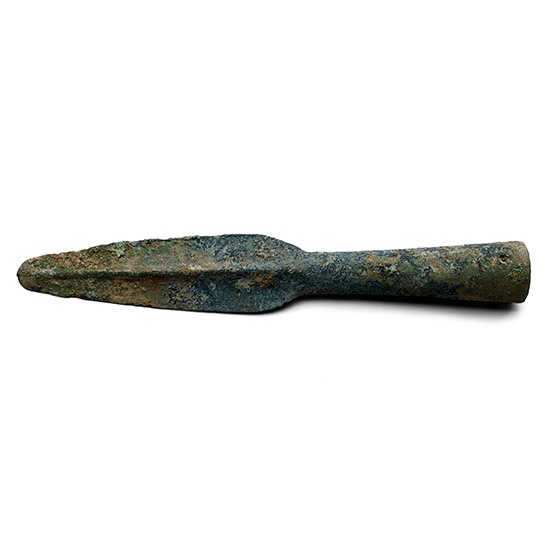
Luristan Bronze Socketted Spearhead
13th-6th century B.C.Sold for (Inc. bp): £117
Comprising a leaf-shaped blade with a raised midrib and a tapering tubular socket. 317 grams, 23.7 cm
Ex Abelita family collection, 1980s-2000s.
The spear belongs to the type VIII classified by Khorasani (spearheads with well-projecting midribs and long folded sockets) and more specifically to subtype C (with leaf-shaped blade and short hollow socket). Usually the willow-leaf blade has an almost straight shoulder base and a wide, flat midrib tapering towards the point. -
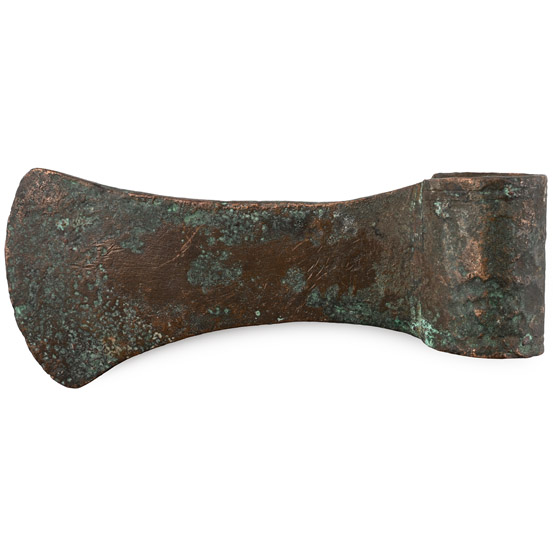
Western Asiatic Bronze Socketted Axehead
2nd-1st millennium B.C.Sold for (Inc. bp): £72
With flat blade a curved cutting edge, hammered round-section tubular socket. 112 grams, 10.8 cm
Ex Abelita family collection, 1980s-2000s. -
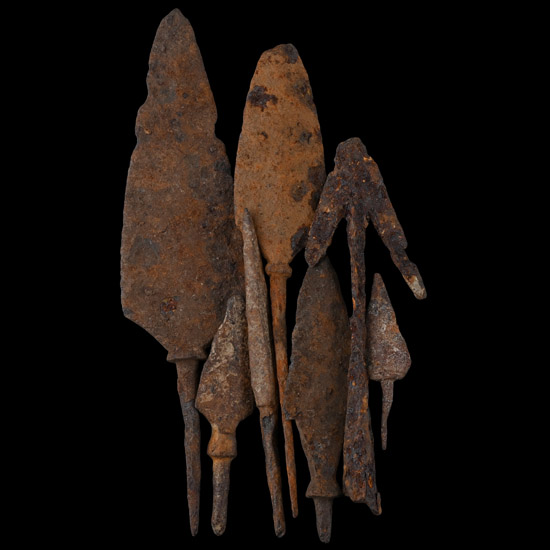
Roman to Medieval Iron Arrowhead Collection
3rd-14th century A.D.Sold for (Inc. bp): £117
Comprising seven tanged arrowheads, one a swallowtail type. 86 grams total, 5.7-13 cm
Ex German art market, 2000s. Acquired from an EU collector living in London. From the collection of a Surrey, UK, gentleman. -
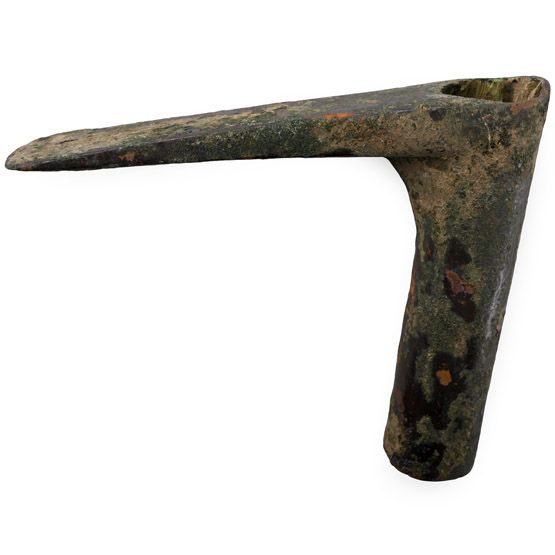
Luristan Bronze Socketted Adze
2nd-1st millennium B.C.Sold for (Inc. bp): £111
Long tubular socket, rectangular-section tapering blade with convex cutting edge. 355 grams, 14.2 cm
Ex Abelita family collection, 1980s-2000s. -
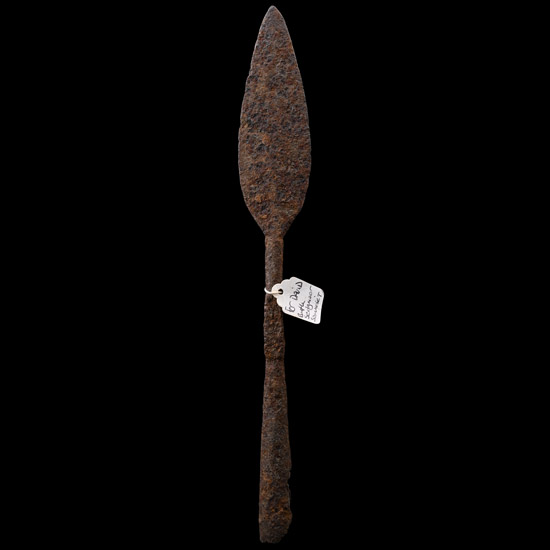
King James II Period Iron Lance Head
Late 17th century A.D.Sold for (Inc. bp): £52
Comprising a flat-section leaf-shaped blade with a short round-section neck, a square-section baluster with hatched surfaces, and a narrow flared socket with remains of original wooden shaft. 162 grams, 28.5 cm
By repute from the site of the battle of Sedgemoor (6th July 1685), Somerset, UK. Formerly from the collection of gentleman from South London, UK. Property of a private collector, West London, UK. -
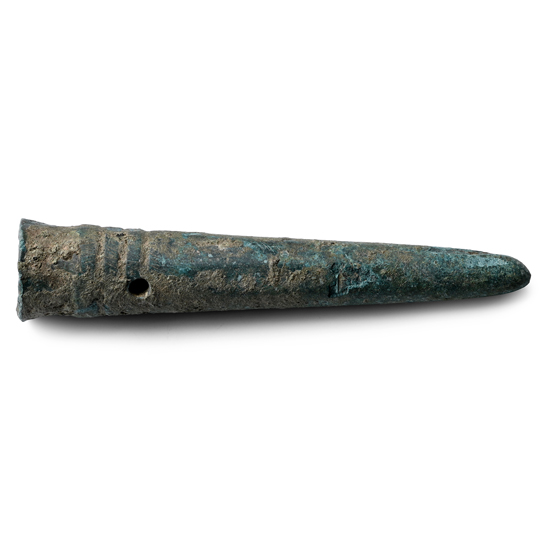
Villanovan Bronze Spear Butt End
Iron Age, circa 8th century B.C.Sold for (Inc. bp): £33
A conical hollow-form tube with ribbed neck, pierced through the sides for attachment. 71 grams, 11.2 cm
From the private collection of a European gentleman (1942-2024), formed since the 1970s.

