-
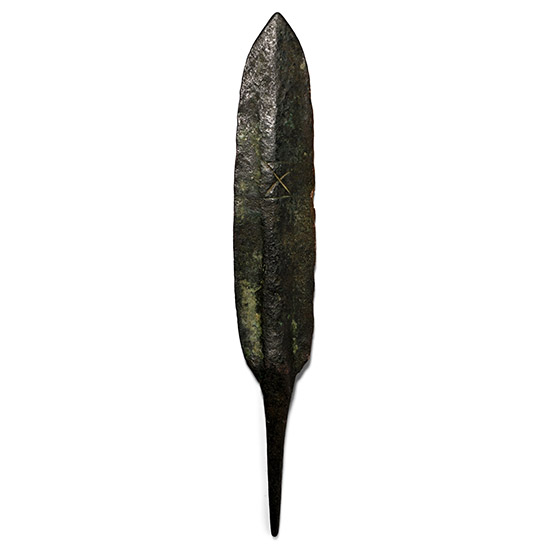
Western Asiatic Bronze Arrowhead or Javelin Head with Inscribed X
Late 2nd millennium B.C.Sold for (Inc. bp): £117
Leaf-shaped with two cutting edges and a broad point, low midrib, on the face an incised 'X' in a square. 15.17 grams, 11.34 cm
Ex Guttman collection, Germany. with Christie's, 28 April 2004, no.27 (part). Acquired from Bidancient and Artifacts UK, 2009. Ex important collection of Greek artefacts, London, UK.
The letter X has been found in various Semitic/Accadic or even Philistine Inscriptions in the Levant: dated between 13th-10th centuries B.C.: on the Lachish bowl no.1, on the Ruweiseh arrowhead, on a Byblian bronze spatula, on the Ahiram graffito, at Yehimilk. This suggests that the arrow or javelin head has been made in the Levant or the Fertile Crescent. -
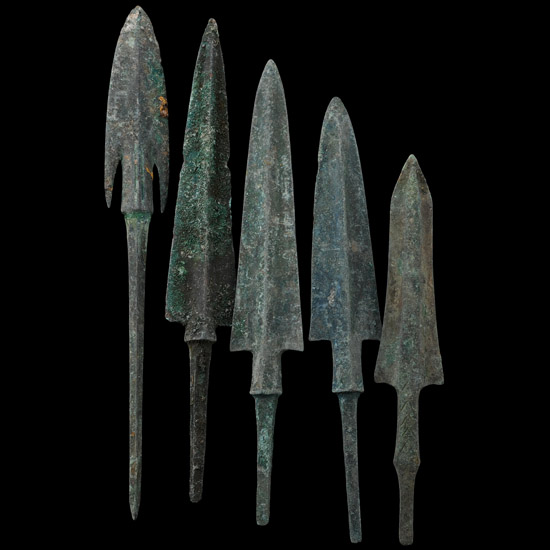
Western Asiatic Bronze Arrowhead Collection
2nd-1st millennium B.C.Sold for (Inc. bp): £143
Comprising five tanged arrowheads with raised midribs, one with barbed shoulders. 150 grams total, 11.7-15.4 cm
London, UK, collection, 1990s.
One category of the represented arrowheads has a sharp blade, the ends of which extend to form wings or barbs, and a prominent midrib extending into a long tang that often has a stop; the blade shape varies from deltoid to more triangular. Another form has no barbs, but it has a prominent midrib and triangular blade, with a stop at the tang. -
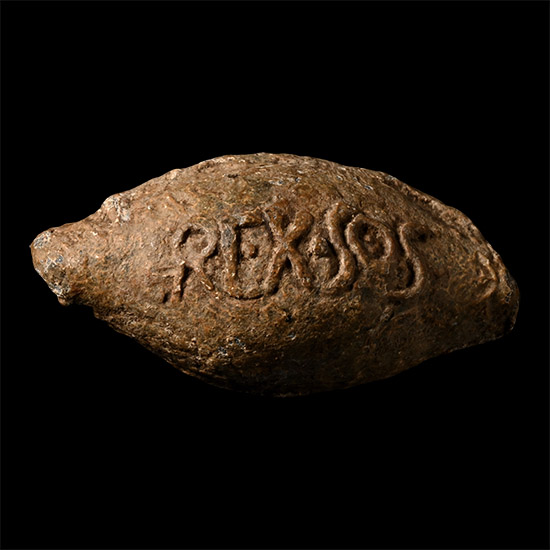
Greek Mauritanian Kingdom Lead Slingshot of King Mastanesosus
Circa 80-49 B.C.Sold for (Inc. bp): £780
Lentoid in form with raised legend to obverse 'REX·SOS'; Neo-Punic monogram to reverse. 72.8 grams, 40 mm
Acquired on the UK art market, early 2000s. Property of a London, UK, antiquarian.
This remarkable slingshot offers a rare insight into a little-known period in the history of the Kingdom of Mauretania in the first century BC. The piece can be linked to King Mastanesosus, who is known to have shortened his name to “Sos.” He was the son of Bocchus I (c. 110–80s BC), the ruler who famously betrayed King Jugurtha of Numidia to Sulla and the Roman Republic. The Latin inscription reflects Rome's growing influence at the time. It may even suggest that Roman slingers were part of Sosus’s army. During this period, Mauretania was already coming under Roman control and influence. Later, Bocchus II, the grandson of Sosus, supported the winning side in Rome’s civil war, and Mauretania became a client kingdom. This eventually led to its full absorption into the Roman Empire after the murder of King Ptolemy, son of Juba, by the emperor Caligula. The reverse of the slingshot shows a monogram in neo-Punic, similar to those found on coins from the same period. This is almost certainly a personal symbol or mark of Sosus himself. The use of both Latin and Neo-Punic makes the piece bilingual, which is particularly interesting. -
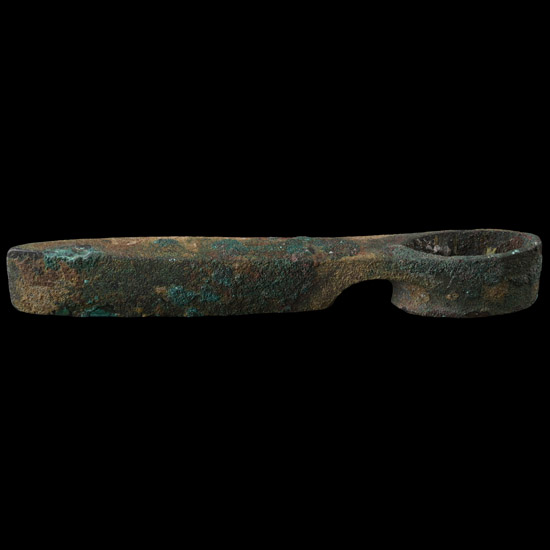
Canaanite Bronze Axehead
Bronze Age, 2000-1200 B.C.Sold for (Inc. bp): £65
Comprising a slender rectangular-section blade and an ellipsoid socket with a flared lower edge. 116 grams, 12 cm
From the private collection of a European gentleman (1942-2024), formed since the 1970s. -
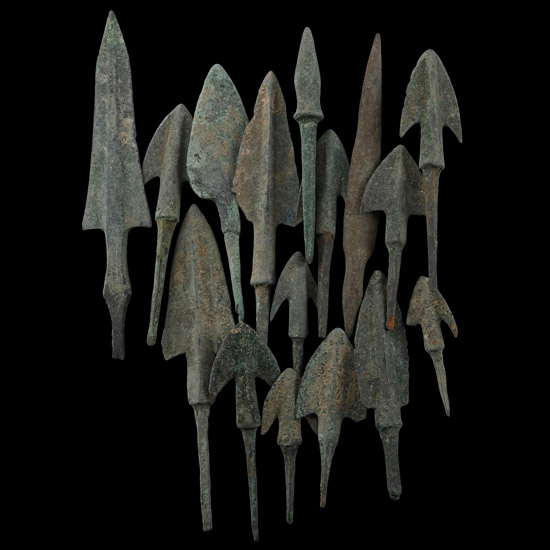
Western Asiatic Bronze Arrowhead Collection
14th-10th century B.C.Sold for (Inc. bp): £169
Mixed group of tanged arrowheads, nine with barbed shoulders, two with lanceolate heads, three with triangular heads, one spiked and one with a pyramidal head. 159 grams total, 4.2-10.3 cm
London, UK, collection, 1990s.
The majority of the arrowheads belong to type IV of the Khorasani classification. They resemble a stylised flying bird, such as a swallow. -
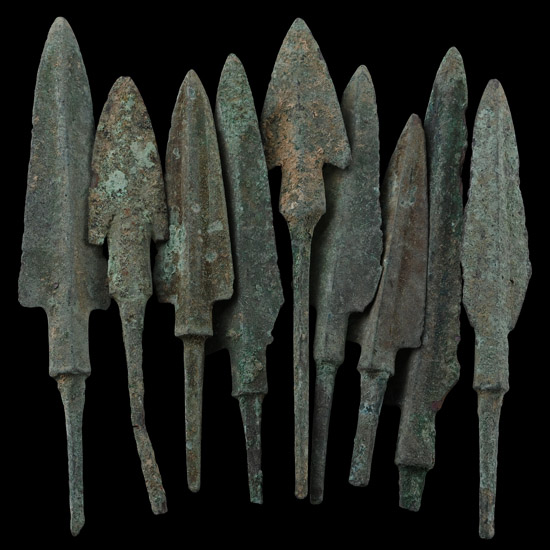
Western Asiatic Bronze Arrowhead Collection
2nd-1st millennium B.C.Sold for (Inc. bp): £195
Comprising tanged arrowheads, seven with large elongated triangular blades and raised midrib, sharp central groove, two with barbed shoulders and cylindrical stem with handle for the shaft. 205 grams total, 9.1-12.3 cm
London, UK, collection, 1990s.
These arrowheads seem to belong to the type V, subcategories C and D, according to the classification of Khorasani and Negahban. In the four categories of triangular bronze arrowheads from Luristan, Marlik, and Northern Iran, individuated by Negahban, subtypes C and D of type V are larger arrow or javelin heads, C with barbed shoulders and D with round shoulders. Most of them were cast in moulds. -
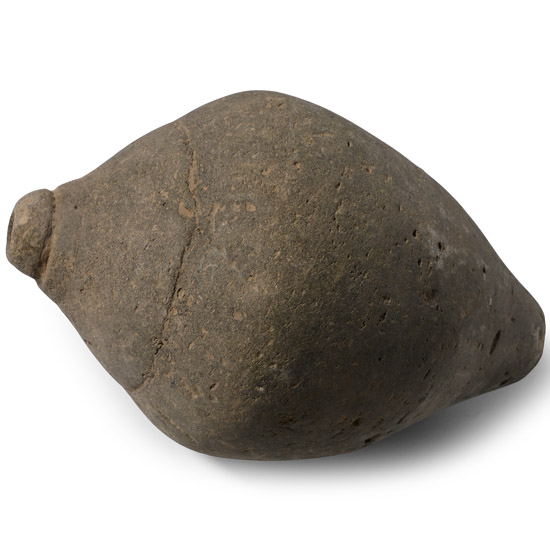
Byzantine 'Greek Fire' Ceramic Fire Bomb or Hand Grenade
9th-11th century A.D.Sold for (Inc. bp): £72
Ovoid in profile with a domed filler hole, a circumferential line above the shoulder; intended to be filled with explosive liquid and a wick, and used as a hand grenade. 474 grams, 14.6 cm
From an important specialist collection, London, UK, 1990s onwards. Accompanied by an academic paper by military specialist Dr Raffaele D'Amato, dated 15 July 2019 and titled 'Eastern Roman Empire - Greek Fire Bomb or Hand Grenade (μεσαίον kακάβιον) 9th-11th century AD'.
Apart from the use of siphons or manual flame-throwers called cheirosiphona, special corps of Roman soldiers employed terracotta grenades, in the form of small jars, abundantly evidenced in archaeological excavations. They were called μεσαία kακαβιά or κυτροκακάβια, where the former had a bulbous shape and the latter a more cylindrical form. -
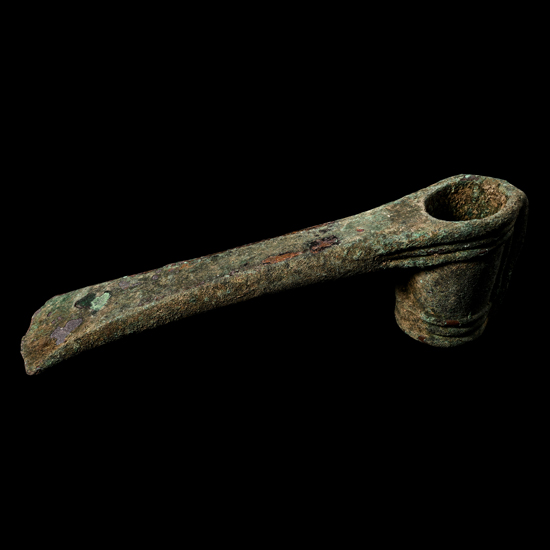
Luristan Bronze Socketted Adze
2nd-1st millennium B.C.Sold for (Inc. bp): £117
Short tubular socket with raised ribs, perpendicular rectangular-section blade with convex cutting edge. 402 grams, 17.6 cm
Ex Abelita family collection, 1980s-2000s.
Unadorned weapons, especially axes, adzes, and picks, were made by Luristan craftsmen using simple clay or stone bivalve moulds, into which a core was inserted to form the socket for the shaft. Typically, the metallic composition consisted of a combination of arsenical bronze and copper, together with a small percentage of lead. -
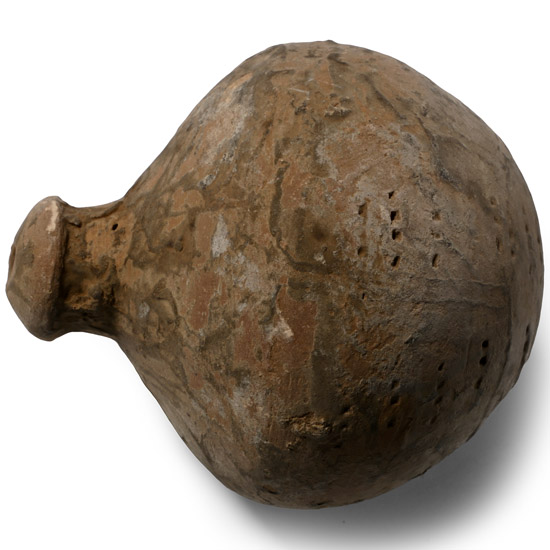
Byzantine 'Greek Fire' Ceramic Fire Bomb or Hand Grenade
9th-11th century A.D.Sold for (Inc. bp): £85
Ovoid in profile with domed filler hole; intended to be filled with explosive liquid and a wick, and used as a hand grenade. 370 grams, 10.4 cm
From an important specialist collection, London, UK, 1990s onwards. Accompanied by an academic paper by military specialist Dr Raffaele D'Amato, dated 15 July 2019 and titled 'Eastern Roman Empire - Greek Fire Bomb or Hand Grenade (μεσαίον kακάβιον) 9th-11th century AD'.
Apart from the use of siphons or manual flame-throwers called cheirosiphona, special corps of Roman soldiers employed terracotta grenades, in the form of small jars, abundantly evidenced in archaeological excavations. They were called μεσαία kακαβιά or κυτροκακάβια where the former had a bulbous shape and the latter a more cylindrical form. -
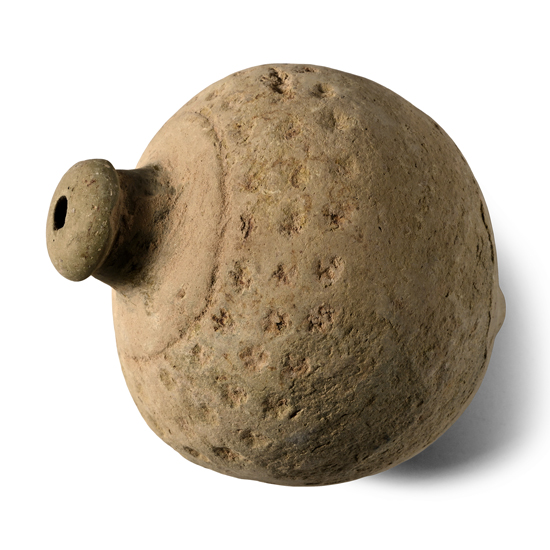
Byzantine 'Greek Fire' Ceramic Fire Bomb or Hand Grenade
9th-11th century A.D.Sold for (Inc. bp): £208
Ovoid in profile with impressed pellet decoration on the upper body; intended to be filled with explosive liquid and a wick, and used as a hand grenade. 436 grams, 11 cm
From an important specialist collection, London, UK, 1990s. Accompanied by an academic paper by military specialist Dr Raffaele D'Amato, dated 15 July 2019 and titled 'Eastern Roman Empire - Greek Fire Bomb or Hand Grenade (μεσαίον kακάβιον) 9th-11th century AD'.
Apart from the use of siphons or manual flame-throwers called cheirosiphona, special corps of Roman soldiers employed terracotta grenades, in the form of small jars, abundantly evidenced in archaeological excavations. They were called μεσαία kακαβιά or κυτροκακάβια, where the former had a bulbous shape and the latter a more cylindrical form. -
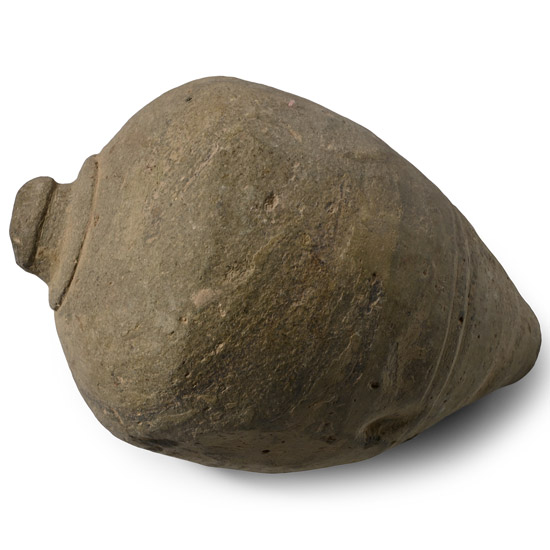
Byzantine 'Greek Fire' Ceramic Fire Bomb or Hand Grenade
9th-11th century A.D.Sold for (Inc. bp): £91
Ovoid in profile with domed filler hole, linear decoration; intended to be filled with explosive liquid and a wick, and used as a hand grenade. 797 grams, 14.1 cm
From an important specialist collection, London, UK, 1990s onwards. Accompanied by an academic paper by military specialist Dr Raffaele D'Amato, dated 15 July 2019 and titled 'Eastern Roman Empire - Greek Fire Bomb or Hand Grenade (μεσαίον kακάβιον) 9th-11th century AD'.
Apart from the use of siphons or manual flame-throwers called cheirosiphona, special corps of Roman soldiers employed terracotta grenades, in the form of small jars, abundantly evidenced in archaeological excavations. They were called μεσαία kακαβιά or κυτροκακάβια, where the former had a bulbous shape and the latter a more cylindrical form. -
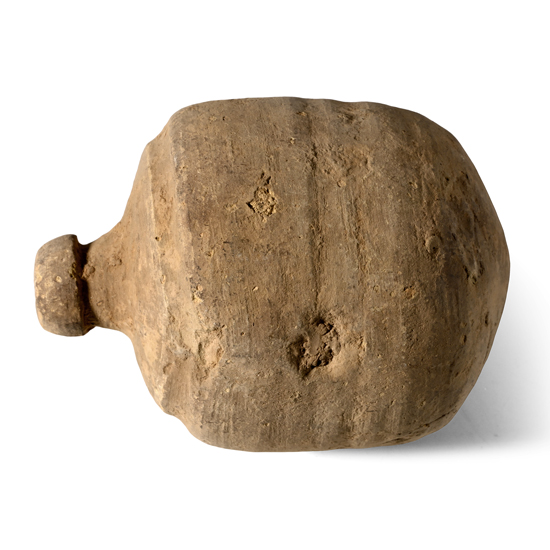
Byzantine 'Greek Fire' Ceramic Fire Bomb or Hand Grenade
9th-11th century A.D.Sold for (Inc. bp): £85
Large, cylindrical body with a domed filler hole; intended to be filled with explosive liquid and a wick, and used as a hand grenade. 636 grams, 12.8 cm
From an important specialist collection, London, UK, 1990s. Accompanied by an academic paper by military specialist Dr Raffaele D'Amato, dated 15 July 2019 and titled 'Eastern Roman Empire - Greek Fire Bomb or Hand Grenade (μεσαίον kακάβιον) 9th-11th century AD'.
Apart from the use of siphons or manual flame-throwers called cheirosiphona, special corps of Roman soldiers employed terracotta grenades, in the form of small jars, abundantly evidenced in archaeological excavations. They were called μεσαία kακαβιά or κυτροκακάβια, where the former had a bulbous shape and the latter a more cylindrical form.

