-
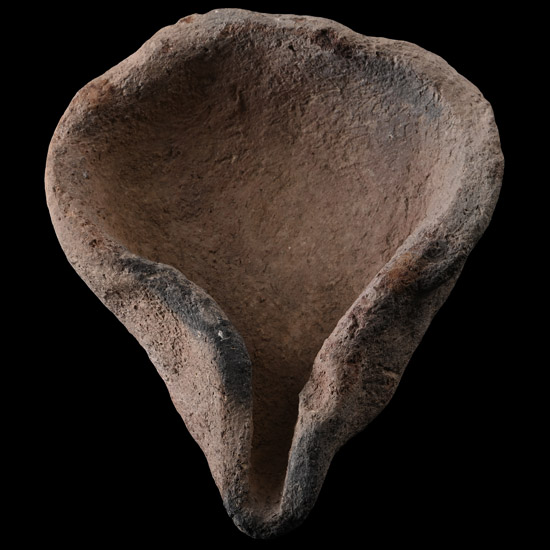
Holy Land Terracotta Pinched Rim Oil Lamp
Iron Age, late 1st millennium B.C.Sold for (Inc. bp): £33
A shallow oil lamp with an open body and a pinched spout. 90 grams, 89 mm
From the collection of a Yorkshire, UK gentleman, items collected in the Holy Land in the 1960s. -
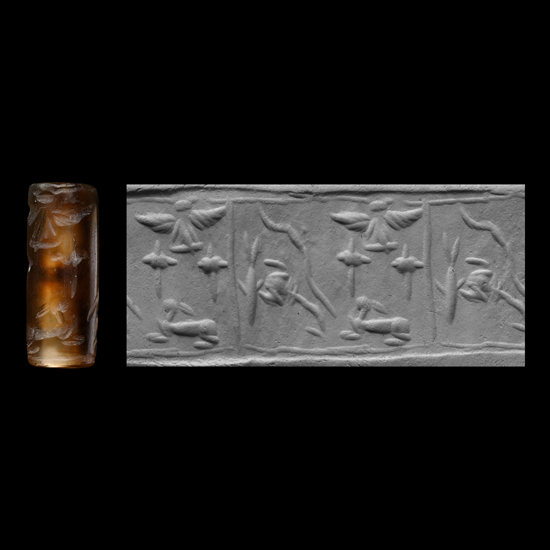
Western Asiatic Carnelian Cylinder Seal with Animals
2nd-1st millennium B.C.Sold for (Inc. bp): £104
Frieze with bird in flight above a crouching quadruped, among trees; supplied with a museum-quality impression. 0.68 grams, 13.97 mm
From the private collection of a European gentleman (1942-2024), formed since the 1970s. -
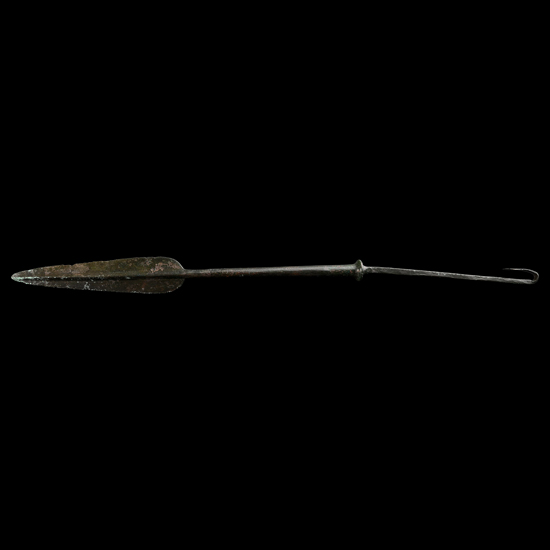
Mesopotamian Bronze Tanged Javelin
3rd-2nd millennium B.C.Sold for (Inc. bp): £156
With a foliate blade, rhomboidal in section, raised mid-rib, medium-length stem widening at its base and forming a small stop, rectangular-section tang with bent terminal. 194 grams, 46 cm
Ex Abelita family collection, 1980s-2000s.
The specimen belongs to the category of tripartite spears with a long, pointed biconvex blade and a single bevelled tang. They seem to be a Mesopotamian and Susian (Elamite) variant, and this type also includes decorated blades, like the spear from Tello with the inscription 'King of Kish'. -
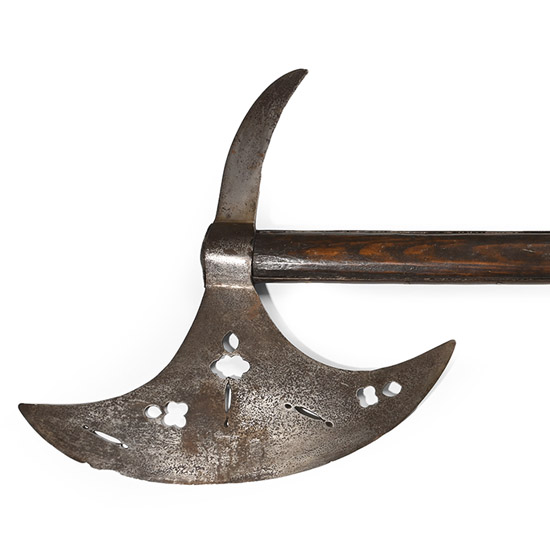
Post Medieval Iron Poleaxe with Wooden Handle
Germany or England, 16th century A.D.Sold for (Inc. bp): £910
With a broad, flaring triangular-section blade extending to a curved edge with carination to its rear, pointed extension to the reverse of the socket; the blade decorated with openwork floral and vegetal patterns; mounted on a wooden shaft. 1.75 kg, 140.5 cm
Acquired from Lyon & Turnbull, UK, in 2013. From a large West London collection formed from the 1990s.
This is a war weapon issued to infantry, intended for use against cavalry. The distinctive openwork blade suggests it was a standard-issue weapon, not for an occasional use. -
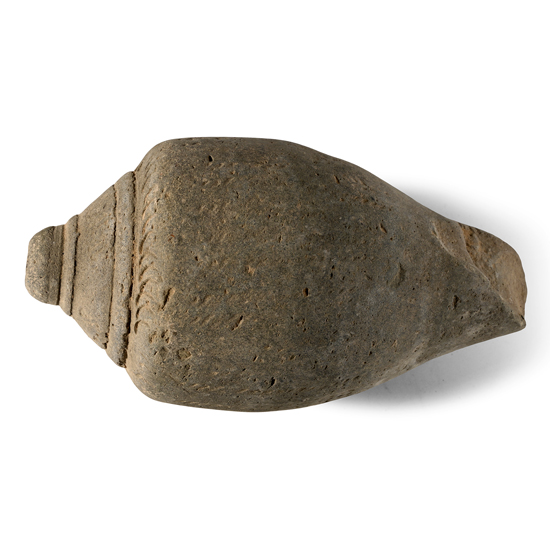
Turco-Mongol 'Greek Fire' Ceramic Fire Bomb or Hand Grenade
14th-15th century A.D.Sold for (Inc. bp): £85
Piriform in profile with a domed mouth and a stepped neck, incised decoration; intended to be filled with explosive liquid and a wick, and used as a hand grenade. 406 grams, 15 cm
From an important specialist collection, London, UK, 1990s.
Apart from the use of siphons or manual flame-throwers called cheirosiphona, special corps of Roman soldiers employed terracotta grenades, in the form of small jars, abundantly evidenced in archaeological excavations. They were called μεσαία kακαβιά or κυτροκακάβια, where the former had a bulbous shape and the latter a more cylindrical form. -
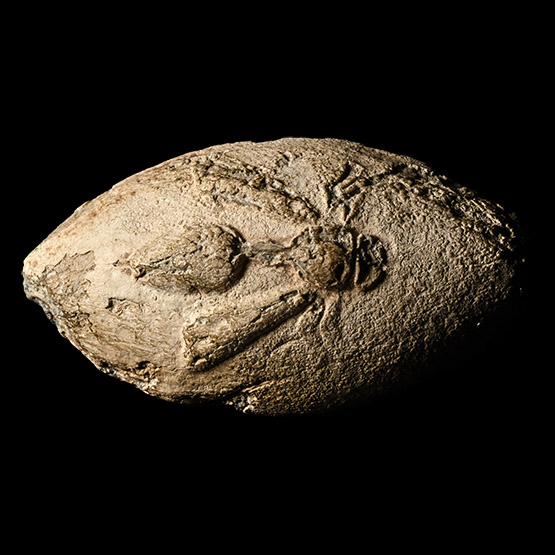
Greek Lead Slingshot with Inscription and Bee
3rd century B.C.Sold for (Inc. bp): £286
Lentoid-section and depicting a bee to one side and the inscription 'ΚΑΛΑ' on the other. 30.4 grams, 31 mm
Ex German art market, 2000s. Acquired from an EU collector living in London. From the collection of a Surrey, UK, gentleman.
The slingshots with an inscription ΚΑΛΑ are believed to originate from the island of Rhodes. On these sling bullets, ΚΑΛΑ should be translated as “nice things.” Together with the Balearic slingers, Rhodian slingers were considered to be the best of the Hellenistic world, and they were also used in the Roman army. -
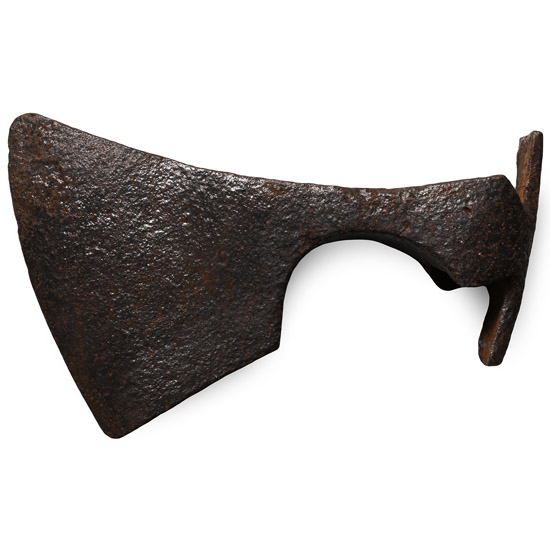
Viking Age Iron Bearded Axehead
Circa 9th-11th century A.D.Sold for (Inc. bp): £260
With a broad, curved blade and a narrow neck, a round socket with an extended edge to the reverse. 358 grams, 15.1 cm
Ex North American collection, 1970s-1980s. -
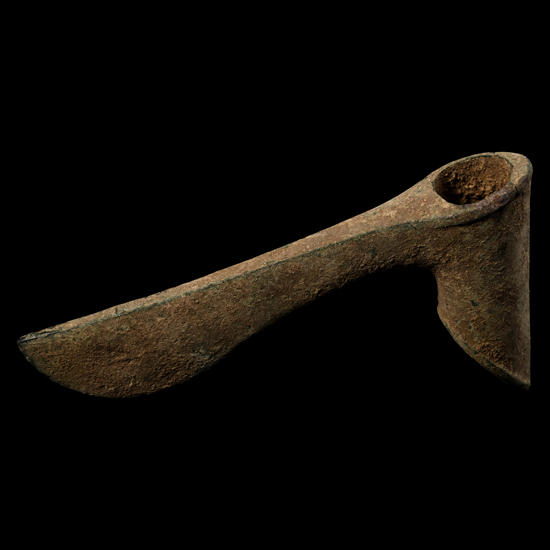
Luristan Bronze Socketted Axehead
2nd millennium B.C.Sold for (Inc. bp): £117
With a long D-shaped blade with a scooped profile and a tubular socket offset at the base. 313 grams, 16 cm
Ex Abelita family collection, 1980s-2000s.
Many examples of bronze axeheads are attributed to the Luristan culture and various shapes have been discussed by different scholars. Moorey (1971, pp.39-41) shows similar axeheads, stating that the texts executed on some specimens have shown them made of arsenical bronze, and attributes them to the late 3rd millennium B.C. or 2nd millennium B.C., period in which this alloy was used abundantly. -
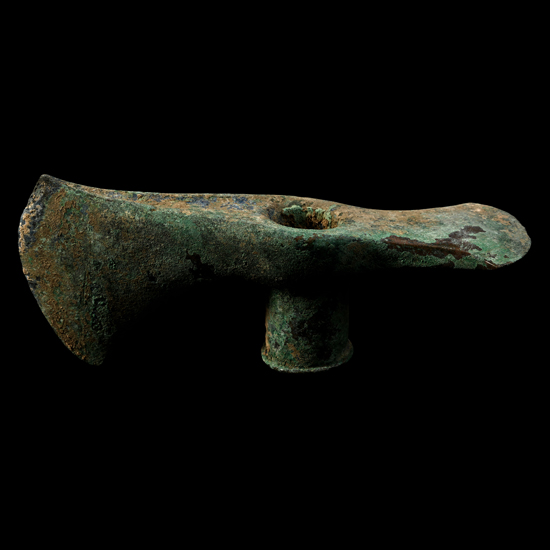
Luristan Bronze Socketted Adze-Axehead
2nd-1st millennium B.C.Sold for (Inc. bp): £117
Short tubular socket with thickened rim, perpendicular short blade with convex cutting edge to the rear, and a larger triangular-section blade with curving blade to the front. 675 grams, 16.5 cm
Ex Abelita family collection, 1980s-2000s.
The earliest axes-adzes from the 3rd millennium B.C. were weapons and tools furnished with socket holes. Usually, the socket is a more secure way of attaching the object to a wooden haft than having a simple tang. These weapons developed into a plethora of forms in the 2nd millennium B.C., and the numerous new forms were used until at least 800 B.C. -
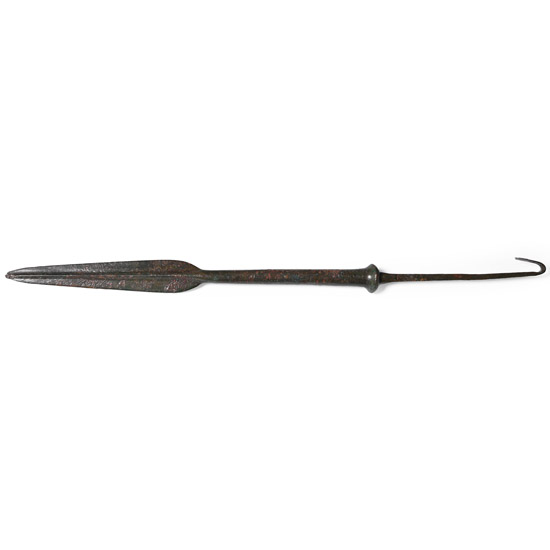
Greek Bronze Tanged Spearhead
1st millennium B.C.Sold for (Inc. bp): £234
Comprising a round-section tapering shank developing to the midrib of a leaf-shaped two-edged blade, flange collar, square-section tang and hooked finial. 181 grams, 36.5 cm
Ex Abelita family collection, 1980s-2000s. -
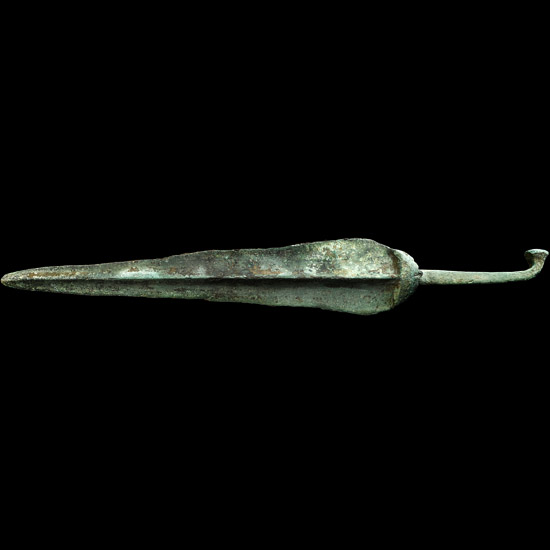
Western Asiatic Bronze Tanged Spearhead
Early 2nd millennium B.C.Sold for (Inc. bp): £182
Slender blade with raised midrib and rectangular-section tang with clubbed finial. 370 grams, 34 cm
Ex Abelita family collection, 1980s-2000s.
A certain number of similar blades, some considered to be spearheads and others to be daggers, all with bent tang, derived from Tepe Hissar Culture III. Some of them, like our specimen, have a button terminal, others have a plain, pointed terminal. The general dating of these specimens is fixed to the early 2nd millennium B.C. -
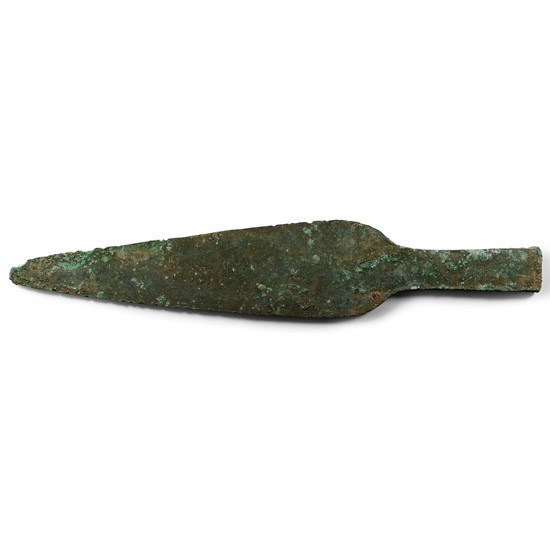
Western Asiatic Integral Hilted Bronze Short Sword
Late 3rd-2nd millennium B.C.Sold for (Inc. bp): £143
With a broad, lentoid-section flat blade, rounded tip, sloping sides, well marked shoulders with wide but short tang. 713 grams, 43.5 cm
Acquired 1980-2015. Ex Abelita family collection.
The sword finds similarity with a one from the Royal Cemetery of Ur. This is the most primitive form of dagger, consisting of a simple, pointed blade having slightly convex outline shoulders sloping to a short tang which has no rivets, and was probably hafted to wood with bitumen.

