-

Viking Inspired Bronze Omega Brooch
Mordvinian, 12th-14th century A.D.Sold for (Inc. bp): £65
With pellets and raised borders to the trapezoidal panels. 17 grams, 63 mm
Property of a North West London, UK, gallery; formerly in a 1980s collection. From the property of a late Lincolnshire, UK, gentleman. -

Viking Age Tooth Pendant
Circa 9th-12th century A.D.Sold for (Inc. bp): £72
Comprising a domed bronze cap with a round suspension loop, set with a long striated tooth or a tusk. 22.9 grams, 78.6 mm
Ex UK private collection, 1980s. Acquired from a London antiques fair. -
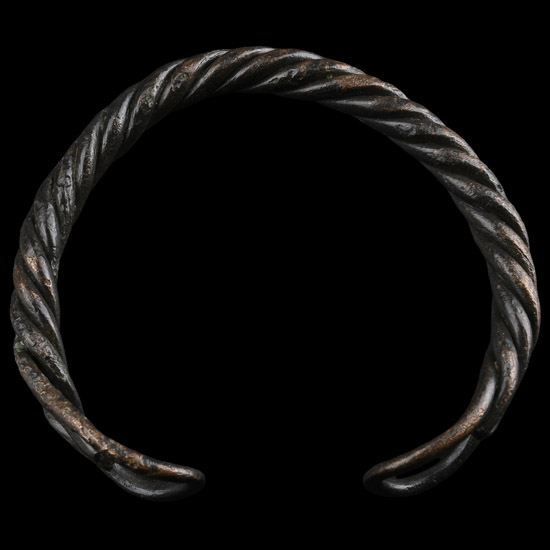
Viking Age Coiled Wire Bracelet
Circa 9th-11th century A.D.Sold for (Inc. bp): £91
Formed of twisted round-section bars with looped terminals. 21.2 grams, 58 mm
Ex German art market, 2000s. Acquired from an EU collector living in London. From the collection of a Surrey, UK, gentleman. -

Viking Age Bronze Omega Brooch with Shell Dangles
Mordvinian, 12th-14th century A.D.Sold for (Inc. bp): £260
A flat-section omega brooch comprising a penannular band and two trapezoidal plates; an articulate tongue; plates with raised pellets and four pierced lugs to the outer edges; cowrie shells suspended from the lugs beneath. 20.8 grams, 85 mm
From the private collection of a European gentleman (1942-2024), formed since the 1970s. -

Viking Age Bronze Ring with Cabochon
Circa 9th-12th century A.D.Sold for (Inc. bp): £104
Comprising a faux-twist hoop and square bezel with a reused glass bead cabochon in a claw setting. 1.26 grams, 22.46 mm overall, 14.05 mm internal diameter (approximate size British F, USA 2 3/4, Europe 3.67, Japan 3)
From the private collection of a European gentleman (1942-2024), formed since the 1970s. -

Anglo-Scandinavian Viking Bronze Stirrup Apex Mount Group
11th century A.D.Sold for (Inc. bp): £39
Comprising: Class A Type 1 with ferrous studs; Class A Type 2 with apex tab absent. 36.3 grams total, 43-45 mm
Found Norfolk, UK. -

Viking Iron Broad Axehead
9th-11th century A.D.Sold for (Inc. bp): £247
With rectangular spurs above and below the curved socket, a medium-broad flaring triangular-section blade extending to a curved edge; remains of the original wooden shaft inside the socket. 670 grams, 15.5 cm
From the private collection of a London gentleman, from his grandfather's collection formed before the early 1970s. -
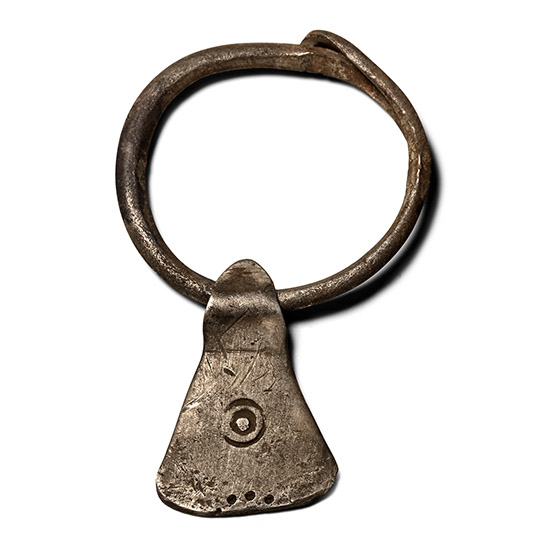
Viking Age Silver Axehead Pendant
Circa 9th-11th century A.D.Sold for (Inc. bp): £130
Comprising an axe-shaped pendant with a flaring blade and a punched annulet-in-ring motif, a large suspension loop. 5.78 grams, 49 mm
Ex German art market, 2000s. Acquired from an EU collector living in London. From the collection of a Surrey, UK, gentleman. -
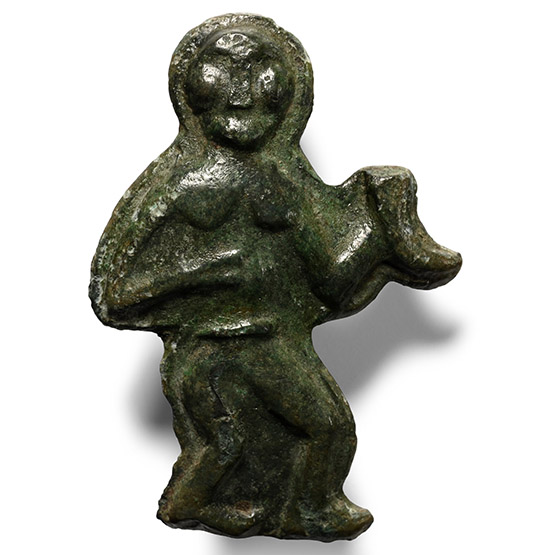
Scandinavian Pre-Viking Bronze Patrix Die with God and Drinking Horn
4th-5th century A.D.Sold for (Inc. bp): £124
Modelled in the half-round, advancing figure with bent legs and holding a drinking horn. 7.62 grams, 37 mm
From the private collection of a London gentleman, from his grandfather's collection formed before the early 1970s. -

Viking Iron Bearded Axehead
9th-11th century A.D.Sold for (Inc. bp): £338
Finely curved broad blade with a chin to the lower edge and a spur to the rear, rounded socket with lateral triangular extensions; traces of the original wooden shaft inside the socket. 655 grams, 18.5 cm
From the private collection of a London gentleman, from his grandfather's collection formed before the early 1970s. -
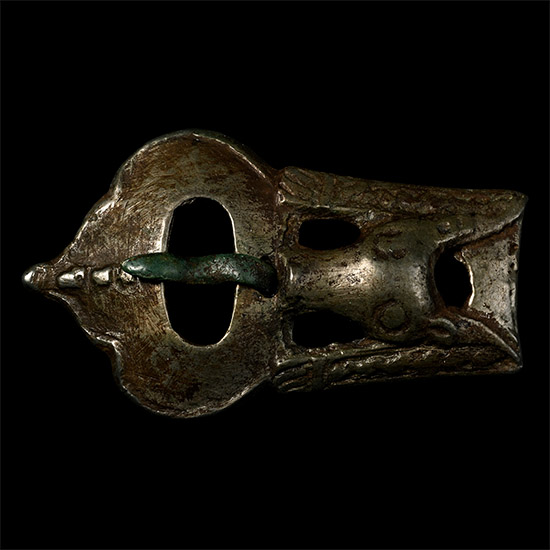
Viking Bronze Buckle with Wolf's Head
Circa 8th-10th century A.D.Sold for (Inc. bp): £195
Comprising a trapezoidal openwork plate and integral buckle loop; the loop domed in section with triangular extension to the forward edge and raised billets, flat-section coiled tongue; the plate formed as a facing lupine head with reserved running zigzag to each flanking foreleg attached to the rear of the loop; Western Baltic type. 26.89, 65.98 mm
From the private collection of a London gentleman, from his grandfather's collection formed before the early 1970s. -
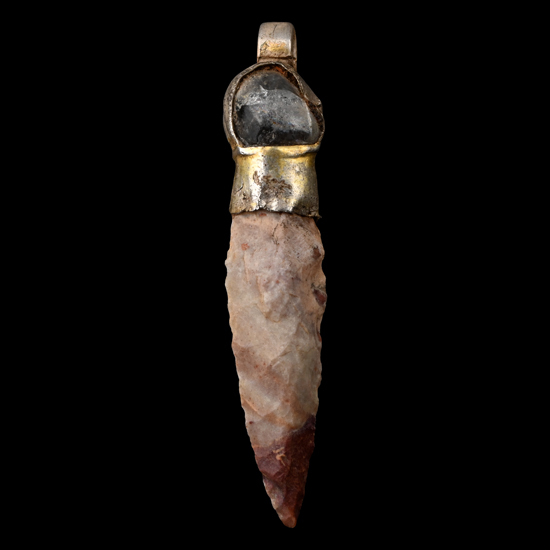
Viking Silver-Gilt Elfshot Pendant with Stone Arrowhead
9th-11th century A.D. and earlierSold for (Inc. bp): £845
Comprising a silver sleeve with a knapped flint arrowhead, a circular cell set with a clear glass cabochon above. 3.46 grams, 44.84 mm
From the private collection of a London gentleman, from his grandfather's collection formed before the early 1970s.
This amulet was believed to offer protection against 'Elfshot'. The attack of elves was believed responsible for mysterious suffering in men and livestock: sudden shooting pains localised to a particular area of the body, such as in rheumatism, arthritis, or muscle stitches or cramps. Elves were thought to shoot darts or arrows where such pains had no obvious external cause. Belief in elfshot persisted into the 20th century in rural areas, and as proof, country folk would sometimes find small arrowheads (the remains of Neolithic or Mesolithic flints, or naturally-occurring spear-shaped stones) that were believed to be the magical weapons that caused the afflictions. Belief in elfshot began in the Pagan Germanic period.

