-
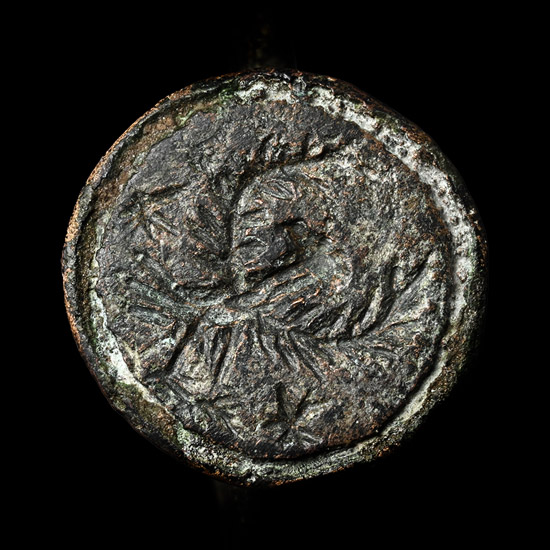
Migration Period Bronze Ring with Spread Eagle
6th-8th century A.D.Sold for (Inc. bp): £98
Round-section hoop with a large discoid bezel with an eagle with curving wings and spread tail, head turned to the left, two stars on the field. 9.50 grams, 29.63 mm overall, 21.66 mm internal diameter (approximate size British W, USA 11, Europe 25, Japan 24)
Ex German art market, 2000s. Acquired from an EU collector living in London. From the collection of a Surrey, UK, gentleman. -
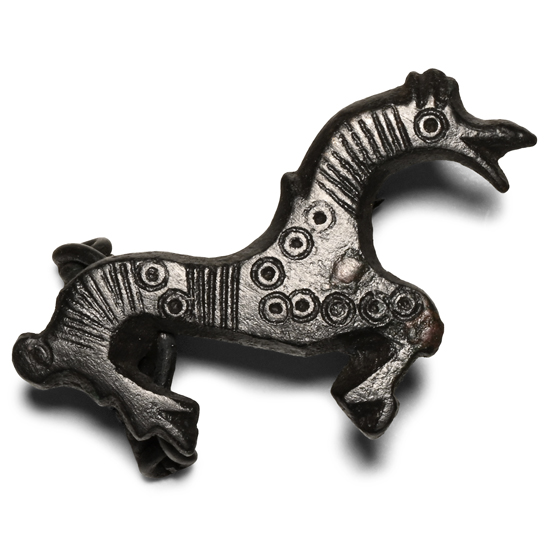
Saxon Bronze Horse Brooch
Circa 5th-6th century A.D.Sold for (Inc. bp): £598
Modelled as a stylised horse in a dynamic pose with an open mouth, the body decorated with linear and ring-and-dot motifs; a coiled pin and a catchplate on the reverse. 6.12 grams, 36 mm
Ex Wiltshire, UK, collection, 1990s. -
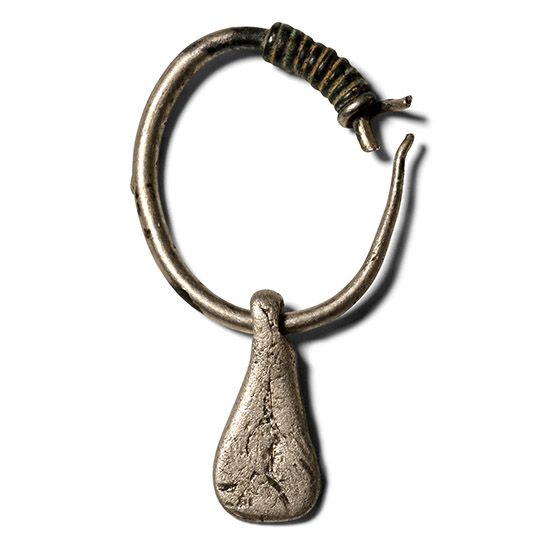
Viking Age Silver Axehead Pendant
Circa 9th-11th century A.D.Sold for (Inc. bp): £72
Flat-section axehead dangle attached to a sturdy wire suspension loop. 4.9 grams, 41 mm
Ex German art market, 2000s. Acquired from an EU collector living in London. From the collection of a Surrey, UK, gentleman. -
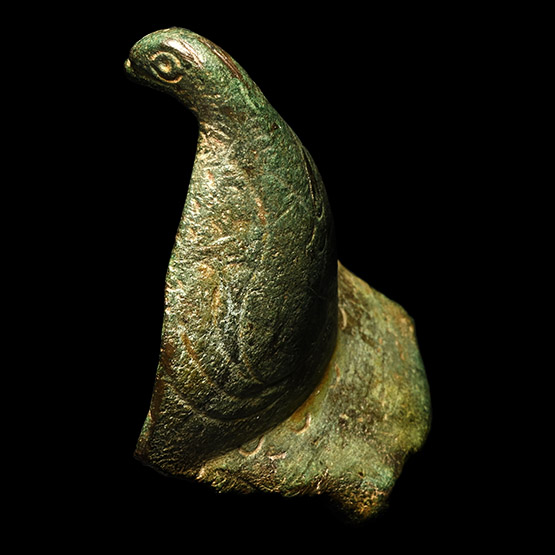
Anglo-Saxon Bronze Bowl Mount in the Shape of a Bird
Late 5th-6th century A.D.Sold for (Inc. bp): £182
Comprising a rounded conical shank with flange to the lower edge, a hooked finial formed as an avian head and neck with eye and beak detailing; incised low-relief swept wings to the outer face. 34.6 grams, 58 mm
Acquired on the UK art market. Property of an Essex, UK, gentleman. -
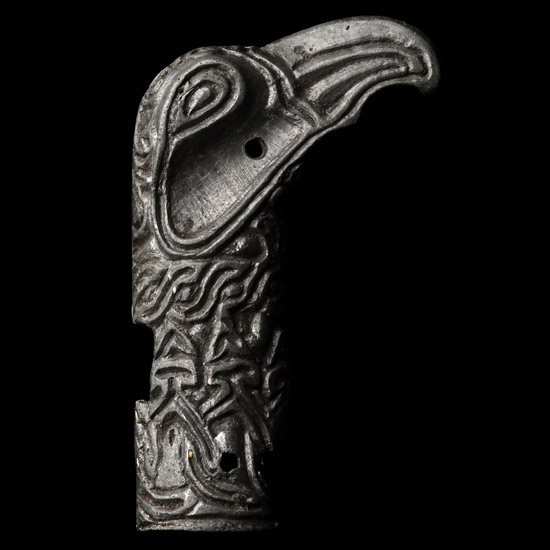
Viking Age Bronze Riding Crop Terminal Plate with Eagle's Head
Circa 9th-10th century A.D.Sold for (Inc. bp): £195
Displaying stylised feather, head and beak detailing; pierced twice for attachment; hollow-formed front plate. 14.19 grams, 56 mm
Private collection formed in Europe in the 1980s. Westminster collection, central London, UK. -
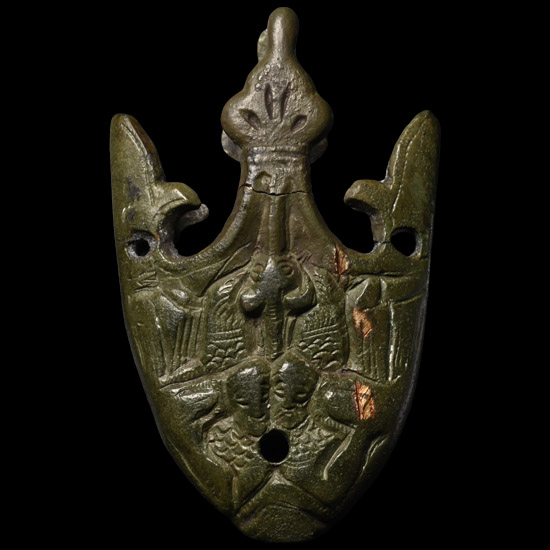
Viking Age Bronze Figural Sword Chape
Circa 11th century A.D.Sold for (Inc. bp): £845
Scaphoid in section and D-shaped in plan with three holes to accept mounting pins; low-relief foliage detailing to both broad faces, trefoil median lobe. 32.77 grams, 57 mm
Private collection formed in Europe in the 1980s. Westminster collection, central London, UK. -
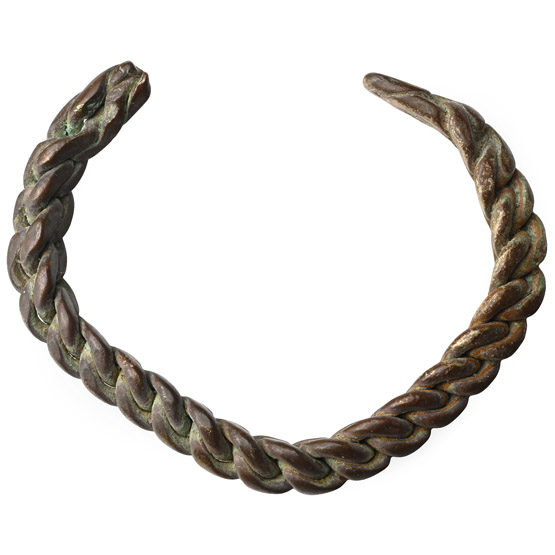
Viking Age Bronze Twisted Bar Bracelet
Circa 9th-11th century A.D.Sold for (Inc. bp): £85
Two rods tightly twisted and curved into a penannular shape, hammered flat towards the ends. 29.9 grams, 67 mm
Ex Arundel, East Sussex, UK, private collection, 1970s-2000. -
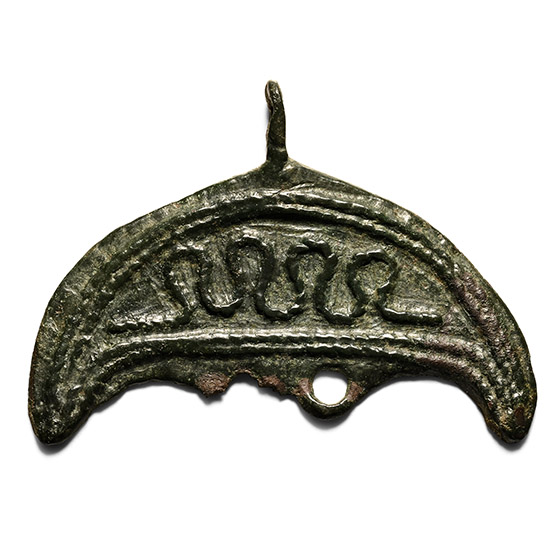
Viking Age Bronze Lunar Pendant with Snake
Circa 9th-11th century A.D.Sold for (Inc. bp): £325
Crescentic pendant with faux rope decoration, at the centre a sinuous snake. 8.35 grams, 48 mm
Ex Wiltshire, UK, collection, 1990s. -
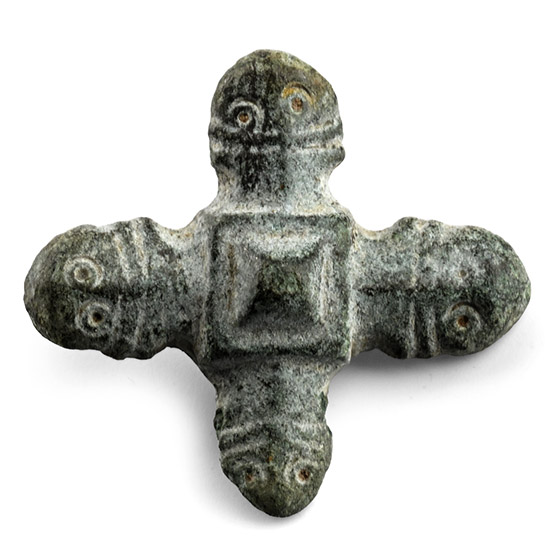
Dark Age Bronze Cruciform Human-Headed Stud Decoration
Circa 6th century A.D.Sold for (Inc. bp): £65
Central pyramidal stud with four radiating D-shaped masks, peg to underside. 5.22 grams, 30 mm
London, UK, collection, 1990s. -
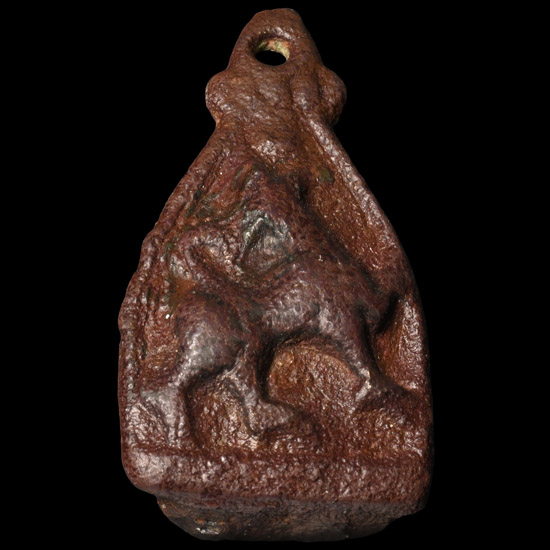
Anglo-Scandinavian Viking Bronze Stirrup Apex Mount with Howling Beast
11th century A.D.Sold for (Inc. bp): £143
Formed with a tongue-shaped body, of Williams's Class A Type 11 with pierced trefoil lug above, ledge to the reverse, two fixing holes, high-relief profile wolf with head thrown back and mouth open in a howling posture. 24 grams, 49.5 mm
Ex Manchester, UK, collection, 1990s. Accompanied by a previous typed catalogue information card. -
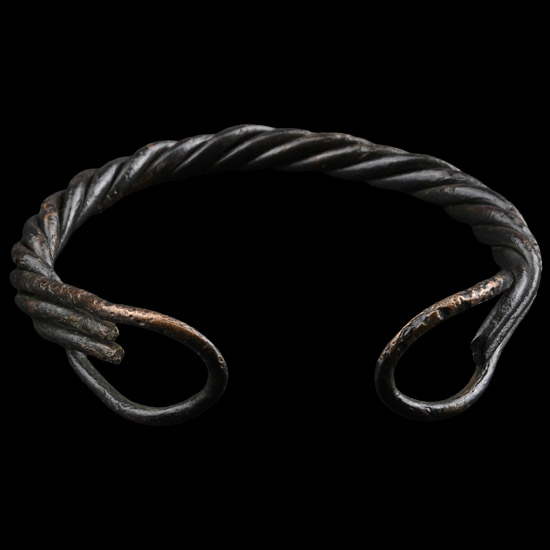
Viking Age Coiled Wire Bracelet
Circa 9th-11th century A.D.Sold for (Inc. bp): £143
Formed of twisted round-section bars with looped terminals. 17.3 grams, 58 mm
Ex German art market, 2000s. Acquired from an EU collector living in London. From the collection of a Surrey, UK, gentleman. -
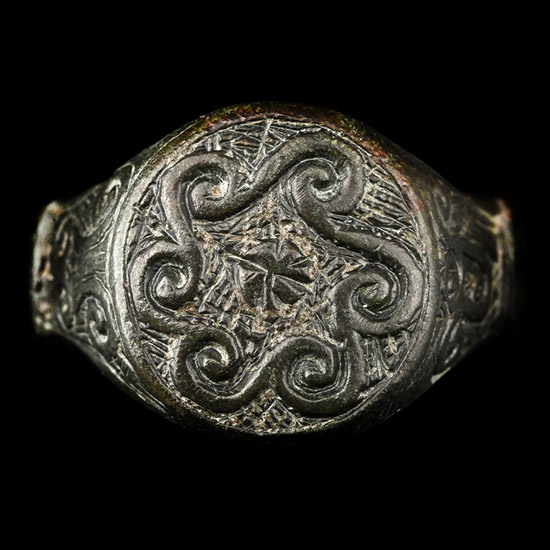
Migration Period Bronze Ring with Sea Scrolls
6th-8th century A.D.Sold for (Inc. bp): £260
Sturdy D-section hoop with a shield on each shoulder, scrolls above, circular bezel with scrolls on a hatched background and a rosette at the centre. 10.35 grams, 24.50 mm overall, 17.92 mm internal diameter (approximate size British P 1/2, USA 7 3/4, Europe 16.86, Japan 16)
Ex German art market, 2000s. Acquired from an EU collector living in London. From the collection of a Surrey, UK, gentleman.

