-
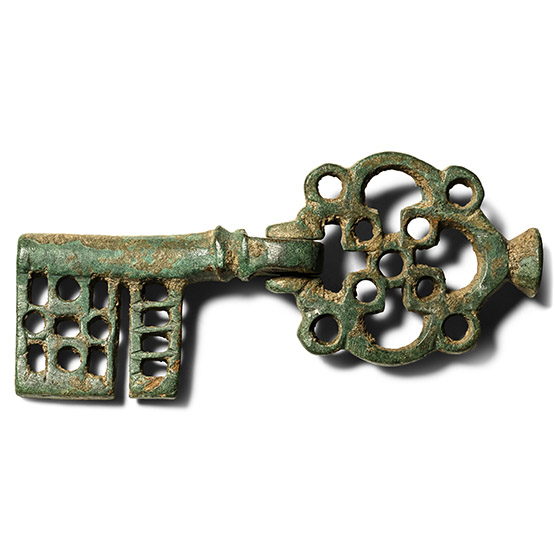
Byzantine Bronze Openwork Key
6th-8th century A.D.Sold for (Inc. bp): £1,040
Comprising an articulated decorative handle with a cross motif, a round-section shaft and an openwork bit. 17.8 grams, 60 mm
Ex German art market, 2000s. Acquired from an EU collector living in London. From the collection of a Surrey, UK, gentleman. -
.jpg)
Kassite Cylinder Seal with Standing God and Sumerian Prayer to Adad, the God of Storm
Mesopotamia, Kassite Period, Babylonia, circa 1300-1100 B.C.Sold for (Inc. bp): £23,400
Cylinder seal, perforated longitudinally for suspension, with inscription; accompanied by a copy of an old scholarly note, typed and signed by W.G. Lambert, late Professor of Assyriology, University of Birmingham, 1970-1993, which states: 'Cylinder seal of white stone with Brown Bands 42 x 16 mm. The art-work shows a single standing figure. The head is perhaps covered with a simple cap and the hair is gathered in a bun at the nape of the neck. There is a big beard. The god or man is wearing a robe wrapped over one arm and then falling from the waist to the feet, but open at the front so that one leg is exposed. One hand is held at the waist, the other hangs down. The remainder of the engraved surface is filled with an eight-line inscription in Middle Babylonian cuneiform. The language, however, is Sumerian and a very difficult form of the language, since it was no longer spoken and the scribes thought in Babylonian, but then expressed themselves in a strange form of Sumerian. Thus there is considerable difficulty in being sure how to translate, and the following is given with reserves: Diskur bára ul pes / háúl-hl gur(4) gur(4) za-lu / zi-bi igi-bar sag ní-za / lum-bi tuku-bi silim-NI / ki-bi níg-si-sá.gar-re / hé-túm-túm-mu-bi / dsîn-ra-im-zeri / dumu be-lí-tim-dmes' “Adad, lofty lord, who rejoices the heart, who strengthens living creatures, arise, look upon the servant who reverences you, grant him his dwelling, ma[l]ke it prosper, establish justice at his place, and lead him — namely sîn-ra' im-zeri, son of … -Marduk.” This is a Cassite period seal, from Babylonia, c.1300-1100 B.C. Such seals are comparatively rare, and this one is a large, fine specimen with long inscription and in very good state of preservation.'; supplied with a museum-quality impression. 18.89 grams, 41 mm
Examined by Professor Wilfrid George Lambert FBA (1926-2011), historian, archaeologist, and specialist in Assyriology and Near Eastern archaeology, in December 1994. Private collection, London, UK. Accompanied by a copy of a scholarly report and translation, typed and signed by Professor Wilfrid George Lambert. This lot has been checked against the Interpol Database of stolen works of art and is accompanied by search certificate number no.13264-253487.
The prayer celebrates Adad as the thunder god. It is written in typically learned Sumerian, translated almost morpheme by morpheme from Akkadian. -
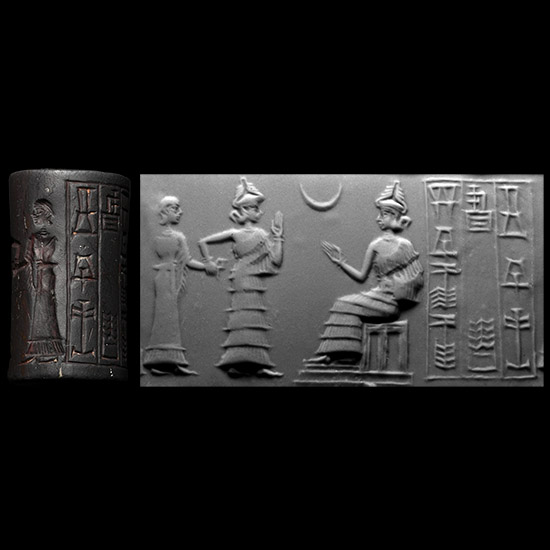
'Professor Erlenmeyer’s First Cylinder Seal' A Neo-Sumerian Haematite Seal of Abbamu, Scribe, Son of Bazige
Mesopotamia, Third Dynasty of Ur, circa 2100-2000 B.C.Sold for (Inc. bp): £8,450
Finely carved in haematite with a formal presentation scene: a goddess sitting enthroned upon a dais, clad in a flounced robe and a multiple-horned tiara, her arm extended in reception; before her a similarly attired interceding goddess approaching, leading a robed worshipper into the divine presence; lunar crescent in the field, with three-line inscription within a panel: 'Abbamu, scribe, son of Bazige'; supplied with a museum-quality impression. 18 grams, 27 mm
From the private collection of Professor Dr. Hans (1900-1967) and Mrs Erlenmeyer, Switzerland. The Erlenmeyer Foundation, Basel Switzerland, since 1981. with Sotheby's, Western Asiatic Cylinder Seals and Antiquities from the Erlenmeyer Collection (Part 1), London, 9 July 1992, no.109. Private collection, London, UK. Accompanied by copies of the relevant Sotheby's catalogue pages. This lot has been checked against the Interpol Database of stolen works of art and is accompanied by search certificate number no.13283-253486.
Prof Hans Erlenmeyer was a noted Swiss collector from 1943 to circa 1960; he and his wife established the Erlenmeyer Foundation. This seal is of particular note as the first cylinder seal given to Professor and Mrs Erlenmeyer. Its imagery belongs to the religious and political language of the Third Dynasty of Ur, when order was restored after the collapse of the Akkadian dynasty. In the eyes of the ancient Mesopotamians, that earlier collapse could be understood as a sign of divine displeasure; under Ur III, renewed piety and correct devotion assumed central importance. The presentation scene seen here reflects that world precisely: the seal owner is led by a minor goddess, or Lamma, into the presence of his personal deity. Seals of this class are valued for their exacting workmanship and disciplined clarity of design. Though they lack the freer energy of the Akkadian age, they possess instead a ceremonial gravity and devotional precision that are wholly characteristic of Neo-Sumerian art. -
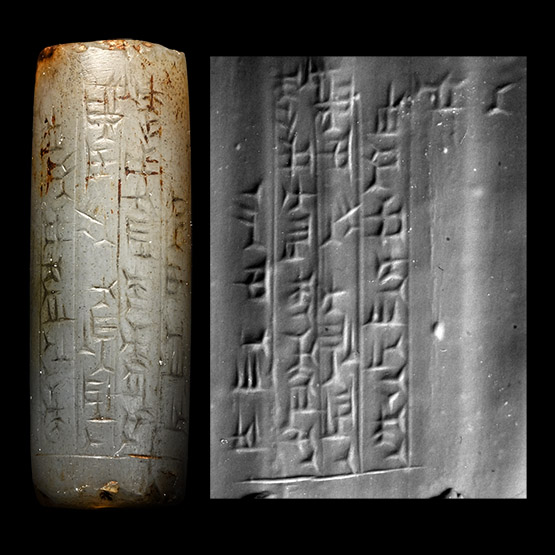
Large Kassite Chalcedony Cylinder Seal for the God Samnuha from Samsanu
16th-12th century B.C.Sold for (Inc. bp): £9,100
Pierced longitudinally, incised with four columns of cuneiform script in a rectangular frame with one character outside, translating to: 'To the god Samnuha, great lord, Samsanu, sha reshi-official, for the life of [the king] Samnuha-shar-ilani, his Lord, he made and gave (this seal)'; supplied with a museum-quality impression. 22.66 grams, 46 mm
Private collection, acquired before 1993; thence by descent. This lot has been checked against the Interpol Database of stolen works of art and is accompanied by search certificate number no.13214-249317.
Several styles of seal-carving are known from the Kassite period. Kassite period artists often drew upon the rich historical traditions of Mesopotamia. In this case, the long-dead Sumerian language and archaic signs were used to write the inscription. -
.jpg)
Neo-Assyrian Banded Calcite Cylinder Seal with Worshipping Scene
8th–7th century B.C.Sold for (Inc. bp): £1,170
Cylinder seal mounted on a card backing with wooden edging; plaster impression; old collector's handwritten notes '40. Néo Assyrien 9°-7° siècle Av.J.C. Calcedoine. Thème du maître des animaux saisissant deux bouquetins. Au centre de la ronde des animaux se tient un griffon ailé. Dans le champ, étoile d'Ishtar. Derrière le héros se dresse un lion qui s'apprête à saisir un bouquetin cabré.' (40. Neo-Assyrian. 9th-7th century BC. Theme of the master of animals seizing two ibexes. In the centre of the circle of animals stands a winged gryphon. In the field, the star of Ishtar. Behind the hero appears a lion who prepares to seize a rearing ibex.); supplied with a museum-quality impression. 31 grams total, seal: 24 mm
Antonovitch Gallery, Paris, 1978. Chesnes Gallery, Lyon, 1982. Acquired at Drouot, Paris, 2022. Private collection, London, UK. -
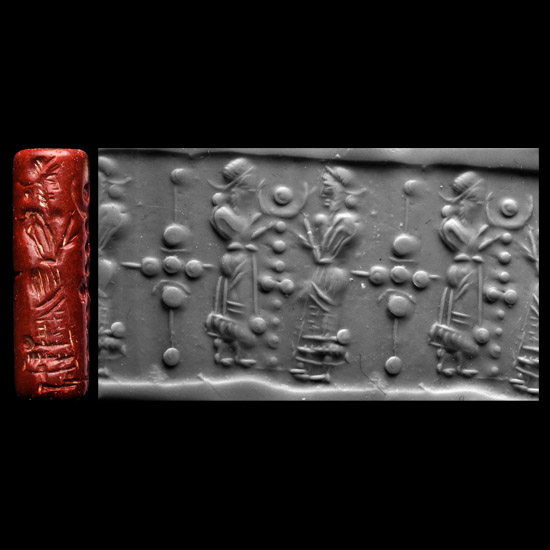
Western Asiatic Red Jasper Cylinder Seal with Figures
2nd-1st millennium B.C.Sold for (Inc. bp): £650
Frieze depicting two standing profile figures wearing ankle-length robes, their raised hands supporting a crescent with pellets in a vertical column, second pelleted motif to the rear; supplied with a museum-quality impression. 3.68 grams, 28.4 mm
From the private collection of a European gentleman (1942-2024), formed since the 1970s. -
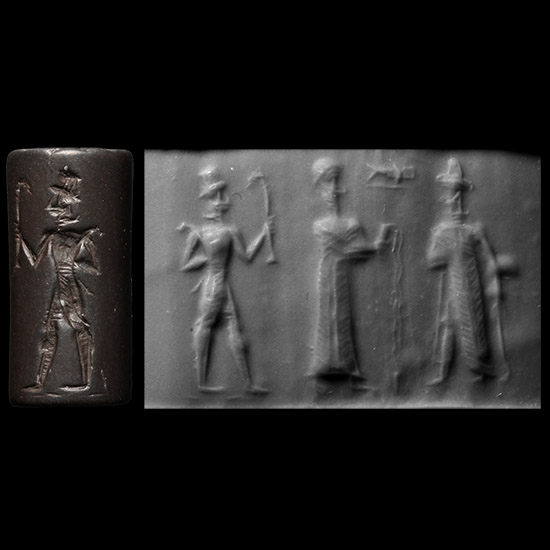
Old Babylonian Hematite Cylinder Seal with the Moon God Sin
Mesopotamia, 1900-1700 B.C.Sold for (Inc. bp): £416
With incuse frieze; accompanied by an old scholarly note, typed and signed by W.G. Lambert, late Professor of Assyriology, University of Birmingham, 1970-1993, which states: 'Cylinder seal of hematite, 19 x 9.5 mm., condition good. Three standing figures: to the right a standing god with horned tiara, holding a scimitar in the left hand, the right clasped at the waist; facing him a standing goddess holding a spouting jar, above her a fish perhaps with lion's face; to the left a god with short dress holding up a shepherd's crook. Old Babylonian, c. 1800-1600 B.C., but probably from northern Mesopotamia. The god with the crook is Amurru, god of shepherding. The other two cannot be identified.'; supplied with a museum-quality impression. 5.9 grams, 18 mm
Mr K. Kobayashi, Osaka, Japan, prior to 1992. Accompanied by a copy of an old scholarly note, typed and signed by W.G. Lambert, late Professor of Assyriology, University of Birmingham, 1992. -
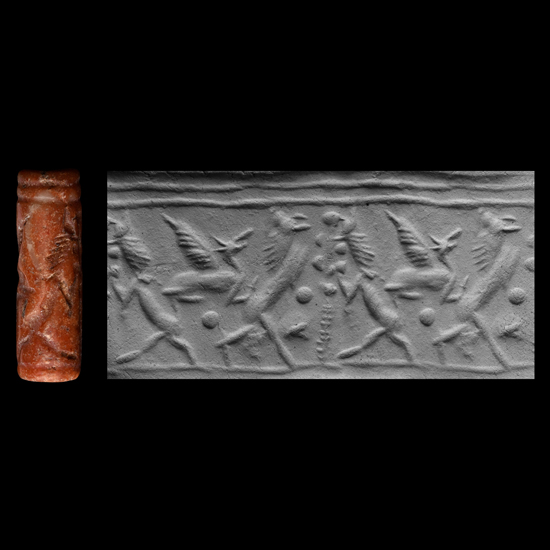
Western Asiatic Red Agate Cylinder Seal with Gryphons
2nd-1st millennium B.C.Sold for (Inc. bp): £195
Frieze with two rearing gryphons flanking a vertical column, a third crouching gryphon between them; supplied with a museum-quality impression. 1.44 grams, 20.8 mm
From the private collection of a European gentleman (1942-2024), formed since the 1970s. -
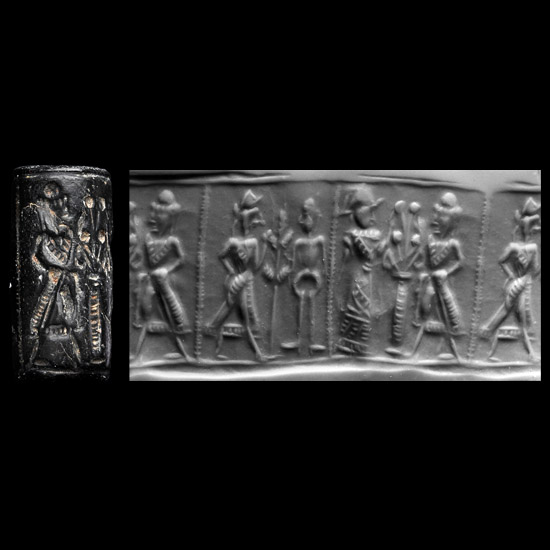
Western Asiatic Black Stone Cylinder Seal with Figural Scene
2nd-1st millennium B.C.Sold for (Inc. bp): £390
Frieze comprising two panels: left: advancing figure in profile with tall headgear, one hand raised to a vertical frond or tree, second figure facing with circular void at the hips; right: profile figure in ankle-length robe with flounces and fringe detailing, one hand raised to a vase with flowers, second figure in open-fronted tunic holding a staff; supplied with a museum-quality impression. 6.94 grams, 26.9 mm
From the private collection of a European gentleman (1942-2024), formed since the 1970s. -
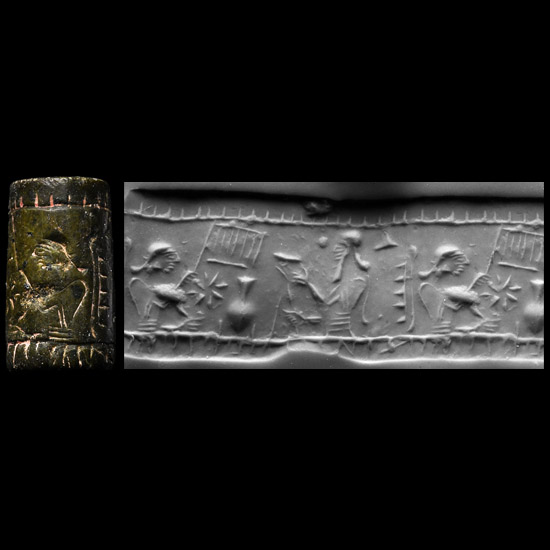
Western Asiatic Black Stone Cylinder Seal with Court Scene
2nd-1st millennium B.C.Sold for (Inc. bp): £338
Frieze depicting a court scene with seated figure in profile holding a dish towards a kneeling figure, with vase, gate and starburst between; supplied with a museum-quality impression. 7.34 grams, 23.74 mm
From the private collection of a European gentleman (1942-2024), formed since the 1970s. -
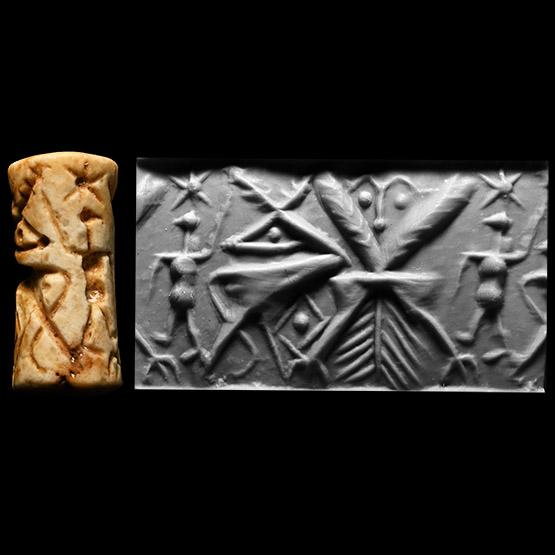
Sumerian Alabaster Cylinder Seal
3rd millennium B.C.Sold for (Inc. bp): £1,235
Waisted cylinder with deeply incuse bird figure flanked by human figure, star, stag's head and others; supplied with a museum-quality impression. 4.1 grams, 24 mm
Private collection, acquired in the late 1980s-early 1990s; thence by descent. -
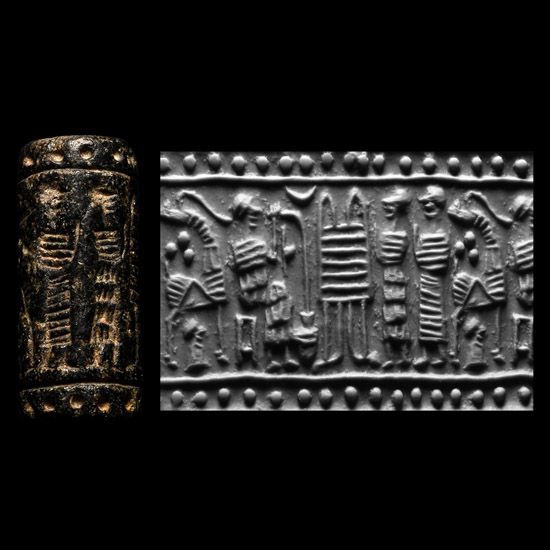
Cappadocian Stone Cylinder Seal with Court Scene
Circa 2000-1900 B.C.Sold for (Inc. bp): £1,040
Frieze including two standing attendants in flounced floor-length robes before a laden table and a seated figure in similar robes, the seated figure drinking from a vessel through a drinking pipe, behind him a stag with a small animal between its legs, a border of pellets above and below; supplied with a museum-quality impression. 21.9 grams, 40 mm
Acquired in the mid 1980s-1990s. Private collection, Switzerland, thence by descent. Private collection, since the late 1990s.

