-
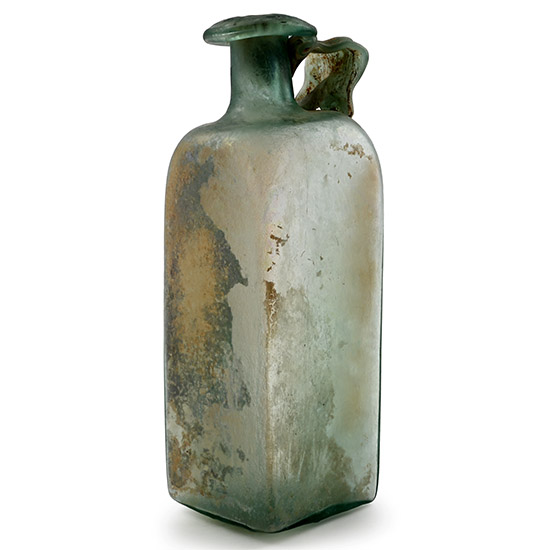
Large Gallo-Roman Mould-Blown Green Glass Flask
1st-2nd century A.D.Sold for (Inc. bp): £702
Square in plan with rounded shoulder and trumpet-shaped mouth; folded strap handle. 303 grams, 20.6 cm
Collection F. Martens Netherlands, 1980s-1990s. Anonymous sale, Cahn International Auction, Basel, Switzerland, 2010. Private collection, Europe.
Glass blowing was first used in the early 1st century B.C. and became widespread in the 1st century A.D. It simplified and increased the production of glass vessels, reducing their cost and transforming them into a general commodity. In the 1st century A.D., colourful glass vessels were still popular, while glass with a natural, light green colour, such as this, gained popularity in the subsequent centuries. -
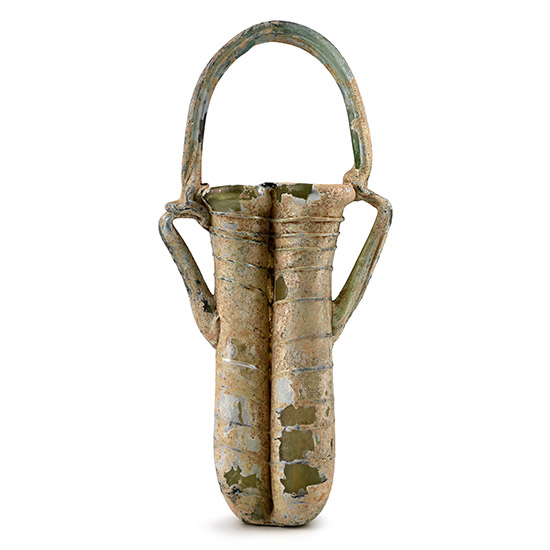
Roman Iridescent Glass Double Unguentarium
2nd-3rd century A.D.Sold for (Inc. bp): £468
With rolled rim to each tapering tube, applied trail detailing to each upper body, lateral angled handles and large applied loop handle above; iridescent surface. 77 grams, 17.5 cm
Private collection, 1990s-early 2000s. -
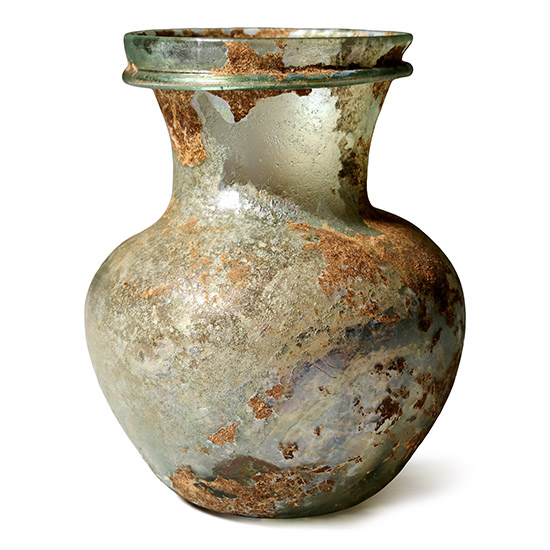
Roman Clear Glass Jar with Iridescence
2nd-3rd century A.D.Sold for (Inc. bp): £234
Squat in profile with trumpet-shaped neck and mouth, collar below the rim, dimple base; some iridescence. 29.6 grams, 85 mm
Private collection, 1990s-early 2000s. -
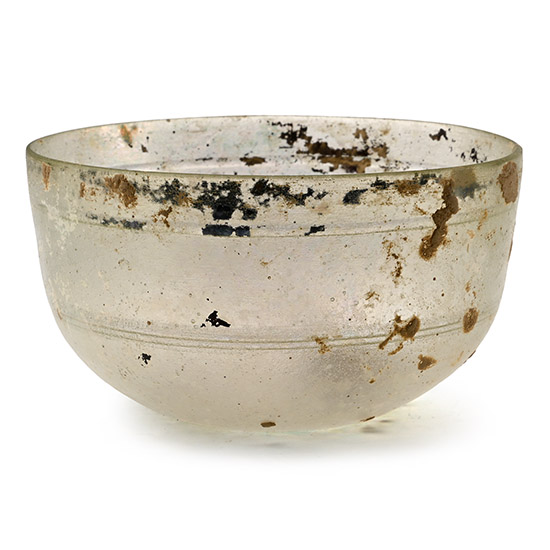
Roman Wheel-Cut Clear Glass Bowl
1st-2nd century A.D.Sold for (Inc. bp): £3,640
Hemispherical in profile with a broad base, bands of wheel-cut horizontal lines to the inner face. 87 grams, 11.4 cm
Private collection, USA and Switzerland, acquired in the late 1980s-early 1990s; thence by descent.
Such bowls are related to the form of Terra Sigillata according to several scholars. The period of their widest use is between 70 and 130 A.D. It was widely used throughout the western parts of the Empire, and especially in Italy. Similar bowls could also be found in the Eastern Mediterranean and were probably produced in Italic workshops, since there are numerous finds in Ticino. -
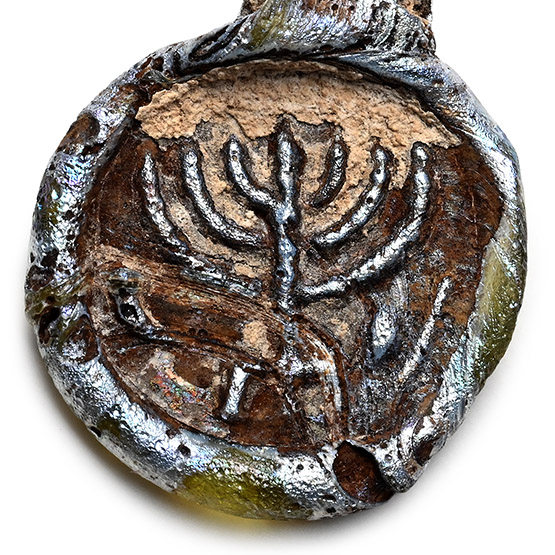
Eastern Roman Glass Pendant with Menorah
6th-7th century A.D.Sold for (Inc. bp): £1,040
Discoid with impressed menorah motif, integral loop. 1.07 grams, 22 mm
Private collection, acquired in the late 1980s-early 1990s; thence by descent.
Glass medallions were produced especially in Syria and decorated with imagery including Christian saints and monograms. The iconography of the Menorah was used by both Christian and Jewish communities, being for the Orthodox church a symbol of divine light, the seven gifts of the Holy Ghost and the church itself. -
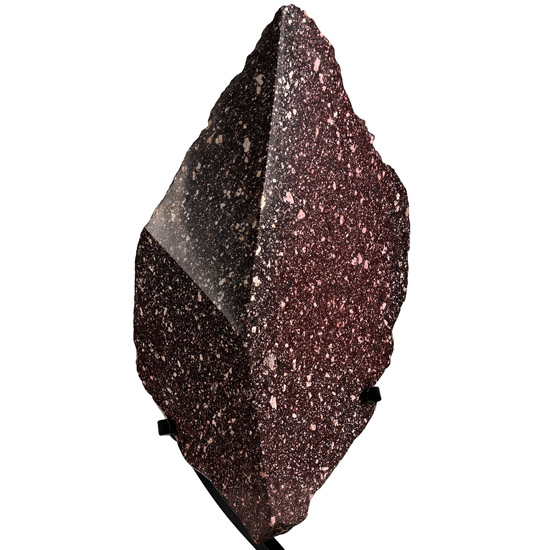
Historic Roman Cut and Polished Roman Imperial Purple Porphyry Section
Sold for (Inc. bp): £1,170
Comprising a triangular piece, cut and polished on several sides, probably recycled material mined in ancient Roman times between the 1st and 5th centuries A.D.; mounted on a custom-made metal display stand. 5.97 kg total, 38 cm including stand
Acquired on the UK art market since the 1990s. From the private collection of a Somerset gentleman.
Mons Porphyrites (today Jabal Abu Dukhkhan) is the mountainous site of a group of ancient quarries in the Red Sea Hills of the inhospitable eastern desert in Egypt, a five-day trip from the Nile during Roman times. They were discovered by Caius Cominus Leugas in 18 A.D., and during the Roman Empire, the mines officially belonged to the emperor and were the only known source of the Imperial Porphyry, Mons Porphyrites. This dark purple stone was associated with royalty and used for prestigious sculpture and architecture. The location of the mines was lost sometime in the 5th century and rediscovered in the early 19th century. Excavations in the area have revealed the well-preserved quarries and the dwelling places of the quarrymen, and also thousands of ostraca have been discovered containing messages that provide details of how the quarrying took place, and of how the highly skilled quarrymen ordered their food. -
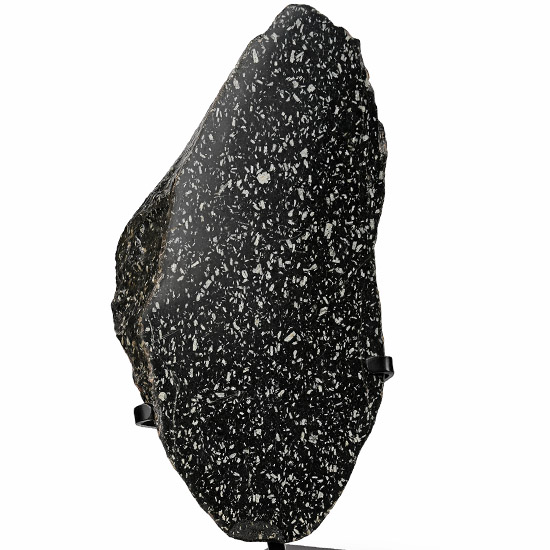
Historic Spartan Basalt Cut and Polished Green Porphyry Fragment
Sold for (Inc. bp): £2,210
Cut and polished section, mined in Greece, cut and polished on one side, probably recycled material mined in ancient Roman times; mounted on a custom-made metal display stand. 6.19 kg total, 33 cm including stand
Acquired on the UK art market since the 1990s. From the private collection of a Somerset gentleman.
Also known as Lapis Lacedaemonius and Porfido Verde Antico, a type of green porphyry quarried in Greece. Spartan basalt is a form of andesite or volcanic rock known today only from a single source in the village of Krokees on the Peloponnese in Greece. In addition, ancient sources mention a quarry of Lapis Lacedaemonius in Taygetus. -
.jpg)
Byzantine Gold Openwork Earring Pair
Circa 6th-8th century A.D.Sold for (Inc. bp): £1,560
Each a crescent plaque with beaded borders, sprung hook and catch; openwork foliage motif. 6.98 grams total, 28 mm each
Property of a North American gentleman, London, UK, 1990-2010. -
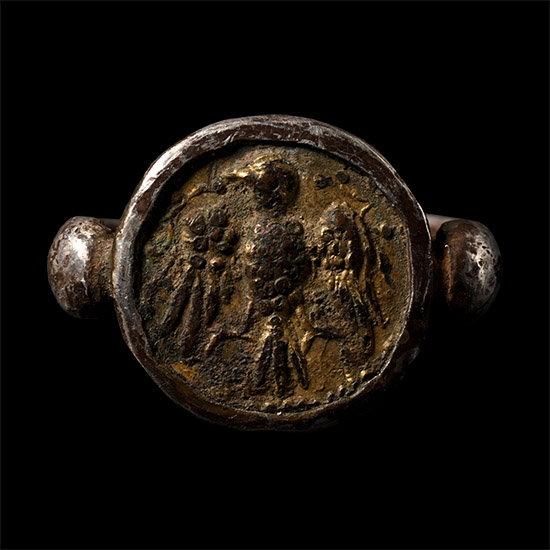
Byzantine Silver Ring with Gilt Eagle
5th-6th century A.D.Sold for (Inc. bp): £468
Disc bezel flanked by two bosses; gilt panel with low-relief eagle. 6.69 grams, 24.36 mm overall, 21.21 x 20.94 mm internal diameter (approximate size British W, USA 11, Europe 25, Japan 24)
UK private collection before 2000. Acquired on the UK art market. Private collection, London, UK. -
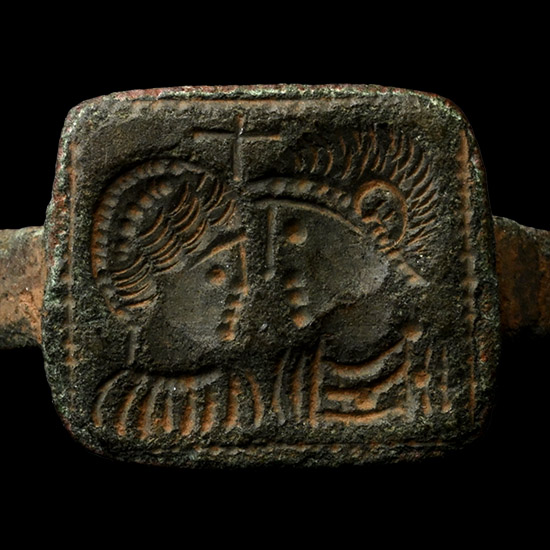
Byzantine Bronze Marriage Ring Depicting Two Facing Portraits
5th-6th century A.D.Sold for (Inc. bp): £468
With a facetted hoop, a rectangular bezel, and opposed profile busts (male and female). 3.60 grams, 24.13 mm overall, 21.06 mm internal diameter (approximate size British T 1/2, USA 9 3/4, Europe 21.89, Japan 21)
UK private collection before 2000. Acquired on the UK art market. Private collection, London, UK. -
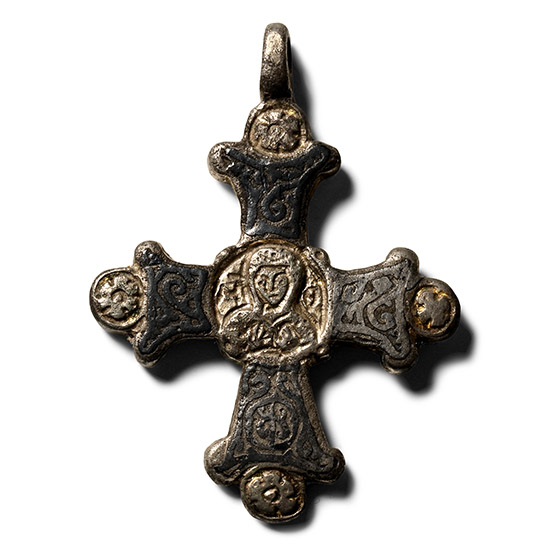
Byzantine Silver Cross Pendant
8th-12th century A.D.Sold for (Inc. bp): £1,560
Cross moline type with central facing bust, rosette to end of each arm, applied niello-filled tendril panel to each arm; integral loop. 7.32 grams, 41 mm
Ex German art market, 2000s. Acquired from an EU collector living in London. From the collection of a Surrey, UK, gentleman. -
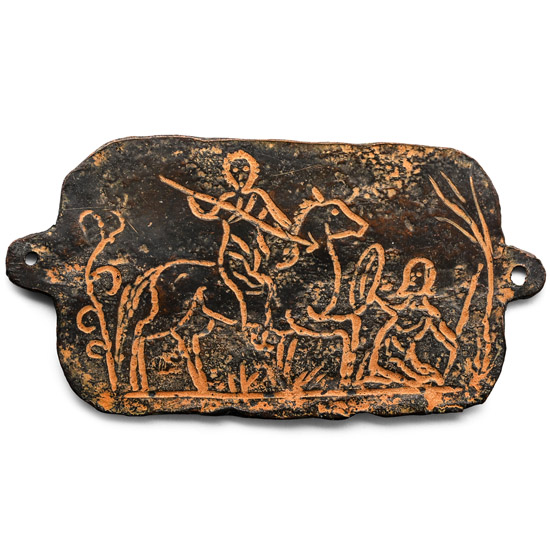
Byzantine Bronze Plaque with Warrior Saint
Circa 6th century A.D.Sold for (Inc. bp): £338
Rectangular with rounded corners and pierced lug to each short side; low-relief scene with a horseman brandishing a spear against an infantryman with spear and shield; foliage and baseline. 8.82 grams, 58 mm
From the collection of a gentleman, acquired on the London art market in the 1990s.

