-
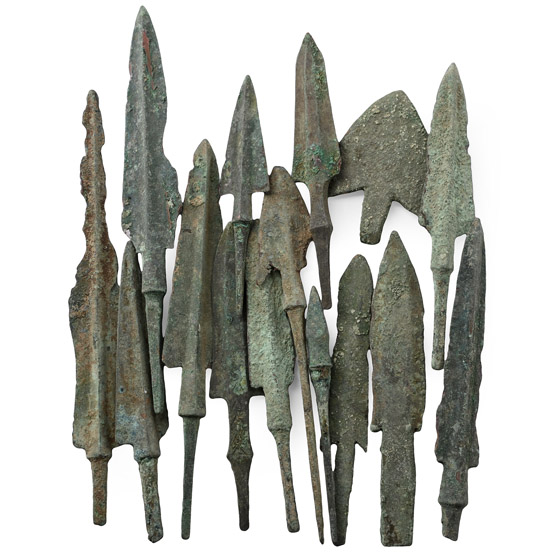
Western Asiatic Bronze Arrowhead Collection
2nd-1st millennium B.C.Sold for (Inc. bp): £156
Comprising tanged arrowheads, four with large elongated triangular blades and raised midrib, sharp central groove, one triangular type with barbed shoulders and flat socket, one with barbed shoulders and cylindrical stem with handle for the shaft; four with squared shoulders and rectangular stem with handle for the shaft, one with trilobate blade, two with barbed shoulder and flat tang, one with short pyramidal head and cylindrical stem, and another with short tang and long blade with raised midrib. 384 grams total, 5.8-15.7 cm
Ex London, UK, collection, 1990s.
These arrowheads seem to belong to the type V, subcategory types A, B, C and D according to the classification of Khorasani and Negahban. In the four categories of triangular bronze arrowheads from Luristan, Marlik, and Northern Iran, individuated by Negahban, subtypes C and D of type V are larger arrow or javelin heads, C with barbed shoulders and D with round shoulders. Most of them were cast in moulds. -
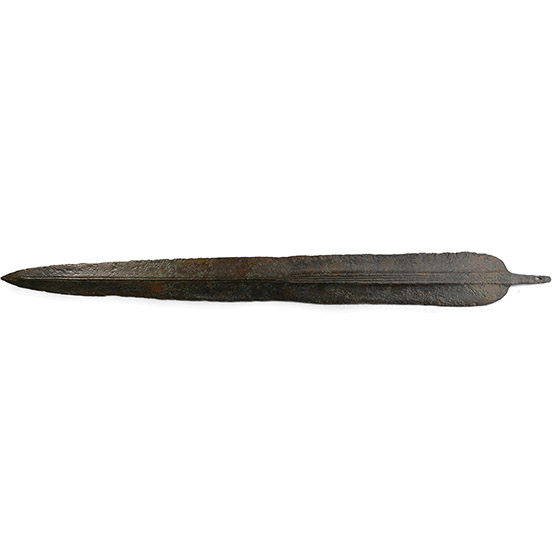
Western Asiatic Sword Blade with Blood Channels
2nd-1st millennium B.C.Sold for (Inc. bp): £316
With corrugated raised midrib extending to a short tang, fullers with curved ends extending to the shoulders. 345 grams, 47.5 cm
Ex Abelita family collection, 1990s. -
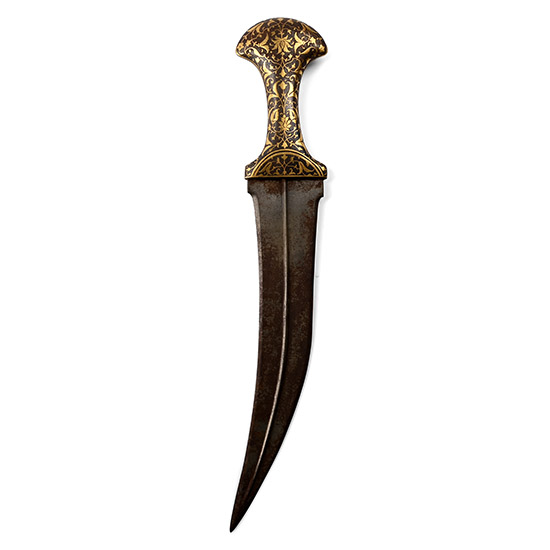
Indo-Persian Iron Dagger with Gilded Hilt
20th century A.D.Sold for (Inc. bp): £845
Broad two-edged iron blade with midrib, narrow grip with flared pommel and inlaid yellow-metal floral ornament. 250 grams, 34.5 cm
Private collection, UK. -
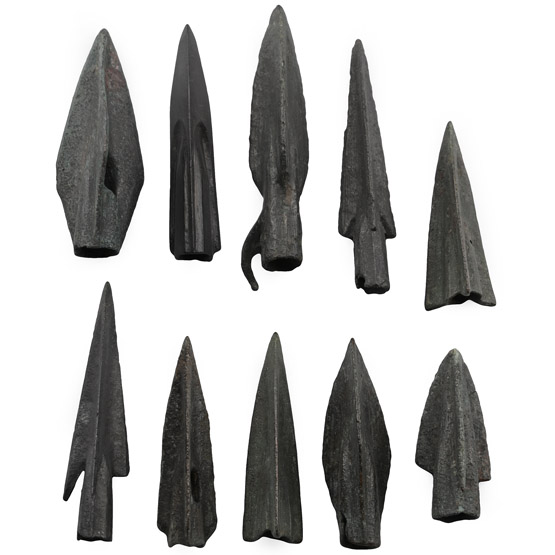
Greek Bronze Arrowhead Group
5th-3rd century B.C.Sold for (Inc. bp): £143
Socketted type with three radiating narrow flanges, some barbed. 22 grams total, 22-38 mm
Ex German art market, 2000s. Acquired from an EU collector living in London. From the collection of a Surrey, UK, gentleman. -
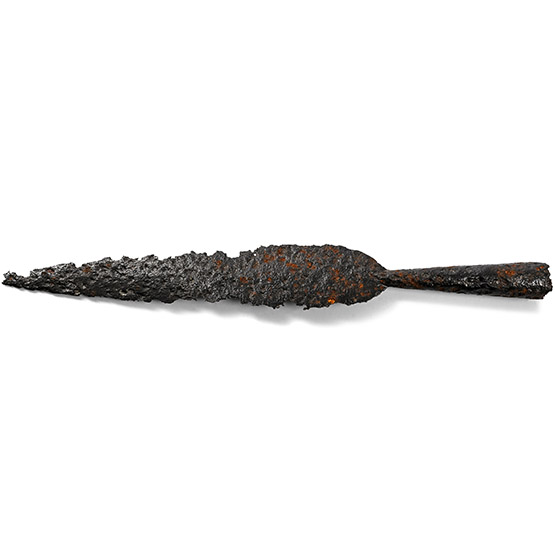
Greek Iron Lancehead
Magna Graecia, 6th century B.C.Sold for (Inc. bp): £234
Blade widened at the base, ribbed, conical socket with wooden remains. 277 grams total, 43 cm including stand (lance 25.8 cm)
From the famous arms and armour collection of Axel Guttmann (1944-2001), Berlin, Germany. Ex Hermann Historica, Munich, Germany, 4 May 2011, no.1783 (lot). From a private specialist collection, London, UK. Accompanied by copies of the relevant Hermann Historica catalogue pages.
The spear finds an almost identical parallel in two spearheads from Lavello, found associated with a Corinthian helmet and a sword, as part of Burial objects, dating back to around the middle of the 6th century BC. This type of hoplite weaponry was used by individual warriors, who, in Daunia (South Italic Apulia), while adopting Greek models, fought on horseback, according to a fighting style centred on the heroic duel between leaders. -
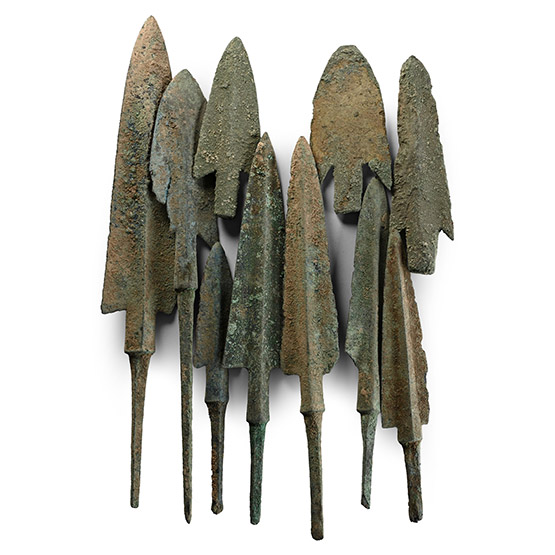
Luristan Bronze Arrowhead Collection
2nd-1st millennium B.C.Sold for (Inc. bp): £124
Mainly barbed and tanged types of slender profile. 287 grams total, 6.2-17.7 cm
Ex London, UK, collection, 1990s. -
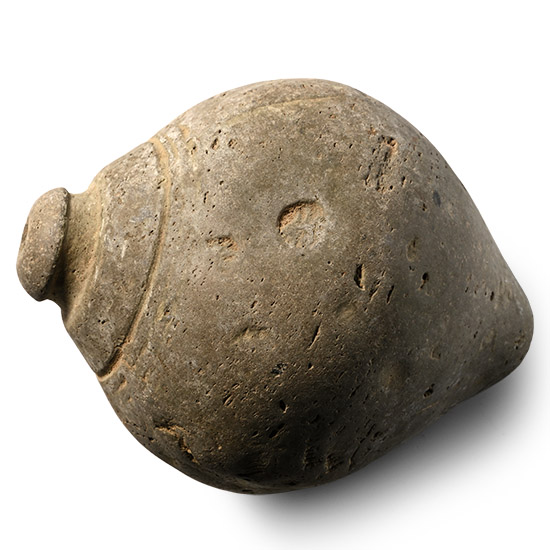
Byzantine 'Greek Fire' Ceramic Fire Bomb or Hand Grenade
9th-11th century A.D.Sold for (Inc. bp): £72
Ovoid in profile with a rounded base, a circumferential band around the neck; intended to be filled with explosive liquid and a wick, and used as a hand grenade. 650 grams, 11.8 cm
From a specialist collection, London, UK, 1990-2000s. Accompanied by an academic paper by military specialist Dr Raffaele D'Amato, dated 15 July 2019 and titled 'Eastern Roman Empire - Greek Fire Bomb or Hand Grenade (μεσαίον kακάβιον) 9th-11th century AD'.
Apart from the use of siphons or manual flame-throwers called cheirosiphona, special corps of Roman soldiers employed terracotta grenades, in the form of small jars, abundantly evidenced in archaeological excavations. They were called μεσαία kακαβιά or κυτροκακάβια, where the former had a bulbous shape and the latter a more cylindrical form. -
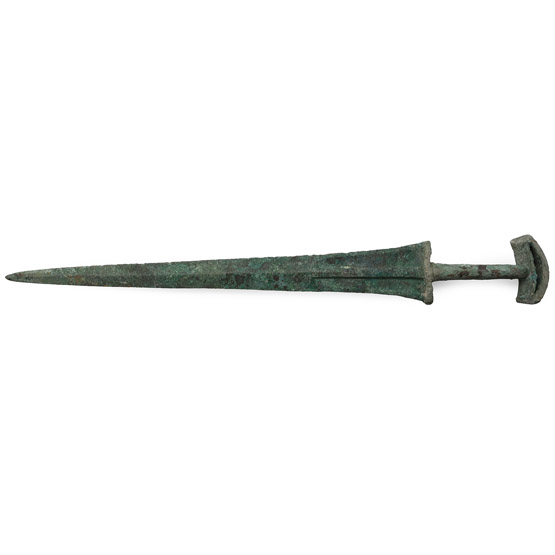
Luristan Bronze Short Sword
2nd-1st millennium B.C.Sold for (Inc. bp): £884
Triangular blade with single median rib, crescent-shaped hollow pommel open at the edges to accept an organic insert, columnar grip and lower guard at the juncture between hilt and blade. 499 grams, 50 cm
Ex Norri collection, Milton Keynes, Bedfordshire, UK, 1980s-1990s. -
.jpg)
Turco-Mongol 'Greek Fire' Ceramic Fire Bomb or Hand Grenade
14th-15th century A.D.Sold for (Inc. bp): £130
Piriform in profile with a domed mouth and stepped neck, raised vertical lugs on the body, linear decoration; intended to be filled with explosive liquid and a wick, and used as a hand grenade. 511 grams, 15.4 cm
From a specialist collection, London, UK, 1990-2000s.
Apart from the use of siphons or manual flame-throwers called cheirosiphona, special corps of Roman soldiers employed terracotta grenades, in the form of small jars, abundantly evidenced in archaeological excavations. They were called μεσαία kακαβιά or κυτροκακάβια, where the former had a bulbous shape and the latter a more cylindrical form. -
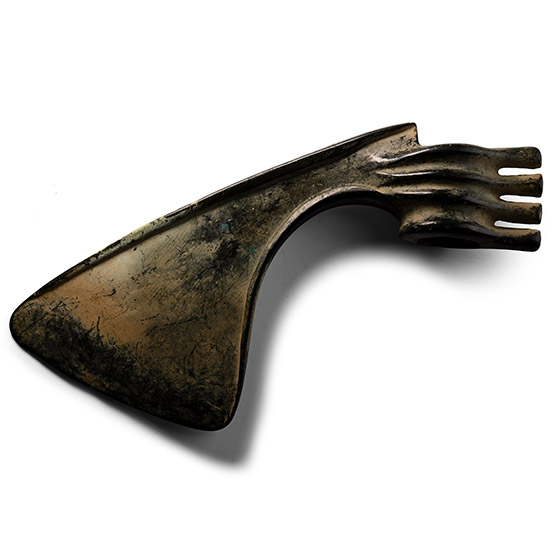
Luristan Comb-Backed Axehead
2nd-1st millennium B.C.Sold for (Inc. bp): £312
With ribbed openwork socket terminating in a butt formed of four cones, the blade expanding from the socket. 400 grams, 21 cm
From a London collection, early 2000s. -
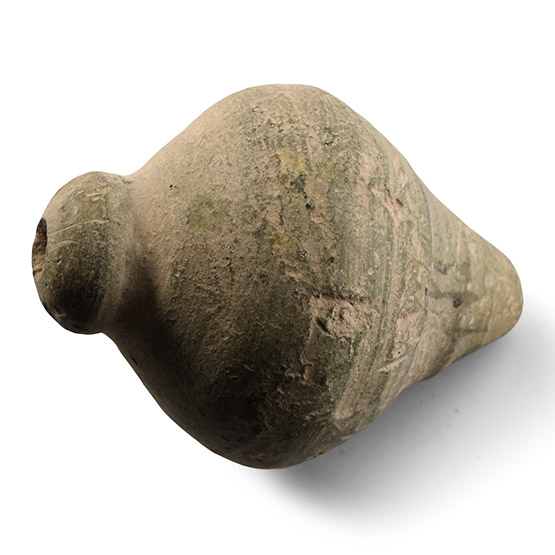
Miniature Byzantine 'Greek Fire' Ceramic Fire Bomb or Hand Grenade
9th-11th century A.D.Sold for (Inc. bp): £98
Small and biconical in profile with narrow point; intended to be filled with explosive liquid and a wick, and used as a hand grenade. 89 grams, 67 mm
From an important specialist collection, London, UK, 1990s onwards. Accompanied by an academic paper by military specialist Dr Raffaele D'Amato, dated 15 July 2019 and titled 'Eastern Roman Empire - Greek Fire Bomb or Hand Grenade (μεσαίον kακάβιον) 9th-11th century AD'.
Apart from the use of siphons or manual flame-throwers called cheirosiphona, special corps of Roman soldiers employed terracotta grenades, in the form of small jars, abundantly evidenced in archaeological excavations. They were called μεσαία kακαβιά or κυτροκακάβια where the former had a bulbous shape and the latter a more cylindrical form. -
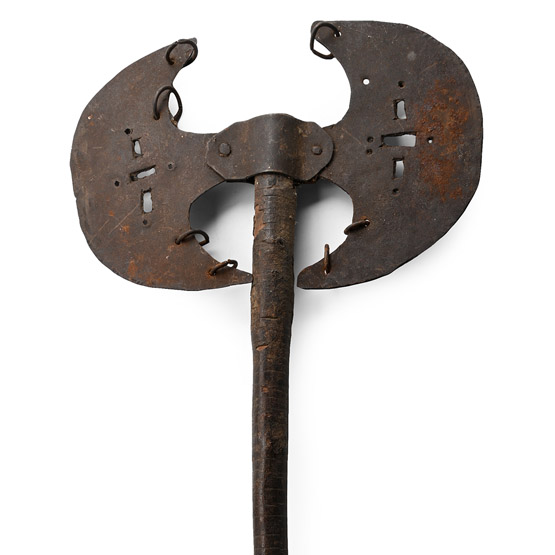
African Ceremonial Iron Double Axe
Late 20th century A.D.Sold for (Inc. bp): £26
Comprising: tapering wooden shaft with circumferential grooves; iron twibill head with two-part flat socket riveted to two crescent blades, each with punched rectangular slots and holes, butted rings to the inner angles. 450 grams, 56.5 cm
Property of a Berkshire, UK, gentleman collector.

