-
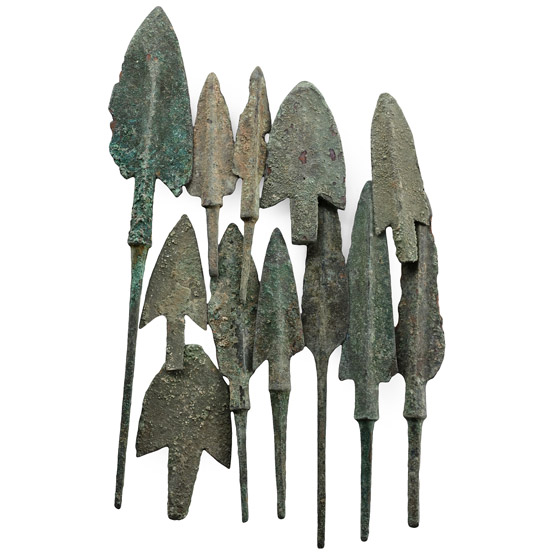
Western Asiatic Bronze Arrowhead Collection
1st millennium B.C.Sold for (Inc. bp): £117
Including triangular, barbed, leaf-shaped and other types. 266 grams total, 6-19.5 cm
Ex London, UK, collection, 1990s. -
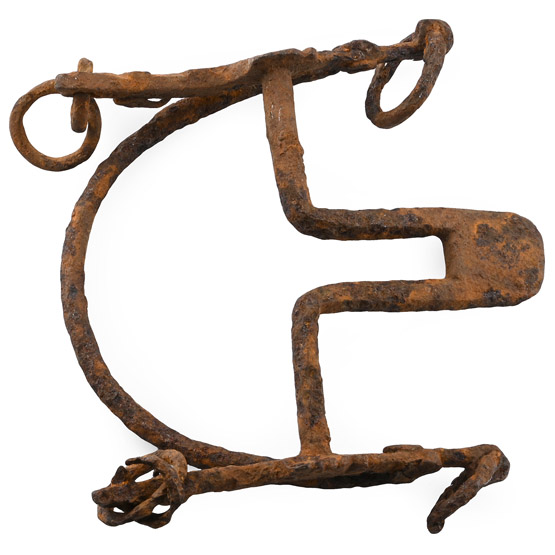
Late Roman Iron Horse Bit
4th-5th century A.D.Sold for (Inc. bp): £59
Curb-bit comprising two horizontal lateral bars with attachment points for the reins and bridle, U-shaped high-port and tongue-bar. 233 grams, 13.5 cm
Ex German art market, 2000s. Acquired from an EU collector living in London. From the collection of a Surrey, UK, gentleman. -
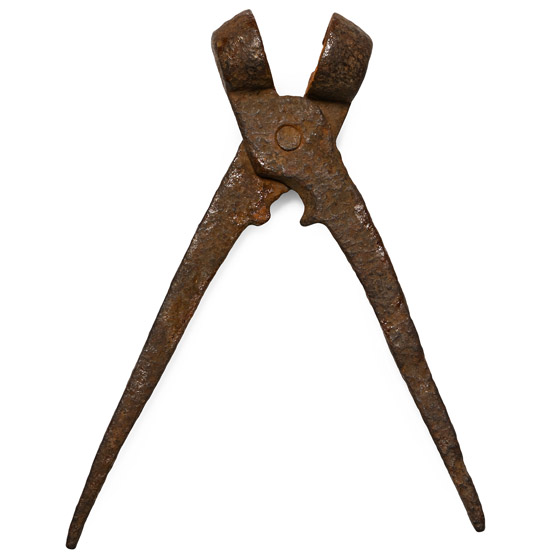
Post Medieval Iron Pistol Ball Scissor Mould
17th-19th century A.D.Sold for (Inc. bp): £20
Comprising a two-part mould with pivoting handles. 50.5 grams, 11.3 cm
Found Suffolk, UK. Property of a Suffolk, UK, gentleman. -
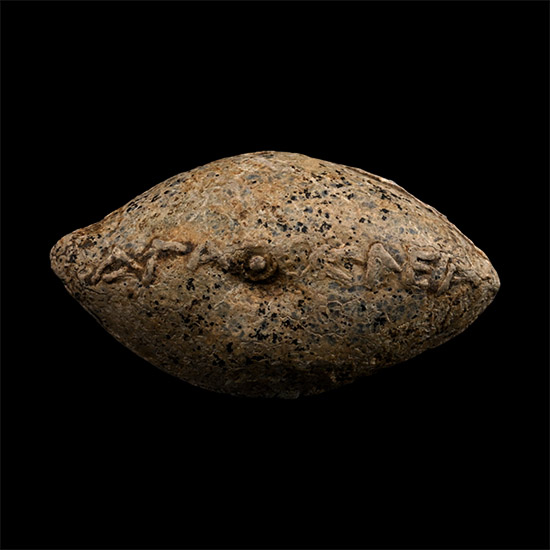
Greek Macedonian Lead Slingshot
4th-3rd century B.C.Sold for (Inc. bp): £104
Lentoid type with reserved legend 'AΓΑΟ[.]ΕΑ'. 45.3 grams, 35 mm
Ex German art market, 2000s. Acquired from an EU collector living in London. From the collection of a Surrey, UK, gentleman. -
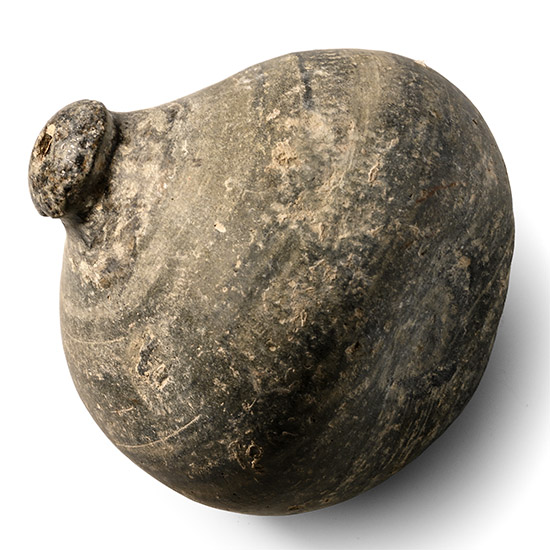
Byzantine 'Greek Fire' Ceramic Fire Bomb or Hand Grenade
9th-11th century A.D.Sold for (Inc. bp): £65
Rounded, undecorated body with a rounded base; intended to be filled with explosive liquid and a wick, and used as a hand grenade. 424 grams, 95 mm
From a specialist collection, London, UK, 1990-2000s. Accompanied by an academic paper by military specialist Dr Raffaele D'Amato, dated 15 July 2019 and titled 'Eastern Roman Empire - Greek Fire Bomb or Hand Grenade (μεσαίον kακάβιον) 9th-11th century AD'.
Apart from the use of siphons or manual flame-throwers called cheirosiphona, special corps of Roman soldiers employed terracotta grenades, in the form of small jars, abundantly evidenced in archaeological excavations. They were called μεσαία kακαβιά or κυτροκακάβια, where the former had a bulbous shape and the latter a more cylindrical form. -
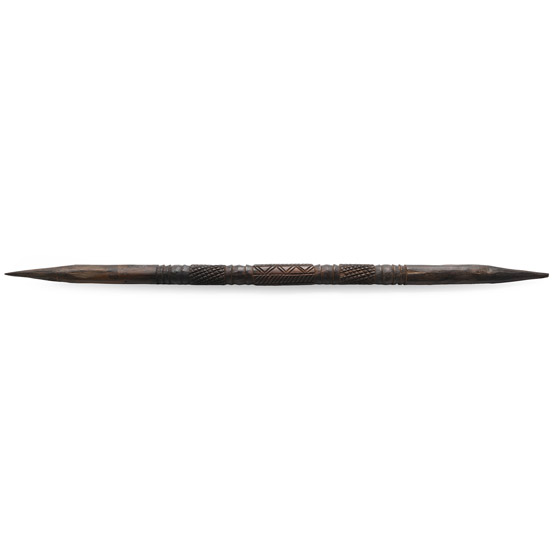
Polynesian Carved Hardwood Fighting Stick
Late 20th century A.D.Sold for (Inc. bp): £52
Comprising a worked round-section stave with point to each end, central grip with carved balusters and hatched sleeves. 320 grams, 69.2 cm
Property of a Berkshire, UK, gentleman collector. -
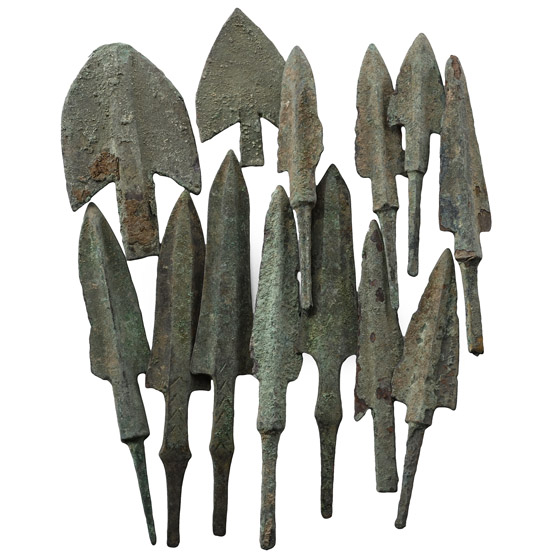
Western Asiatic Bronze Arrowhead Collection
13th-9th century B.C.Sold for (Inc. bp): £117
Comprising tanged arrowheads, having large, elongated triangular blades and raised midrib, sharp central groove, rectangular section stem with handle for the shaft, others with barbed shoulders and convex or squared sides. 248 grams total, 5-11.8 cm
Ex London, UK, collection, 1990s.
These arrowheads seem to belong to the type V, subcategory types A and C, according to the classification of Khorasani and Negahban. In the four categories of triangular bronze arrowheads from Luristan, Marlik and Northern Iran, individuated by Negahban, subtypes A and C of type V are larger arrowheads with barbed shoulders and triangular heads. These types of arrowheads were commonly used in Anatolia and Mesopotamia from the 2nd millennium B.C., but apparently their employment began earlier in this area, where types like these occur alongside the non-barbed, predominantly ribbed and tanged types. -
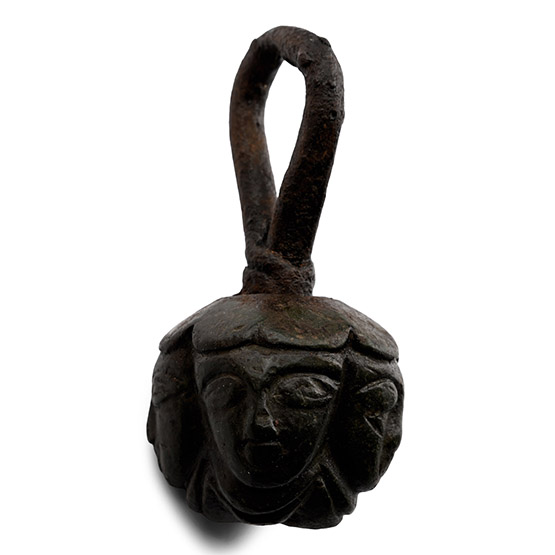
Medieval Bronze Flail Head with Four Heads
14th-15th century A.D.Sold for (Inc. bp): £468
Formed as four radiating D-shaped masks beneath a rosette, substantial suspension loop. 114 grams, 60 mm
From the private collection of a London gentleman, from his grandfather's collection formed before the early 1970s. -
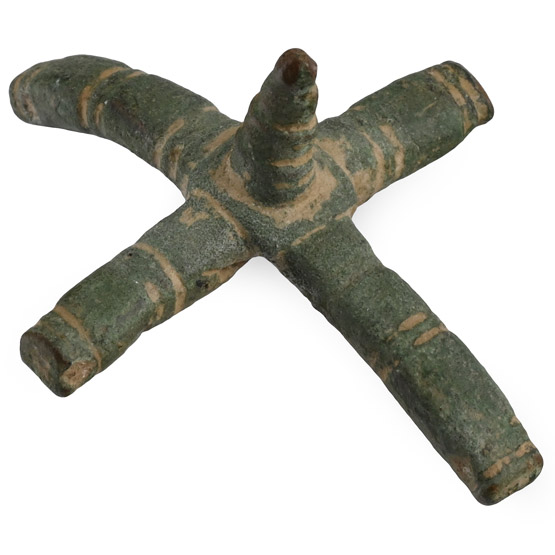
Anglo-Saxon Warrior's Bronze Prick Spur
Late 8th-9th century A.D.Sold for (Inc. bp): £195
Comprising a horizontal D-section curved bar with paired incuse lines, vertical extensions, conical spike at the junction. 13 grams, 47 mm
Found whilst searching with a metal detector near Bottisham, East Cambridgeshire, UK, on Thursday, 1st May 2025. Accompanied by a copy of the British Museum's Portable Antiquities Scheme (PAS) report no.SF-CF48EC.
The Portable Antiquities Scheme states: 'This is a find of note and has been designated: Regional importance.' -
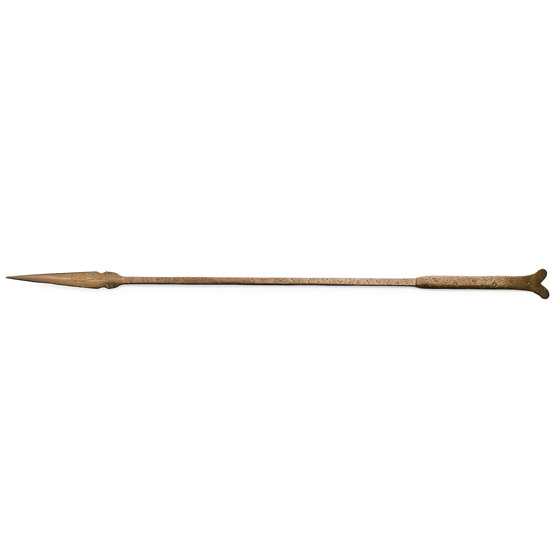
Indian Inscribed Ceremonial Brass Dart
Late 20th century A.D.Sold for (Inc. bp): £33
Comprising a rectangular-section shank with incised diagonal lines and punched pellets; narrow leaf-shaped blade with lateral flanches and notching; tail developing to lateral lobes with incised and punched ornament. 216 grsms, 60.5 cm
Property of a Berkshire, UK, gentleman collector. -
.jpg)
Western Asiatic Bronze Arrowhead Collection
2nd-1st millennium B.C.Sold for (Inc. bp): £338
Comprising tanged arrowheads, four with large elongated triangular blades and raised midrib, sharp central groove, three with barbed shoulders and cylindrical stem with handle for the shaft; three with barbed shoulders and convex on sides, one elongated triangular type with barbed shoulders and flat socket, one with trilobate blade and another with short tang and barbed blade with raised midrib. 305 grams total, 6.5-13.6 cm
Ex London, UK, collection, 1990s.
These arrowheads seem to belong to the type V, subcategory types A, B, C and D according to the classification of Khorasani and Negahban. In the four categories of triangular bronze arrowheads from Luristan, Marlik, and Northern Iran, individuated by Negahban, subtypes C and D of type V are larger arrow or javelin heads, C with barbed shoulders and D with round shoulders. Most of them were cast in moulds. -
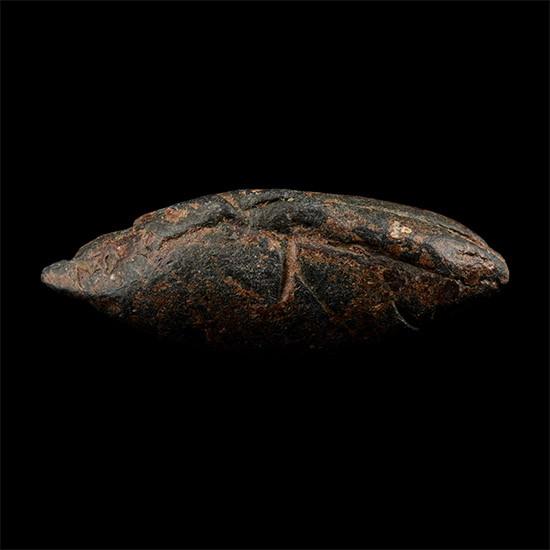
Greek Macedonian Lead Slingshot
4th-3rd century B.C.Sold for (Inc. bp): £46
Lentoid type with one end deformed on impact; incised running zigzag design. 54.4 grams, 45 mm
Ex German art market, 2000s. Acquired from an EU collector living in London. From the collection of a Surrey, UK, gentleman.

