-
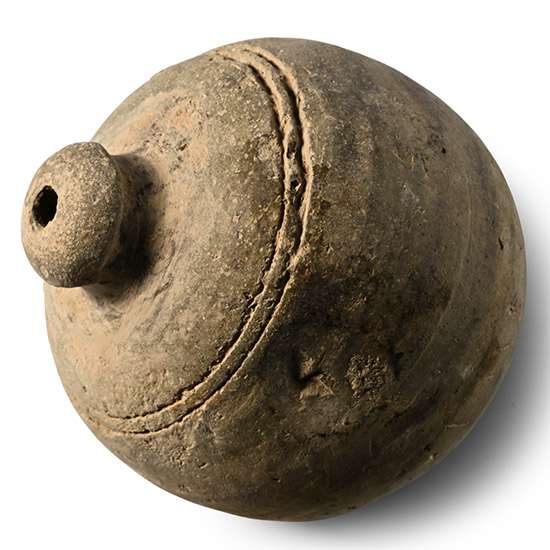
Byzantine 'Greek Fire' Ceramic Bomb or Hand Grenade
9th-11th century A.D.Sold for (Inc. bp): £85
Ovoid in profile with a rounded base, two incised circumferential bands above the shoulder; intended to be filled with explosive liquid and a wick, and used as a hand grenade. 666 grams, 10 cm
From a specialist collection, London, UK, 1990-2000s. Accompanied by an academic paper by military specialist Dr Raffaele D'Amato, dated 15 July 2019 and titled 'Eastern Roman Empire - Greek Fire Bomb or Hand Grenade (μεσαίον kακάβιον) 9th-11th century AD'.
Apart from the use of siphons or manual flame-throwers called cheirosiphona, special corps of Roman soldiers employed terracotta grenades, in the form of small jars, abundantly evidenced in archaeological excavations. They were called μεσαία kακαβιά or κυτροκακάβια, where the former had a bulbous shape and the latter a more cylindrical form. -
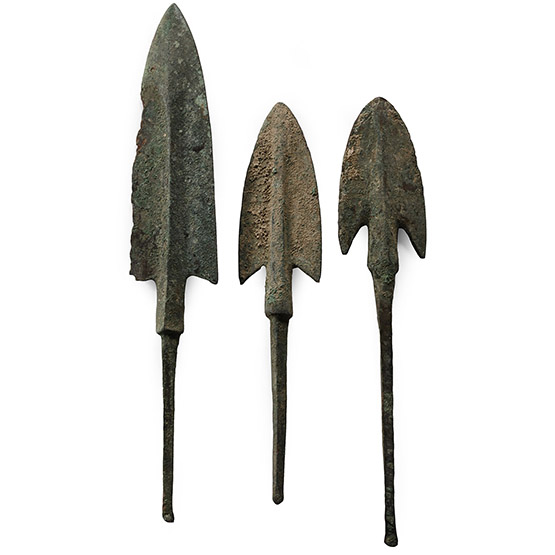
Luristan Bronze Arrowhead Collection
2nd-1st millennium B.C.Sold for (Inc. bp): £117
Comprising: two large triangular arrowheads with barbed shoulders and rounded midrib; one large arrowhead with lanceolate head and rounded shoulders. 94 grams total, 12.5-16.1 cm
Acquired in the 1990s. Ex Abelita family collection.
The arrowheads belong to the type V of the classification of Khorasani: subtype D (triangular arrowheads with rounded or angular midrib) and subtype C, arrowheads with elongated, triangular shape with barbed shoulders and convex sides, and a raised midrib with a sharp central line. -
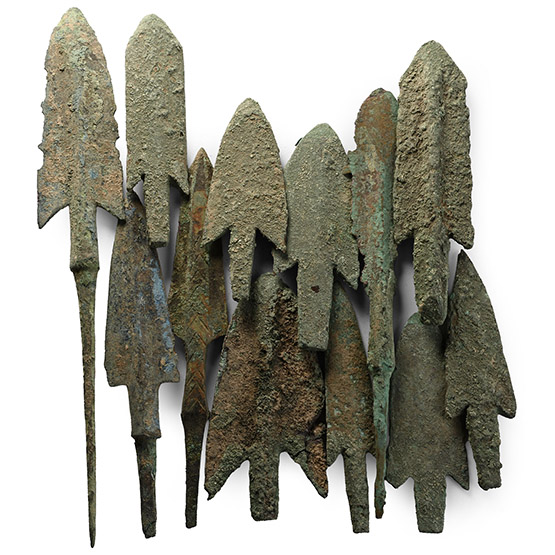
Luristan Bronze Arrowhead Collection
2nd-1st millennium B.C.Sold for (Inc. bp): £130
Mainly barbed and tanged types. 280 grams total, 6.3-16 cm
Ex London, UK, collection, 1990s. -
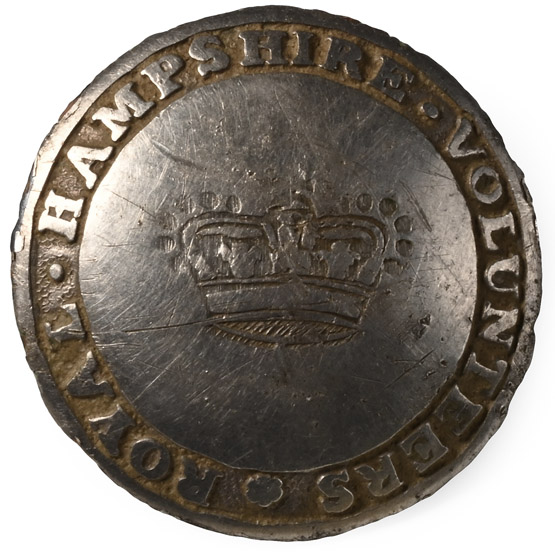
Royal Hampshire Volunteers Silver-Plated Button
19th century A.D.Sold for (Inc. bp): £26
Silver-plated military button bearing the legend 'ROYAL HAMPSHIRE VOLUNTEERS' around a crown; loop to reverse. 2.18 grams, 17 mm
Found Waltham St. Lawrence, Windsor and Maidenhead, UK. Accompanied by a copy of the British Museum's Portable Antiquities Scheme (PAS) report no.BERK-0A5A9A.
From the PAS Report: 'Similar recorded examples have 'I. Nutting' backmark (without '& Son') which indicates a manufacture date of c.1794-1802 ('& Son' being added in 1803, dropped again c1820 when the father died).' The story of the unit is difficult to determine. 'The Volunteer & Militia lists for 1794,1796, 1797, 1799, 1800 & 1801 have all been checked and no unit of this title is listed. Also the Parliamentary Return for December 9th & 13th, 1803 which lists many units that didn't make it into the April 1804 War Office List have been searched, again no such unit is listed. There were a few infantry volunteer regiments raised c1780-1783 as so many of the regular regiments were fighting in the War of American Independence, 'Royal Lancasters Volunteers' was one such that is listed, but there is no mention of one for Hampshire.' -
.jpg)
Luristan Bronze Dirk
2nd-1st millennium B.C.Sold for (Inc. bp): £143
With a parallel-sided blade curving to a point, with a broad mid-rib, and a rectangular-section tang. 275 grams, 37 cm
Ex Abelita family collection, 1980s-2000s.
MacGregor dated such blades to the Late Bronze Age or Early Iron Age. Moorey, Gordon and Khorasani created a classification of bladed weapons, according to which daggers are edged weapons no greater than 36cm in length, dirks (short swords) are between 36cm and 50cm in length, and swords are edged weapons greater than 50cm in length. -
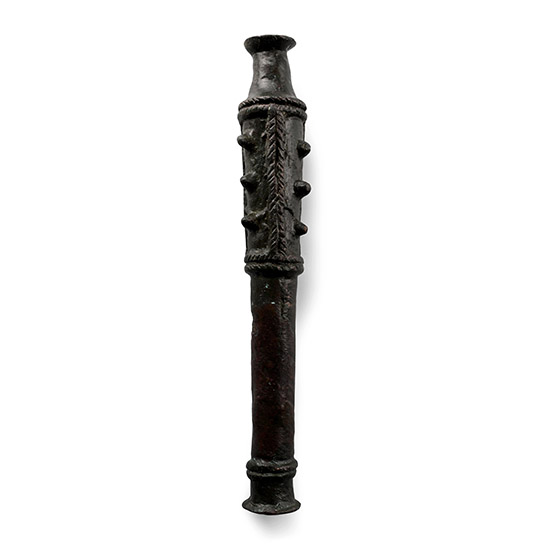
Luristan Bronze Macehead
Late 2nd millennium B.C.Sold for (Inc. bp): £293
Of cylindrical shape, the upper section with alternating rectangular panels framed by pseudo-rope design and vertical rows of three prominent spikes, a short cylindrical shaft edged at top and bottom. 190 grams, 15.6 cm
Ex Abelita family collection, 1980s-2000s.
This weapon has been used in different ways, and it was probably considered the main tool in the Kassite civilisation because of the high number of maces found in this area. Bronze maces in Luristan possibly had wooden handles, although most of them unfortunately, have been eroded and severely deteriorated. According to Khorasani, such maces were realised with the lost-wax process. -
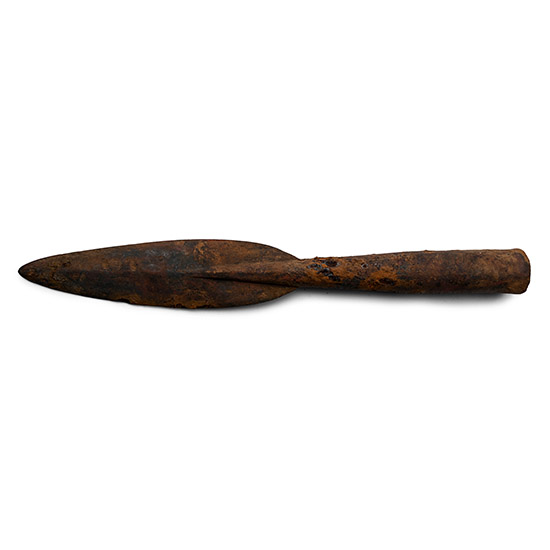
Large Greek Socketted Iron Spearhead
Sarissa, circa 3rd-2nd century B.C.Sold for (Inc. bp): £247
Comprising a leaf-shaped lentoid-section blade and long tubular socket. 826 grams, 38.5 cm
Ex Hermann Historica, 7 October 2009, no.207 (Part). Private collection, Germany. Kept in the UK from 2016. -
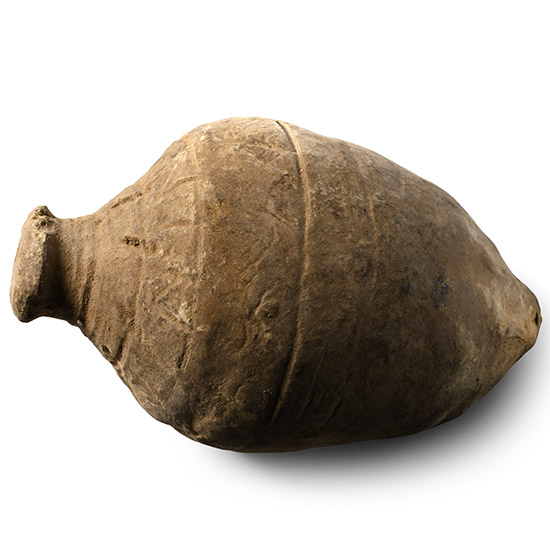
Byzantine 'Greek Fire' Ceramic Bomb or Hand Grenade
9th-11th century A.D.Sold for (Inc. bp): £78
Piriform in profile with a rounded base, and two circumferential bands on the shoulder; intended to be filled with explosive liquid and a wick, and used as a hand grenade. 465 grams, 13.7 cm
From a specialist collection, London, UK, 1990-2000s. Accompanied by an academic paper by military specialist Dr Raffaele D'Amato, dated 15 July 2019 and titled 'Eastern Roman Empire - Greek Fire Bomb or Hand Grenade (μεσαίον kακάβιον) 9th-11th century AD'.
Apart from the use of siphons or manual flame-throwers called cheirosiphona, special corps of Roman soldiers employed terracotta grenades, in the form of small jars, abundantly evidenced in archaeological excavations. They were called μεσαία kακαβιά or κυτροκακάβια, where the former had a bulbous shape and the latter a more cylindrical form. -
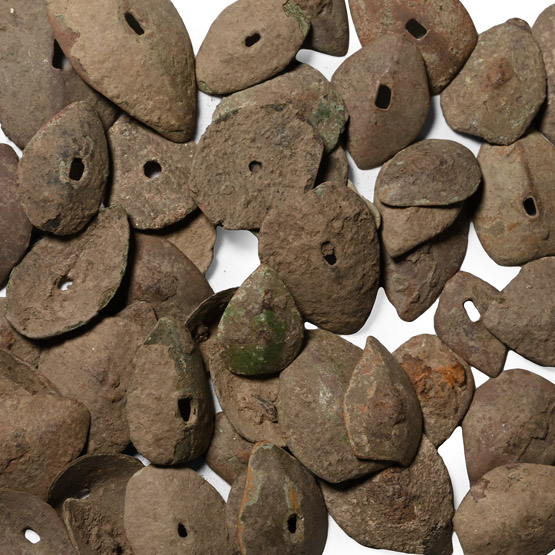
Post Medieval Bronze Scale Armour Collection
Circa 16th-17th century A.D.Sold for (Inc. bp): £85
Mainly teardrop and disc types, with attachment holes. 46 grams, 14-25 mm
Ex London Coin Fair, 1990s. Ex Buckinghamshire, UK, collection. -
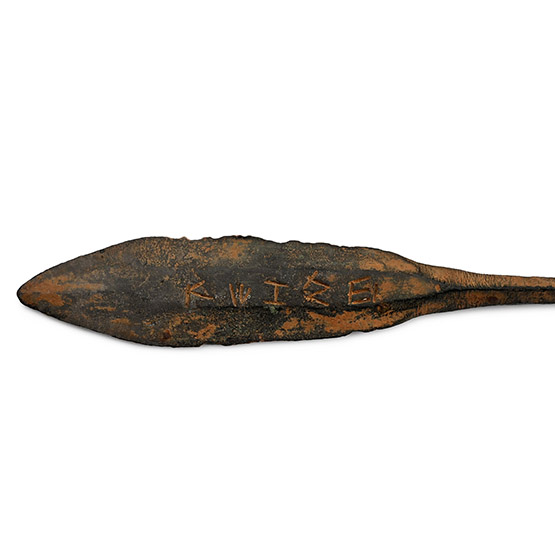
Aramaic Inscribed Bronze Arrowhead for Zscha..., Son of Adnb
1st millennium B.C.Sold for (Inc. bp): £1,105
Comprising a two-edged lentoid-section leaf-shaped blade and lozenge-section tang; each side with a short incised Aramaic inscription; ḥṣ zš bn ʾdnb = arrow of Zscha..., son of Adnb. 14 grams, 94 mm
From the collection of a gentleman, acquired on the London art market in the 1990s. -
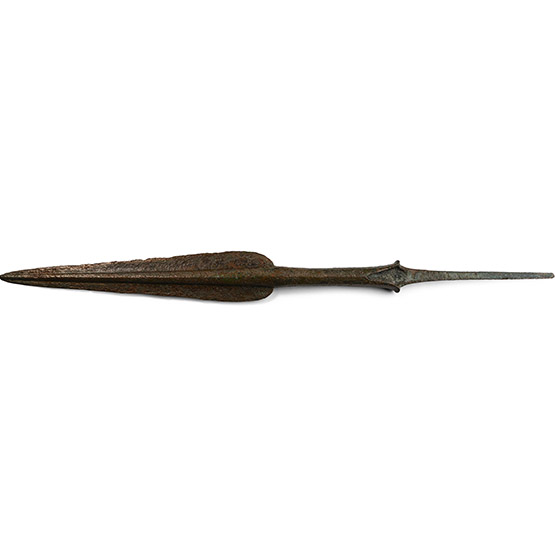
Luristan Bronze Spearhead
2nd-1st millennium B.C.Sold for (Inc. bp): £208
Triangular in profile with rounded shoulders and thick square-section mid-rib running to the tip; short flared neck and square-section tang. 331 grams, 42.3 cm
Ex Abelita family collection, 1990s. -
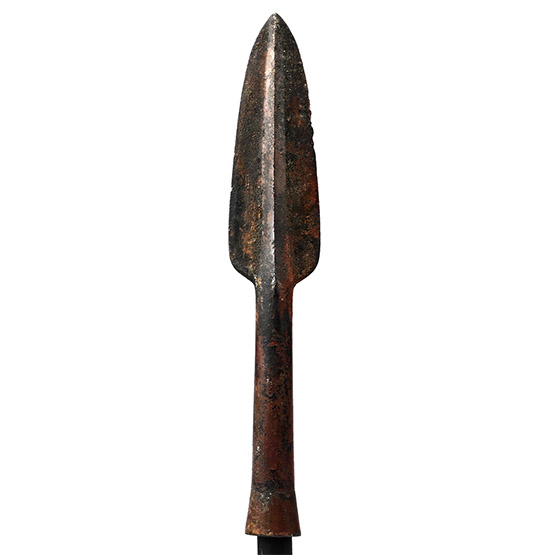
Luristan Bronze Socketted Spearhead
13th-6th century B.C.Sold for (Inc. bp): £169
With a broad leaf-shaped blade, a triangular mid-rib and a tapering tubular socket; accompanied by a display stand. 382 grams total, spearhead: 23.1 cm (31.2 cm including stand)
Ex Abelita family collection, 1980s-2000s.
The spear belongs to the type VIII classified by Khorasani (spearheads with well-projecting midribs and long folded sockets) and more specifically to subtype C (with leaf-shaped blade and short hollow socket). Usually, the willow-leaf blade has an almost straight shoulder base and a wide, flat midrib tapering towards the point.

