-
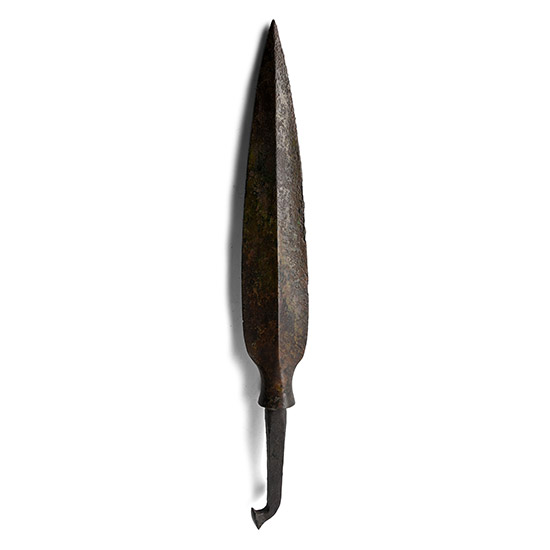
Luristan Bronze Spearhead
2nd-1st millennium B.C.Sold for (Inc. bp): £286
Comprising a leaf-shaped blade with a raised midrib extending to the shaft with a flared collar, rectangular-section tang with curved end and a button finial. 608 grams, 34.2 cm
Ex Abelita family collection, 1980s-2000s.
The type belongs to the category of tripartite lances with a long, pointed biconvex blade and single bevelled tang. In this typology, the blade, of rhomboidal section, is usually well balanced. The stem, medium or short, is widened at its base and forms a fairly clean stop. Elements of the shaft of a similar spear found at Tepe Hissar have allowed the reconstruction of the length of the spear reaching up to 1.40 m. -
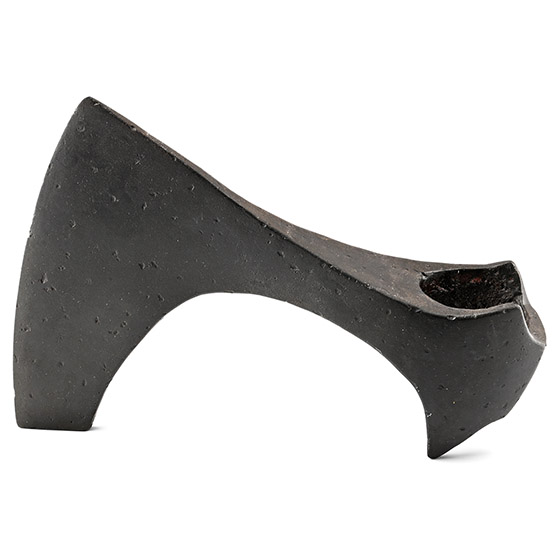
Viking Age Iron Socketted Bearded Axehead
Circa 10th-11th century A.D.Sold for (Inc. bp): £546
Finely curved, broad blade with square chin to the lower edge, rounded socket with lateral triangular extensions; professionally cleaned, conserved, and restored. 552 grams, 16 cm
From the family collection of a South East London collector; formerly acquired in the late 1950s.
This type of bearded axe seems to correspond to the E2 category of the Viking axe classification, but also has affinity with the Slavic axes of type Y. Usually, these bearded axeheads (skeggöks) had a longer edge, designed to split tree trunks into planks and beams. Some of the bearded axes were known as halfÞynna öx; the neck on such a 'half thin axe' was thinly forged, to make it lighter. -
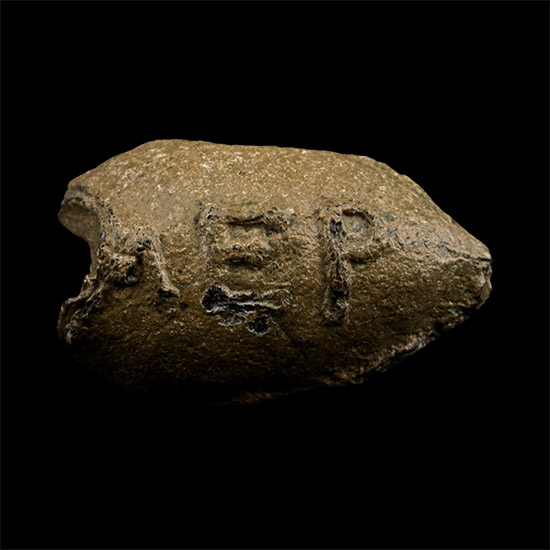
Greek Macedonian Lead Impacted Slingshot
4th-3rd century B.C.Sold for (Inc. bp): £52
Lentoid type with one end deformed on impact; raised legend '[.]MEP' to one face and 'NA[..]' to the other. 26.6 grams, 25 mm
Ex German art market, 2000s. Acquired from an EU collector living in London. From the collection of a Surrey, UK, gentleman. -
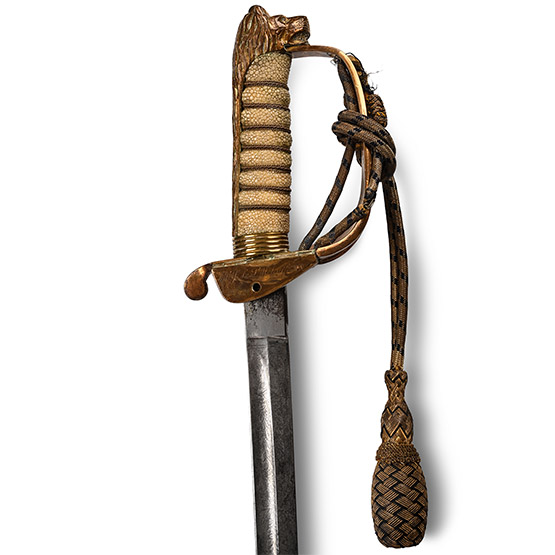
Naval Officer's Dress Sword with Belt
19th century A.D.Sold for (Inc. bp): £260
Classic 1827 Pattern dress sword in scabbard, comprising brass lion-head pommel, half-basket-hilt with folding guard and fouled anchor motif to underside, wire-bound fishskin grip, sword-knot tied through slot in the knuckle-bow; etched, pipe-backed steel blade with the Royal Arms and Crown/Anchor, housed in a leather scabbard with brass fittings; suspension straps and waist-belt with navy-pattern buckle. 1.34 kg, 94.7 cm
From a Cambridgeshire, UK, collection. -
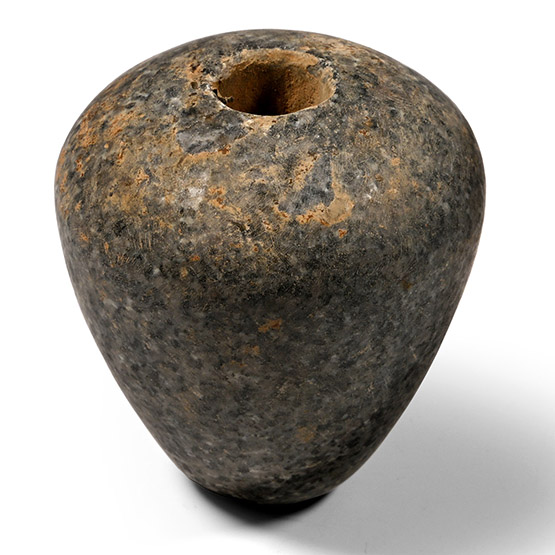
Western Asiatic Stone Macehead
3rd-2nd millennium B.C.Sold for (Inc. bp): £169
Piriform with vertical socket expanding towards the narrower end. 342 grams, 67 mm
Ex London, UK, collection, 1990-2000s. -
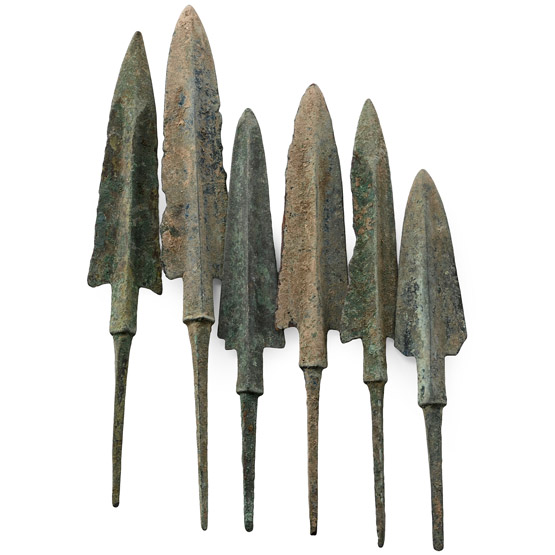
Western Asiatic Bronze Arrowhead Collection
1st millennium B.C.Sold for (Inc. bp): £117
Each a narrow barbed-and-tanged type with a thick midrib. 216 grams total, 12.6-18.5 cm
Ex London, UK, collection, 1990s. -
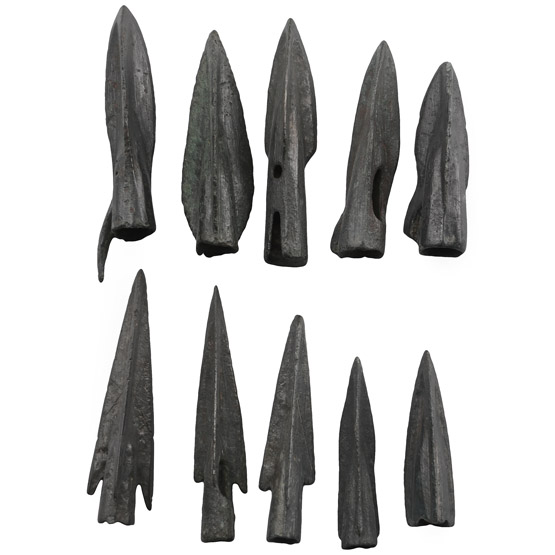
Greek Bronze Arrowhead Group
5th-3rd century B.C.Sold for (Inc. bp): £85
Socketted type with three radiating narrow flanges. 22.92 grams total, 24-38 mm
Ex German art market, 2000s. Acquired from an EU collector living in London. From the collection of a Surrey, UK, gentleman. -
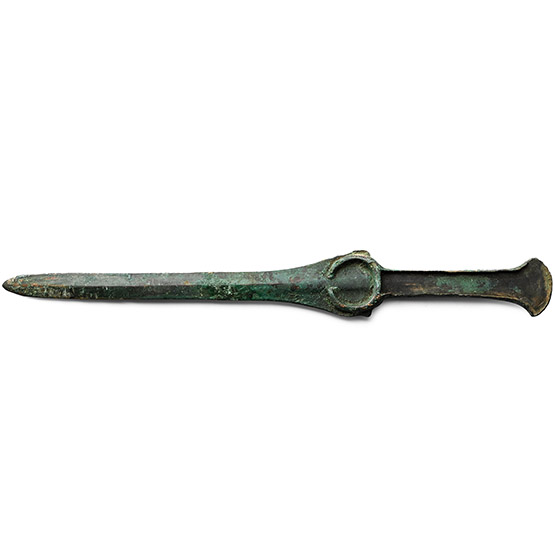
Luristan Bronze Dagger
2nd-1st millennium B.C.Sold for (Inc. bp): £338
Blade with a shallow median rib, crescentic pennannular guard, handle with pommel in the shape of a nail head. 151 grams, 30.5 cm
Ex Abelita family collection, 1980s-2000s.
This is a type of blade rare among Luristan weapons. The simplest type that appeared to J. de Morgan and Godard in the first excavations of Luristan looked like this: a blade always featuring a median groove, a guard decorated with a crescent, and a round hilt with a nail-shaped head. The hilt was usually filled with organic material, such as wood, bone, or ivory. -
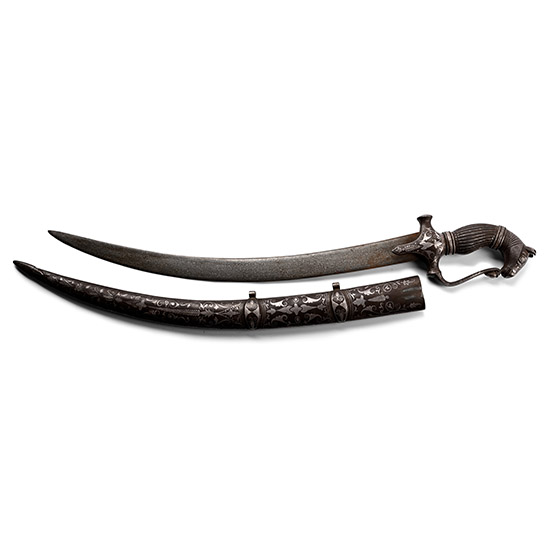
Indo-Persian Inlaid Iron Talwar with Scabbard
20th century A.D.Sold for (Inc. bp): £468
Comprising a curved damascened steel blade, hilt with horse-head pommel, knuckle-guard and stub quilolons; scabbard with two suspension points, inlaid white-metal detailing. 823 grams, 64 cm
Private collection, UK. -
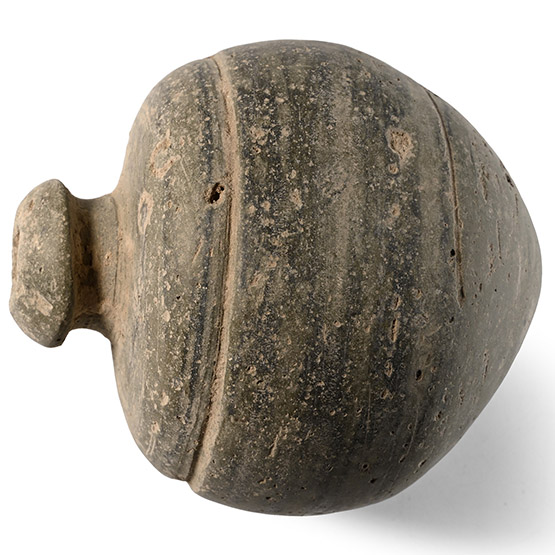
Byzantine 'Greek Fire' Ceramic Fire Bomb or Hand Grenade
9th-11th century A.D.Sold for (Inc. bp): £91
Ovoid body with impressed ring to the shoulder, domed filler-hole; intended to be filled with explosive liquid and a wick, and used as a hand grenade. 251 grams, 84 mm
From an important specialist collection, London, UK, 1990s onwards. Accompanied by an academic paper by military specialist Dr Raffaele D'Amato, dated 15 July 2019 and titled 'Eastern Roman Empire - Greek Fire Bomb or Hand Grenade (μεσαίον kακάβιον) 9th-11th century AD'.
Apart from the use of siphons or manual flame-throwers called cheirosiphona, special corps of Roman soldiers employed terracotta grenades, in the form of small jars, abundantly evidenced in archaeological excavations. They were called μεσαία kακαβιά or κυτροκακάβια where the former had a bulbous shape and the latter a more cylindrical form. -
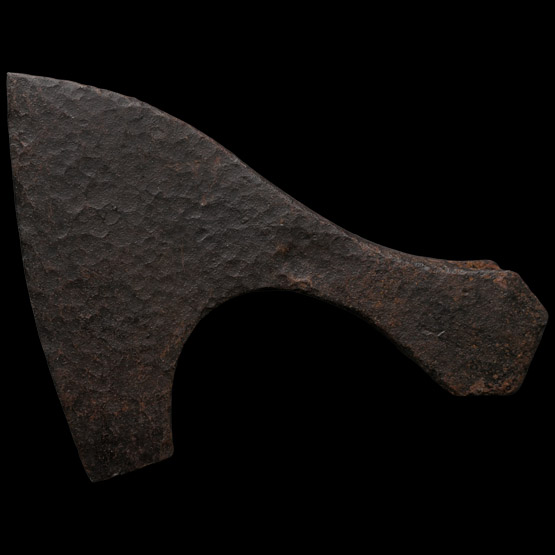
Viking Age Iron Bearded Axehead
Circa 9th-11th century A.D.Sold for (Inc. bp): £468
Broad blade with thickened edge, rounded socket with lateral triangular extensions. 269 grams, 13.5 cm
Ex North American collection, 1970s. -
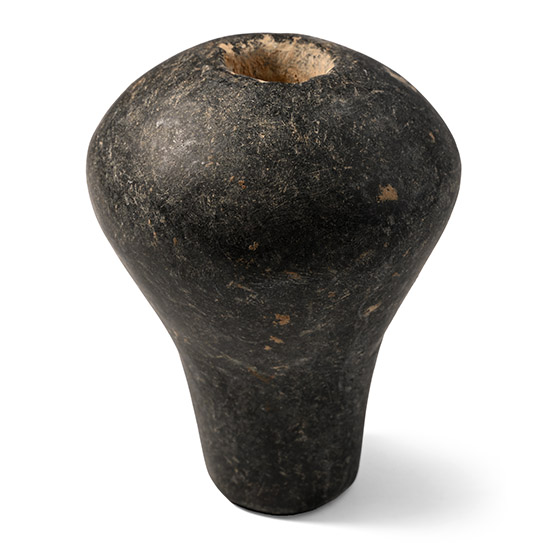
Western Asiatic Polished Stone Macehead
3rd-2nd millennium B.C.Sold for (Inc. bp): £143
With slightly carinated equator to the globular body and tubular shaft. 456 grams, 90 mm
From the collection of North West London, UK, gentleman, early 2000s.

