-
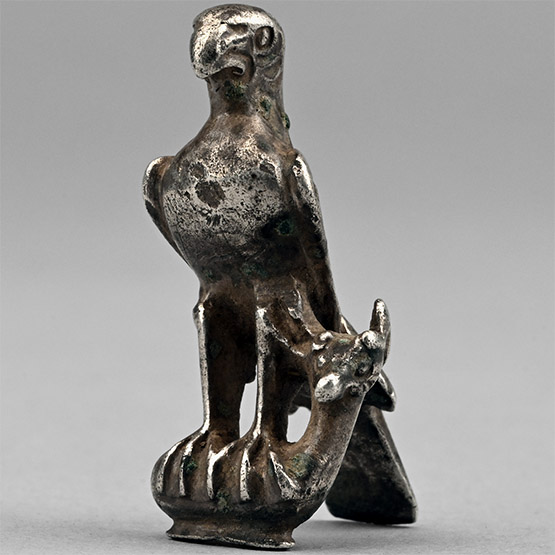
Roman Silver Eagle Holding a Deer
2nd-3rd century A.D.Sold for (Inc. bp): £1,170
The eagle standing with its wings folded, erect head with natural facial detailing, claws gripping the body of a reclining doe with raised head and pricked ears. 21.5 grams, 38 mm high
Acquired in the 1980s. Private collection, Switzerland, thence by descent. Private collection, since the late 1990s.
The motif of an eagle and a stag or a deer is typically associated with the God Jupiter/Zeus Dolichenus and his wife Juno Dolichena, name derived from his sanctuary in Doliche, Anatolia. Jupiter Dolichenus was a soldier god, usually portrayed wearing full military attire and standing on a bull, while his consort would have been shown standing on a deer or stag. -
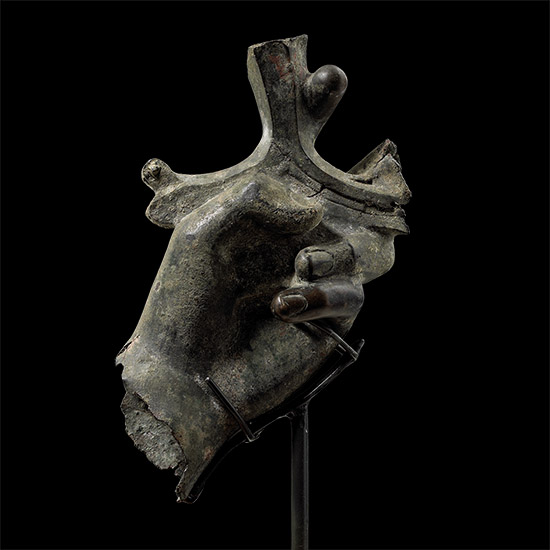
Roman Bronze Hand Holding a Parazonium
2nd-3rd century A.D.Sold for (Inc. bp): £7,000
Fragment from a hollow-formed monument comprising a left hand holding the base of a cross fleury with hexagonal cross-section; mounted on a custom-made display stand. 1.97 kg total, 32.6 cm high including stand
Ex Arthur Richter (1925-2018), California, USA. Private collection, England. Accompanied by an academic report by Dr Raffaele D'Amato. This lot has been checked against the Interpol Database of stolen works of art and is accompanied by search certificate number no.13084-249671.
Here, the hand of what was once a colossal statue of a general or emperor brandishes an object that may be a cross, or the hilt of a commander's sword (parazonium). These monumental bronzes belong to the late period of the Empire, when the image of the victorious emperor or general was intended as propaganda demonstrating military strength, despite the Empire being surrounded by external enemies and devastated by internal strife. -
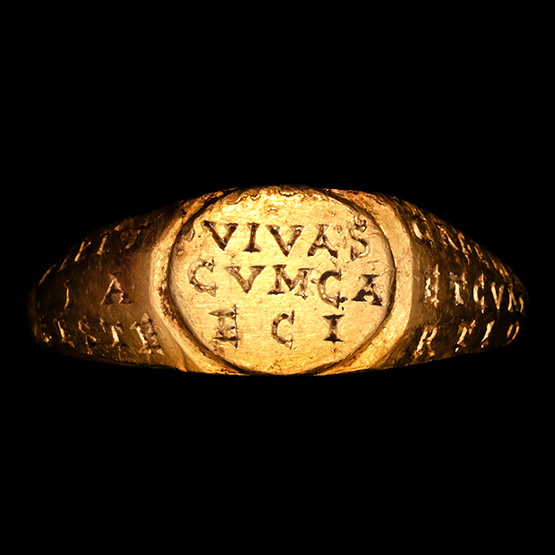
Roman Gold 'Talismanic' Ring with Inscriptions
3rd-4th century A.D.Sold for (Inc. bp): £5,200
Comprising chamfered sloped shoulders and ellipsoid bezel; engraved with later blundered Latin legends in capitals: left shoulder - ‘REBET ?IA SESTE’ (It is rebated), bezel - ‘VIVAS CVM CAECI’ (Live with Caecus), right shoulder - ‘CAFELIX ET CVM RTIO’ (Safe and comfortable). 3.80 grams, 18.19 mm overall, 14.94 mm internal diameter (approximate size British F, USA 2 3/4, Europe 3.67, Japan 3)
Private collection, Europe. Acquired on the English art market. This lot has been checked against the Interpol Database of stolen works of art and is accompanied by search certificate number no.13044-248372.
The ring is extensively engraved with the following Latin words and approximate translations: Left shoulder - ‘REBET ?IA SESTE’ - It is rebated. Bezel - ‘VIVAS CVM CAECI’ - Live with Caecus. Right shoulder - ‘CAFELIX ET CVM RTIO’ - Safe and comfortable. The Latin expression can be understood as part of a personal protective message. -
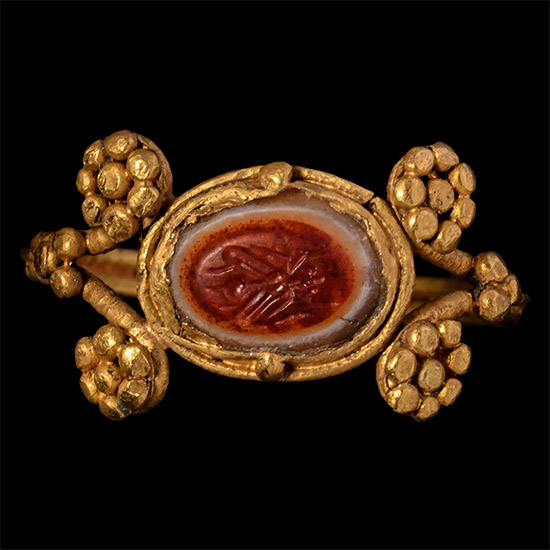
Roman Gold Ring with 'Eye' Gemstone with Engraved Bee
3rd century A.D.Sold for (Inc. bp): £1,690
Sardonyx cabochon with incuse bee to centre; set in a cell with flanking gold rosettes; hoop formed with three beaded wire bands and granule detailing; supplied with a museum-quality impression. 4.52 grams, 22.29 mm overall, 19.07 mm internal diameter (approximate size British Q 1/2, USA 8 1/4, Europe 18.12, Japan 17)
Private collection, Europe. Acquired on the English art market. -
.jpg)
Roman Bronze Hand-Standing Acrobat
1st-2nd century A.D.Sold for (Inc. bp): £7,800
A statuette of an acrobat on a round, drum-shaped base, standing on his hands, body arching slightly and legs together; wearing a loin cloth and cap decorated with floral pattern; eyes inlaid with silver. 162 grams, 12 cm high
Ex property of a Surrey collector; acquired in the early 1970s. This lot has been checked against the Interpol Database of stolen works of art and is accompanied by search certificate number no.13125-249637.
Acrobats in ancient Rome could perform at a number of venues; either in theatres, as 'gap fillers' between gladiatorial contests at the amphitheatre, at private parties or at impromptu street performances and fairs. A convivium was a dinner party with family, friends or associates. It was somewhat like a Greek symposium except that it was generally regarded as a chance to talk business or politics rather than philosophy and weighty matters. A commissatio was a wild drinking party. Prostitutes, jugglers, musicians, acrobats, actors and fire-eaters entertained guests at the banquets of wealthy Romans. From the descriptions given by Roman authors these banquets were lavish affairs with rose petals scattered on the floor, mechanical devices lowering acrobats and entertainers from the ceiling and slaves blew exotic scents into the room. The emperors also had special entertainment barges constructed on some of the ornamental lakes in the parks of Rome where acrobats entertained the guests. -
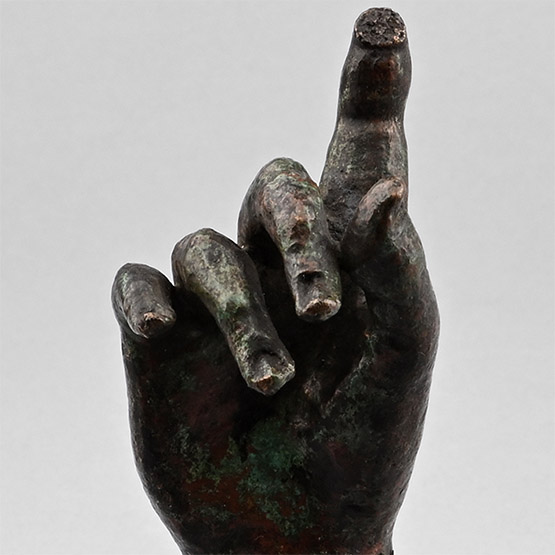
Roman Bronze Statue Hand
2nd century A.D.Sold for (Inc. bp): £2,860
The slender right hand from a large statue with index finger extended and the others curled as if gripping a thin wand, flower-stem or similar item; cracked at the wrist; mounted on a custom-made display stand. 457 grams total, 16.9 cm including stand
Private collection, Europe. Acquired on the English art market. This lot has been checked against the Interpol Database of stolen works of art and is accompanied by search certificate number no.13127-248405. -
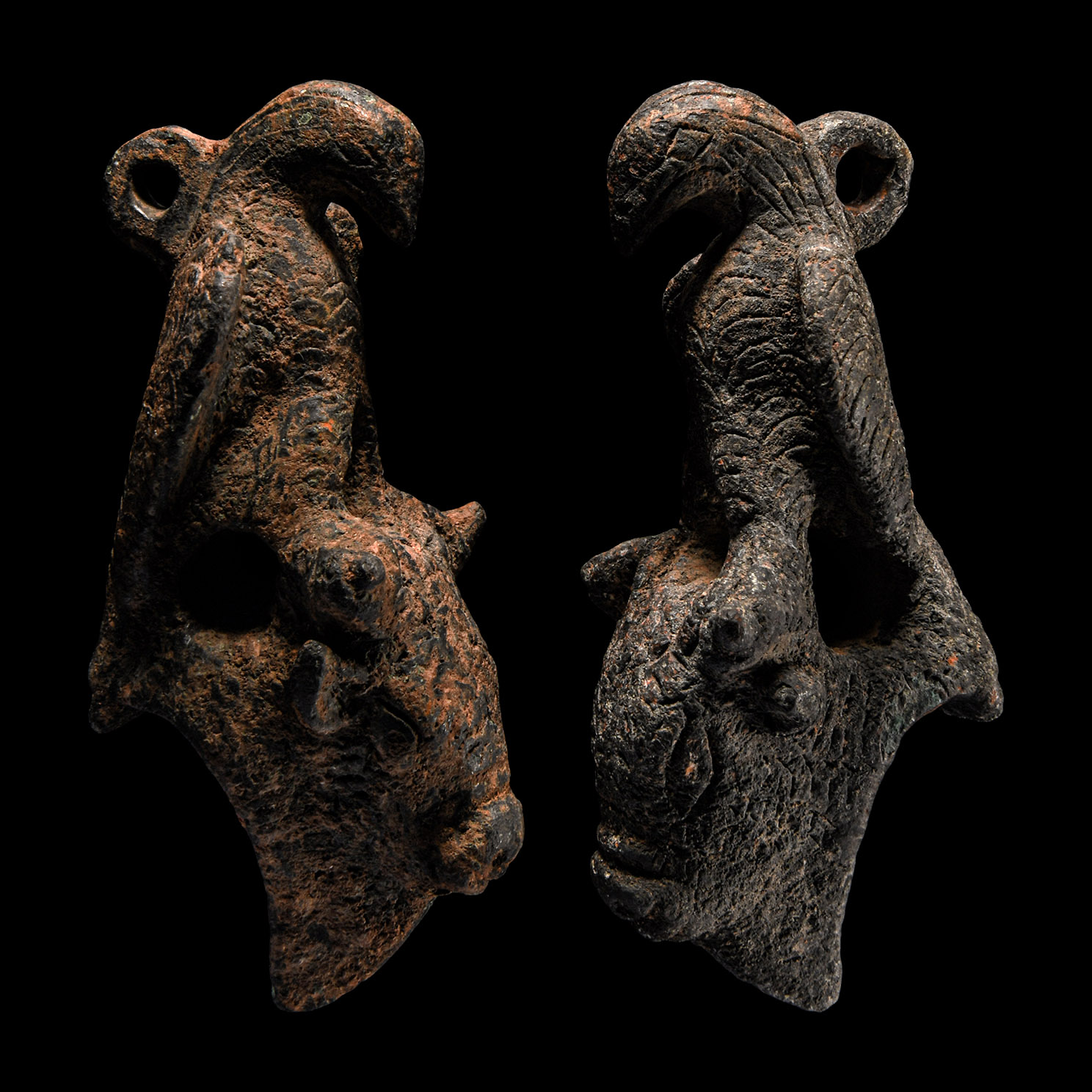
Roman Bronze Jupiter Dolichenus Eagle Pair
2nd-3rd century A.D.Sold for (Inc. bp): £1,170
Formed as imperial birds modelled in the round, each standing on the head of a horned bull, wings partially spread; semi-naturalistic detailing to the head and feathers; suspension loop behind the neck. 482 grams total, 86-92 mm
Acquired in Europe before 1992. Private collection, UK. -
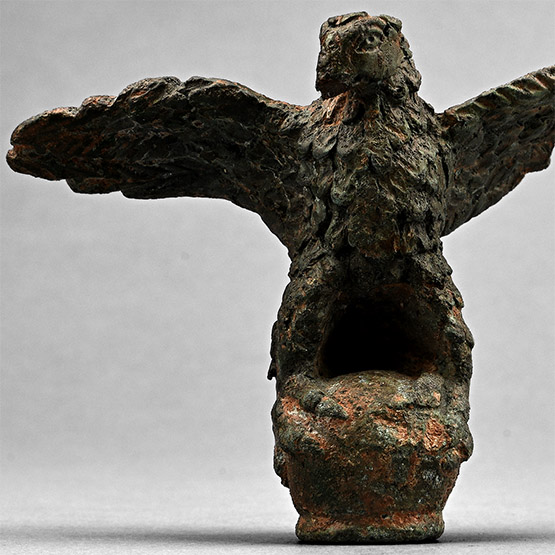
Roman Bronze Legionary Eagle Staff Finial
2nd-3rd century A.D.Sold for (Inc. bp): £2,210
Comprising a hollow-formed knop with collar to the socket, eagle modelled in the round perching on the knop with wings spread and head turned; socket behind the shoulders. 236 grams, 81 mm
Acquired in the mid 1980s-1990s. Private collection, Switzerland, thence by descent. Private collection, since the late 1990s. This lot has been checked against the Interpol Database of stolen works of art and is accompanied by search certificate number no.12238-222314. -
.jpg)
Roman Enamelled Bronze Openwork 'Camp Gate' Plate Brooch
1st-2nd century A.D.Sold for (Inc. bp): £325
Tongue-shaped openwork plate with knob finial and yellow enamel; pin, pin-lugs and catchplate to the reverse. 21.2 grams, 44 mm
Ex property of an Essex, UK, gentleman collector. From the private collection of a Colchester, UK, gentleman. -
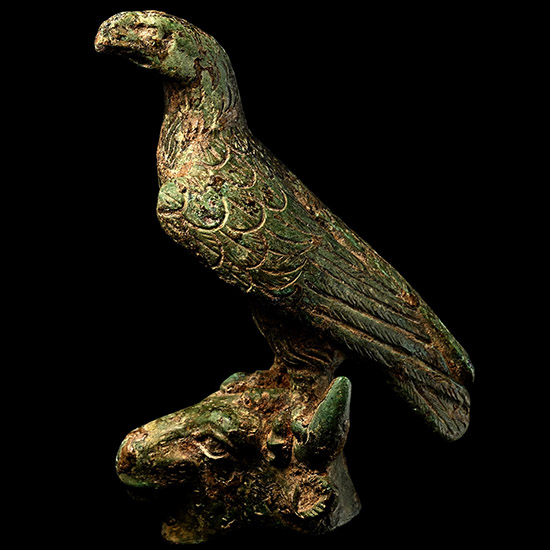
Roman Bronze Eagle on Bull's Head
2nd-3rd century A.D.Sold for (Inc. bp): £1,170
Modelled in the round figure of a bull's head (bucranium) with an eagle with folded wings perched on the horns; hollow to the underside. 129 grams, 70 mm
Acquired by a Swiss family in the mid-1980s to late 1990s, thence by descent. Private collection, Switzerland, since the late 1990s. -
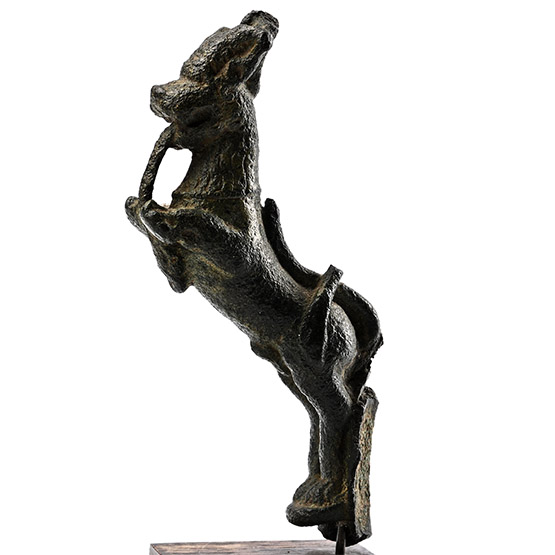
Roman Bronze Prancing Lion Statuette
1st-3rd century A.D.Sold for (Inc. bp): £715
Modelled in the round with the tail laid along the spine, collar to the neck and crest between the pricked ears; tongue protruding to form a loop against the chest, possibly from a handle; mounted on a display stand. 226 grams total, 13 cm including stand
Acquired from Bath Antiques Centre, 1990s; and inspected and verified by Robert Knox of the British Museum. From the private collection of a Somerset gentleman. -
.jpg)
Late Roman Silver Ring with Nicolo Gemstone with Facing Busts and Chi Rho
4th-6th century A.D. or laterSold for (Inc. bp): £1,690
Broad hoop and shoulder with stepped bezel, inset nicolo with incuse image of two profile busts flanking a frond surmounted by a Christogram; supplied with a museum-quality impression. 12.79 grams, 25.74 mm overall, 17.61 x 14.24 mm internal diameter (approximate size British I 1/2, USA 4 1/2, Europe 8.07, Japan 7)
Private collection, England.

