-
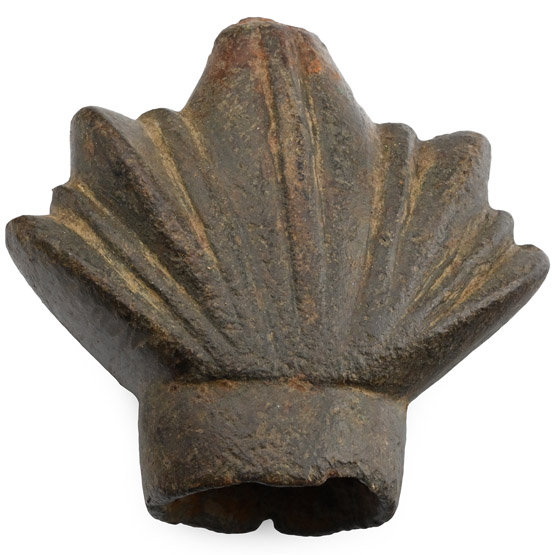
Large Medieval Bronze Dagger Pommel
14th-15th century A.D.Sold for (Inc. bp): £85
Comprising an ellipsoid collar and five radiating lobes with interstitial bands. 43.4 grams, 39 mm
Found Norfolk, UK. -
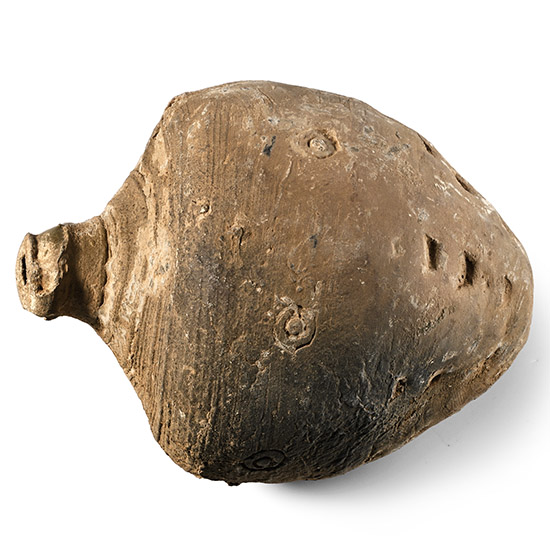
Byzantine 'Greek Fire' Ceramic Bomb or Hand Grenade
9th-11th century A.D.Sold for (Inc. bp): £52
Ovoid in profile with a rounded base, a band of ring-and-dot motifs on the shoulder and radiating indentations on the base; intended to be filled with explosive liquid and a wick, and used as a hand grenade. 783 grams, 14.7 cm
From a specialist collection, London, UK, 1990-2000s. Accompanied by an academic paper by military specialist Dr Raffaele D'Amato, dated 15 July 2019 and titled 'Eastern Roman Empire - Greek Fire Bomb or Hand Grenade (μεσαίον kακάβιον) 9th-11th century AD'.
Apart from the use of siphons or manual flame-throwers called cheirosiphona, special corps of Roman soldiers employed terracotta grenades, in the form of small jars, abundantly evidenced in archaeological excavations. They were called μεσαία kακαβιά or κυτροκακάβια, where the former had a bulbous shape and the latter a more cylindrical form. -
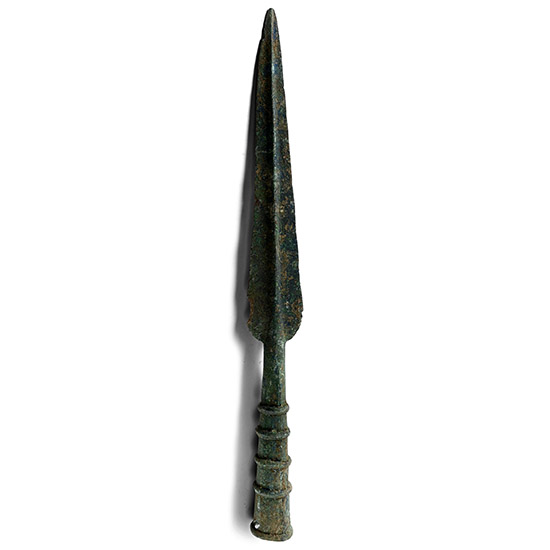
Luristan Bronze Spearhead
800-600 B.C.Sold for (Inc. bp): £182
Socketted with slight horizontal cast-in grooves on the shaft, foliate head with strong mid-rib, fastening hole on the socket. 166 grams, 34.7 cm
Ex Abelita family collection, 1980s-2000s.
These kinds of spearheads were realised by casting in a mould. They were of different lengths and used by Luristan, Hamadan, early Median and Achaemenid warriors. -
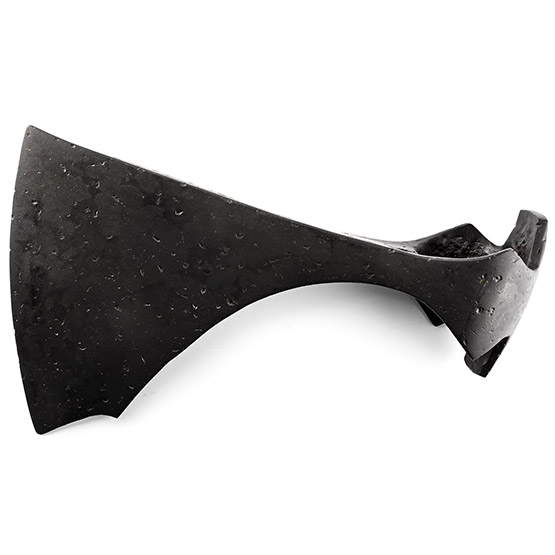
Large Viking Age Iron Socketted Bearded Axehead
Circa 10th-11th century A.D.Sold for (Inc. bp): £442
Finely curved broad blade with chin to the lower edge, rounded socket with lateral triangular extensions and a rectangular extension to the rear; professionally cleaned, conserved, and restored. 730 grams, 21 cm
From the family collection of a South East London collector; formerly acquired in the late 1950s.
This type of bearded axe seems to correspond to the E2 category of the Viking axe classification, but also has affinity with the Slavic axe-type Y. Usually these bearded axeheads (skeggöks) had a longer edge, designed to split tree trunks into planks and beams. Some of the bearded axes were known as halfÞynna öx; the neck on such a 'half thin axe' was thinly forged, to make it lighter. -
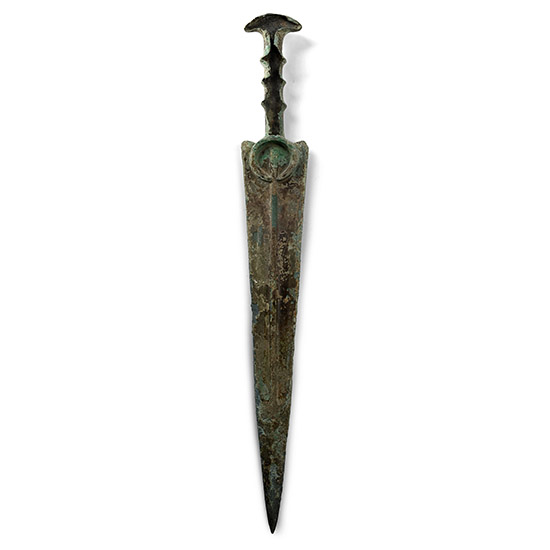
Luristan Bronze Dirk
2nd-1st millennium B.C.Sold for (Inc. bp): £468
Blade with single median rib, crescent-shaped pommel, ridged grip and pseudo-penannular guard embossed over the junction between the hilt and the blade. 355 grams, 43.5 cm
Ex Abelita family collection, 1980s-2000s.
These dirks were integrally cast. Moorey, Gordon and Khorasani created a classification of bladed weapons, according to which daggers are edged weapons no greater than 36cm in length, dirks (short swords) are between 36cm and 50cm in length, and swords are edged weapons greater than 50cm in length. -
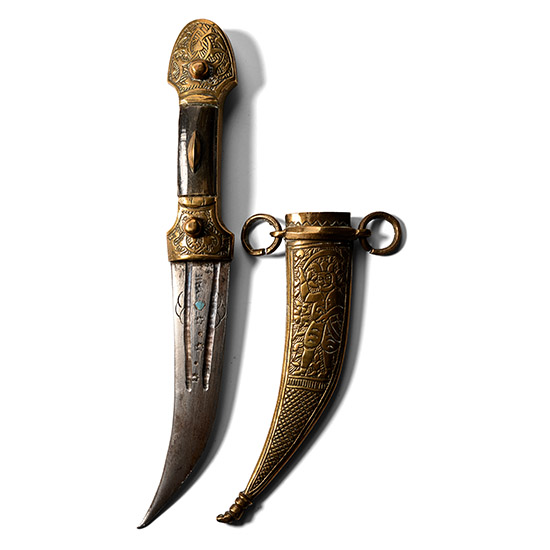
Turkish Iron Dagger with Brass Hilt and Scabbard
Mid 20th century A.D.Sold for (Inc. bp): £78
Two-edged jambiya with narrow curved blade, two deep fullers and punched detailing with inset turquoise-coloured pellet; brass bolster and applied bone panels to the grip, silver facing to pommel; brass sheath with low-relief foliage and figural ornament, suspension rings. 211 grams, 23.2 cm
Acquired on the UK art market in the early 2000s. -
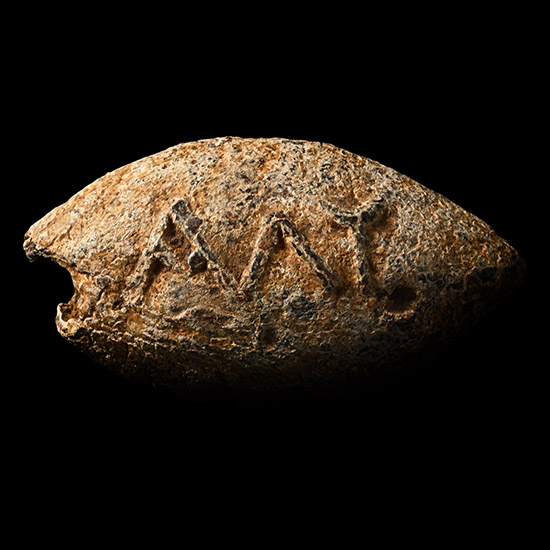
Greek Lead Slingshot of Alexander the Great
3rd-1st century B.C.Sold for (Inc. bp): £1,170
Biconical in profile with casting seam and reserved legend 'ΑΛ[EXANΔΡΟ]Υ.', the club of Herakles on the other side. 29.6 grams, 30 mm
Acquired on the German art market before 2000. Private collection, Munich, Germany.
The presence of the club of Herakles connects the slingshot with the Macedonian Dynasty. Similar slingshots were found in Miletos. -
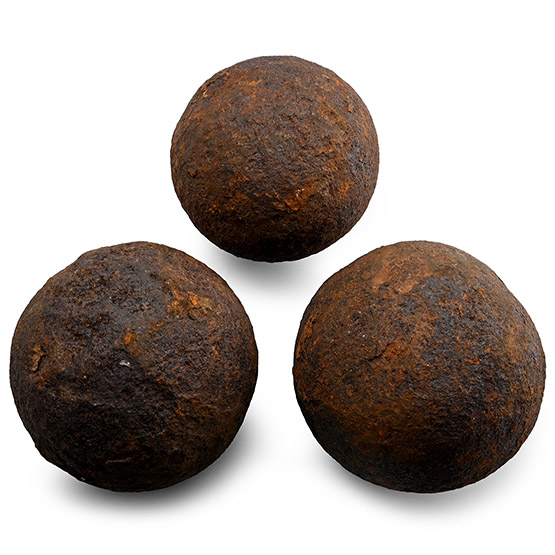
Civil War Period Iron Cannon Ball Collection
17th century A.D.Sold for (Inc. bp): £117
Group of three rough-cast cannonballs for a saker-type cannon, each approximately five pounds in weight and three inches diameter. 7.14 kg total, 76-87 mm
Found Southwell, Nottinghamshire, circa 1975. -
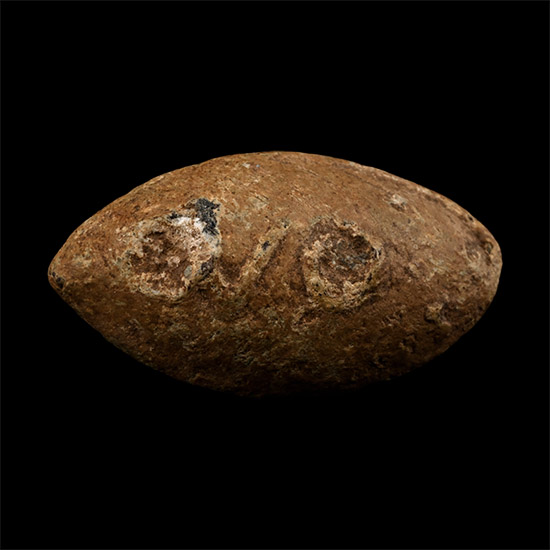
Greek Hellenic Inscribed Lead Slingshot
3rd century B.C.Sold for (Inc. bp): £130
Lenticular type with casting seam to the rim, raised 'OΛO' legend; with old dealer's ticket. 4.53 grams, 34 mm
From Asia. Acquired on the UK art market. From the private collection of an East Anglian, UK, Specialist Collector. Accompanied by a copy of a previous catalogue entry. -
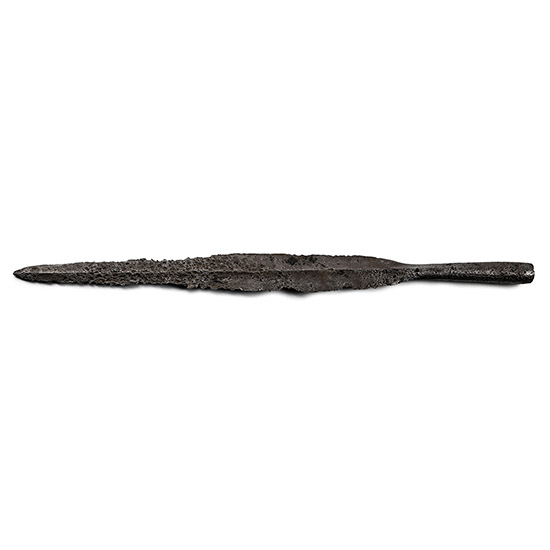
Large Iron Age Celtic Spearhead
Circa 450 B.C.– 50 A.D.Sold for (Inc. bp): £234
A long, slender leaf-shaped blade with expanding conical socket. 321 grams, 47.7 cm
Axel Guttmann, Germany. Hermann Historica, 7 October 2009, no.207 (Part). Private collection, Germany. Kept in the UK from 2016. -
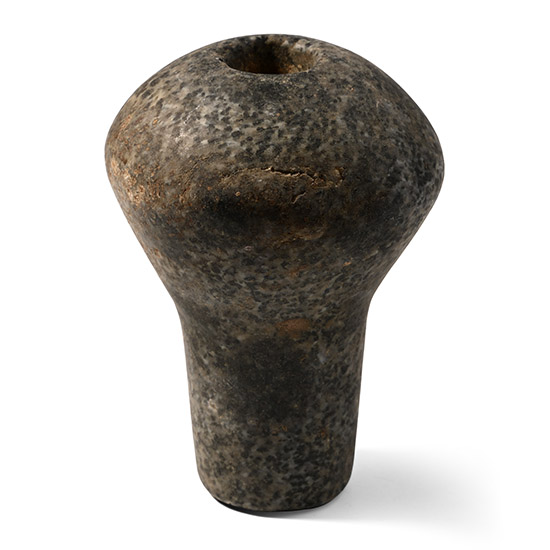
Western Asiatic Polished Stone Macehead
3rd-2nd millennium B.C.Sold for (Inc. bp): £117
With slightly carinated equator to the globular body and tubular shaft. 377 grams, 91 mm
From the collection of North West London, UK, gentleman, early 2000s. -
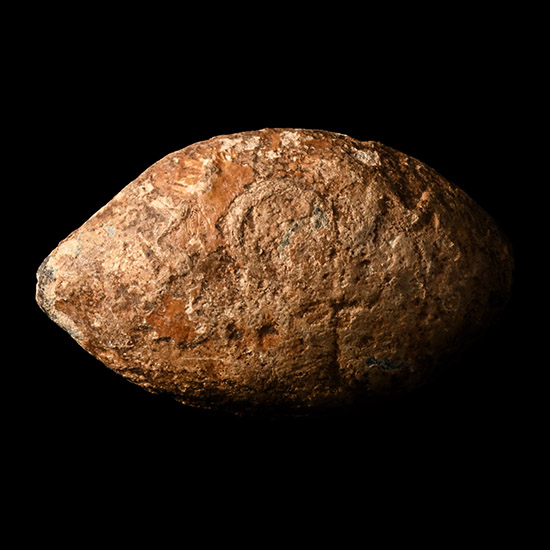
Greek Lead Slingshot
3rd-1st century B.C.Sold for (Inc. bp): £130
Biconical in profile with casting seam and reserved legend 'ΣΟΜA' to one face, 'HPAKAEI' to reverse, with the possible meaning 'Body of Herakles'. 29.8 grams, 29 mm
Acquired on the German art market before 2000. Private collection, Munich, Germany.
The principal varieties of the inscriptions found on sling bullets are: 1) the name of a man, a place or a person; 2) the name of a deity, sometimes on its own and sometimes in connection with ‘victory’; 3) words conveying orders, jokes or sarcasms. Here the inscription connects the power of the bullet to the mythical god of strength.

