-
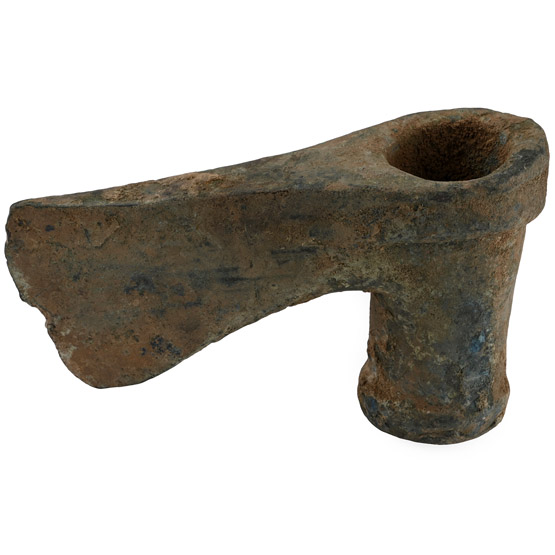
Large Luristan Bronze Socketted Axehead
2nd-1st millennium B.C.Sold for (Inc. bp): £117
With convex cutting edge and prominent round socket. 955 grams, 14.4 cm
Ex Abelita family collection, 1980s-2000s. -
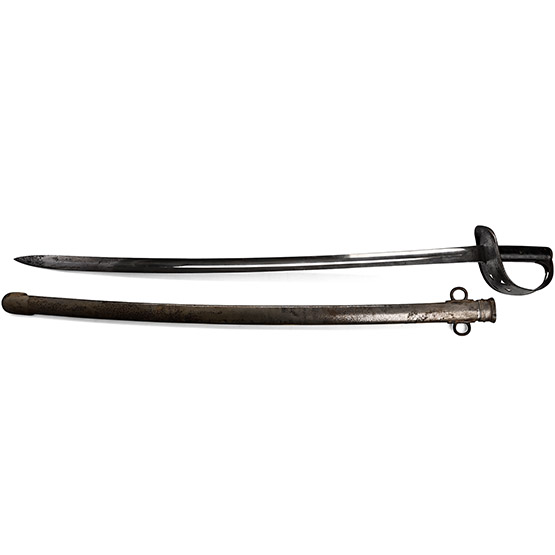
British Cavalry Trooper's Sword
1885 A.D. PatternSold for (Inc. bp): £416
A British trooper's backsword comprising a slightly curved single-edged blade with a deep fuller to each face, iron hilt with D-shaped pierced guard, leather-covered grip and bulb pommel; stamped on one face of the blade at the ricasso with 'WD' and broad arrow, crown over 'S12', crown over 'E12 YC' and to the other face '/86' over 'Baum & Co. [Sol]ingen'; scabbard with cast frog with securing srewws and stamped '/88 WD' and arrow; integral reinforced chape. 1.76 kg, 103.5 cm
From a Cambridgeshire, UK, collection. -
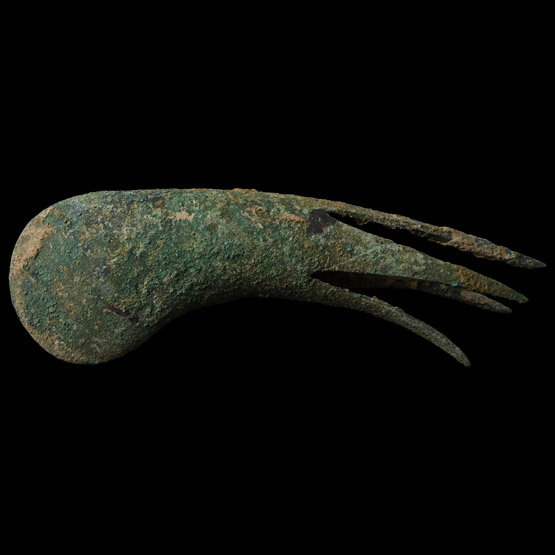
Bactrian Bronze Claw Axehead
3rd millennium B.C.Sold for (Inc. bp): £442
Egg-shaped with spiked prongs to the socket, narrow rounded cutting edge. 148 grams, 13.2 cm
Ex Abelita family collection, 1980s-2000s.
The 'claw mace' was an enigmatic ancient bronze weapon from the Bronze Age Near East. The hollow bulbous head was trailed by tines of varying lengths. It is believed that it was affixed over a wooden shaft and used like a club in combat, and not necessarily used as ceremonial weapon. The knife-edge bulb end could have broken bones and proven to be a formidable striking weapon requiring no skill to wield. The tines would have not only been decorative, but have served to add strength below the striking end to prevent breakage. In battle, maces were often used by commanders to display rank when giving orders in battle and leading soldiers, inspiring leadership and power. Egg-shaped with spiked sleeves or prongs, the top of the weapon with a narrow edge, the sleeves with small internal tangs for mounting. -
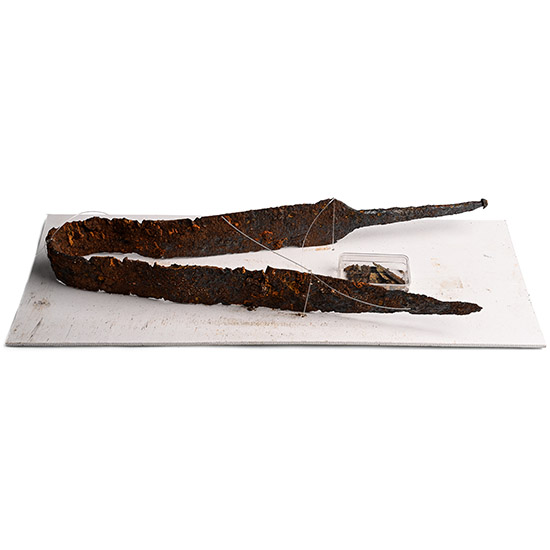
Iron Age Celtic La Tene Ritually Bent Sword
Circa 450 B.C.– 50 A.D.Sold for (Inc. bp): £351
An iron long sword of Stead's Type II with two-edged, parallel-sided flat-section blade, rounded shoulders, long lenticular-section tang with knop finial. 760 grams total, 40 cm
Acquired on the German art market. Private collection, Germany. Kept in the UK from 2016. -
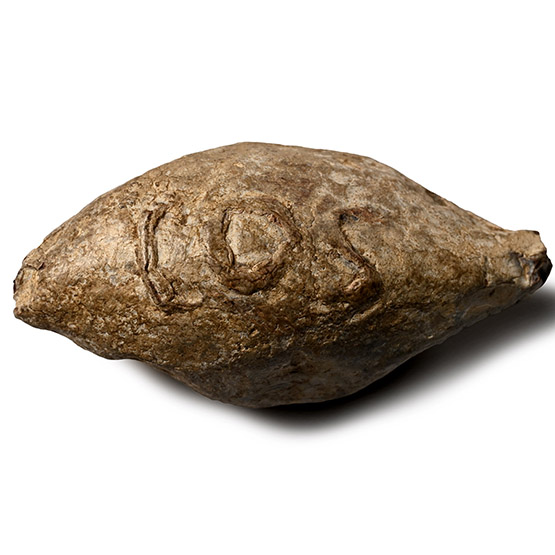
Roman 'Consular' Lead Slingshot
1st century B.C.Sold for (Inc. bp): £143
Fusiform shot with casting nipple at each end, low-relief legend 'COS' to one face and traces of letters on the other. 38 grams, 36 mm
From the collection of a London antiquarian, formed since the 1980s.
The shot (Völling type 1C) is marked with the abbreviation COS, meaning CO(N)S(UL), the highest military magistrate of the Roman Res Publica. The projectiles were made of different materials: lead (glandes) or pottery or stone (lapides missiles). -
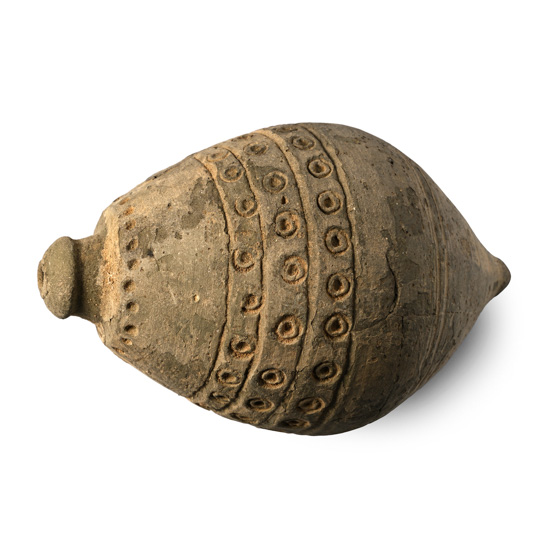
Byzantine 'Greek Fire' Fire Bomb or Hand Grenade
9th-11th century A.D.Sold for (Inc. bp): £91
A piriform vessel with short neck, domed lip and conical base, bands to the shoulder with impressed annulets and other detailing; intended to be filled with explosive liquid and a wick, and used as a hand grenade. 885 grams, 16.3 cm
Fine condition.
From the collection of a North London gentleman, latterly with a London gallery as a display collection exhibiting the wide range of decorative types; accompanied by an academic paper by military specialist Dr Raffaele D'Amato, dated 15 July 2019 and titled Eastern Roman Empire - Greek Fire Bomb or Hand Grenade (μεσαίον kακάβιον) 9th-11th century AD. -
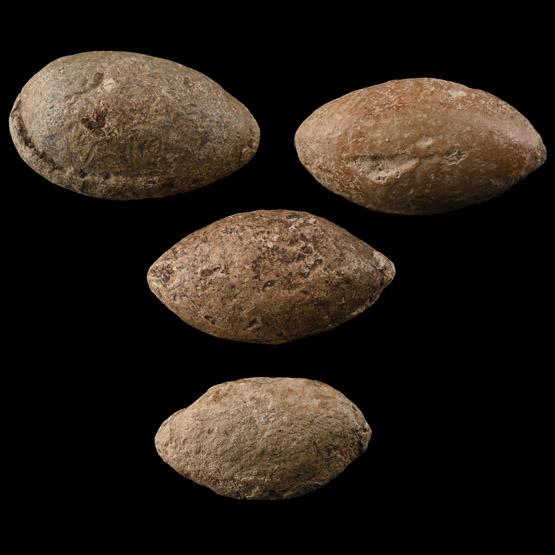
Greek Lead Slingshot Group
4th-3rd century B.C.Sold for (Inc. bp): £85
Each lentoid with thick casting seam to the rim. 131 grams total, 26-31 mm
Ex German art market, 2000s. Acquired from an EU collector living in London. From the collection of a Surrey, UK, gentleman. -
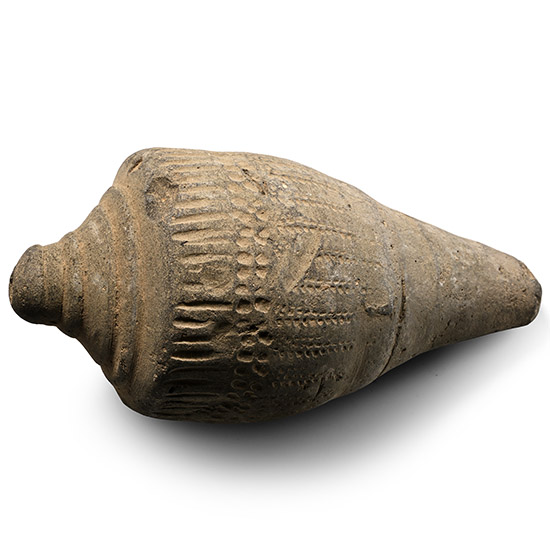
Turco-Mongol 'Greek Fire' Ceramic Bomb or Hand Grenade
14th-15th century A.D.Sold for (Inc. bp): £111
Piriform in profile with a domed mouth and a stepped neck, incised decoration; intended to be filled with explosive liquid and a wick, and used as a hand grenade. 460 grams, 16.5 cm
From a specialist collection, London, UK, 1990-2000s.
Apart from the use of siphons or manual flame-throwers called cheirosiphona, special corps of Roman soldiers employed terracotta grenades, in the form of small jars, abundantly evidenced in archaeological excavations. They were called μεσαία kακαβιά or κυτροκακάβια, where the former had a bulbous shape and the latter a more cylindrical form. -
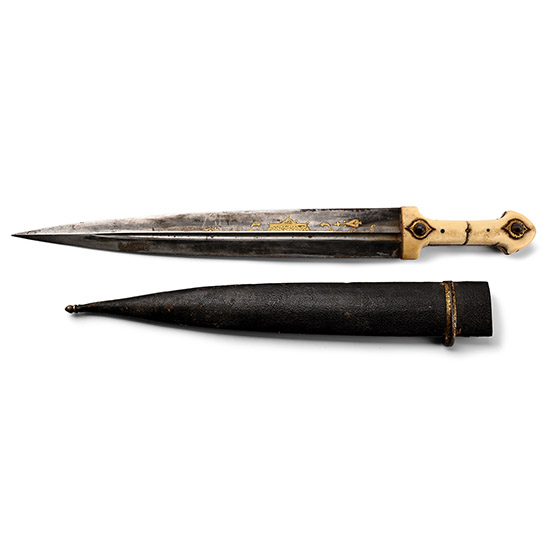
Ottoman Iron Dagger with Bone Hilt
19th century A.D.Sold for (Inc. bp): £572
Broad iron blade with reinforcing corrugations, inlaid brass ornament; bone scales to the hilt with fixing studs; scabbard with wooden core, leather sleeve, bronze frog and chape; fastened with wire stitching; narrow pocket to reverse to accept a smaller companion knife. 683 grams, 58 cm
Private collection, UK. -
.jpg)
Luristan Bronze Spearhead
2nd-1st millennium B.C.Sold for (Inc. bp): £143
With leaf-shaped blade, raised midrib and rounded shoulders, short neck and the square-section tapering tang with pointed tip. 373grams total, 40.5 cm
Ex Norri collection, Milton Keynes, Bedfordshire, UK, 1980s-1990s. -
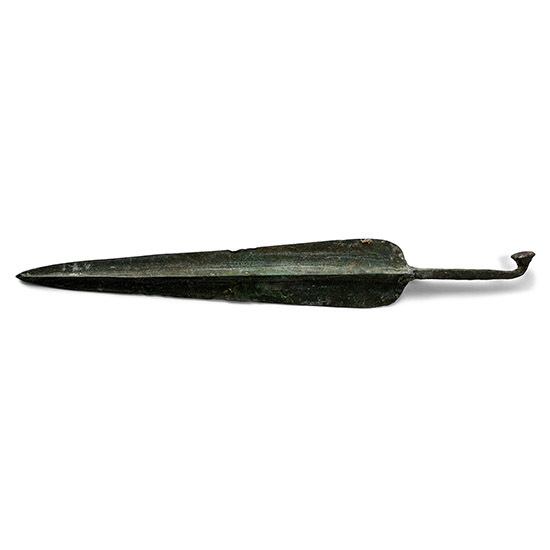
North-Western Persian Bronze Blade
Circa 1st millennium B.C.Sold for (Inc. bp): £117
With a long tapering blade having rounded shoulders and a prominent mid-rib, the tang bent over at the tip with a round stud terminal. 230 grams, 33.5 cm
Ex Abelita family collection, 1980s-2000s.
The metalworking techniques used in making bronze weapons in early Iran were very complex. Surfaces were often finished in repoussé work, and some of the weapons were chased, others engraved. The ruling elites of warrior horsemen were buried with their weapons and horses. -
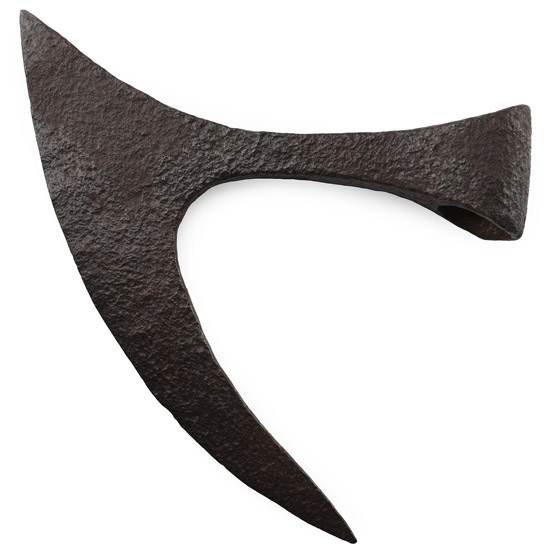
Viking Hooked Iron Axehead
Circa 9th-11th century A.D.Sold for (Inc. bp): £442
With broad curved blade and pointed chin, tapering neck, deep socket. 366 grams, 20.1 cm
Ex North American private collection, 1970s.

