-
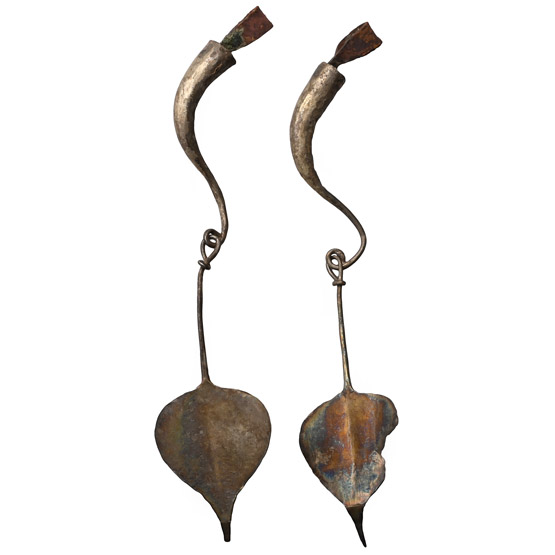
Sasanian Silver Earring Pair with Leaf-Shaped Droplets
5th-6th century A.D.Sold for (Inc. bp): £65
Comprising a round-section tapering body with a wide attachment loop to the top, a flat leaf-shaped plaque attached with a round-section coiled shaft. 25 grams total, 15.3-15.5 cm
London, UK gallery, 1971-early 2000s. Private collection, London, UK. -
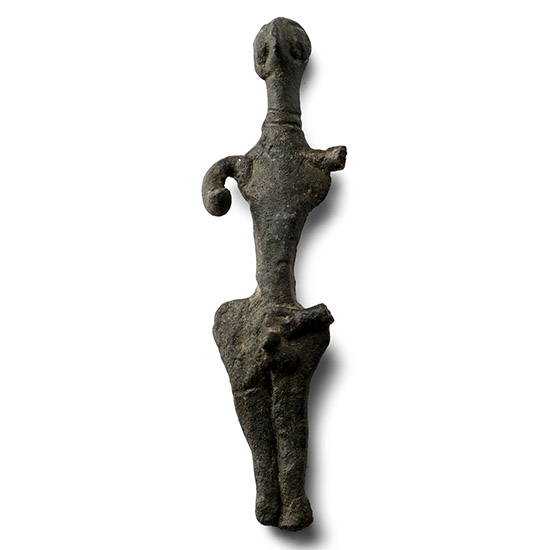
Syro-Hittite Bronze Male Idol
2nd millennium B.C.Sold for (Inc. bp): £130
Round-section body with pinched facial detailing, right arm raised and bent, left hand on hip above the genitals. 46.8 grams, 99 mm
Previously the property of an Islington, London, UK, dealer. From a London, UK, private collector since circa 1990. -
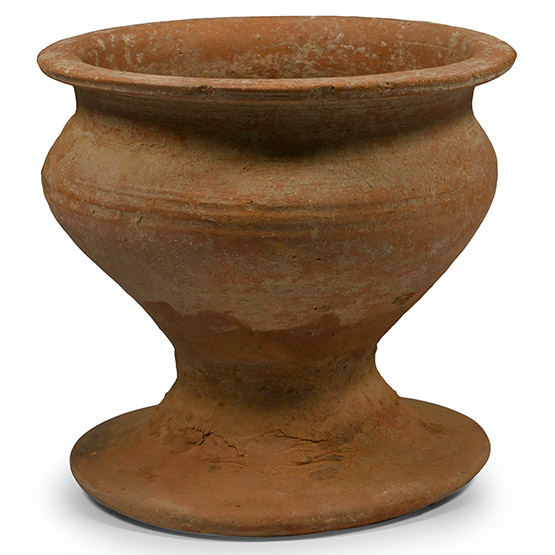
Western Asiatic Terracotta Jar
1st millennium B.C.Sold for (Inc. bp): £13
With trumpet-shaped base, thick stem, carinated bowl an everted rim; ribbed band to the equator. 1.06 kg, 16.8 cm
From the collection of a London, UK, gentleman, 1990s. -
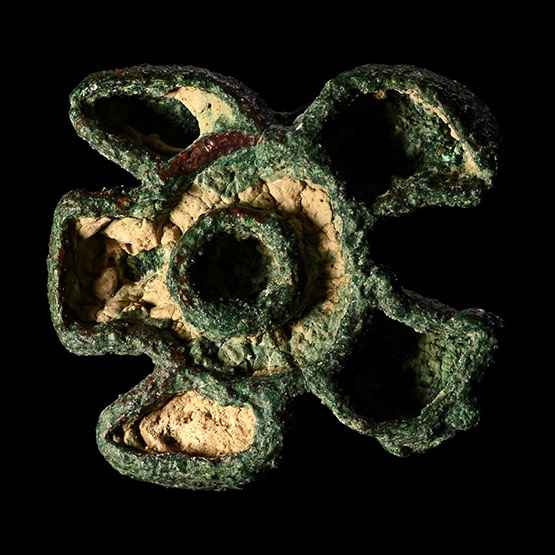
West Central Asian Bronze Stamp Seal with Horned Beast
Circa 2300-2000 B.C.Sold for (Inc. bp): £98
Zoomorphic stamp with loop handle to the reverse; accompanied by an old scholarly note, typed and signed by W.G. Lambert, late Professor of Assyriology, University of Birmingham, 1970-1993, which states: 'Stamp Seal of Bronze. 27.5x35x13 mm. This bears the shape of what is depicted. The face is flat and compartmented, and the back is flat also with look of sheet metal for suspension. The design shows the face of a horned quadruped frontally, with drooping ears and stout horns, but with one big central eye. This comes from west central Asia and dates to c. 2300-2000 B.C. It is a rare design and in good condition.' 12.5 grams, 31 mm
Acquired in the late 1980s-early 1990s. Ex property of a West London businessman. Academically researched and catalogued by the late Professor Lambert in the early 1990s. -
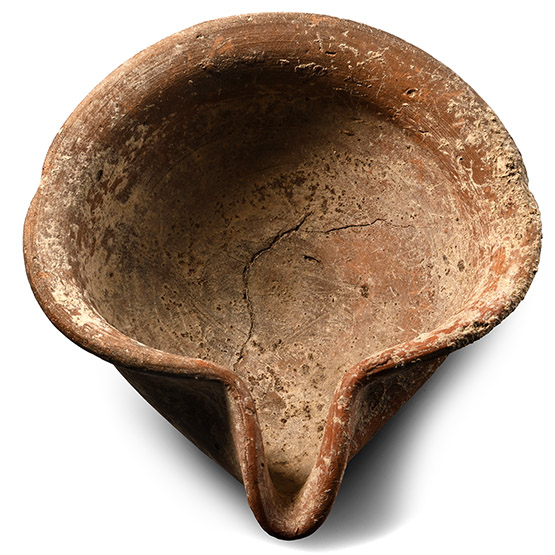
Very Large Bronze Age Holy Land Terracotta Pinched Rim Oil Lamp
Joash-Jeroboam II to Pekah, circa 885-815 B.C.Sold for (Inc. bp): £182
Discoid in plan with domed centre and carinated rim pinched to form a nozzle; impressed legend on base. 297 grams, 15.3 cm
From the Lloyd and Jeanne Raport collection, Washington, D.C. and Florida, USA, formed between 1972-2000. Acquired through Bonhams, London, UK. -
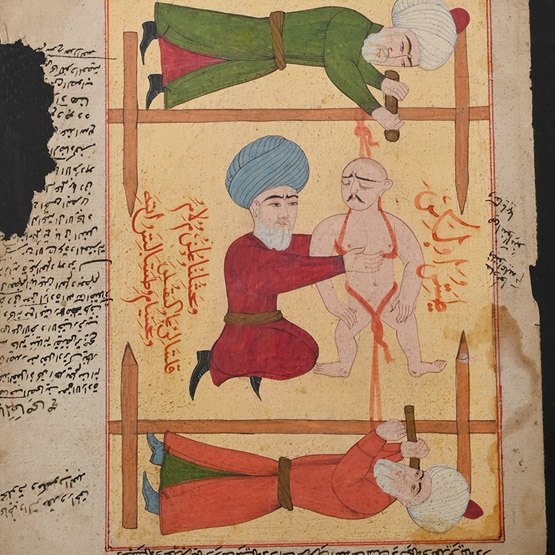
Framed Ottoman Painted Miniature Leaf
20th century A.D.Sold for (Inc. bp): £98
Paper leaf with hand-painted scene depicting a torture scene: two outer bearded figures wearing turbans and ankle-length robes holding the handles of a frame with spikes; third similar figure kneeling in the middle grasping fourth figure, suspended naked and attached by ropes round his chest and thighs to the frame; blocks of explanatory text in red and black within the scene and outside; edges of leaf chipped; mounted in a glazed wooden frame. 1.06 kg, 45.5 x 35.5 cm
Private collection, UK. -
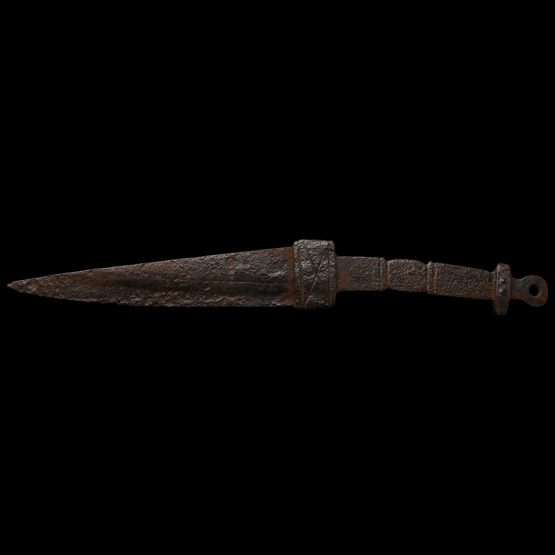
Thracian Iron Dagger
Circa 5th-1st century B.C.Sold for (Inc. bp): £1,430
Single-edged curving upper blade, rectangular guard with incised saltire, segmented grip and upper guard fixed with pins, loop finial; rhomphaia type. 276 grams, 34.7 cm
Ex North American collection, 1970s. -
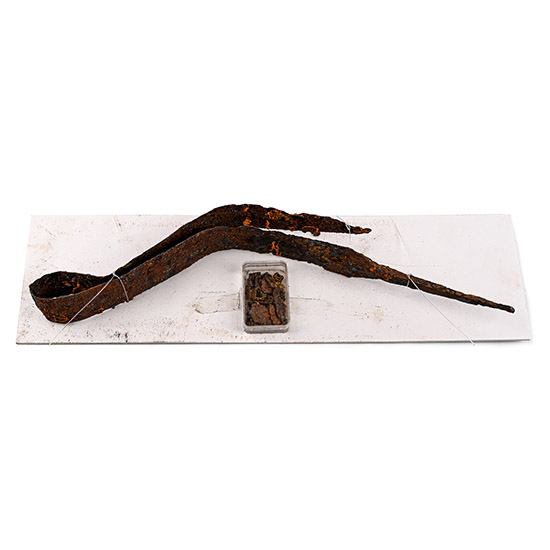
Iron Age Celtic La Tene Ritually Bent Sword
Circa 450 B.C.-50 A.D.Sold for (Inc. bp): £338
An iron long sword of Stead's Type III with two-edged, parallel-sided flat-section blade, rounded shoulders, long lenticular-section tang. 620 grams total, 40.6 cm
Acquired on the German art market. Private collection, Germany. Kept in the UK from 2016. -
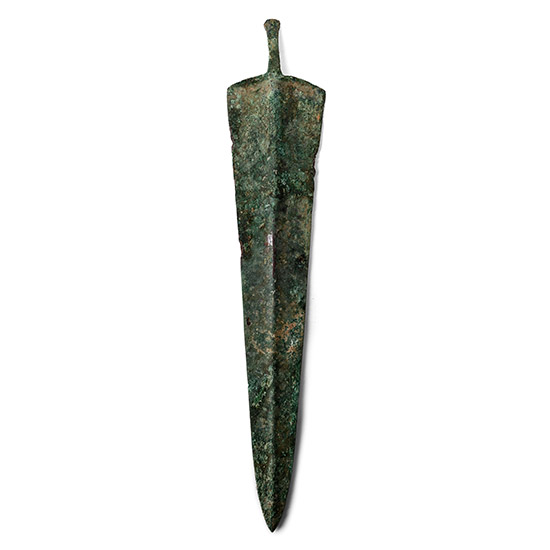
North Western Persian Bronze Blade
Early 1st millennium B.C.Sold for (Inc. bp): £169
With a long tapering blade, rounded shoulders, broad flattened mid-rib, and a tapering square-section tang. 311 grams, 37.7 cm
Ex Abelita family collection, 1980s-2000s.
Edged weapons with tangs are among the simplest forms of weapons from this culture. This basic type was hardly altered in the period when bronze was the most important material in weapon production. The retention of this basic type with so few alterations makes precise dating challenging. Bronze daggers, dirks and swords exist today only as bronze blades, having lost their perishable handles over the course of time. -
.jpg)
Civil War Period and Later Lead Pistol and Musket Balls
17th-19th century A.D.Sold for (Inc. bp): £7
A mixed group of lead musket and pistol ball. 2.31 kg total, 9-20 mm
Found Suffolk, UK. Property of a Suffolk, UK, gentleman. -
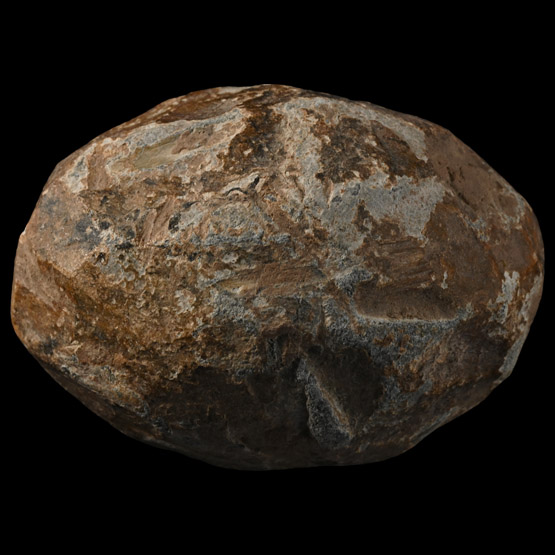
Roman Lead Slingshot
1st century A.D.Sold for (Inc. bp): £52
Lenticular type with casting seam to the rim. 92 grams, 31 mm
From the collection of a late Gloucestershire, UK, collector. -
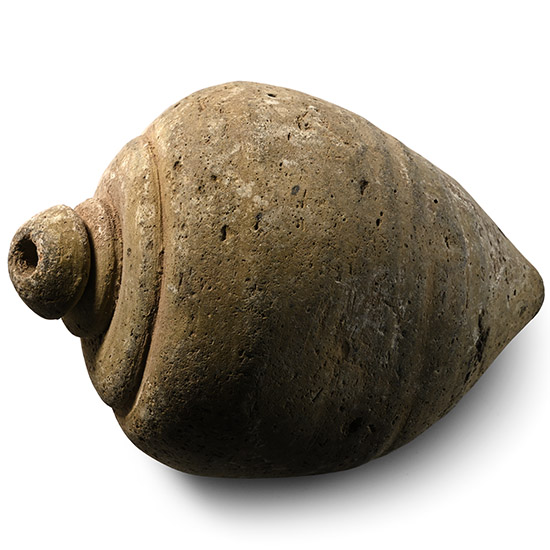
Byzantine 'Greek Fire' Ceramic Fire Bomb or Hand Grenade
9th-11th century A.D.Sold for (Inc. bp): £65
Ovoid in profile with a rounded base and a gently ribbed body; intended to be filled with explosive liquid and a wick, and used as a hand grenade. 774 grams, 14.6 cm
From a specialist collection, London, UK, 1990-2000s. Accompanied by an academic paper by military specialist Dr Raffaele D'Amato, dated 15 July 2019 and titled 'Eastern Roman Empire - Greek Fire Bomb or Hand Grenade (μεσαίον kακάβιον) 9th-11th century AD'.
Apart from the use of siphons or manual flame-throwers called cheirosiphona, special corps of Roman soldiers employed terracotta grenades, in the form of small jars, abundantly evidenced in archaeological excavations. They were called μεσαία kακαβιά or κυτροκακάβια, where the former had a bulbous shape and the latter a more cylindrical form.

