-
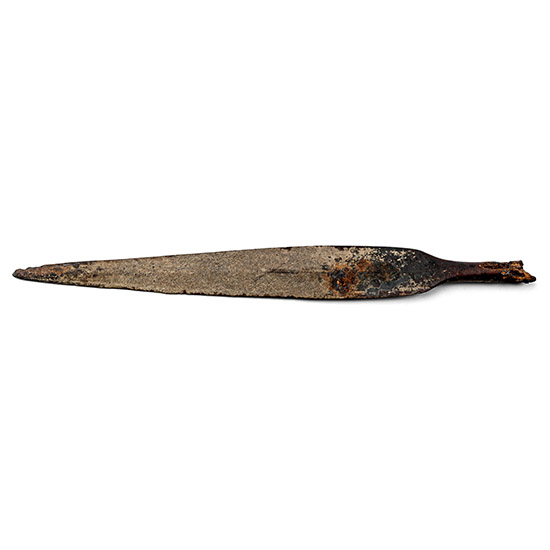
Large Iron Age Celtic Spearhead
Circa 450 B.C.-50 A.D.Sold for (Inc. bp): £221
With long slender leaf-shaped blade and short tubular socket. 550 grams, 48.1 cm
Acquired on the German art market. Private collection, Germany. Ex Axel Guttmann collection and acquired through Hermann Historica in 2010. Kept in the UK from 2016. -
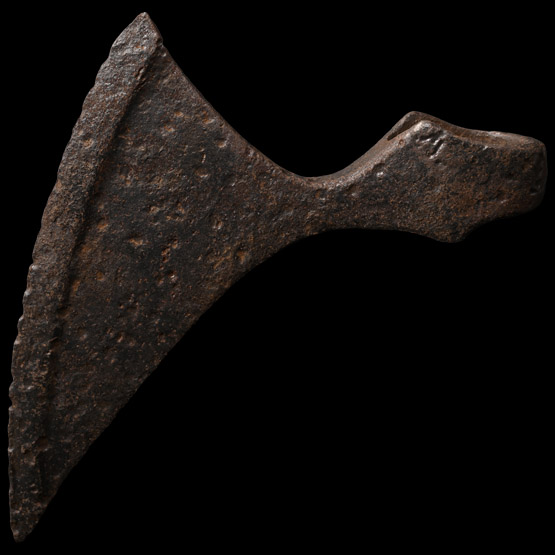
Viking Age Iron Hook-Billed Axehead
Circa 9th-11th century A.D.Sold for (Inc. bp): £312
Broad blade with thickened edge, rounded socket with lateral triangular extensions. 347 grams, 16.5 cm
Ex North American collection, 1970s. -
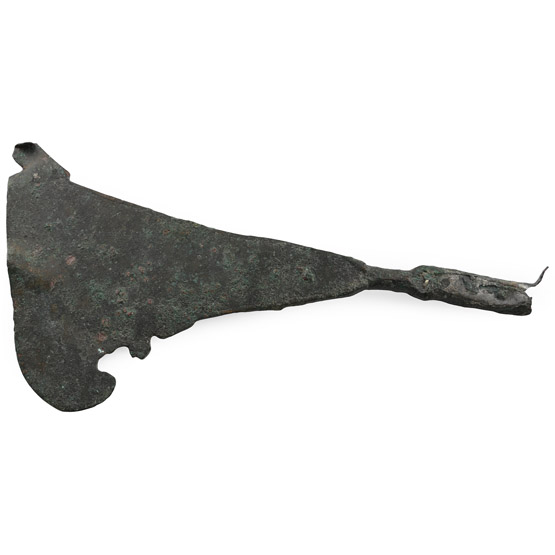
Roman Bronze Tool with Maker's Mark
1st-4th century A.D.Sold for (Inc. bp): £20
Comprising a triangular blade with lobes to the angles of the lower edge; narrow neck and tubular socket; stamped '[A]R FEC' (... made [this]). 29.8 grams, 12 cm
Ex German art market, 2000s. Acquired from an EU collector living in London. From the collection of a Surrey, UK, gentleman.
Possibly a kitchen tool for scraping; the edge has been roughly sharpened. -

Luristan Bronze Socketted Axehead
2nd-1st millennium B.C.Sold for (Inc. bp): £117
With a short socketted shaft and flange to the mouth, the blade broadening towards the cutting edge. 335 grams, 11.6 cm
Ex Abelita family collection, 1980s-2000s. -
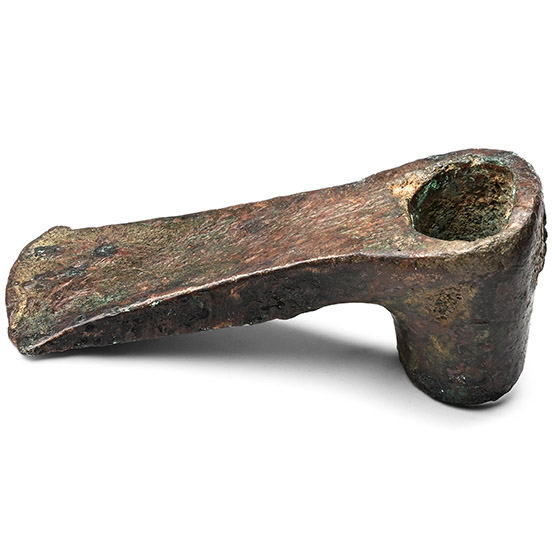
Luristan Socketted Bronze Adze
2nd-1st millennium B.C.Sold for (Inc. bp): £72
Short tubular socket, perpendicular rectangular-section blade with convex cutting edge. 326 grams, 11.1 cm
From an old English collection, 1980s. -
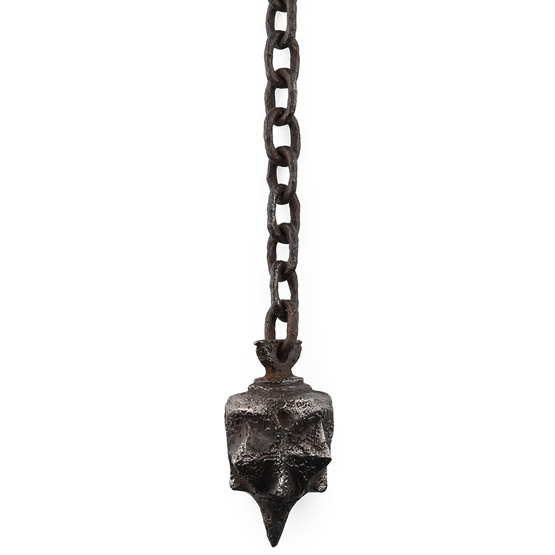
Medieval Socketted Iron Flail
Circa 15th century A.D.Sold for (Inc. bp): £910
Hand-forged tubular socket of conical form and with collar to mouth, substantial loop, chain of oval links and connecting ring; a facetted conical head with lateral spikes. 1.13 kg, 58.5 cm
Ex North American private collection, 1970s. -
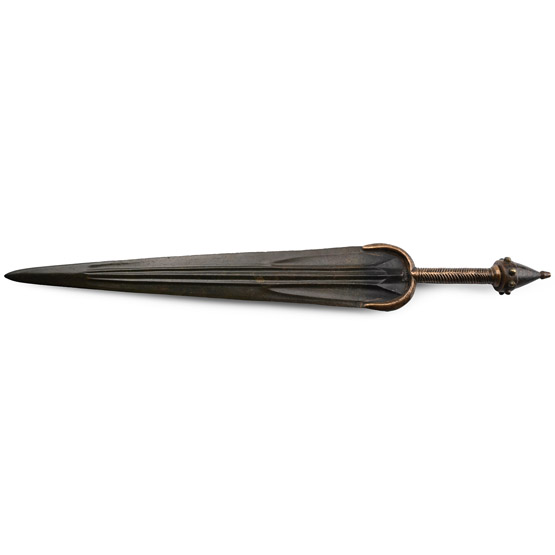
Luristan Bronze Re-Hilted Sword
2nd-1st millennium B.C.Sold for (Inc. bp): £416
Broad two-edged bronze blade with corrugated midrib and lateral channels, lentoid-setion tip; fitted with a modern reproduction hilt. 884 grams, 56.4 cm
Ex Abelita family collection, 1980s-2000s. -
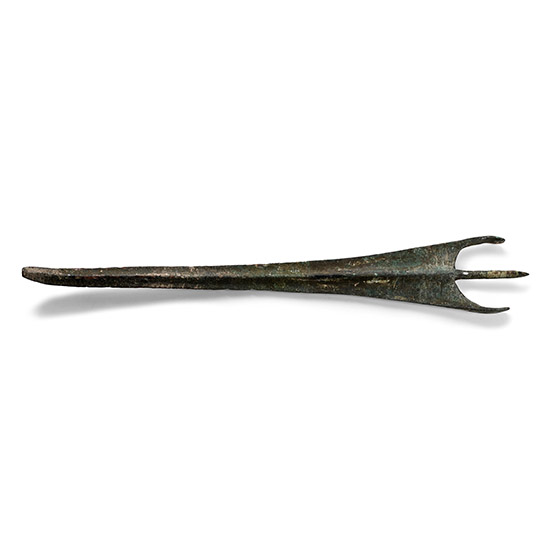
Western Asiatic Bronze Dagger Blade
2nd-1st millennium B.C.Sold for (Inc. bp): £117
With a prominently curved guard, extending out from the ricasso of the blade and partly frames the hilt, a thick midrib extending slightly above the ricasso where it held the hilt. 250 grams, 38.5 cm
Ex Abelita family collection, 1980s-2000s.
The hilt of such swords was made separately, and unfortunately, is nearly always missing from the archaeological records. Similar daggers had a northern Iranian background, and excavated examples have been recorded from the South Caspian Area from Tomadjan and Ghalekuti. -
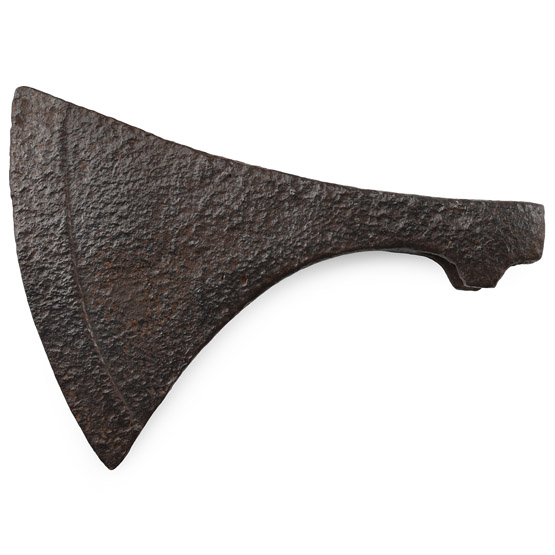
Viking Iron Fighting Broad Axehead
Circa 9th-11th century A.D.Sold for (Inc. bp): £715
With triangular spurs below the square socket, medium-broad flaring triangular-section blade extending to a curved edge, hammer extension to the rear. 280 grams, 15 cm
Ex North American private collection, 1970s. -
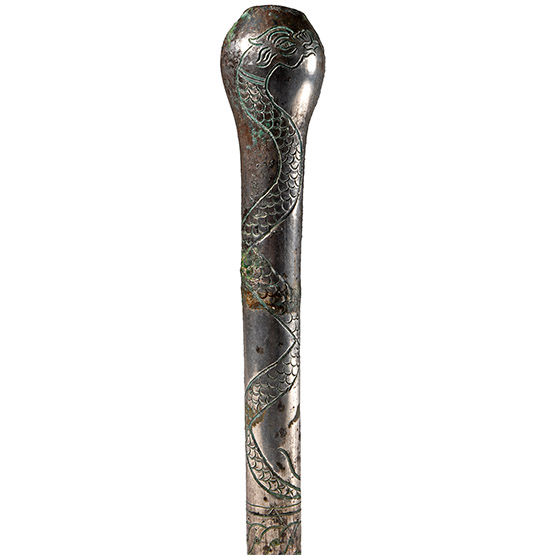
Bactrian Silver Macehead with Interlaced Dragons
2nd-1st millennium B.C.Sold for (Inc. bp): £936
Hollow-formed with bulb finial, low-relief image of opposed dragons with detailed scale texture; circumferential band with incised guilloche below; rim chipped; mounted on a custom-made stand. 440 grams total, 20 cm including stand
London, UK gallery, 1971-early 2000s. Private collection, London, UK. -
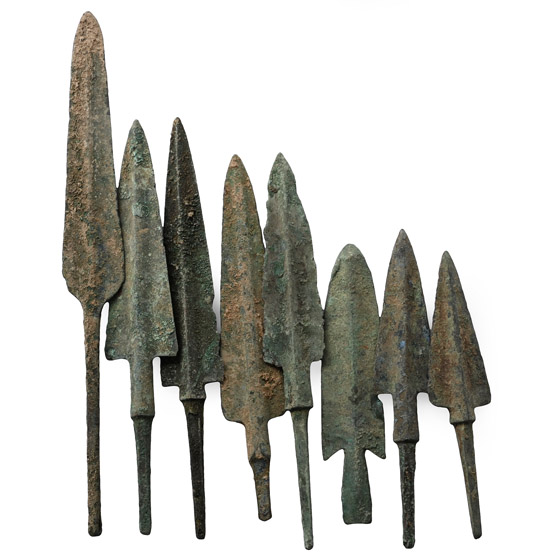
Western Asiatic Bronze Arrowhead Collection
1st millennium B.C.Sold for (Inc. bp): £169
Including barbed-and-tanged, spade-shaped and other types. 319 grams total, 7.4-18 cm
Ex London, UK, collection, 1990s. -
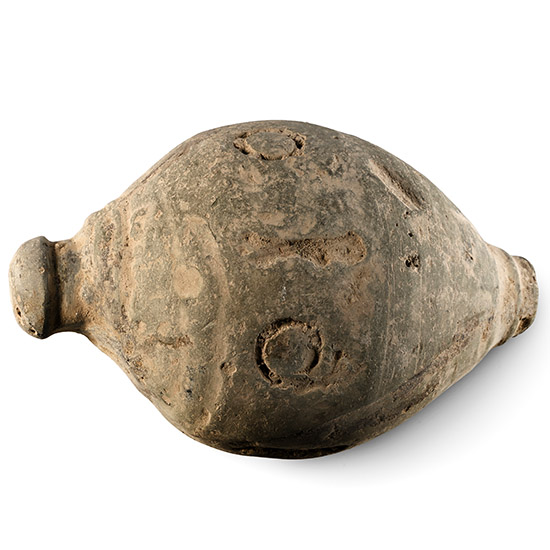
Byzantine 'Greek Fire' Ceramic Fire Bomb or Hand Grenade
9th-11th century A.D.Sold for (Inc. bp): £91
Ovoid in profile with a rounded base, a band of annulets and vertical lines on the upper body; intended to be filled with explosive liquid and a wick, and used as a hand grenade. 691 grams, 14.6 cm
From a specialist collection, London, UK, 1990-2000s. Accompanied by an academic paper by military specialist Dr Raffaele D'Amato, dated 15 July 2019 and titled 'Eastern Roman Empire - Greek Fire Bomb or Hand Grenade (μεσαίον kακάβιον) 9th-11th century AD'.
Apart from the use of siphons or manual flame-throwers called cheirosiphona, special corps of Roman soldiers employed terracotta grenades, in the form of small jars, abundantly evidenced in archaeological excavations. They were called μεσαία kακαβιά or κυτροκακάβια, where the former had a bulbous shape and the latter a more cylindrical form.

