-
.jpg)
Italic Banded Agate Scarab with Kneeling Warrior in Gold Mount
3rd century B.C.Sold for (Inc. bp): £11,700
Scarab bezel with carapace detailing and intaglio of a kneeling male nude wearing a helmet, holding a shield, sword and a spear; set into a later gold swivel ring; supplied with a museum-quality impression. 5.24 grams, 25 mm
English private collection. Acquired on the English art market. This lot has been checked against the Interpol Database of stolen works of art and is accompanied by search certificate number no.13110-248399.
The intaglio can depict Capaneus, a legendary, strong, skilled, but arrogant warrior. He was one of the Seven Against Thebes, who boasted that not even Zeus could stop him from scaling the city walls. However, as he climbed them, Zeus struck him down with a bolt of lightning, illustrating divine punishment for his hubris. Evadne, his wife, then threw herself onto the funerary pyre in her grief. The story of strength but excessive pride was reflected in Dante's Inferno, where Capaneus is in the seventh circle as a condemned blasphemer. -
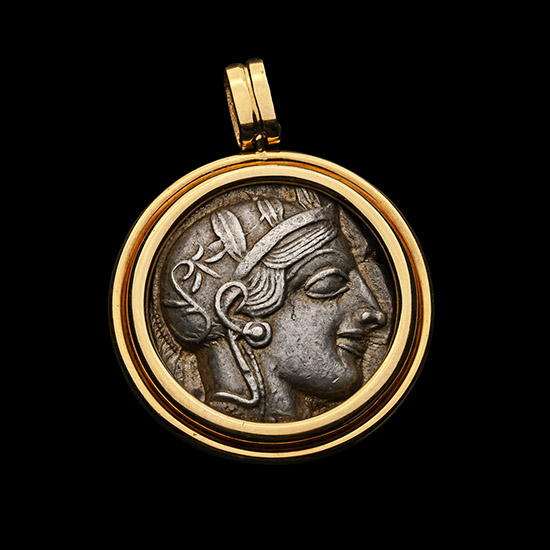
Greek Silver Tetradrachm of Athens in Gold Pendant
Circa 454-404 B.C.Sold for (Inc. bp): £2,340
Obv: head of Athena with profile eye to right, wearing disc earring, pearl necklace and a crested Attic helmet adorned with three olive leaves and a pi-style palmette. Rev: ΑΘΕ, owl standing to right, head facing the viewer, olive sprig with berry and crescent moon in upper left field, all within incuse square. Kroll 8; Dewing 1591-8; SNG Copenhagen 31; HGC 4, 1597; the coin enclosed inside a modern gold medallion pendant stamped '750' with double border. 24.36 grams, 37 mm
Roma Numismatics, E-LIVE Auction 4, 29 November 2018, no.155. Private collection of Mr K.A., France. with Kallos Gallery, London. This lot has been checked against the Interpol Database of stolen works of art and is accompanied by search certificate number no. 13024-246751.
The Athenian components of several of the hoards in which these tetradrachms were found, together with other published and unpublished tetradrachms, make it clear that this coinage of c.400/390 to 353 was not only substantial, but was one of the most prolific Greek coinages of the period. -
.jpg)
Roman Gold Ring with Jasper Gemstone of Fountain and Dolphin
2nd-3rd century A.D.Sold for (Inc. bp): £910
The hoop octagonal in section with a cell to the bezel and an inset conical jasper stone, intaglio vessel and dolphin with attributes; some restoration and polishing; supplied with a museum-quality impression. 5.39 grams, 21.00 mm overall, 15.51 x 13.97 mm internal diameter (approximate size British J, USA 4 3/4, Europe 8.69, Japan 8)
Private collection, Europe. Acquired on the English art market. -
.jpg)
Roman Child's Gold Ring with Figural Gemstone
1st-2nd century A.D.Sold for (Inc. bp): £780
Inset amethyst intaglio of a stylised human standing on a baseline with his arm extended in front; supplied with a museum-quality impression. 1.73 grams, 12.81 mm overall, 9.85 mm internal diameter
Private English collection, formed between the late 1970s and early 1990s. Private collection, UK. -
.jpg)
Roman Gold Marriage Ring with 'Dextrarum Iunctio' Cameo
3rd century A.D.Sold for (Inc. bp): £3,380
With hoop formed as three rods, the outer one beaded, paired granules to the shoulders, an elliptical bezel with beaded wire border, set with an onyx cameo with clasped hands above the Greek term 'HOMONOIA' (concord). 6.81 grams, 27.53 mm overall, 22.01 mm internal diameter (approximate size British U, USA 10, Europe 22.52, Japan 21)
Ex Swiss collection. with St Paul's Auction, Sale 1, no.145. Private collection, England. This lot has been checked against the Interpol Database of stolen works of art and is accompanied by search certificate number no.13111-249496. -
.jpg)
Eastern Roman Gold Ring with Duck Gemstone
4th-5th century A.D.Sold for (Inc. bp): £3,380
Comprising a flat-section hoop and a raised rectangular bezel, the tapering bezel set with a garnet intaglio engraved with a standing duck; supplied with a museum-quality impression. 3.85 grams, 23.13 mm overall, 18.91 mm internal diameter (approximate size British Q 1/2, USA 8 1/4, Europe 18.12, Japan 17)
Private English collection. Private collection, London, UK. This lot has been checked against the Interpol Database of stolen works of art and is accompanied by search certificate number no.12940-245981. -
.jpg)
Life-Size Roman Republican Marble Portrait Head of a Man
2nd-1st century B.C.Sold for (Inc. bp): £6,500
Private portrait head of a beardless but aged man sculpted in provincial style to be full of character with pinched mouth and furrowed brow; the short hairstyle characteristic of Late Republican Rome; nose abraded; socket to underside for mounting on the display stand. 25.75 kg total, 50 cm including stand
Private collection, Auvergne, France, 1970s. Accompanied by a copy of an Art Loss Register certificate no.S00131545. This lot has been checked against the Interpol Database of stolen works of art and is accompanied by search certificate number no.12477-228801.
In view of the fact that visual conventions (i.e. the Julian hairstyle) developed in the capital reached the “Romanised” provinces with a certain time lag, this portrait head was probably created in the Late Republican or Early Imperial Period. -
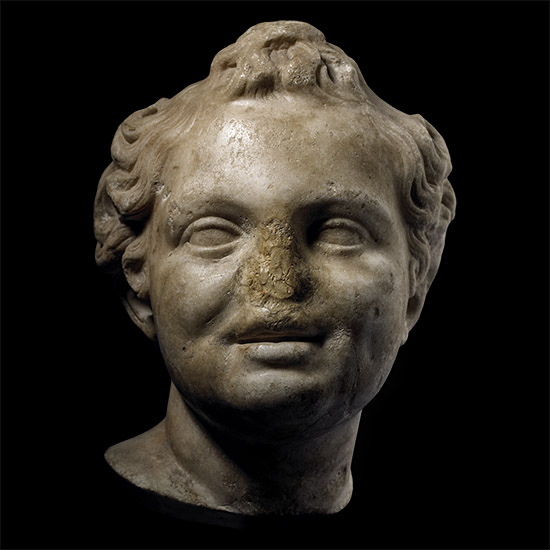
Roman Marble Head of Youthful Eros, the Greek God of Love
2nd-3rd century A.D.Sold for (Inc. bp): £11,700
Carved in the round as a bust of a child with youthful face, wide cheeks, slightly opened mouth with full lips, almond-shaped eyes, chipped nose; curly hair combed on the top of the head; mounted on a custom-made display stand. 9.95 kg total, 34 cm including stand
Collection of Mr and Mrs A., in their private mansion near the Champs-Élysées; thence by descent. Acquired on the French art market, 2024. Private collection, England. This lot has been checked against the Interpol Database of stolen works of art and is accompanied by search certificate number no.13109-249674.
The finely sculpted head represents a young child, probably intended as Eros (Cupid). Such depictions were produced in numerous variations to illustrate the stages of childhood and the capacity of children to undertake meaningful or symbolic actions. The softly modelled features and gentle expression recall the celebrated work of Boethos', The Boy Strangling the Goose, as well as the widespread images of Eros and the Erotes found throughout Graeco-Roman sculpture and painting. In Graeco-Roman art, representations of children occupied an important and evolving role. Initially, youthful figures were portrayed as miniature adults, but from the 4th century BC onwards - particularly during the Hellenistic and Roman periods - artists began to study children’s anatomy more closely, reproducing their characteristic proportions and expressions with naturalistic sensitivity. The figure of Eros, the constant companion of Aphrodite, became the quintessential model of the child in ancient art, identifiable by his traditional attributes of wings and bow. As evidenced by numerous statuettes and wall paintings unearthed at Pompeii, scenes of childhood were among the most popular subjects for adorning the gardens and interiors of wealthy Roman villas. These figures appear in lively and varied activities - playing, working, performing, or interacting with animals such as birds, hares, and dolphins - celebrating both the charm and vitality of early life within an idealised artistic vision. -
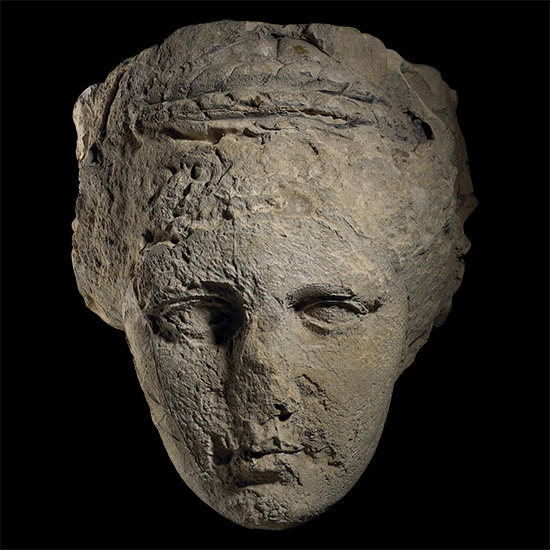
Three Times Life-Size Roman Head of the Goddess Diana
1st-2nd century A.D.Sold for (Inc. bp): £13,000
The goddess (Greek Artemis) with elegant features, sensual lips and deep eyes; detailed treatment of the hairstyle in transverse braids across the brow, laurel wreath with two rows of leaves resting above the forehead, an architectural element that was placed for the support of the sima of a building of great size; mounted on a custom-made display stand. 99.5 kg total, 72 cm high including stand
Ex private Belgian collection. with Madame Andree Mace collection. English private collection. Accompanied by an academic report by Prof. Neritan Ceka. This lot has been checked against the Interpol Database of stolen works of art and is accompanied by search certificate no.11625-199748.
The upper part of the head, cut horizontally, creates a semi-circular surface, on which the rest of the hair, or an architectonic capital, may have been mounted into a T-shaped socket. The back of the head, cut perpendicularly, proves that the head was intended for architectural use, and not to be viewed in the round. This piece may have been intended as the head of a caryatid (a sculpture serving as a pilaster) or an architectural stone corbel (an architectural element placed to support the sima of a significant building). -
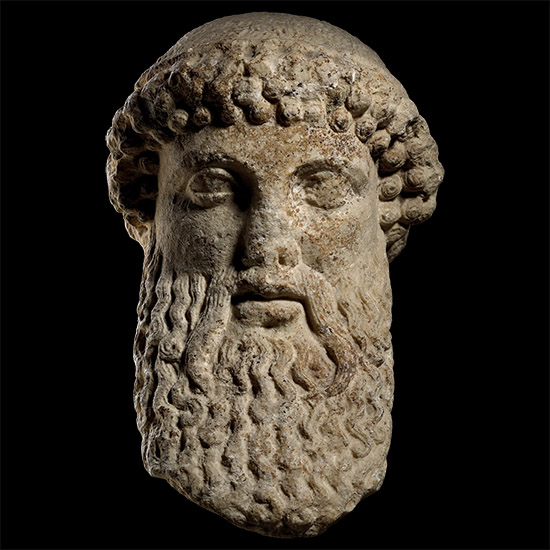
Life-Size Roman Bearded Head of the Greek God Hermes
1st-2nd century A.D.Sold for (Inc. bp): £33,800
With densely curled hair, stern facial expression beneath a broad brow, luxuriant curled beard falling in waves and cut square at the lower edge, a Roman copy after a 5th century B.C. Greek original; mounted on a custom-made display stand. 32.2 kg total, 52 cm high including stand
with Chaucer Fine Arts Ltd, 1980s. English private collection. Accompanied by an academic report by Dr Marina Mattei and Dr Laura Maria Vigna. This lot has been checked against the Interpol Database of stolen works of art and is accompanied by search certificate no.11615-199747.
This belongs to a type of archaic sculpture which can be traced back to the original ‘Hermes Propylaios’ by the Attic sculptor Alkamenes, a pupil of Phidias, active in the second half of the 5th century B.C. According to some theories, such depictions of Hermes (Hermae) were created for the Propylaea of the Acropolis of Athens, Hermes being the patron deity of doors and entrances. According to others, this type of bearded Hermes was located within the Acropolis as a devotional figure. -
.jpg)
Roman Marble Head of Eros, the Greek God of Love
2nd-3rd century A.D.Sold for (Inc. bp): £3,000
Carved in the half-round with undercuts to the curly hair, fleshy facial features; attachment ring to reverse. 2.02 kg, 17.5 cm
Acquired on the French art market, 13 November 2022. Private collection, England. This lot has been checked against the Interpol Database of stolen works of art and is accompanied by search certificate number no.13086-249672.
The finely sculpted head represents a young child, probably intended as Eros (Cupid). Such depictions were produced in numerous variations to illustrate the stages of childhood and the capacity of children to undertake meaningful or symbolic actions. The softly modelled features and gentle expression recall the celebrated work of Boethos', The Boy Strangling the Goose, as well as the widespread images of Eros and the Erotes found throughout Graeco-Roman sculpture and painting. In Graeco-Roman art, representations of children occupied an important and evolving role. Initially, youthful figures were portrayed as miniature adults, but from the 4th century BC onwards - particularly during the Hellenistic and Roman periods - artists began to study children’s anatomy more closely, reproducing their characteristic proportions and expressions with naturalistic sensitivity. The figure of Eros, the constant companion of Aphrodite, became the quintessential model of the child in ancient art, identifiable by his traditional attributes of wings and bow. As evidenced by numerous statuettes and wall paintings unearthed at Pompeii, scenes of childhood were among the most popular subjects for adorning the gardens and interiors of wealthy Roman villas. These figures appear in lively and varied activities - playing, working, performing, or interacting with animals such as birds, hares, and dolphins - celebrating both the charm and vitality of early life within an idealised artistic vision. -
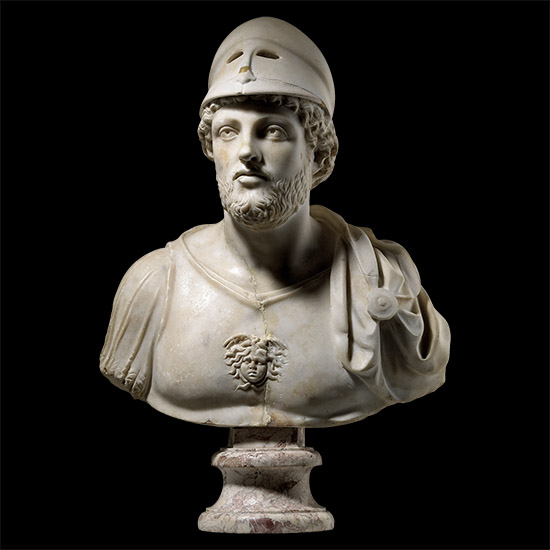
Roman Marble Helmetted and Cuirassed Bust of Mars, the God of War
Late 4th century A.D.Sold for (Inc. bp): £32,000
His head turned slightly to the right, calm and idealised facial expression with heavy-lidded eyes defined by incised irises and drilled, crescent-shaped pupils, and a neatly trimmed beard; his wavy hair crowned by a Corinthian helmet, pushed back high on the forehead; wearing a cuirass decorated at the centre with a small gorgoneion, and a chlamys secured by a brooch on the left shoulder; mounted on a later variegated stone socle. 45.2 kg, 68.5 cm
European private collection, 18th century (based on the restoration techniques). Private collection, France, acquired on the Marseilles art market in the late 1960s. Sotheby's, London, 13th June 2016, no.18. UK collection, acquired from the above auction. Sotheby's, Ancient Marbles: Classical Sculpture and Works of Art, 3-9 July 2020, no.30. Accompanied by copies of the relevant Sotheby's 2016 catalogue pages. This lot has been checked against the Interpol Database of stolen works of art and is accompanied by search certificate number no.13115-249591.
The sculpture has undergone both ancient and modern intervention. The back has been hollowed out in modern times, indicating that it was originally part of a tondo. Restoration is visible to the tip of the nose, the lower edges of the helmet’s cheek-pieces, and a small area of drapery. There is minor reworking to parts of the drapery folds and the brooch, as well as light retouching to the proper right corner of the lower lip and possibly the right side of the moustache. A small area of fill is also present on the restored nose of the helmet. In style, the bust belongs to the Late Antique tradition of ideal sculpture. The simplified facial features and distinctive eye treatment closely recall a comparable head in the Vatican, dated to the late 4th century AD. The military dress and iconography strongly suggest that the figure represents the Roman god Mars, comparable to known images of Mars Ultor. The Corinthian helmet, restored with a sculpted nose-guard, reflects an 18th-century restoration practice well attested in Roman collections, including examples from the Villa Albani.

