-
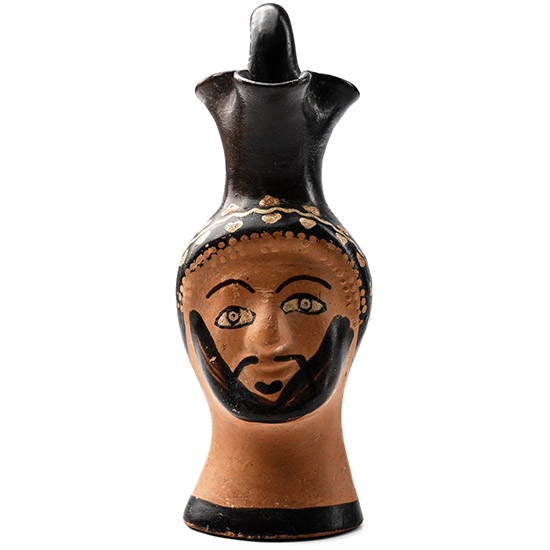
Greek 'Plastic' Oinochoe with a Bust of a Bearded Man
5th century B.C.Sold for (Inc. bp): £3,380
The body formed as a male head with his elongated neck forming the foot of the vessel; wearing an ivy-leaf crown, stylised, painted facial features and a full beard, two rows of stylised curls above the forehead; the neck of the vessel emerging from the top of his head, trefoil mouth and a handle to the rear; some repainting. 77 grams, 11.8 cm
Swiss private collection formed in 1960s-1970s. Accompanied by an academic report by Dr Raffaele D'Amato. This lot has been checked against the Interpol Database of stolen works of art and is accompanied by search certificate number no.13016-246780.
Head vases first appeared in the late 7th century B.C. in eastern Greece. The potters of Attica adopted this shape in the late 6th century, with a clear preference towards female heads, but not excluding male heads, especially when referring to mythological heroes or characters. The work, with its finely modelled features, is the product of an Attic workshop. According to the Beazley classification, the oinochoe should belong to the group N (Cook Class), generally dated to the 480-460 B.C. and widespread around the Mediterranean and Black Sea (a similar female example was found in Aphytis – Chalcidika). -
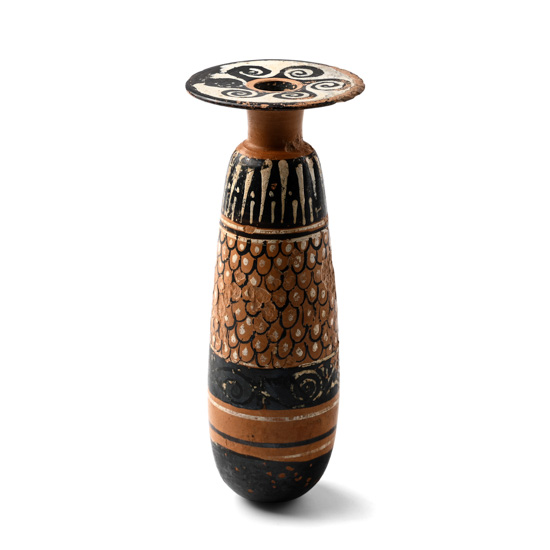
Greek Black-Figure Alabastron with Fish Scale Pattern, Possibly Attributed to the Bulas Group
Attic, early 4th century B.C.Sold for (Inc. bp): £2,340
Ovoid shape with short neck and expanded flat rim; painted with horizontal bands with vertical strokes on the shoulder, fish-scale pattern below and running scrolled tendrils; horizontal stripes below. 87 grams, 13 cm
partially repainted
Collection of M. Bouvier, Switzerland (1901-1980), Switzerland. Bouvier was a law professor in Alexandria prior to 1930. with Christie's, London, 7 October 2010, no.117. Private collection, 2010. Accompanied by an original thermoluminescence analysis report no.N125q42 by Oxford Authentication. Accompanied by copies of the Christie's catalogue pages. Accompanied by an academic report by Dr Raffaele D’Amato. This lot has been checked against the Interpol Database of stolen works of art and is accompanied by a search certificate number no.13008-246447.
The alabastra of the Bulas Group display scale-like patterns. They were painted with slip, a liquid clay which vitrifies when fired. This group is usually dated to the late 5th – early 4th century B.C. It was named after Kazimierz Bulas, who was the first to study them in depth in the 1930s. He characterised various shapes according to their decorative techniques (nets and floral patterns) and their functions. -
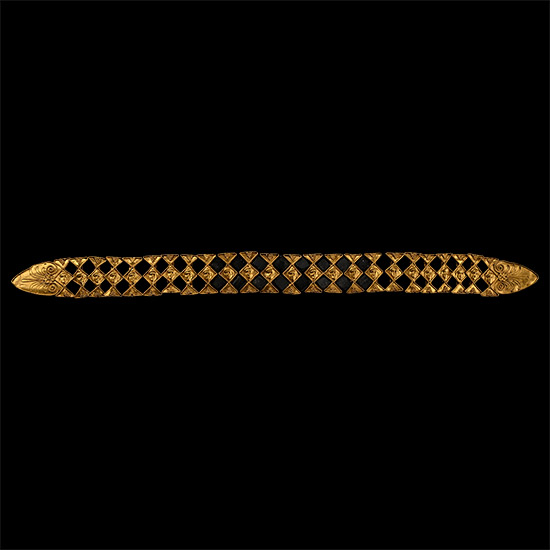
Greek Gold and Jet Diadem with Masks
Hellenistic, 3rd-2nd century B.C.Sold for (Inc. bp): £14,300
A gold necklace or diadem composed of twenty-two articulated units each in the form of a complex shields terminating in finials decorated with palmettes executed in filigree; body consists of shield-shaped jet(?) elements with a central rhomboid panel, joined above and below by triangular sections decorated with granulated triangles; the perimeter of each shield framed by a soldered beaded wire; at the centre of each rhomboid panel, an embossed appliqué mask in low relief; to the reverse of each element, two vertically aligned loops formed from narrow gold strips and intended for articulation; offered in a lined wooden display case. 22.5 grams, 21.6 cm
Ex M. Velensky collection, London, UK, 1990s. Accompanied by a copy of a four page examination report number 90/2015 by Dr habil Mikhail Treister. This lot has been checked against the Interpol Database of stolen works of art and is accompanied by search certificate number no.13104-248043.
The terminals are comparatively rare survivals, decorated with palmettes in filigree, a feature only occasionally attested among comparable assemblages from Bosporan contexts. The overall typology, decorative programme, and construction techniques closely parallel examples recovered from well-documented burials at Phanagoria, Pantikapaion, Tanais, and Tsukur-Liman. Comparable necklaces combining shield elements with embossed human heads are particularly characteristic of the 3rd-2nd centuries BC. According to the examination conducted by Dr habil. Mikhail Treister, there is nothing to challenge the authenticity of the object. The specific form, restricted geographic distribution, and close parallels suggest manufacture within a workshop of the Bosporan Kingdom, most plausibly in Phanagoria, one of its principal production centres during the Hellenistic period. -
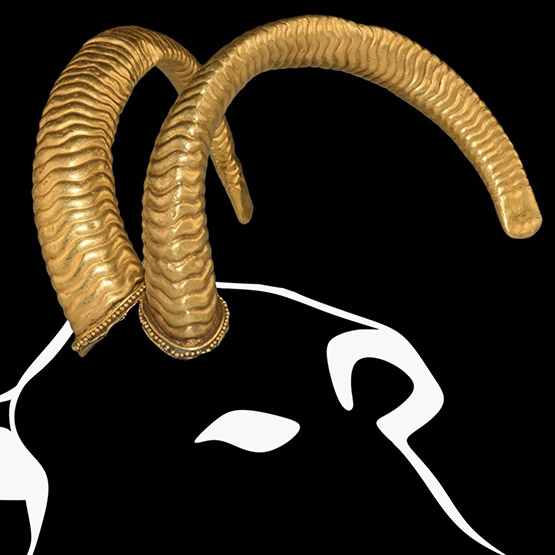
Greek Gold 'Golden Fleece' Ram-Horn Pair
5th-3rd century B.C.Sold for (Inc. bp): £6,240
A matched pair of sheet-gold model ram's horns, each curved with a narrow end flattened, ribbed body, flared rim to the mouth with applied granule detailing; probably from a representation of the χρυσόμαλλον δέρας or 'golden fleece' from the legend of Jason and his adventures with the crew of the ship Argo. 60.61 grams total, 10.5 cm each
From a private collection of seals and amulets, the property of a Canadian gentleman living in London; from his father's collection formed in the late 1960s to 1980s. This lot has been checked against the Interpol Database of stolen works of art and is accompanied by search certificate number no.13105-249639.
The legend of the Golden Fleece is referenced by several ancient writers, including Pindar, whose reformulation forms the basis of most modern retellings, but an earlier version was evidently familiar to Homer in the 8th century B.C. It appears as a pictorial theme on early Greek vases. The story refers to a celestial winged ram with golden wool, which was believed to live and be worshipped by the inhabitants of lands north of the Black Sea; this ram, in some versions of the tale, is transformed into the constellation Aries. -
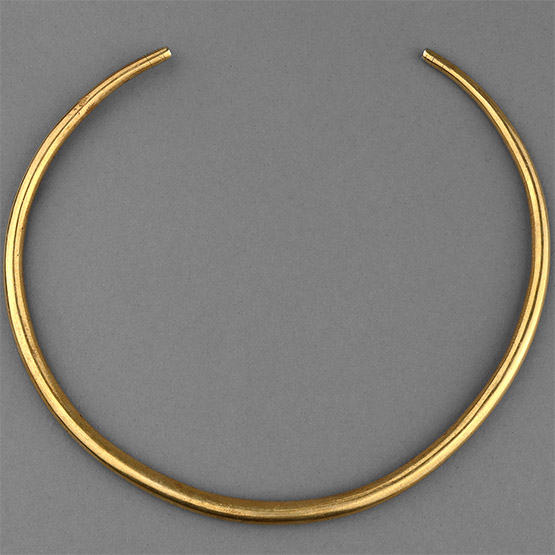
Scythian Electrum Torc
7th-5th century B.C.Sold for (Inc. bp): £14,300
Formed as a simple penannular hoop from a single piece of electrum, tapering towards the terminals. 169 grams, 16.5 cm diameter
Ex Jack Ogden, 1990s. Accompanied by an expertise from Striptwist Ltd, a London-based company run by historical precious metal specialist Dr Jack Ogden, reference number [191101]. This lot has been checked against the Interpol Database of stolen works of art and is accompanied by search certificate number no.13106-248042.
Portable X-ray fluorescence (XRF) analysis confirms the alloy to be electrum, with an average composition of approximately 62% gold, 34% silver, and 3% copper. The purity and metal ratios are consistent with ancient manufacture. The restrained form, lacking figural ornament, is characteristic of early Scythian metalwork and suggests a date prior to the 5th century BC. -
.jpg)
Bronze Batillum Depicting a Reclining Banqueteer with Skyphos and Rhyton
Parthian, 3rd-1st century B.C.Sold for (Inc. bp): £4,680
Comprising a square base with a raised border and supported by four stub feet, each originally surmounted by poppy-head finials (some absent); a hollow-formed figure of a banqueteer reclining elegantly with his weight resting on his left elbow, his right leg drawn up beneath the folds of a finely pleated robe; in his right hand, a ram’s head rhyton and his left hand cradling a skyphos; his bearded head with a laurel wreath. 1.58 kg, 25 cm
Private New York collection, formed in the 1960s. Acquired on the North American art market, 1990s. with Cahn Auktionen AG, Basel, Switzerland, 13 November 2015, no.84 (CHF 18,000). Accompanied by an academic report by Dr Raffaele D'Amato. This lot has been checked against the Interpol Database of stolen works of art and is accompanied by a search certificate number no.12379-226873.
The composition reflects the iconography of elite banquet culture in the ancient world, capturing both refinement and ritual in a single expressive figure. The Greek 'συμπόσιον' 'symposium' was the later part of a formal banquet which took place after the food had been consumed, when the serving of strong drink was accompanied by music, dancing, poetic composition or recital or earnest conversation. The custom has similarities with the Roman convivium and with the customs of many Mediterranean and Western Asiatic people. The Parthian Empire was culturally diverse and included many Hellenic groups; the Arsacid court adopted a range of aspects of contemporary Greek culture, among them Greek military structures and the Greek language as a lingua franca alongside the Parthian (Iranian) language and Aramaic. -
.jpg)
'The Guttmann' Large Greek Bronze Funerary Situla
7th century B.C.Sold for (Inc. bp): £1,560
Formed with a single-piece bottom and two-piece body riveted together; the underside recessed, sidewall flared with a carination at the shoulder and rolled rim; attachment point for handles at the seams below the shoulder and to the inner face of the rim; small repair panel to the inner face. 1.56 kg, 26.2 cm
Ex Axel Guttmann Collection of Ancient Arms and Armour, Germany [1944-2001], AG 490. Private collection, UK. Accompanied by a copy of the relevant pages where this situla is published. This lot has been checked against the Interpol Database of stolen works of art and is accompanied by search certificate number no.13059-248969.
The situla (type A of the Giuliani-Pomes classification) comes from a funerary complex that may have also included a geometric helmet with a horse protome. A very similar example comes from the Bernardini Tomb in Palestrina, now in the Archaeological Museum of Villa Giulia, Rome. -
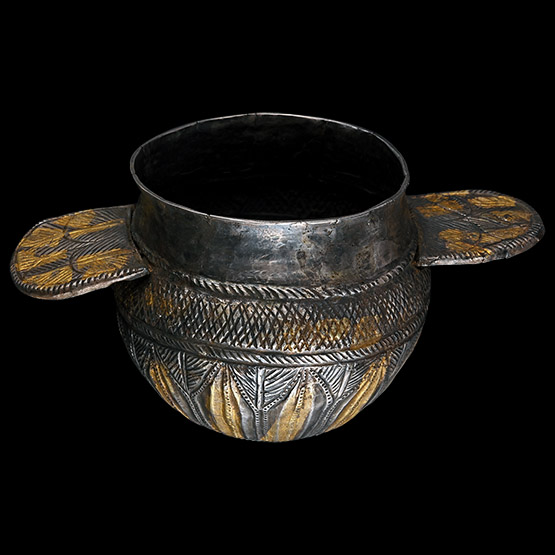
Greek Silver-Gilt Wine Cup with Handles
Hellenistic, 2nd-1st century B.C.Sold for (Inc. bp): £6,240
Comprising a globular body with a rounded underside, a repoussé rosette with ropework border, segmented band with leaf detailing, hatched shoulder framed by ropework bands, scooped neck with chamfered rim; two D-shaped ledge handles with recessed rim, ropework border, hatched panels; accompanied by a custom-made display case. 179 grams, 15.5 cm wide
Acquired on the US art market, early 1990s. Private collection, North America. Ex private collection, USA. TimeLine Auctions, 23 February 2023, no.48. Private collection, London. Accompanied by an academic report by Dr Raffaele D'Amato. This lot has been checked against the Interpol Database of stolen works of art and is accompanied by a search certificate number no.13037-247507. -
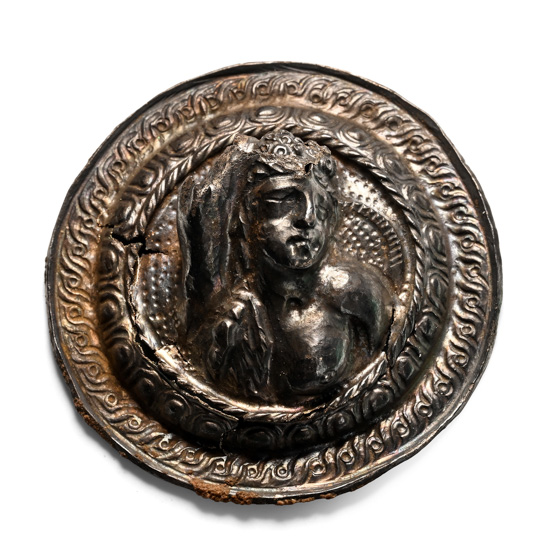
Greek Silver Phalera with Dionysus
3rd-2nd century B.C.Sold for (Inc. bp): £1,560
Discoid in plan with returned rim, guilloche to the outer field and egg-and-dart to the dome; central bust of Dionysus modelled in high-relief with garland in his hair. 5.28 grams, 41 mm
Private collection, assembled in the 1950s-1970s, thence by descent. -
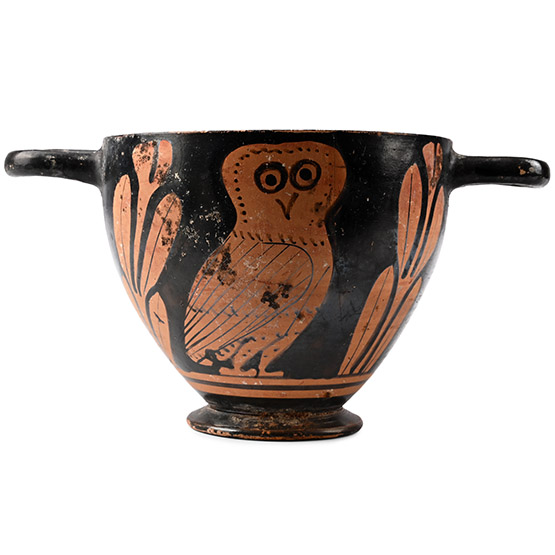
Greek Red-Figure Owl Skyphos
Attic, 4th century B.C.Sold for (Inc. bp): £1,235
Mammiform body with flared pedestal base and two loop handles to the rim; each side with a facing image of an owl between laurel fronds; concentric circles to the base, Attic workmanship. 115 grams, 15.2 cm wide
Acquired on the art market between the late 1990s and mid-2000s. Estate of the late Barry Paul Buxton (1944–2024), Oakham, Rutland. Acquired on the UK art market, 2025. -
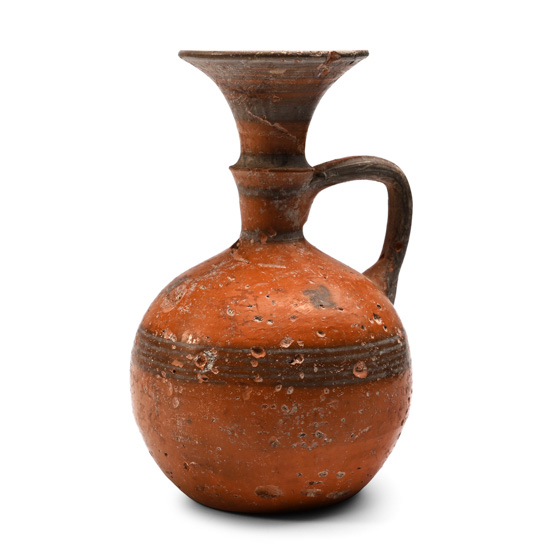
Cypriot Terracotta Jug with Decorations
7th-6th century B.C.Sold for (Inc. bp): £364
Comprising a spherical body and flat base, trumpet-shaped mouth with biconvex collar and strap handle; painted circumferential bands. 67 grams, 91 mm
Acquired by a Swiss family in the mid-1980s to late 1990s, thence by descent. Private collection, Switzerland, since the late 1990s. -
.jpg)
Greek Terracotta Standing Figure
Archaic, 7th-5th century B.C.Sold for (Inc. bp): £468
Modelled in the round figure standing with arms raised, head tilted upward with shoulder-length hair and horned cap, collar to the throat with large disc closure, pectoral pendant on a stylised braided thong; mounted on a custom-made stand; possibly Cypriot workmanship. 277 grams total, 17 cm high including stand
Ex Ernest Ohly collection. Acquired from Woolley & Wallis, Wiltshire, UK, 20 May 2010, no.1010 (part). From an important Cambridgeshire estate; thence by descent. From the private collection of John Meredith, acquired since the 1990s; thence by descent.

