-
.jpg)
Egyptian Carnelian Eye of Horus
New Kingdom, 1550-1295 B.C.Sold for (Inc. bp): £2,080
Plano-convex in section with incised bilinear borders. 3.08 grams, 22 mm
Ex early 20th century collection of a lady. This lot has been checked against the Interpol Database of stolen works of art and is accompanied by search certificate number no.13045-248616.
The wedjat-eye amulet is a representation of the healed eye of the god Horus, featuring both human and falcon elements. The name Wedjat in ancient Egyptian means ‘the one that is sound.’ According to Egyptian mythology, Horus' eye was wounded or taken by the god Seth and restored by Thoth. The wedjat-eye amulet was thought to protect its wearer and bestow the power of recovery and regeneration onto them. It was very popular and used by both the living and the dead. -
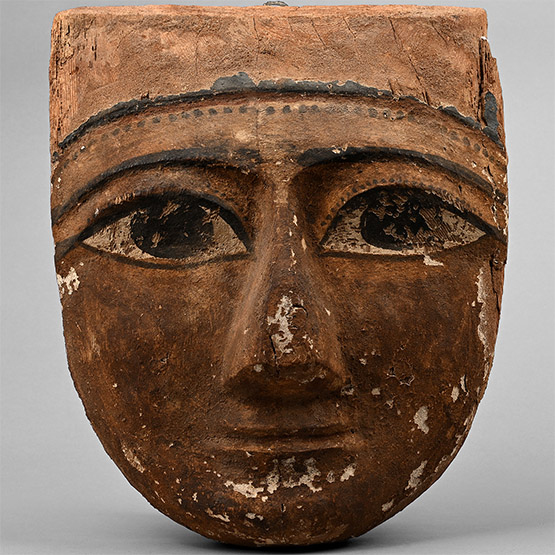
Egyptian Painted Wooden Mummy Mask
Ptolemaic Period, circa 3rd century B.C.Sold for (Inc. bp): £3,900
D-shaped in plan with carved facial detailing, thick nose and full lips; painted bands to the brow, pierced in three places for attachment. 1.04 kg, 30 cm
Swiss private collection, Zurich, assembled in the 1950s. Private collection. Acquired on the Zurich art market in 2013. This lot has been checked against the Interpol Database of stolen works of art and is accompanied by a search certificate number no.12847-241680.
The cartonnage mask from the Ptolemaic Period (305-30 BC) was a funerary covering made of wood or layers of papyrus/linen and plaster, modelled and painted, which covered the face of the mummy, often gilded, decorated with coloured glass and stones, and depicted the deceased with an idealized face and golden skin to protect him and guarantee him rebirth as a deity in the afterlife, combining Egyptian tradition with Graeco-Roman influences. -
.jpg)
Egyptian Bronze Osiris Statuette
Late Period, 664-332 B.C.Sold for (Inc. bp): £1,235
Standing figure in mummiform stance, wearing the conical Atef crown with flanking ostrich plumes and frontal uraeus, holding the crook (heka) and flail (nekhakha) regalia; mounted on a display stand. 185 grams total, 15.4 cm including stand
Property of a deceased gentleman's collection, 1980s. Ex John Nicholson Auction, Haslemere, Surrey, UK. -
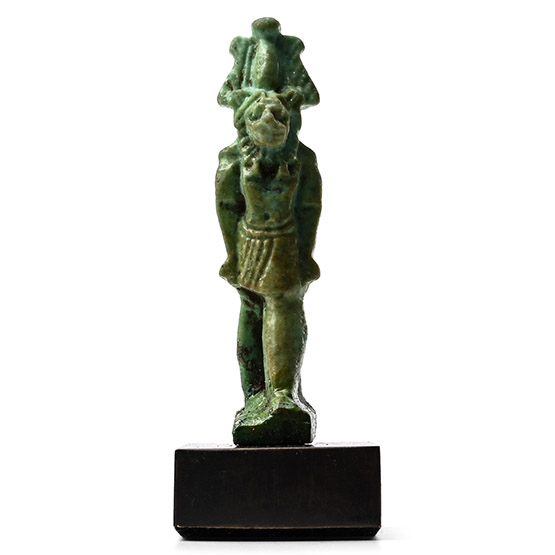
Egyptian Faience Mayhes Amulet
Late Period, 664-332 B.C.Sold for (Inc. bp): £520
Standing erect with dorsal pillar and rectangular base, arms straight and one leg advancing; lion-head wearing atef crown and a uraeus; mounted on a custom-made stand. 50.8 grams total, 84 mm including stand
Ex early 20th century London, UK, collection.
Mahes was an Egyptian lion-headed deity linked to divine protection, royal authority, and retributive justice. Considered a son of the goddess Bastet—or, in some traditions, Sekhmet—he embodied the fierce, solar power of the sun god Re and served as a fierce protector of cosmic order. Mahes was especially venerated in the Delta region, notably at Leontopolis, where his leonine form highlighted his role as a guardian and destroyer of enemies. Iconographically, he is commonly depicted as a lion or, as here, a man with a lion’s head, wearing an atef- crown. -
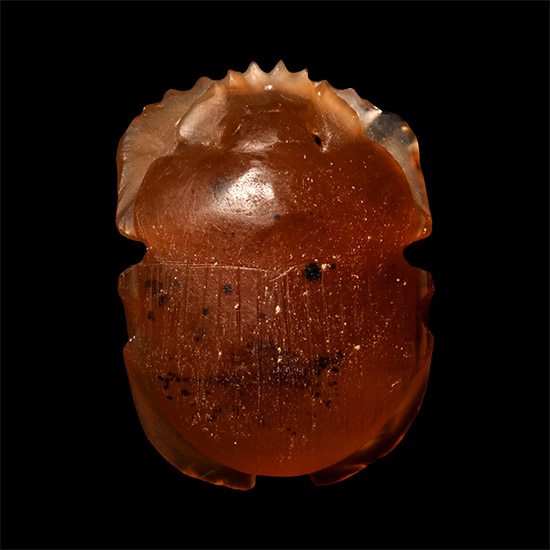
Large Egyptian Carnelian Scarab
Late Period, 664-332 B.C.Sold for (Inc. bp): £2,925
Naturalistically modelled, featuring detailed head and elytra, with suspension loop on the underside. 3.98 grams, 22 mm
Collection of a lady, circa 1940. Ex Mayfair gallery, London, UK. Ex an important Wiltshire, UK, collection. This lot has been checked against the Interpol Database of stolen works of art and is accompanied by search certificate number no.13158-249420.
The scarab amulet was arguably the most ubiquitous symbol in ancient Egypt, representing rebirth, transformation, and protection. Modelled after the scarab beetle, which was associated with the sun god Khepri - believed to roll the sun across the sky - the amulet illustrated the cycle of life and regeneration. Scarabs were commonly placed with the deceased as funerary amulets to ensure safe passage into the afterlife. They also served as seals and personal charms, often inscribed with prayers, names, or protective formulas. Widely used from the early Middle Kingdom (c. 2050 BCE) onwards, scarab amulets reflect both spiritual beliefs and everyday practices in ancient Egyptian life. -
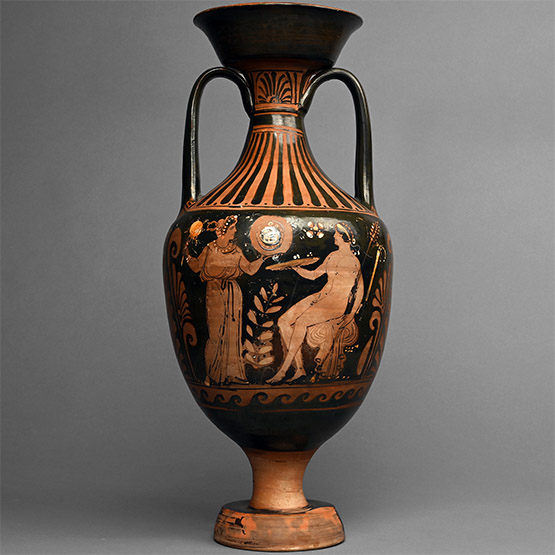
Large Greek Red-Figure Amphora with Dionysian Scenery
Apulian, 3rd-2nd century B.C.Sold for (Inc. bp): £3,640
The piriform body with broad, stepped rim and two lentoid-section handles; painted palemete beneath each handle and on the neck below the mouth; Side A: red-figure frieze depicting a standing woman wearing a himation and stephane, her hands raised supporting objects, a laurel frond before her and a seated nude male with thyrsus and other items; Side B: two opposed figures standing supported by staves, each wearing a loosely draped floor-length garment; objects in the field. 1.88 kg, 43 cm
Acquired on the art market between the late 1990s and mid-2000s. Estate of the late Barry Paul Buxton (1944-2024), Oakham, Rutland. Acquired on the UK art market, 2025. Accompanied by a thermoluminescence analysis report no.N126a18 from Oxford Authentication. This lot has been checked against the Interpol Database of stolen works of art and is accompanied by search certificate no.13075-248951.
The subject is standard, often representing the draped youths completely enveloped in their himatia. -
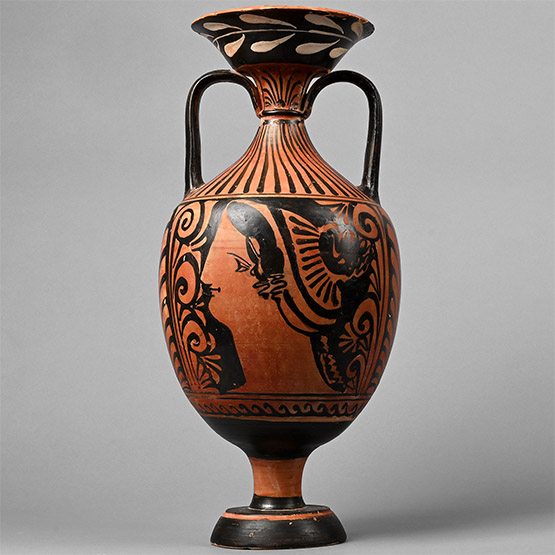
Large Greek Red-Figure Amphora with Lady of Fashion
Apulian, 3rd-2nd century B.C.Sold for (Inc. bp): £3,900
The conical mouth with laurel-leaf motif, palmettes below; lateral strap handles to the shoulder and palmette below each; Side A: profile bust of a lady of fashion with her hair in a chignon covered by a sakkos; Side B: similar design. 2.48 kg, 46.5 cm high
Acquired on the art market between the late 1990s and mid-2000s. Estate of the late Barry Paul Buxton (1944-2024), Oakham, Rutland. Acquired on the UK art market, 2025. Accompanied by a thermoluminescence analysis report no.N126a17 from Oxford Authentication. This lot has been checked against the Interpol Database of stolen works of art and is accompanied by search certificate no.13076-248950.
The pattern-work and the female head seem to connect the vase more closely with the Monopoli Group. The corkscrew curls on the hair over the ear and the sakkos with a bow at the top are, in fact, typical of the heads of this group. -
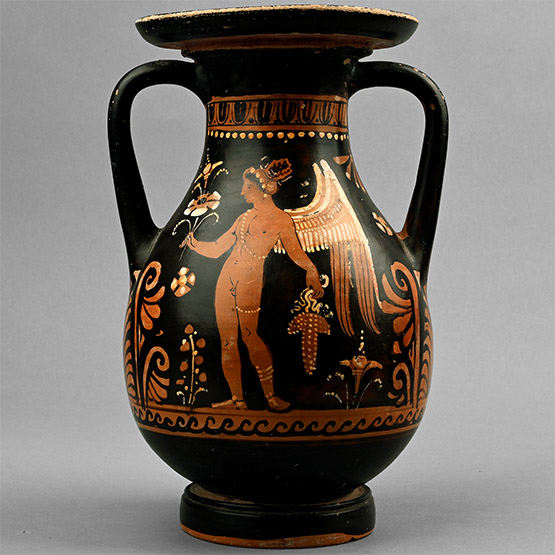
Large Greek Red-Figure Pelike with Nike
Apulian, 3rd-2nd century B.C.Sold for (Inc. bp): £2,860
Comprising a pedestal base, mastoid body, lateral strap handles and funicular neck, broad mouth with stepped rim; the neck decorated with a band of egg-and-dart; palmette below each handle, flanked by tendrils and flowers; Side A: naked Eros (Cupid), hair in a bun and tied with a cloth, right arm outstretched and holding a flower by the stem, left hand holding leaves and tendrils; Side B: Nike standing in himation and stephane, holding up a drum-shaped object and supporting leaves and tendril, flower patterns to the background. 1.19 kg, 26 cm high
Acquired on the art market between the late 1990s and mid-2000s. Estate of the late Barry Paul Buxton (1944–2024), Oakham, Rutland. Acquired on the UK art market, 2025. Accompanied by a thermoluminescence analysis report no.N126a15 from Oxford Authentication. Accompanied by an academic report by Dr Raffaele D'Amato. This lot has been checked against the Interpol Database of stolen works of art and is accompanied by search certificate number no.13089-248952.
The Greek term pelike (pl. pelikai) was used for a number of shapes, and it is not certain what this one-piece vessel with a distinctive sagging belly was called in antiquity. It seems to have been invented after the introduction of the red-figure technique, although there are examples in black-figure. It continued to be produced into the 4th century and in the Roman period. It is shown in use as a container for liquids, especially wine, and in this context was linked with Bacchus, Pan, and Silenus. -
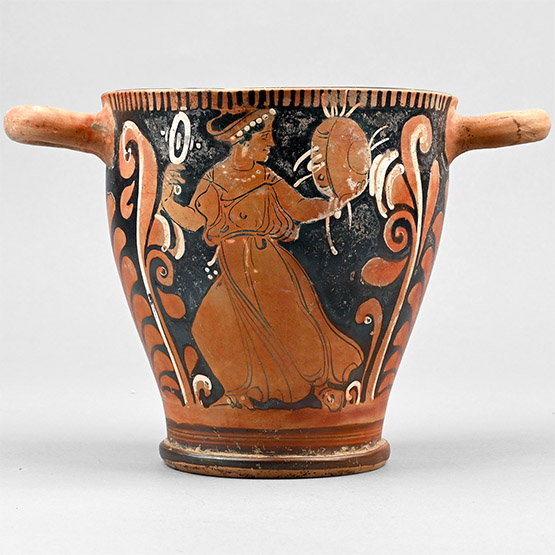
Large Greek Red-Figure Skyphos with Lady of Fashion
Campanian, 3rd-2nd century B.C.Sold for (Inc. bp): £1,235
With mammiform body, pedestal base and two loop handles; ovolo patterns in ochre beneath the rim and palmette beneath each handle; Side A: lady of fashion in advancing pose holding up a dish and a mirror, white detailing to the stephane and necklace; Side B: standing figure in a himation with a stephane. 640 grams, 23 cm wide
Acquired on the art market between the late 1990s and mid-2000s. Estate of the late Barry Paul Buxton (1944-2024), Oakham, Rutland. Acquired on the UK art market, 2025. -
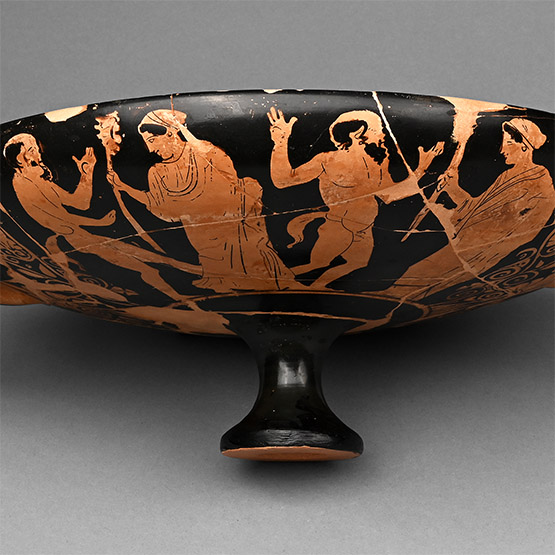
Greek Red-Figure Kylix with Dancing Nymphs and Satyrs
Attic, 5th century B.C.Sold for (Inc. bp): £2,080
With short stem and broad bowl with carination at the shoulder; two strap handles with an ivy-leaf with tendrils and volutes underneath; the underside of the bowl with a frieze of four satyrs and four maenads performing a dance, the maenads dressed in fancy Ionian dress, long peplos and himation, and a kekrykephalos (hair net) on their heads, and holding a thyrsus in their right hands; the centre of the cup showing dancing Silenus and a nymph, dressed in a similar manner and holding a thyrsus, border of meanders and chequered squares surrounding; restored. 875 grams, 37 cm wide
Ex Dr Gonik and the late Mr Wirth, 1960-1970s. Private collection, Switzerland. Accompanied by an academic report by Dr Raffaele D’Amato. This lot has been checked against the Interpol Database of stolen works of art and is accompanied by a search certificate number no.12573-232109.
Silenus, the only individualised satyr, was a companion and tutor to the wine god Dionysus, and he is represented here in the place of honour. He is typically older than the satyrs of the Dionysian retinue (thiasos) and his representation on the tondo symbolises respect towards his senior position. -
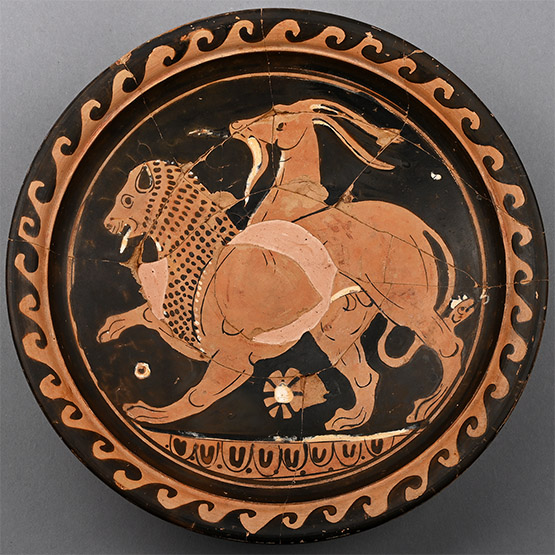
Greek Red-Figure Patera with Chimera
Apulian, 4th century B.C.Sold for (Inc. bp): £5,720
With curved rim, carinated profile and low foot; rim with reserved wave pattern, tondo with reserved ring enclosing a chimera in profile advancing on an egg-and-dart baseline; repaired and partly restored. 342 grams, 20.5 cm wide
Ex private North American collection. Acquired in the United States, 2010. Accompanied by an academic report by Dr Raffaele D'Amato. Accompanied by a thermoluminescence analysis report no.N126a12 from Oxford Authentication. This lot has been checked against the Interpol Database of stolen works of art and is accompanied by search certificate number no.13028-246781.
The legend of Bellerophon and the chimaera was a subject highly appreciated by the Greek ceramists. Red-figure Apulian plates depicting the chimaera were realised in South Italian workshops dating back to around 350-340 BC. The most famous example and possible prototype is the one held at the Musée du Louvre in Paris, created using the red-figure technique. -
.jpg)
Greek Red-Figure Kantharos with Lady of Fashion
Apulian, 3rd-2nd century B.C.Sold for (Inc. bp): £1,040
High-handled cup with flared body and a tall offset foot with a collar, coiled lateral handles; profile 'ladies of fashion' busts with white and cream detailing to the hair, diadem and earrings. 415 grams, 18.6 cm
Acquired on the art market between the late 1990s and mid-2000s. Estate of the late Barry Paul Buxton (1944–2024), Oakham, Rutland. Acquired on the UK art market, 2025.

