-
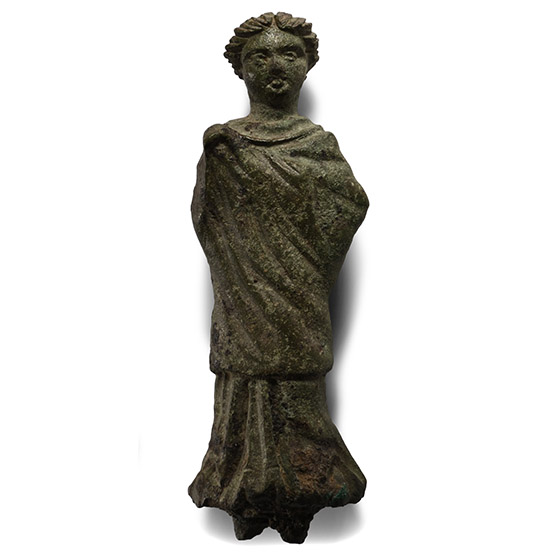
Etruscan Bronze Ceres Statuette
3rd-2nd century B.C.Sold for (Inc. bp): £1,170
Female with hair drawn up in a chignon, palla wrapped tightly around the upper body hiding the right arm bent with the hand at the shoulder, lower hem of robe flared; fixing lug to underside. 86 grams, 71 mm
Acquired in the mid 1980s-1990s. Private collection, Switzerland, thence by descent. Private collection, since the late 1990s.
This is a figurine of a deity of difficult interpretation representing an ex-voto. This typology is widespread in the votive offerings of Etrusco-Roman sanctuaries, and by analogy with various statuettes could represent Ceres. -
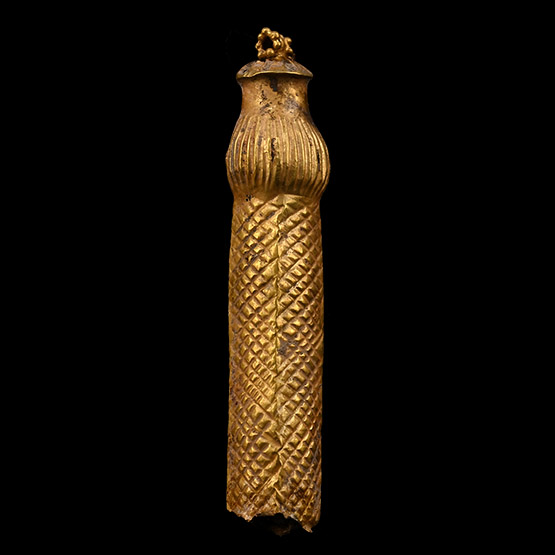
Large Greek Gold Bead Pendant
Circa 3rd-2ndcentury B.C.Sold for (Inc. bp): £351
Square in section with crosshatching to each face, hatched bulb with domed cap and loop with granulated edges. 4.79 grams, 50mm
From the London collection of the late Mr S.M., 1969-1999. -
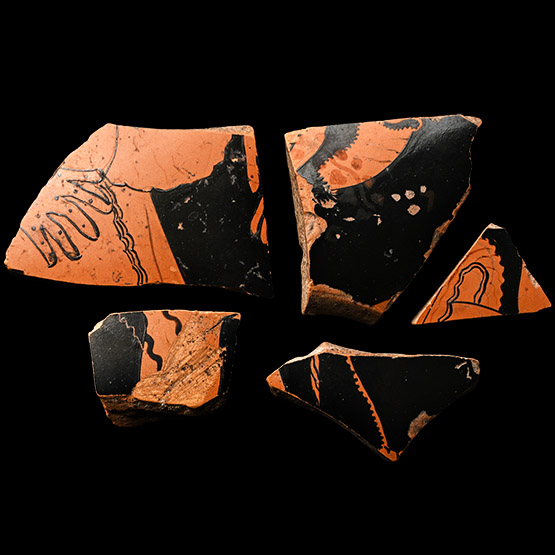
Greek Attic Red-Figure Fragments
Circa 490-470 B.C.Sold for (Inc. bp): £780
Comprising irregular, finely painted fragments, one with letters and one with prominent dotted hand; possibly attributable to the Brygos Painter. 20 grams total, 20-41 mm
From the stock of a former UK antiquarian, acquired at trade fairs and from private collection formed in the 1980s-1990s. Private collection, Europe. -
.jpg)
Parthian Terracotta Horse-Head Finial
2nd-3rd century A.D.Sold for (Inc. bp): £247
A hollow-formed horse-head finial with ribbed mane to the arched neck, elaborate bridle strap detail. 62 grams, 79.5 mm
Fine condition.
From an important central London collection formed since the mid 1960s; thence by descent. From the private collection of John Meredith, acquired since the 1990s; thence by descent. -
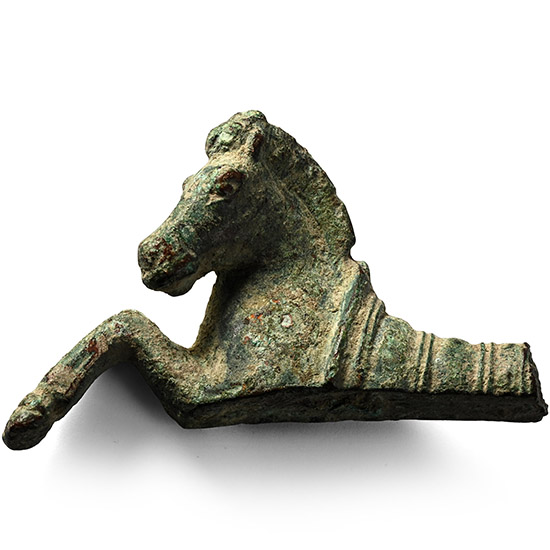
Greek Bronze Laconian Horse
5th-1st century B.C.Sold for (Inc. bp): £338
Protome formed as the upper body of a horse with forelegs bent and head turned; ribbed saddlecloth to the back; remains of attachment peg to underside. 27.8 grams, 49 mm
Acquired by a Swiss family in the mid-1980s to late 1990s, thence by descent. Private collection, Switzerland, since the late 1990s. -
.jpg)
Greek Attic Red-Figure Fragment Collection
Early 5th century B.C.Sold for (Inc. bp): £1,950
Comprising four irregular, finely painted fragments depicting: an outstretched hand below a letter, a young male face in profile, and a pair of horseheads. 6.31 grams total, 18-26 mm
From the stock of a former UK antiquarian, acquired at trade fairs and from private collection formed in the 1980s-1990s. Private collection, Europe. -
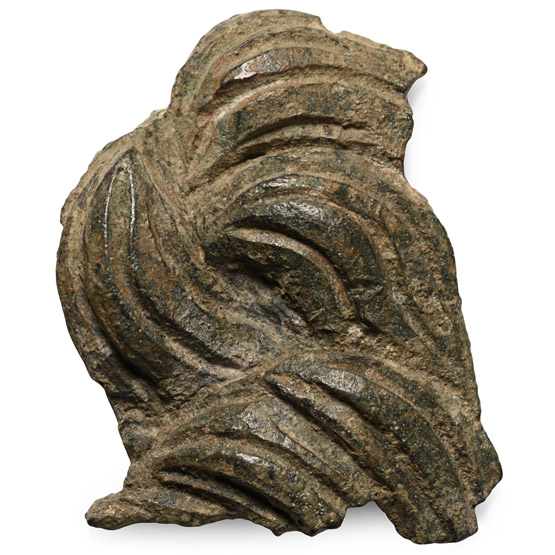
Greek Bronze Beard Fragment from a Life-Size Statue
Hellenistic, 2nd-1st century B.C.Sold for (Inc. bp): £169
Section from a groomed beard showing neatly arranged curls with incised striations. 20.77 grams, 46 mm
London, UK, art market, 1980s. Private collection, London, UK. -
.jpg)
Eastern Greek Bronze Ring with Bull
5th century B.C.Sold for (Inc. bp): £1,690
Ellipsoid bezel with incuse profile figure of a bull, frond above. 6.02 grams, 23.53 mm overall, 19.02 x 17.78 mm internal diameter (approximate size British Q 1/2, USA 8 1/4, Europe 18.12, Japan 17)
English art market, 2022. Private collection, England. -
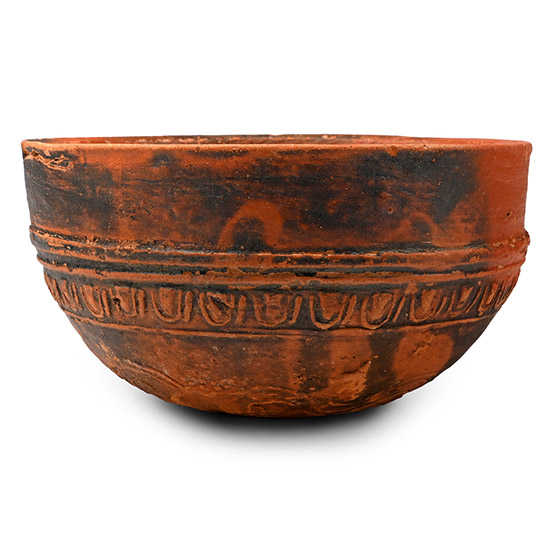
Greek Megarian Bowl
2nd century B.C.Sold for (Inc. bp): £386
Hemispherical in profile with slightly everted rim and a matt glaze, raised architectural motifs to the shoulder, dense stylised vines below; shallow rosette foot. 208 grams, 13.5 cm
From the collection of a gentleman, acquired on the London art market in the 1990s. -
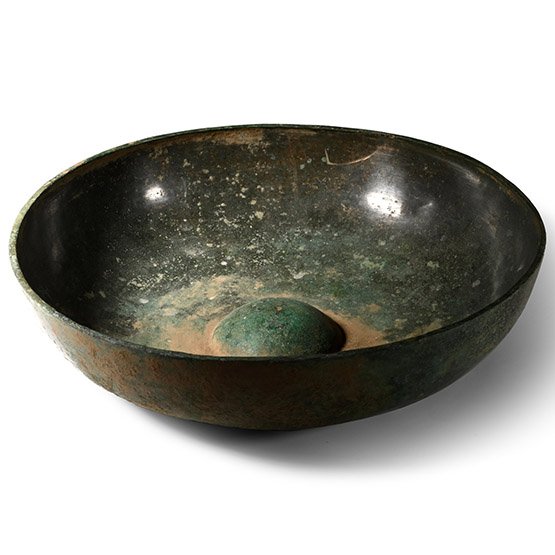
Late Lydian Bronze Phiale with Boss
600-400 B.C.Sold for (Inc. bp): £650
Broad and squat with thickened rim, central boss to the base. 536 grams, 24 cm wide
Acquired in the mid 1980s-1990s. Private collection, Switzerland, thence by descent. Private collection, since the late 1990s. -
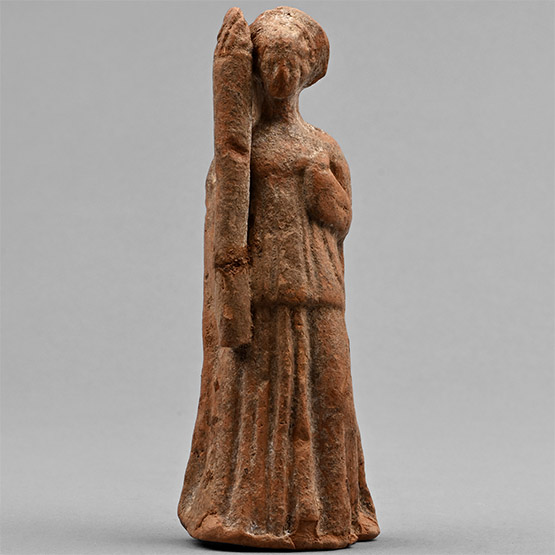
Greek Terracotta Goddess Figure
4th-3rd century B.C.Sold for (Inc. bp): £338
Tanagra type, hollow-formed with a void to the reverse, standing female in tiered robe wearing a diadem and with her hair drawn back, applied torch in her right hand. 18 grams, 12 cm
European art market. Acquired in Münich in 2012. European private collection. -
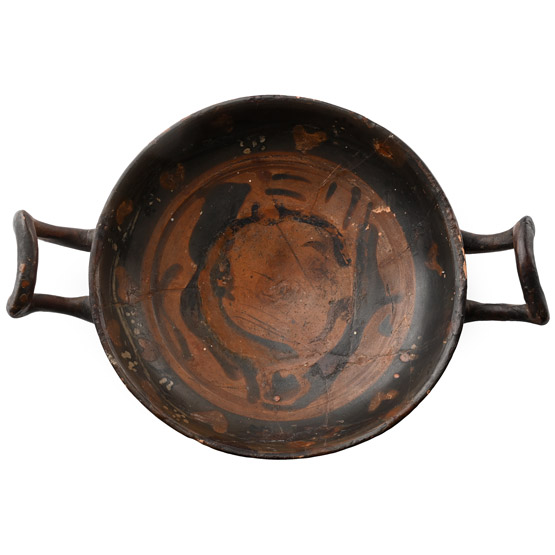
Greek Blackware Kylix
Circa 5th century B.C.Sold for (Inc. bp): £364
Broad and shallow with two strap handles, tondo displaying a wreath of ivy leaves with tendrils and volutes underneath; the underside of the bowl with acanthus motifs; restored. 215 grams, 21.5 cm wide
Acquired on the UK art market, early 2000s.
Drinking cups (kylikes and skyphoi), along with mixing bowls and wine coolers (kraters and psykters), wine jars (amphorae), water jars (hydrai), pitchers (oinochoai), and ladles (kyathoi), were essential equipment for drinking parties. The kylix appears to have been the most popular form of drinking cup, probably because it was especially well-suited to the Greek custom of eating and drinking while reclining on a couch. These Attic kylikes were usually presented with a stemmed base, a deep bowl and two upturned loop handles, on a concave base.

