-
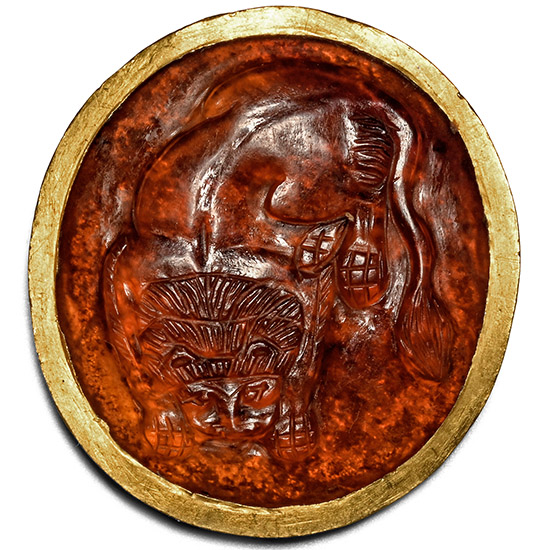
Roman Carnelian Cameo of a Crouching Lion in Gold Mount
Eastern Roman, 3rd-4th century A.D.Sold for (Inc. bp): £4,680
Discoid cell with flange rim, inset convex gemstone with reserved image of a lion resting with his head on his forepaws. 2.72 grams, 25 mm
Private English collection, formed between the late 1970s and early 1990s. Private collection, London, UK. This lot has been checked against the Interpol Database of stolen works of art and is accompanied by search certificate number no.13100-248677. -
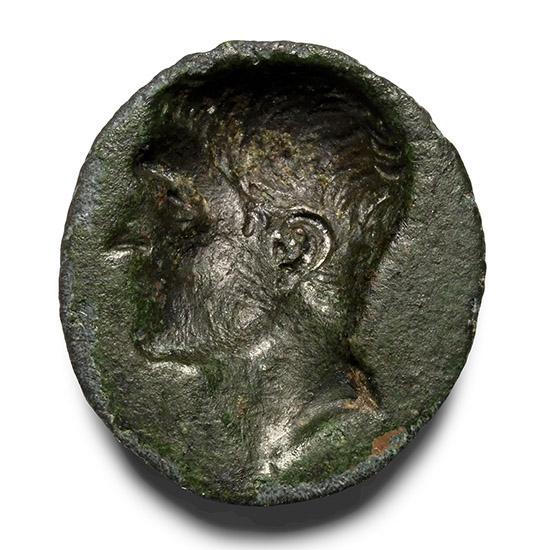
Engraved Bronze Seal of a Republican Period Male Portrait
2nd-1st century B.C.Sold for (Inc. bp): £1,235
Discoid in plan with a deeply engraved clean-shaven male bust; supplied with a museum-quality impression. 3.11 grams, 17 mm
Private English collection, formed between the late 1970s and early 1990s. Private collection, London, UK. -
.jpg)
Roman Carnelian Gemstone with Portrait of Hercules
1st century B.C.-2nd century A.D.Sold for (Inc. bp): £1,300
Discoid in plan with intaglio profile bust of Hercules sporting a browband and thick beard; supplied with a museum-quality impression. 0.83 grams, 14 mm
Private English collection, formed between the late 1970s and early 1990s. Private collection, London, UK. -
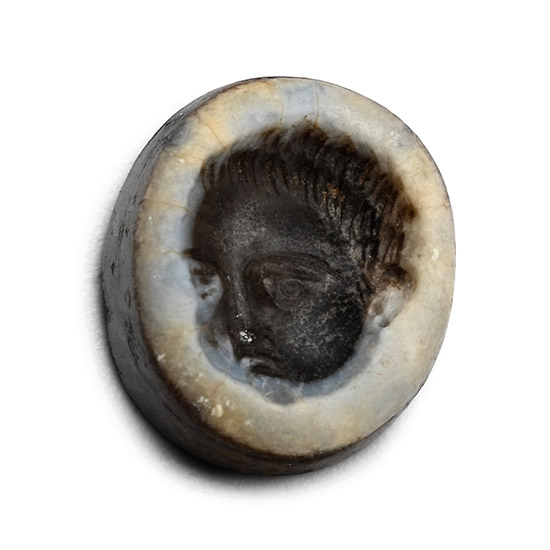
Roman Nicolo Gemstone of Boy
1st century A.D.Sold for (Inc. bp): £1,170
Discoid in plan with incuse juvenile head in three-quarter view; supplied with a museum-quality impression. 0.18 grams, 7 mm
Private English collection, formed between the late 1970s and early 1990s. Private collection, London, UK. -
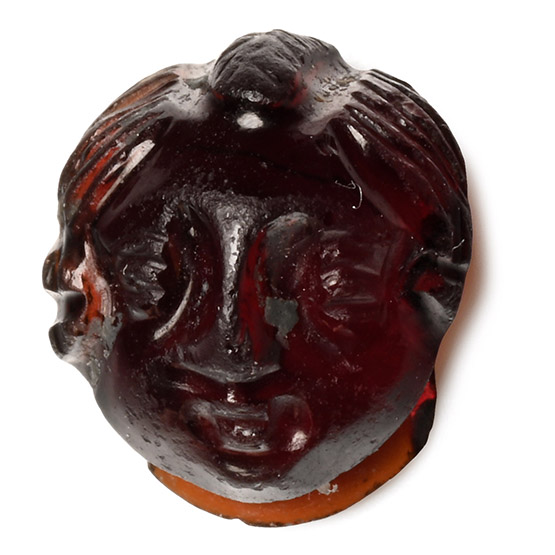
Roman Garnet Cameo of Eros, the Greek God of Love
1st century B.C.-1st century A.D.Sold for (Inc. bp): £702
With the head of Eros (Cupid), the god of love, facing; supplied with a museum-quality impression. 0.76 grams, 9 mm
Private English collection, formed between the late 1970s and early 1990s. Private collection, London, UK. -
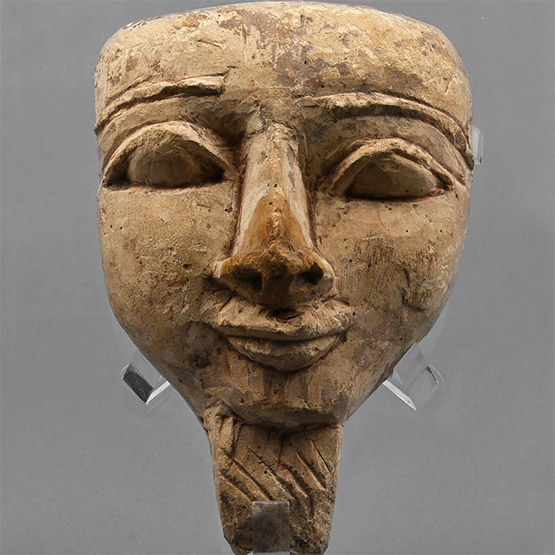
Phoenician Limestone Funerary Mask
Circa 4th-3rd century B.C.Sold for (Inc. bp): £1,950
Carved in the half-round with tall nose and chin with false beard dua wer, full lips and wide cheeks, stylised eyes and asymmetrical eyebrows; mounted on a custom-made stand. 1.3 kg total, 19.7 cm including stand
Private collection, Europe. Acquired on the French art market. -
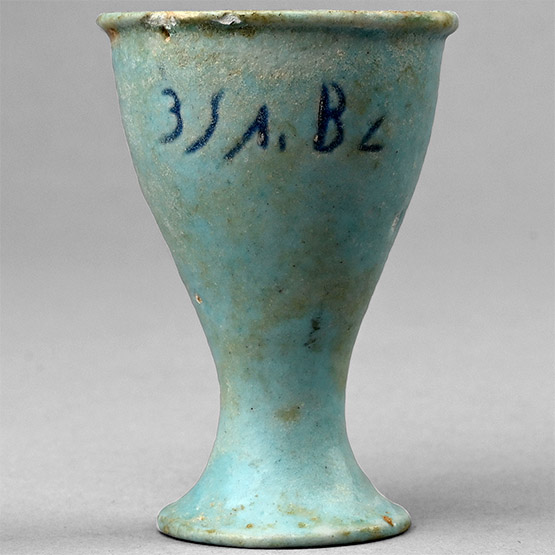
Egyptian Blue Faience Offering Cup with Inscription
Late Period-Ptolemaic Period, 664-30 B.C.Sold for (Inc. bp): £1,170
Conical in profile with a wide base and a shallow interior hollow; inscription in a darker blue glaze, consisting of a single line of demotic-script text. 57 grams, 62 mm
Mariaud de Serres, Drouot, Paris, 1999. with Christie’s, New York, 5-6 December 2001, no.354. Accompanied by copies of the relevant Christie's catalogue pages.
Demotic script was an ancient Egyptian writing system that was used from approximately the 7th century B.C. to the 4th century A.D. It represented a more simplified and cursive form of writing compared to hieroglyphs and hieratic script. Demotic text was employed for a wide range of purposes in ancient Egypt, including administrative, legal, religious, and literary documents. Deciphering Demotic has played a pivotal role in enhancing our understanding of ancient Egyptian culture, history, and everyday life. -
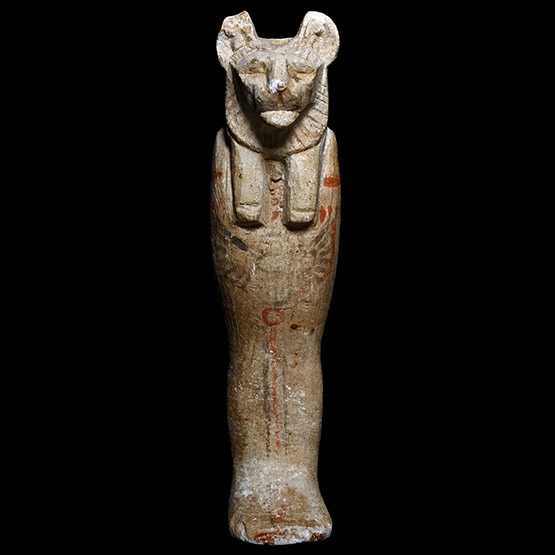
Egyptian Painted Limestone Mummiform Sekhmet Statuette
Circa 7th-6th century B.C.Sold for (Inc. bp): £3,000
Carved in the round depiction of Bastet or Sekhmet in a lion-headed form with a tripartite headdress, with front lappets overlain by the leonine mane; between the ears, a hole possibly for the insertion of a separate sun disc element; red pigment lines and fringe to the shoulders; a black diamond pattern with central red dots decorating the back, and a winged scarab in black on the abdomen; marked on the underside with the collector's reference 'BAOP SAKKARA'; mounted on a custom-made display stand. 29 grams total, 77 mm including stand
Private collection of George Anastase Michaelides (1900-1973) and legally exported from Egypt in the 1940s. Black ink inscription on base "BAOP SAKKARA". Christie's, London, 29 October 2003, no.167. Accompanied by a copy of the relevant Christie's catalogue pages. This lot has been checked against the Interpol Database of stolen works of art and is accompanied by search certificate number no.13101-248076.
Considering the specified Saqqara provenance, it is probable that the statuette originated from the Bubastaeion, dedicated to Bastet. The goddess was more commonly depicted as a cat or a human with a cat's head, although she also sometimes displayed a leonine aspect. It is also possible that the statuette represents her son, Mahes, who was depicted as a man with a lion's head. -
.jpg)
Egyptian Wooden Mummy Mask
Late Period, 664-332 B.C.Sold for (Inc. bp): £1,950
Columnar in form with carved facial detailing, thick block of hair, full lips; pierced to reverse for attachment. 4.85 kg total, 38.8 cm high including stand
English private collection, formed in the early 20th century. Acquired on the English art market. -
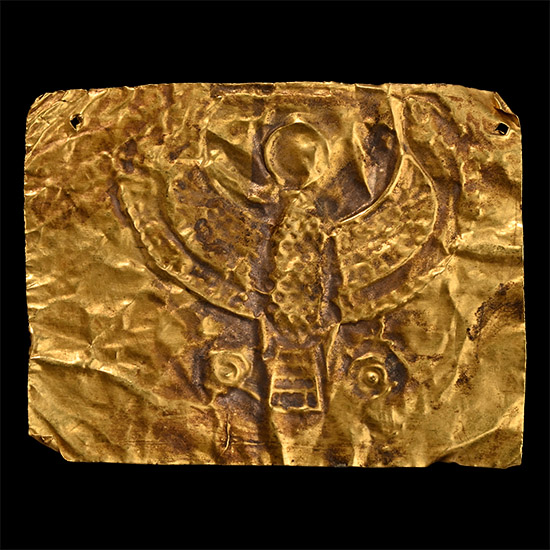
Egyptian Gold Plaque with the Falcon God Horus
Late Period, 664-332 B.C.Sold for (Inc. bp): £1,170
Rectangular foil panel featuring a repoussé motif of a bird with wings spread in an arc, with a sun-disc on its head, and claws clutching each a shen ring; honeycomb detailing on the wings and body. 1.03 grams, 40 x 31 mm
UK private collection before 2000. Acquired on the UK art market. Private collection, London, UK. -
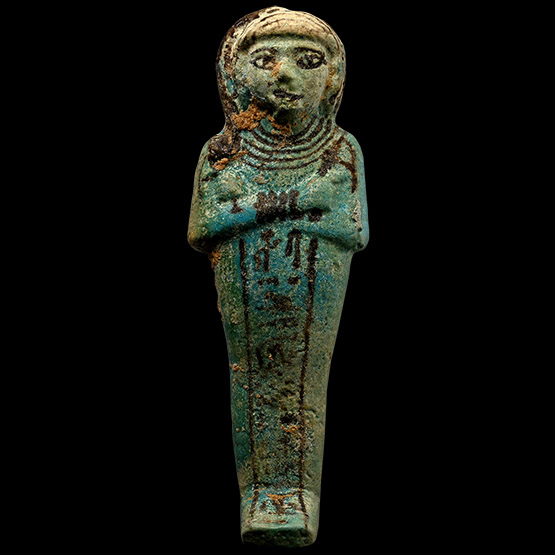
Egyptian Faience Ushabti
2nd millennium B.C.Sold for (Inc. bp): £2,106
Mummiform figure with black-pigment facial detailing, sidelock, tripartite wig, dorsal seed-net, tiered collar, and vertical panel of hieroglyphic text. 134 grams, 15 cm
Acquired in the mid 1980s. Private collection, Switzerland, thence by descent. Private collection, since the late 1990s. This lot has been checked against the Interpol Database of stolen works of art and is accompanied by a search certificate number no.12848-241648.
A shabti (also known as ushabti or shawabti) is a small funerary figurine found in ancient Egyptian tombs, from around 2000 BCE to 30 BCE. Its main purpose was to act as a servant for the deceased in the afterlife, carrying out manual tasks like farming or irrigation as directed by the gods. Shabtis were frequently inscribed with a magical formula from the Book of the Dead to ensure they would animate when summoned. -
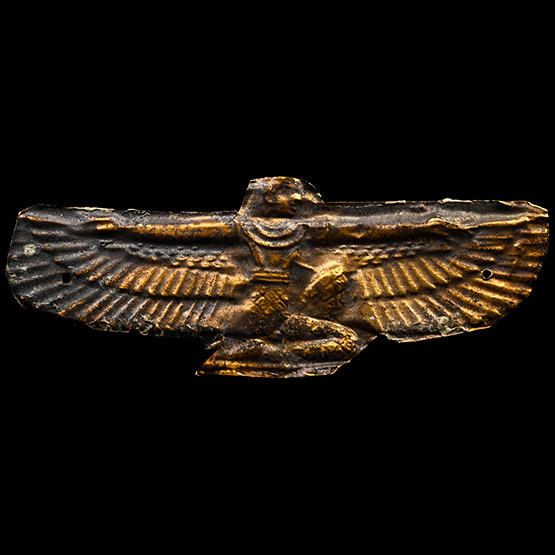
Egyptian Gold Plaque with Winged Goddess
1st millennium B.C.Sold for (Inc. bp): £1,820
Foil figure of a kneeling goddess with outstretched wings; wearing a tripartite wig with a headband, a multi-strand collar, and a tight robe with diamond detailing; mounted in a display frame. 1.57 grams, 62 mm
UK private collection before 2000. Acquired on the UK art market. Private collection, London, UK.
Several winged goddesses appear in Egyptian iconography. Without a headdress, the deity's identity here remains uncertain, but Isis, Nephthys, or Nut are likely candidates. All three are often shown in avian form as protectresses of the dead.

