-
.jpg)
Egyptian Carnelian Scarab Amulet
Late Period, 664-332 B.C.Sold for (Inc. bp): £98
Carved in the round scarab with longitudinal piercing. 0.40 grams, 8.5 mm
Ex Belinda Elliston collection, 20th century. -
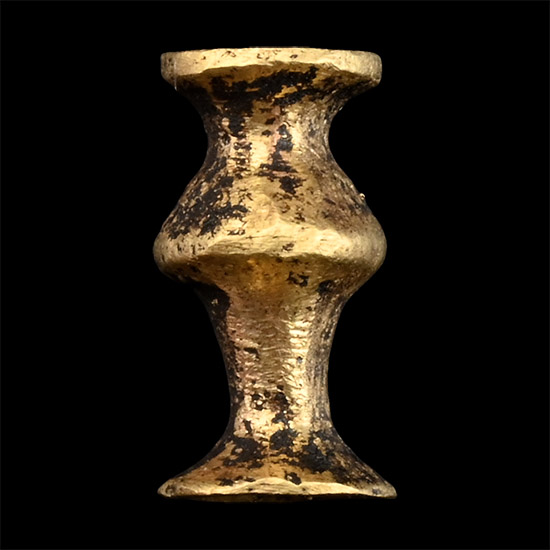
Egyptian Gold Vase-Shaped Bead
Late New Kingdom, 1279-1070 B.C.Sold for (Inc. bp): £234
With median baluster and flange to each end. 4.80 grams, 50 mm
Ex French collection, early 20th century.
This bead likely represents a hes vase, an important ritual vessel used for libations to both the living and the dead. -
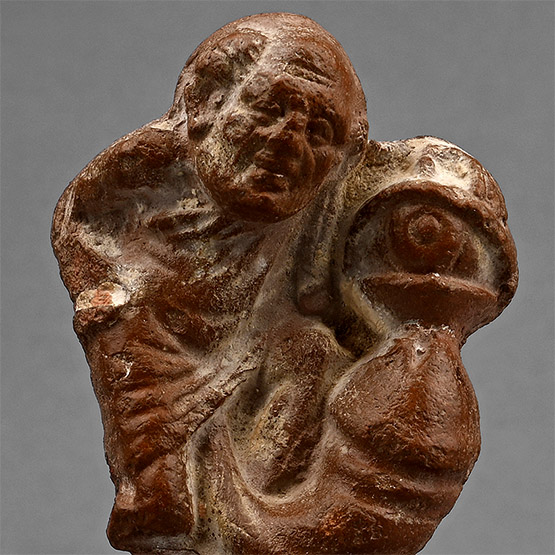
Romano-Egyptian Terracotta Figurine with Large Phallus and Apotropaic Eye
1st century B.C.-2nd century A.D.Sold for (Inc. bp): £316
Representing a slave or a dwarf in a crouched position, dressed in a short tunic leaving the left shoulder uncovered (exomis), a large curving phallus emerging from underneath the tunic topped with a large apotropaic eye; accompanied by a display stand. 64 grams, 81 mm (80 grams total, 10 cm high including stand)
The Erotica Collection Christian von Faber-Castell, Küsnacgt ZH, Switzerland, since the late 1970s.
Except for the enormous phallus, the figure is human in all aspects. The apotropaic aspect, symbolised also by the eye, is combined with the erotic. It should be pointed out that according to the physiognomic conceptions held in the ancient world, from the 4th century B.C. onwards, small-scale sculptures developed a rich repertoire of grotesque types. These so-called grotesques were a development of the Hellenistic interest in the human body and its imperfections. They range from representations of individuals with clinically diagnosable disfigurements to those with exaggerated physical features. According to some scholars, terracotta (and bronze) figurines of this kind were life-like representations of beggars and others who gathered at big feasts in temples or at the houses of the wealthy. In the latter case, they indicated the importance and wealth of the host because the more beggars an event attracted, the greater the fortune of the event organizer. By implication, the bronze and terracotta portraits of these marginal people could have become symbols and charms of good luck that would have been placed in private houses. Christian von Faber-Castell (born 1950) is a renowned German entrepreneur and art collector, best known as a member of the prominent Faber-Castell family, famed for their iconic writing instruments. A passionate advocate for art and culture, Christian von Faber-Castell curated an extensive and diverse private collection of erotica, spanning centuries and cultures. His collection reflects a deep appreciation for the interplay of beauty, sensuality, and artistic expression, bringing together rare and unique works that explore themes of intimacy and human connection. Pieces from this collection have been featured in notable exhibitions and are celebrated for their artistic and historical significance. This offering represents a rare opportunity to acquire works from one of the most fascinating and eclectic private collections of its kind. -
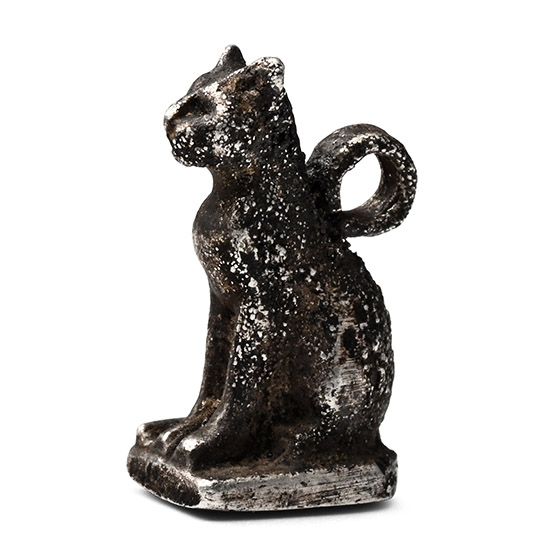
Egyptian Silver Bastet Cat Amulet
Late Period-Ptolemaic Period, 664-32 B.C. or laterSold for (Inc. bp): £260
Seated figure of a cat with pointed ears mounted on a rectangular base with a rounded end; suspension loop on the back. 1.55 grams, 12 mm
Ex London, UK, gentleman's collection, 1990s.
The goddess Bastet was believed to be the daughter of the sun god and was shown with the features of a lion up until about 1000 B.C. when she was first portrayed as a cat or human with a cat head. As the daughter of Ra she was associated with the rage inherent in the sun god's eye which was considered to be his instrument of vengeance. Her development into a cat goddess occurred during the New Kingdom but did not fully develop until the Late Period. She was still associated with the destructive power of the sun and was shown on the prow of the solar boat, decapitating the evil serpent Apophis in the Book of the Dead. The maternal, protective and hunting characteristics of the cat are obvious in Bastet and she was seen as a protector of pregnant women and young children. In the Pyramid Texts she is invoked by the deceased king to act as his protector and to help him reach the sky to join the sun god; the king proclaims that Bastet is his mother and nurse. Like her counterpart, Sekhmet, Bastet has an aggressive side and, in a text from Karnak, Amenhotep II described his enemies being slaughtered like the victims of Bastet. The goddess had a shrine at Karnak, where she is known as the 'Lady of Asheru' which aligns her closely with the goddess Mut, the consort of Amun-Ra. Her most famous shrine was in the north-east Delta region, at Bubastis, and was known as Per-Bastet or 'the House of Bastet.' Herodotus describes the festival of Bastet as one of the most elaborate in all of Egypt and identifies her with the Greek Artemis. Cemeteries of cats have been excavated at Bubastis and at Saqqara and Memphis. -
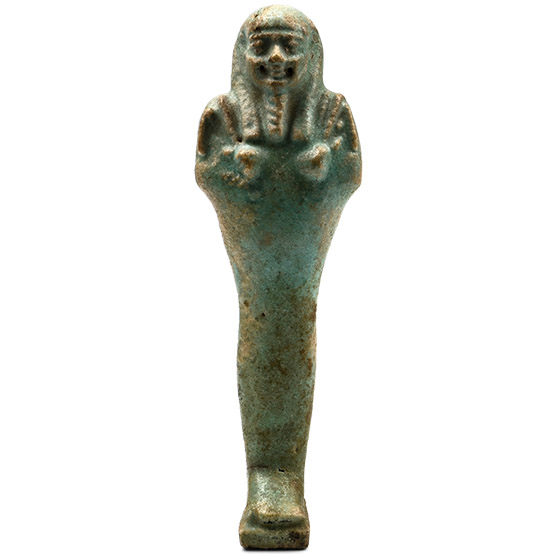
Egyptian Blue Glazed Faience Shabti
Ptolemaic Period, circa 305-30 B.C.Sold for (Inc. bp): £715
Characteristic mummiform figure wearing a tripartite wig and a false beard, with a seed-bag suspended over the shoulder, a plain dorsal column, and with arms crossed and hands holding agricultural tools. 72 grams, 12.5 cm
From the collection of a late Tavistock, Devon, UK, gentleman, formed from the 1990s. Accompanied by an old handwritten date note on British Museum, Department of Egyptian Antiquities headed paper, where the second part relates to this item. -
.jpg)
Egyptian Faience Bes Amulet
Late Period, 664-332 B.C.Sold for (Inc. bp): £312
Rectangular plaque with a head of Bes modelled in low relief on one side and symbols on the reverse; pierced longitudinally. 3.54 grams, 20 mm
Ex early 20th century collection, London, UK.
From the New Kingdom onwards, Bes became one of ancient Egypt's most popular apotropaic deities. Despite his somewhat fearsome appearance, Bes served as the patron and protector of pregnant women and children, and was also believed to shield them from snakes. Double-sided Bes amulets appear during the Third Intermediate Period and continued into the Late Period, possibly perpetuated in part by Levantine demand (Cf. Pierrat-Bonnefois, G., ”Les questions d'identité culturelle que soulèvent certaines faïences de la première moitié du Ier millénaire”, dans Bonadies, L., Chirpanlieva, I., Guillon, É. (dir.), Les Phéniciens, les Puniques et les autres. Échanges et identités en Méditerranée ancienne, Orient & Méditerranée 31, Paris, 2019, pp. 58-60, fig. 5b). -
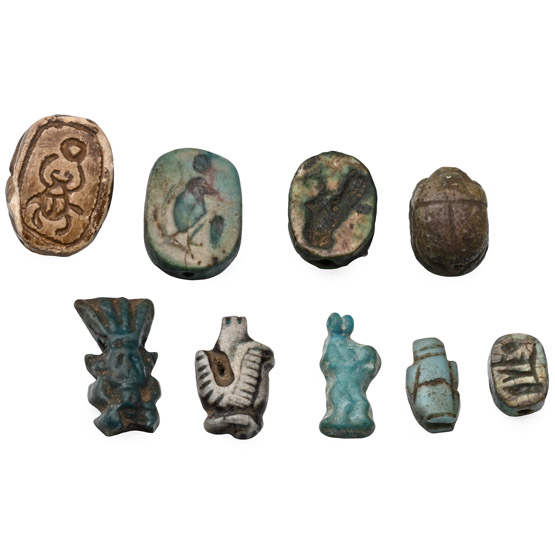
Egyptian Faience Amulet Collection
New Kingdom-Ptolemaic Period, 1550-30 B.C.Sold for (Inc. bp): £312
Comprising: four scarabs and scaraboids, three with hieroglyphs on the underside; a tabular bead with a figure of a bird on both sides; and four small amulets, including two of Bes and a uraeus. 5.79 grams total, 7-14 mm
From the Walter Thomas Gaze Cooper (1895-1980) collection; thence by descent. -
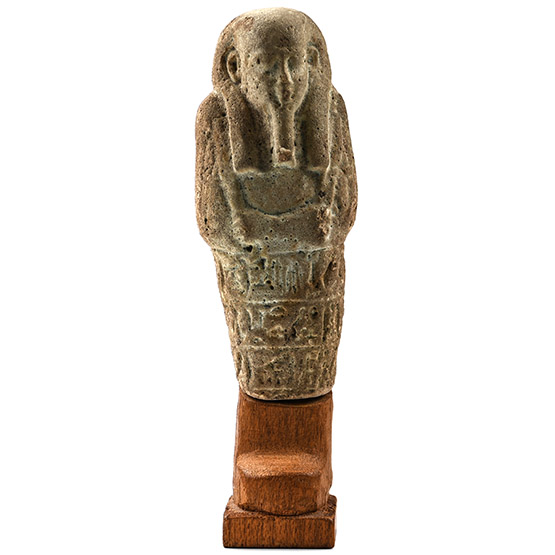
Egyptian Pale Green Glazed Faience Shabti Fragment with Hieroglyphs
Late Period, 664-332 B.C.Sold for (Inc. bp): £364
Head and torso of a mummiform figure, wearing a tripartite wig and divine beard, with arms crossed and hands holding agricultural implements and a cord for a seed bag over the left shoulder, three horizontal bands of hieroglyphic inscriptions to the lower body; mounted on a wooden display stand. 86 grams, 12.5 cm including stand
From a Scottish gentleman’s collection, Glasgow, formed from the early 2000s.
The owner's name is poorly preserved, although the filiation that follows may read: "...born (to) Djed-mut-ies-ankh" (ms ḏd mwt ı͗w s Ꜥnḫ). -
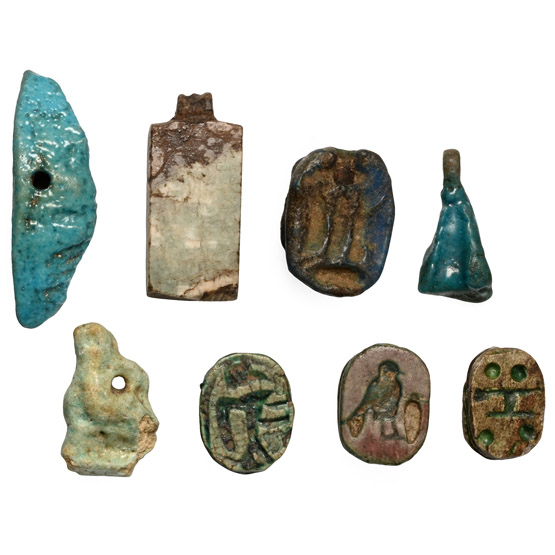
Egyptian Faience Group of Amulets
New Kingdom-Ptolemaic Period, 1550-30 B.C.Sold for (Inc. bp): £182
Comprising of blue-glazed composite amulets including lotus flower; crescentic bead; bird amulet with minor chips to the body; four scarabs with longitudinal piercing and carvings to the underside; a plain green stone rectangular plaque with ribbed suspension bar to the top. 6.17 grams total, 10-24 mm
From the Walter Thomas Gaze Cooper (1895-1980) collection; thence by descent. -
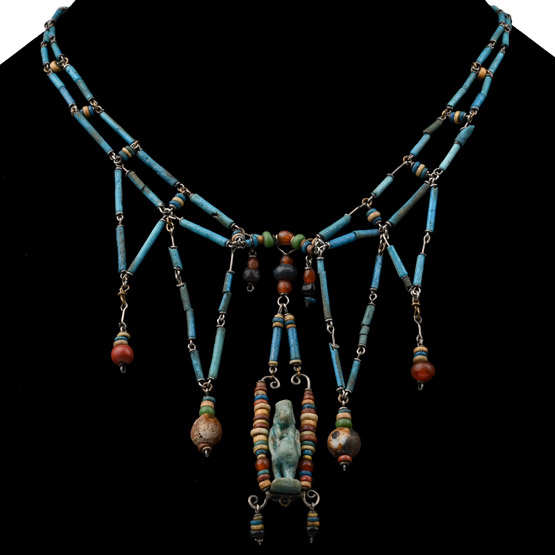
Egyptian Blue Faiance Bead Necklace with Taweret
Late Period, 664-332 B.C.Sold for (Inc. bp): £520
A restrung designer necklace composed of cylindrical and spherical beads; centrpiece composed of polychrome annular beads flanking a Taweret amulet; modern clasp. 21.2 grams, 37.5 cm
French private collection, formed in the early 20th century. Private collection, London, UK. -
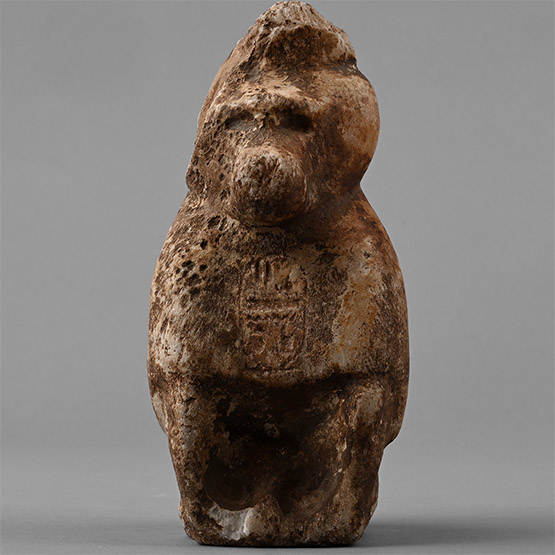
Egyptian Alabaster Baboon with Dedication to Queen Tiye
New Kingdom, 1184-1152 B.C.Sold for (Inc. bp): £3,120
Carved alabaster figure of a baboon, crouching with his forepaws resting on his knees, tail curled around from the rear; cartouche dedicated to Queen Tiye at the chest as a later addition. 1.06 kg, 15.4 cm
From the private collection of Dr Athanasios Ghertsos, Zurich, by at least 1970. Private collection of Hermann A. Schlögl (1932-2023), Basel. Accompanied by a copy of an Art Loss Register certificate, no.S00261724. This lot has been checked against the Interpol Database of stolen works of art and is accompanied by search certificate no.13073-248325.
In ancient Egypt, baboons were sacred, representing wisdom, the moon, and the underworld, linked to gods like Thoth and Babi, often depicted greeting the sun or guarding tombs, and were imported, mummified as offerings, and used as powerful religious symbols despite their often harsh captive conditions. The aforementioned Tiye is the wife of Sethnakht, the founder of the 20th Dynasty, and not to be confused with the wife of Amenhotep III. All monuments bearing her name originate from Abydos, where her son Ramesses III built a temple for his parents. -
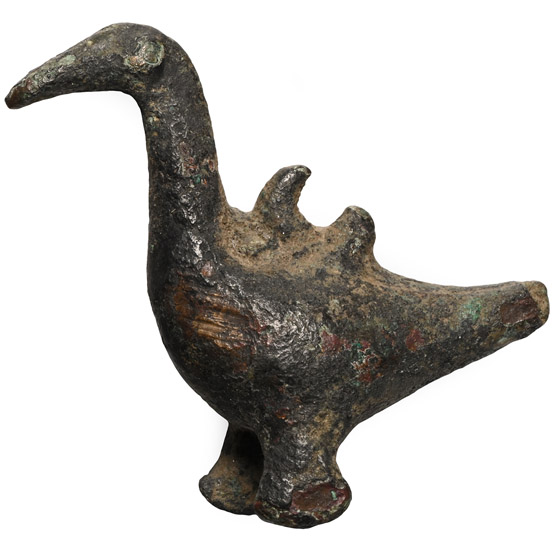
Greek Bronze Bird Figure
8th century B.C.Sold for (Inc. bp): £94
Amuletic pendant formed as a perching bird with long neck and stub legs, loop to the back. 21.9 grams, 42 mm
Acquired in the mid 1980s-1990s. Private collection, Switzerland, thence by descent. Private collection, since the late 1990s.

