-
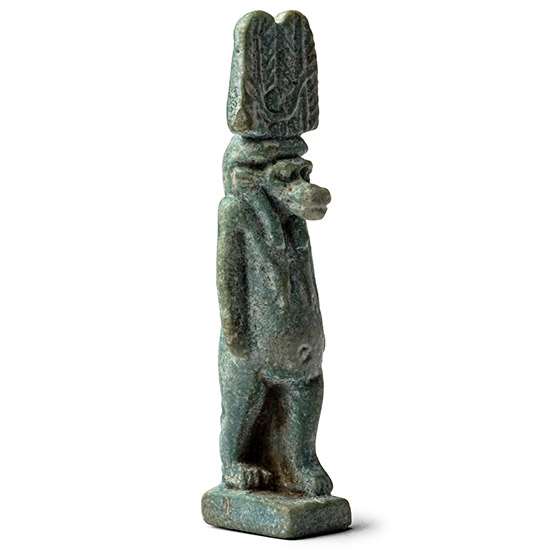
Egyptian Blue Faience Amulet Representing Taweret
Late Period, 664-332 B.C.Sold for (Inc. bp): £546
Modelled standing on a rectangular base in characteristic hippopotamus-headed form with a dorsal pillar, pierced for suspension at the rear of the tall two-feather headdress. 5.18 grams, 52 mm
Private collection, Carouge, Switzerland, assembled in the 1980s-1990s. Thence by descent to the collection of Mr S.P., since 2020. -
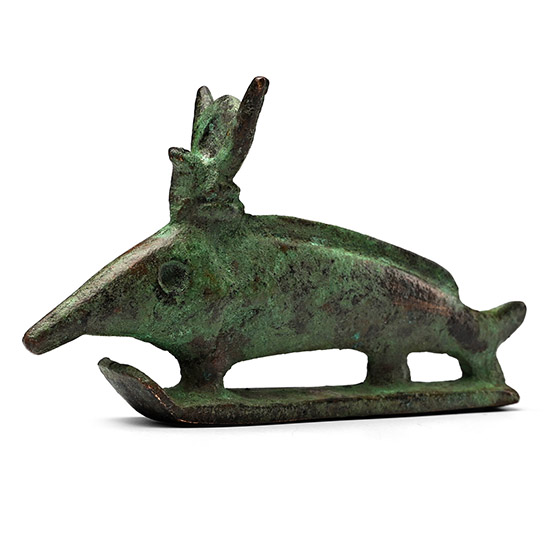
Egyptian Bronze Oxyrhynchus Fish
Late Period, 664-332 B.C. or laterSold for (Inc. bp): £1,235
Modelled in the round on a sledge attached by ventral and pectoral fins; with forked tail, a dorsal ridge, and a tapering nose, featuring recessed circular eyes to accept an insert, a horned sun disc headdress fronted by a uraeus, and a suspension loop behind. 203 grams, 11.5 cm
From the collection of a gentleman, acquired on the London art market in the 1990s. -
.jpg)
Egyptian Bronze Statue of Isis with Inscribed Base
Late Period, 664-332 B.C.Sold for (Inc. bp): £5,330
Seated figure of the goddess, wearing a vulture headdress from which the bird’s head projects, topped by a crown consisting of a low modius of rearing cobras, surmounted by cow horns and a central sun disk; a tight-fitting three-quarter-length dress; shown suckling the naked infant Horus, with a uraeus at his brow; the goddess’s feet rest on a plinth, of which two sides are inscribed with a dedication, only partially preserved: (May) Isis give life (to) Wennenefer [......] Ankh-hor-(en)-sa (Ꜣst rdı͗ Ꜥnḫ wn n nfr [……] ꜥnḫ ḥr (n) sꜢ (?)). 875 grams, 22.1 cm including stand
From the estate of Alexander Dobkin (1908-1975), New York, USA, acquired prior to 1975. Thence by descent to his daughter, Katherine Dobkin, New York, USA.
Isis, one of the principal goddesses of the Egyptian pantheon, was revered as divine mother, protector of kingship, and mistress of magic. As the wife of Osiris and mother of Horus, she embodied maternal care, resurrection, and cosmic order, playing a central role in myths of death and renewal. Isis lactans statuettes emphasise this intimate maternal relationship and its protective and regenerative power; such bronzes were widely dedicated in temples and domestic shrines as votive objects invoking divine protection, healing, and royal legitimacy. The lacuna in the inscription on this example most likely supplied the filiation between the two named individuals. -
.jpg)
Egyptian Pale Blue Steatite Scarab with Hieroglyphs
Late Period, 664-332 B.C. or laterSold for (Inc. bp): £104
Plano-convex in section with scarab detailing to the upper face; underside with hieroglyphic inscription; pierced longitudinally. 2.22 grams, 17 mm
Ex Constable collection, 1990s. Ex P. Morris collection. -
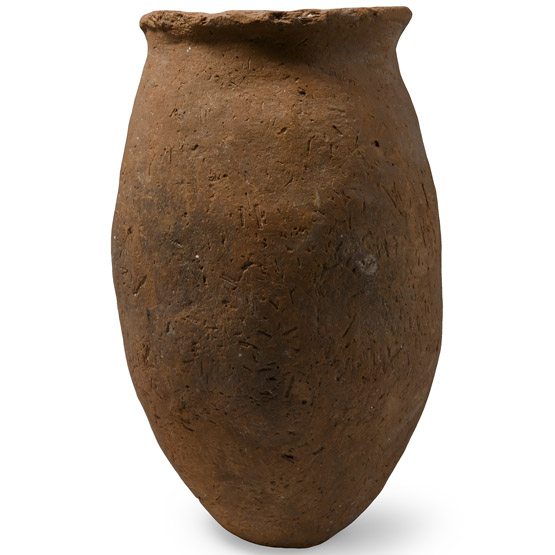
Egyptian Predynastic Terracotta Jar
3500-3100 B.C.Sold for (Inc. bp): £234
Piriform in profile with flared rim; marked with collector's reference to base '2348'. 1.14 kg, 21 cm
Private collection, London, UK. Acquired on the UK art market, 2003. -
.jpg)
Egyptian Faience Nephthys Amulet
Late Period, 664-332 B.C.Sold for (Inc. bp): £208
Standing figure of the goddess, wearing a striated lappet wig topped by her characteristic headdress, with her arms at her sides; supported by a dorsal pillar pierced once for suspension. 1.68 grams, 34 mm
Ex early 20th century collection, London, UK.
This amulet represents Nephthys (Egyptian: Nebet-Hut), a protective goddess closely associated with mourning, magic, and the afterlife. Often depicted as a woman with her name in hieroglyphs atop her head, Nephthys is Isis’s sister and, together with Isis, plays a central role in the funerary rites of Osiris. Amulets of Nephthys were often worn or placed among the deceased’s wrappings to invoke her protective role during the journey to the afterlife. As a divine mourner, Nephthys was believed to guard the dead and assist in their rebirth, making her amulet a symbol of divine protection, sacred lamentation, and renewal. -
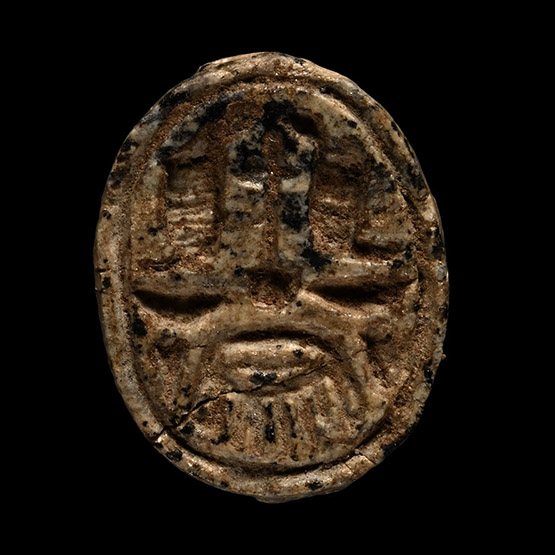
Egyptian Faience Scarab with Hieroglyphs
Late Period, 664-332 B.C.Sold for (Inc. bp): £156
Modelled as a scarab resting on a textured base with a tubular extension behind and before the head forming part of the piercing, the underside features two rearing cobras atop neb signs flanking a nefer sign, with a large nwb sign (meaning 'gold') below. 2.66 grams, 18 mm
From the property of a London, UK, gentleman, 1970-2000s. -
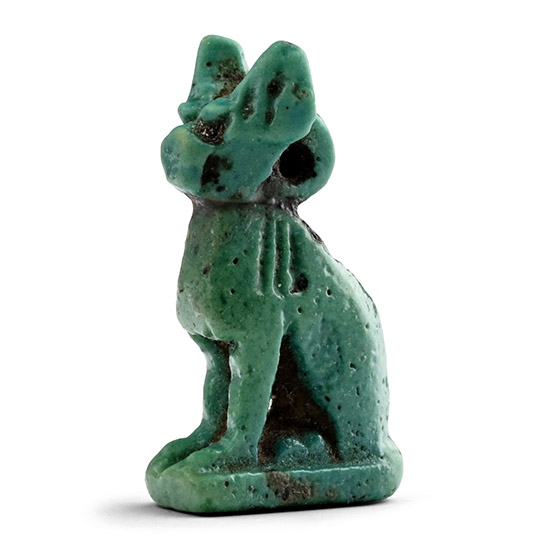
Egyptian Faience Sekhmet Cat Amulet
Late Period, 664-332 B.C.Sold for (Inc. bp): £390
Modelled seated on a tongue-shaped base, with simple facial detailing and suspension loop to the back. 2.91 grams, 28 mm
Ex early 20th century collection.
The goddess Bastet was believed to be the daughter of the sun god and was shown with the features of a lion up until about 1000 B.C. when she was first portrayed as a cat or human with a cat head. As the daughter of Ra she was associated with the rage inherent in the sun god's eye which was considered to be his instrument of vengeance. Her development into a cat goddess occurred during the New Kingdom but did not fully develop until the Late Period. She was still associated with the destructive power of the sun and was shown on the prow of the solar boat, decapitating the evil serpent Apophis in the Book of the Dead. The maternal, protective and hunting characteristics of the cat are obvious in Bastet and she was seen as a protector of pregnant women and young children. In the Pyramid Texts she is invoked by the deceased king to act as his protector and to help him reach the sky to join the sun god; the king proclaims that Bastet is his mother and nurse. Like her counterpart, Sekhmet, Bastet has an aggressive side and, in a text from Karnak, Amenhotep II described his enemies being slaughtered like the victims of Bastet. The goddess had a shrine at Karnak, where she is known as the 'Lady of Asheru' which aligns her closely with the goddess Mut, the consort of Amun-Ra. Her most famous shrine was in the north-east Delta region, at Bubastis, and was known as Per-Bastet or 'the House of Bastet.' Herodotus describes the festival of Bastet as one of the most elaborate in all of Egypt and identifies her with the Greek Artemis. Cemeteries of cats have been excavated at Bubastis and at Saqqara and Memphis. -
.jpg)
Historic Collection of 591 Slides of Egyptian Archaeological and Other Subjects
1960s-1980s A.D.Sold for (Inc. bp): £910
Housed in five linen-covered boxes, covering ancient Egypt, Aswan, Karnak, Philae, Medinet, Step Pyramids, Nile birds and animals, boats, irrigation, Palestine, Damascus, Greece, Pompeii, Baalbek, Byblos, personal slides etc. 4.32 kg total, 26.5 x 16.5 x 6.5 cm each box
Property of archaeologist Stephanie Gee, N.W. London, UK, 1960s-1980s.
Stephanie Gee was a prominent archaeologist who took part in several expeditions in Egypt. She was a trusted assistant to the British-Australian archaeologist Veronica Seton-Williams, who excavated in Egypt, Britain, and the Near East. Stephanie also took part in the Tell El-Farâ'în expeditions of 1965-1968, and assisted Seton-Williams with preparing the 1966 expedition report. Their collaboration continued and Stephanie helped with the manuscript of Seton-Williams’ book ‘The Road to El-Aguzein’, a narrative account of her life that was first published in 1988. -
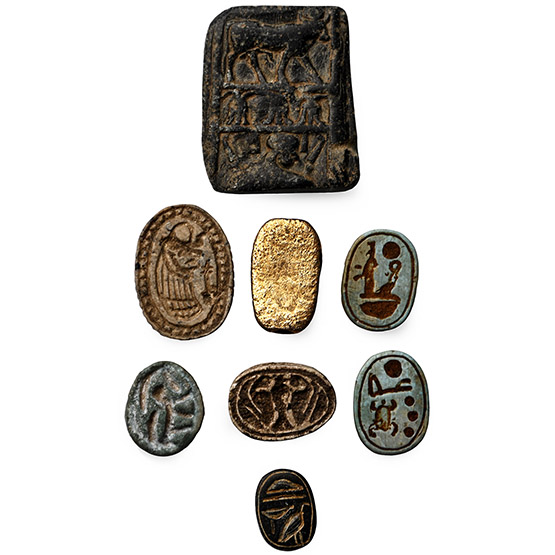
Egyptian Mixed Scarab Collection
2nd-1st millennium B.C. and laterSold for (Inc. bp): £780
Stone plaque with raised relief depictions of the Apis bull and a falcon deity beneath; a mixed group of scarabs and scaraboids, most bearing text or motifs on the underside, including: a rope border enclosing the head of a lion wearing a sun disc and uraeus; a plain gold scaraboid; a line border enclosing the throne name of Amenhotep III (neb-maat-Re); an indeterminate standing figure; a central hes- vase flanked by rearing cobras; a group of hieroglyphs, perhaps a slightly incorrect spelling of the throne name of Amenhotep II (akheperu-Re); and a group of four hieroglyphs. 36.9 grams total, 14-35 mm
From the collection of a gentleman, acquired on the London art market in the 1990s. -
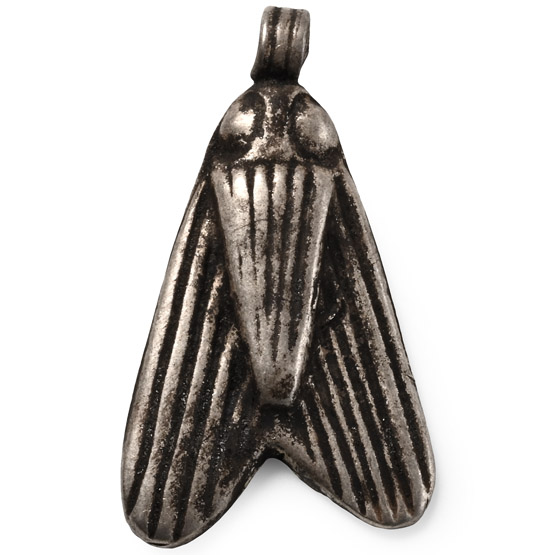
Egyptian Silver Fly Amulet
Late Period, 664-332 B.C.Sold for (Inc. bp): £260
With detailing to wings and eyes, loop for suspension above the head. 2.15 grams, 24 mm
From the collection of a London, UK, gentleman, 1990s.
Considering that Egyptian artists often depicted fly whisks in the hands of pharaohs and high officials, one might assume that flies were merely a nuisance. However, the Egyptians held flies in high regard for their speed, quick reactions, and persistence. Small fly amulets first appeared in burials during the Naqada II Period, around 3200 B.C. These amulets gained popularity and were crafted from various materials such as gold, silver, lapis lazuli, carnelian, amethyst, faience, and bone. These amulets were believed to protect against insect bites and to ward off troublesome flying creatures through apotropaic magic. Some believe they may have even symbolised the fly’s fecundity. Additionally, pharaohs would bestow gold fly-shaped pendants as military awards to honour the bravery and persistence of soldiers in battle. -
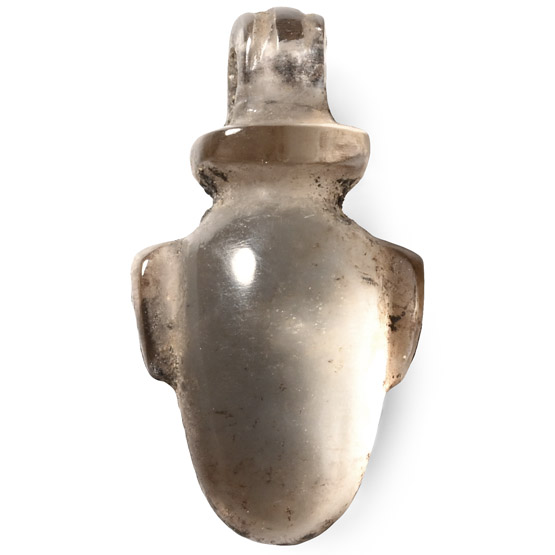
Egyptian Rock Crystal Heart Amulet
New Kingdom, 1550-1295 B.C.Sold for (Inc. bp): £416
Carved with lateral triangular lugs and ribbed bale. 0.9 grams, 17 mm
Ex early 20th century collection.

