-
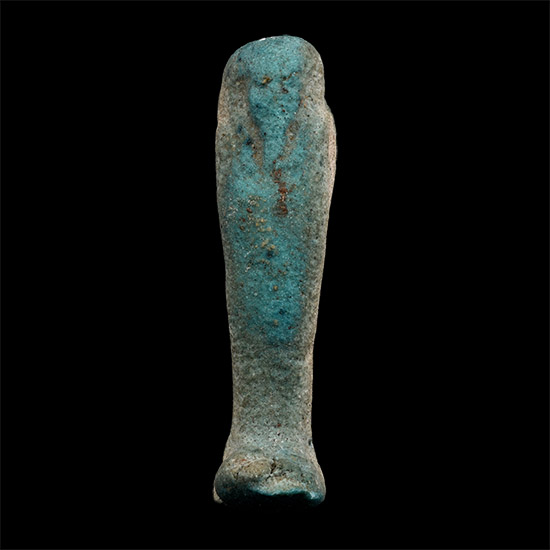
Egyptian Light Blue Faience Shabti
Ptolemaic Period, 332-30 B.C.Sold for (Inc. bp): £98
Mummiform figure with a lappet wig and divine beard. 10.77 grams, 64 mm
Ex private collection, London, UK, 1970s-1990s. -
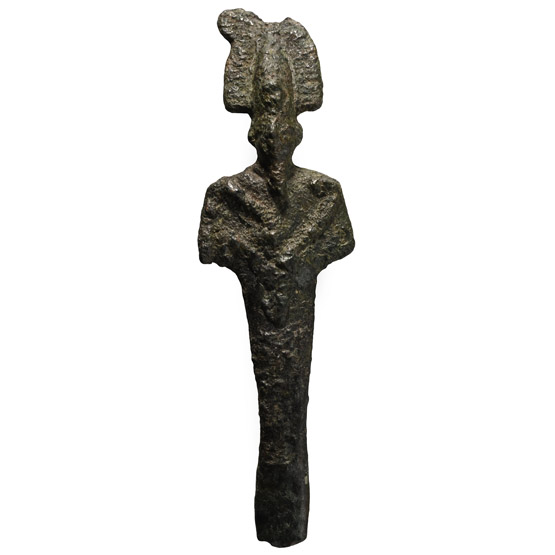
Egyptian Bronze Osiris Statuette
Late Period, 664-332 B.C.Sold for (Inc. bp): £130
Standing mummiform figure, wearing the conical Atef crown with flanking ostrich plumes and frontal uraeus, holding the crook (heka) and flail (nekhakha) regalia; minor chip to the crown. 16.5 grams, 69 mm
Ex Constable collection, 1990s. Ex P. Morris collection. -
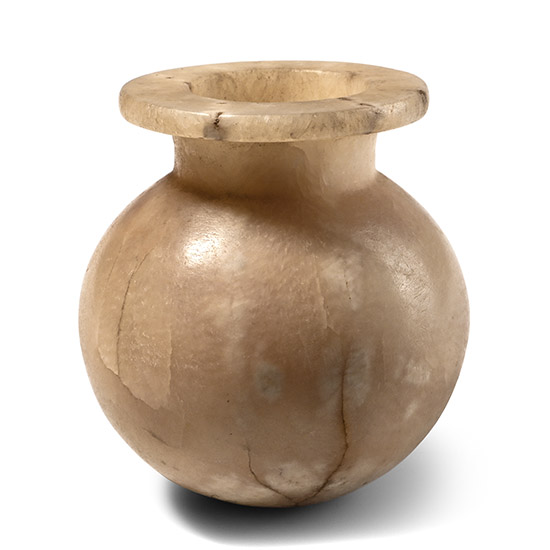
Banded Alabaster Globular Jar
2nd-1st millennium B.C.Sold for (Inc. bp): £286
Globular in profile with low neck and broad square-section rim; mineralised bronze deposit to base. 156 grams, 80 mm
Ex William Ohly, 1883-1955. Ex Abbey Museum, Barnet, by descent. -
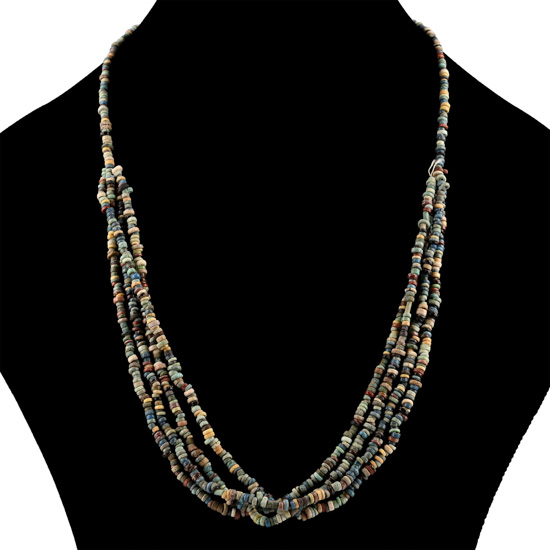
Egyptian Multi-Stranded Mummy Bead Necklace
Late Period, 664-332 B.C.Sold for (Inc. bp): £143
Four-stranded designer necklace composed of polychrome beads of mainly disc and cylindrical types. 25.5 grams, 65 cm
Acquired before 1979. From the private collection of Mr F.A., South Kensington, London, UK; thence by descent 2014.
For thousands of years, artisans in Egypt created vibrant ceramics to echo the beauty of rare jewels. These ornaments were created with almost every material, colour, and texture imaginable, and they come from across Egypt and beyond: vibrant blue lapis lazuli from Afghanistan, glossy black obsidian from Turkey, and aqua-green turquoise from the Sinai. They were worn in life and, after death, they served as precious ornamentation for mummies. -
.jpg)
Historic Collection of 565 Slides of Egyptian Archaeological Sites and Artefacts
1960s-1980s A.D.Sold for (Inc. bp): £845
Housed in five linen-covered boxes, covering ancient Egypt, Tutankhamun jewellery, Nefetari, Amun Hr Khopshef, Khaemwast, Tuthmosis IV, Tye, Archaic stele, maceheads, inscriptions, pottery, sculpture, Saqqara tombs, Esna etc. 3.85 kg total, 26.5 x 16.5 x 6.5 cm each box
Property of archaeologist Stephanie Gee, N.W. London, UK, 1960s-1980s.
Stephanie Gee was a prominent archaeologist who took part in several expeditions in Egypt. She was a trusted assistant to the British-Australian archaeologist Veronica Seton-Williams, who excavated in Egypt, Britain, and the Near East. Stephanie also took part in the Tell El-Farâ'în expeditions of 1965-1968, and assisted Seton-Williams with preparing the 1966 expedition report. Their collaboration continued and Stephanie helped with the manuscript of Seton-Williams’ book ‘The Road to El-Aguzein’, a narrative account of her life that was first published in 1988. -
.jpg)
Egyptian Faience Menat Amulet
Late Period, 664-332 B.C.Sold for (Inc. bp): £286
Amuletic pendant formed as keyhole-shaped plaque with decorative column to one face, ribbed suspension loop to the top. 1.52 grams, 25 mm
Ex early 20th century collection, London, UK.
The menat was a counterpoise that hung at the back of a heavy ornamental collar and was closely associated with the goddess Hathor. Amulets representing the counterpoise were thought to bring good luck, protect against evil spirits, and safeguard the wearer in the afterlife. Their Hathoric connection symbolised fertility and good health for women while representing virility for men. -
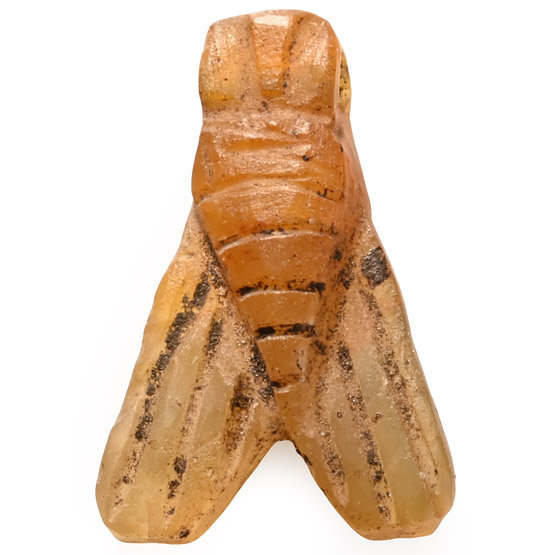
Egyptian Carnelian Fly Amulet
Late Period, 664-332 B.C.Sold for (Inc. bp): £130
With detailing to wings and body, loop for suspension above the head. 0.33 grams, 12 mm
Ex H Norri collection, Milton Keynes, Bedfordshire, UK, 1980s-1990s.
Although flies might seem like mere nuisances, the ancient Egyptians admired them for their speed, agility, and persistence. Fly-shaped amulets, first appearing in Naqada II burials around 3200 B.C., became particularly popular during the New Kingdom and afterwards. Made from materials such as gold, silver, faience, lapis lazuli, and bone, they served apotropaic functions, protecting against bites and warding off pests. Some may have also symbolised fertility. Gold fly pendants were even awarded by pharaohs to honour soldiers’ bravery and tenacity. -
.jpg)
Egyptian Faience Horus Falcon Amulet
Late Period, 664-332 B.C.Sold for (Inc. bp): £130
Seated falcon with impressed detailing to wings and head; rectangular base and suspension loop on the back. 1.08 grams, 17 mm
Ex early 20th century collection, London, UK.
Horus is one of the most significant and widely worshipped gods in ancient Egyptian mythology. His importance spans multiple facets of Egyptian religion, including kingship, protection, the sky, and the sun. Depicted in various human and animal forms, Horus played a vital role in Egyptian cosmology, particularly as the Pharaoh's protector and as a symbol of divine authority. -
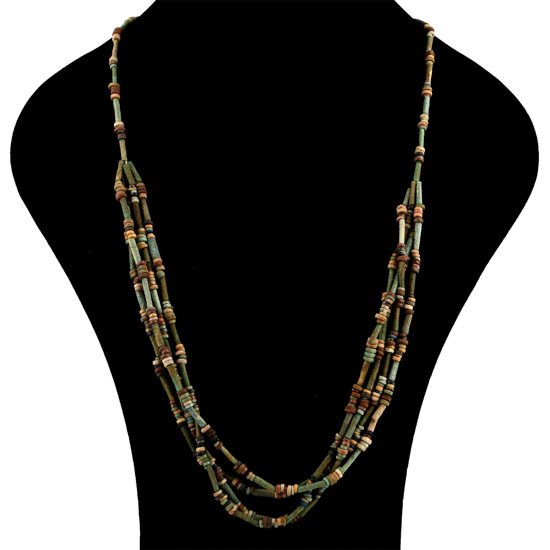
Egyptian Multi-Stranded Mummy Bead Necklace
Late Period, 664-332 B.C.Sold for (Inc. bp): £234
Four-stranded designer necklace composed of polychrome beads of mainly disc and cylindrical types. 27 grams, 81 cm long
Acquired before 1979. From the private collection of Mr F.A., South Kensington, London, UK; thence by descent 2014.
For thousands of years, artisans in Egypt created vibrant ceramics to echo the beauty of rare jewels. These ornaments were created with almost every material, colour, and texture imaginable, and they come from across Egypt and beyond: vibrant blue lapis lazuli from Afghanistan, glossy black obsidian from Turkey, and aqua-green turquoise from the Sinai. They were worn in life and, after death, they served as precious ornamentation for mummies. -
.jpg)
Egyptian Steatite Heart Scarab
Late Period, 664-332 B.C.Sold for (Inc. bp): £143
With ribbed carapace and suspension loop to underside. 2.89 grams, 22 mm
Acquired on the European art market in the early 2000s. with Galerie Rhéa, Zurich, Switzerland. -
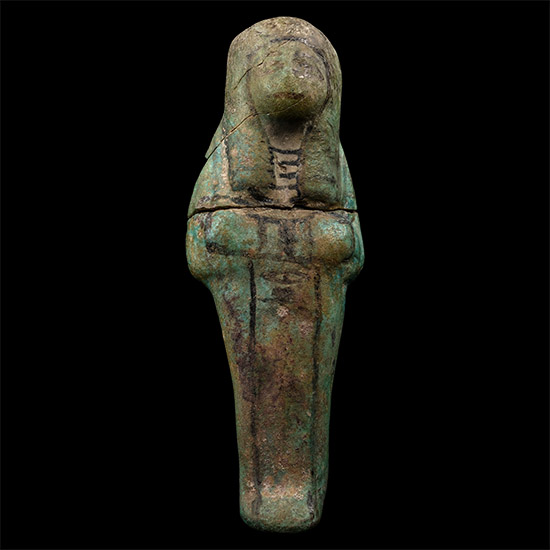
Egyptian Turquoise Blue Faience Shabti with Hieroglyphic Inscription
New Kingdom, 19th-20th Dynasty, 1292-1069 B.C.Sold for (Inc. bp): £338
Mummiform shabti wearing a tripartite wig, with arms crossed and holding a hoe in each hand, and cords for a water pot hanging from the back on each shoulder; a seed bag suspended below the wig; the outline of the eyes, eyebrows, mouth, hoes, water pots, and seed bag painted black; a central column of hieroglyphs on the front, with the opening preserved reading "The Osiris..."; repaired. 98 grams, 13.2 cm
From a UK private collection formed in the 1970s. Ex Ancient Relics. Ex D.S. collection, West Sussex, 1990s-2000s. Accompanied by an illustrated catalogue sheet and a previous catalogue information slip. -
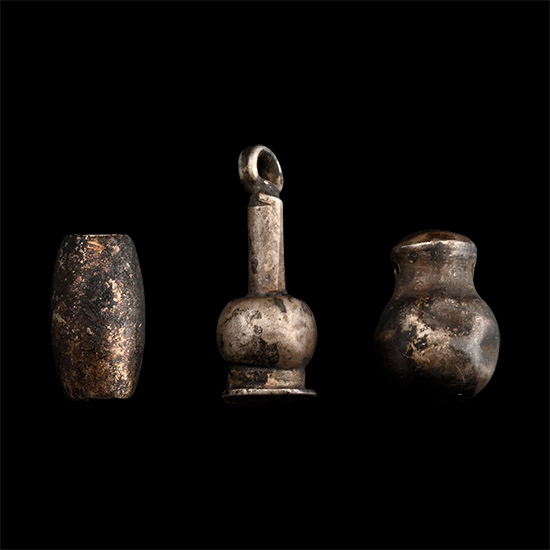
Egyptian Silver Poppy Amulet and Beads
Late Period, 664-332 B.C.Sold for (Inc. bp): £98
Comprising: a fusiform bead, a poppy-head amulet and a jar amulet. 2.80 grams total, 11-16 mm
From the collection of a London, UK, gentleman, 1990s.

