-
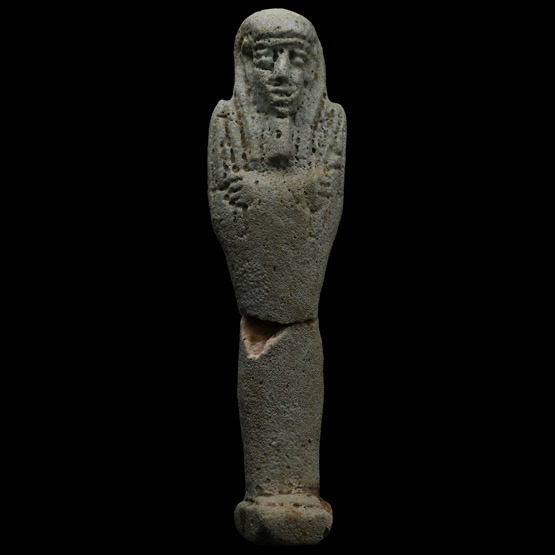
Egyptian Faience Shabti
Late Period, 664-332 B.C.Sold for (Inc. bp): £143
Mummiform figure with plain dorsal pillar, standing with arms crossed and holding agricultural implements, seedbag suspended over the left shoulder; wearing a tripartite wig and a false beard; repaired. 41.6 grams, 10.5 cm
Ex H Norri collection, Milton Keynes, Bedfordshire, UK, 1980s-1990s. -
.jpg)
Egyptian Faience Amulet of Nefertum
Late Period, 664-332 B.C.Sold for (Inc. bp): £78
In a striding pose with arms at the sides, sporting a black coloured tripartite wig surmounted by the god's distinctive headdress consisting of a lotus flower with two plumes on top; mounted on a display stand. 10.66 grams total, 50 mm including stand
Ex H Norri collection, Milton Keynes, Bedfordshire, UK, 1980s-1990s. -
.jpg)
Egyptian Gold Nefer Bead
Late New Kingdom, 1279-1070 B.C.Sold for (Inc. bp): £234
Shaped as the nefer symbol (meaning "good", "beautiful"), with a loop at each end for use as a spacer in a multi-strand necklace. 0.20 grams, 12 mm
Ex French collection, early 20th century. -
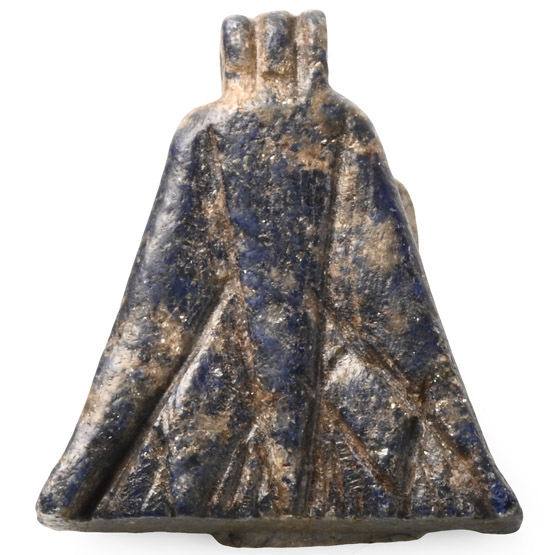
Egyptian Lapis Lazuli Lotus Amulet
Late Period, 664-332 B.C.Sold for (Inc. bp): £117
With ribbed suspension loop bell-shaped plaque; collector's sticker to reverse. 1.77 grams, 17 mm
Ex UK collection, 1970s.
The lotus served as a symbol of both divine beauty and the sun's rejuvenating power. -
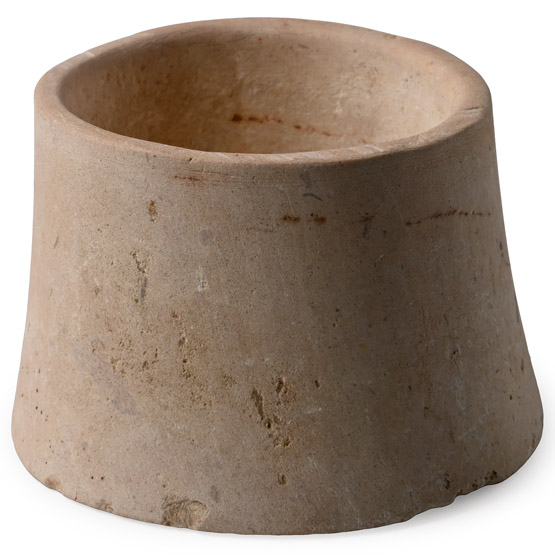
Egyptian Alabaster Vessel
2nd-1st millennium B.C. or laterSold for (Inc. bp): £286
With a cylindrical body with a tapering, slightly concave profile, a flat base and rim. 271 grams, 77 mm wide
From a West Country, UK, collection, 1980-2020s. -
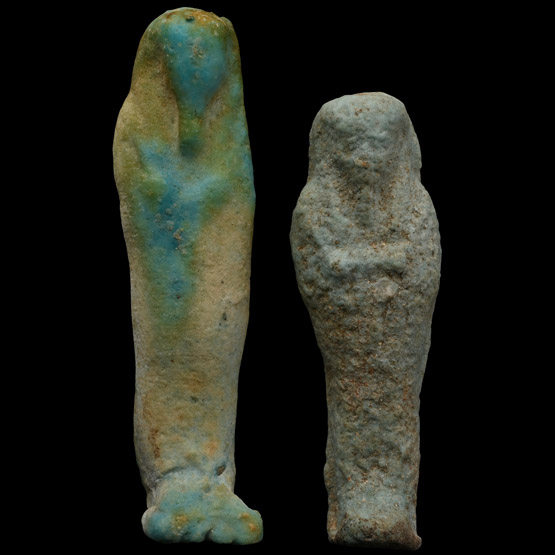
Egyptian Faience Shabti Group
Ptolemaic Period, 332-30 B.C.Sold for (Inc. bp): £117
Comprising two blue mummiform figures with their arms crossed at the chest and wearing a tripartite wig and a false beard. 20 grams total, 58-68 mm
Ex H Norri collection, Milton Keynes, Bedfordshire, UK, 1980s-1990s. -
.jpg)
Egyptian Faience Mahes Amulet
Late Period, 664-332 B.C.Sold for (Inc. bp): £140
Standing figure of the lion-headed god wearing the atef crown and a uraeus, arms slightly forward; with dorsal pillar and rectangular base; pierced for suspension. 1.43 grams, 27 mm
Ex early 20th century collection, London, UK.
Mahes was an Egyptian lion-headed deity symbolising divine protection, royal power, and justice. Considered a son of Sekhmet or Bastet, he represented the aggressive solar force of Ra, serving as a fierce defender of cosmic order. Venerated in the Delta, especially at Leontopolis, Mahes was depicted as a lion or as a man with a lion's head, often adorned with the atef-crown and uraeus. -
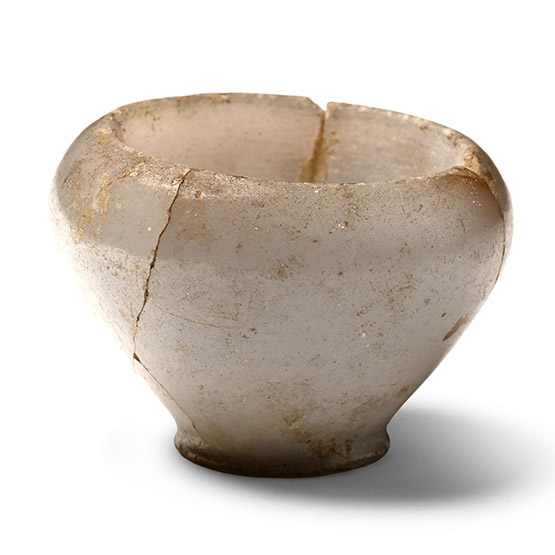
Egyptian Anhydrite Cosmetic Bowl
Middle Kingdom, circa 2040-1780 B.C.Sold for (Inc. bp): £156
Conical in profile with rounded rim, narrow disc base; repaired; a rare stone. 33.68 grams, 39 mm
Ex William Ohly, 1883-1955. Ex Abbey Museum, Barnet, by descent.
Anhydrite, incorrectly called "blue marble" by early excavators, was a stone favoured by the ancient Egyptians from the Middle Kingdom to the Second Intermediate Period. This particular example follows a Middle Kingdom-style cosmetic kohl jar that could be modelled with or without an integral rim. -
.jpg)
Egyptian Bone and Glass Mummy Eye Pair
1st millennium B.C. or laterSold for (Inc. bp): £416
Each lentoid in plan with applied iridescent blue glass panel. 5.18 grams total, 43-45 mm
Acquired in UK art market, 1977-1979. -
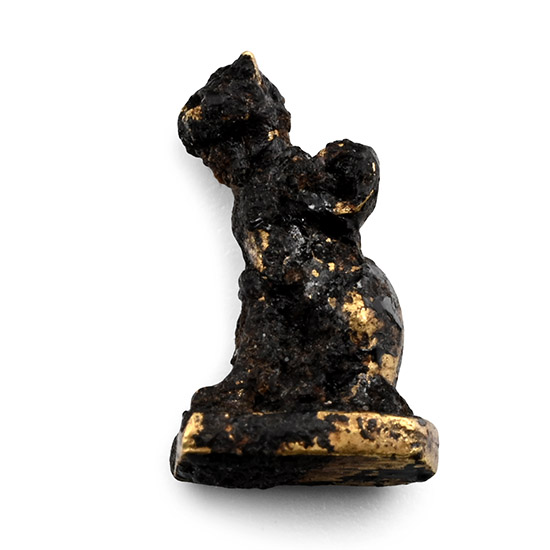
Egyptian Gold Bastet Seated Cat Amulet
Late New Kingdom-Third Intermediate Period, circa 1069-900 B.C.Sold for (Inc. bp): £468
Modelled seated on a tongue-shaped base, with simple facial detailing and suspension loop to the back. 0.51 grams, 8 mm
Ex French collection, early 20th century.
The goddess Bastet was believed to be the daughter of the sun god and was shown with the features of a lion up until about 1000 B.C. when she was first portrayed as a cat or human with a cat head. As the daughter of Ra she was associated with the rage inherent in the sun god's eye which was considered to be his instrument of vengeance. Her development into a cat goddess occurred during the New Kingdom but did not fully develop until the Late Period. She was still associated with the destructive power of the sun and was shown on the prow of the solar boat, decapitating the evil serpent Apophis in the Book of the Dead. The maternal, protective and hunting characteristics of the cat are obvious in Bastet and she was seen as a protector of pregnant women and young children. In the Pyramid Texts she is invoked by the deceased king to act as his protector and to help him reach the sky to join the sun god; the king proclaims that Bastet is his mother and nurse. Like her counterpart, Sekhmet, Bastet has an aggressive side and, in a text from Karnak, Amenhotep II described his enemies being slaughtered like the victims of Bastet. The goddess had a shrine at Karnak, where she is known as the 'Lady of Asheru' which aligns her closely with the goddess Mut, the consort of Amun-Ra. Her most famous shrine was in the north-east Delta region, at Bubastis, and was known as Per-Bastet or 'the House of Bastet.' Herodotus describes the festival of Bastet as one of the most elaborate in all of Egypt and identifies her with the Greek Artemis. Cemeteries of cats have been excavated at Bubastis and at Saqqara and Memphis. -
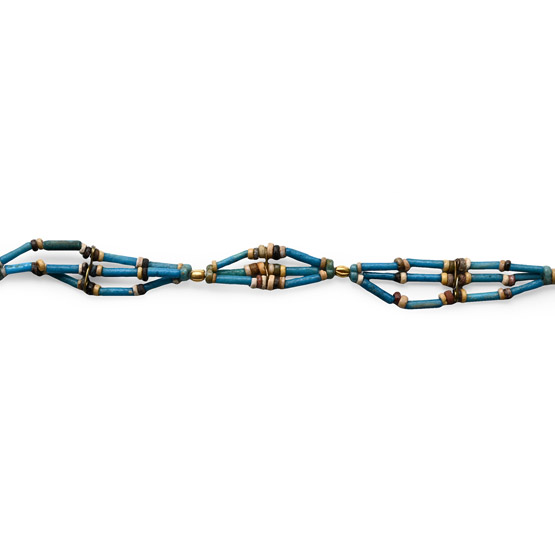
Egyptian Faience and Gold Bead Bracelet
Late Period, 664-332 B.C.Sold for (Inc. bp): £111
A designer restrung three-strand bracelet composed of gold and composition beads coloured shades of blue, cream and brown; modern silver-coloured clasp; accompanied with a note reading 'Egyptian, Faience New Kingdom Beaded Bracelet, C. 1570-30 BC- New Kingdom to Ptolemaic Period. beautiful, restrung, elegant Egyptian beaded bracelet consisting of a selection of turquoise coloured, faience tubular beads & polychromatic disc-shaped beads, in a style inspired by the earliest bracelets known (from about 3000 BC) which were found in the tomb of King Djer.' 3.89 grams, 19 cm
Property of a Cambridgeshire, UK, gentleman. Restrung from various accumulations of Egyptian beads from the last 30 years. -
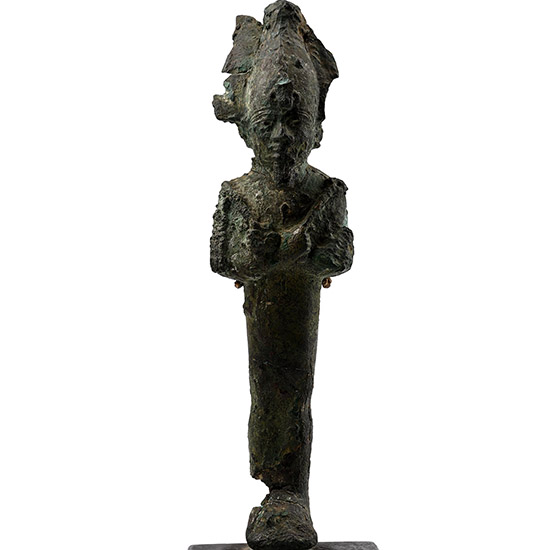
Egyptian Bronze Osiris Statue
Late Period, 664-332 B.C.Sold for (Inc. bp): £910
A sizeable, slender standing mummiform figure of Osiris, wearing his iconic tall conical Atef crown with flanking ostrich plumes and a central uraeus, holding the crook (heka) and flail (nekhakha) regalia; mounted on a display stand. 821 grams total, 26 cm high including stand
From the estate of Alexander Dobkin (1908-1975), New York, USA, acquired prior to 1975. Thence by descent to his daughter, Katherine Dobkin, New York, USA..
Osiris was associated with death and fertility and was widely recognised as the supreme god of renewal and rebirth. Although he was once a mortal ruler, as a deity, his domain was the Underworld. Abydos served as the main site of Osiris’ worship, where a renowned annual celebration in his honour took place.

