-
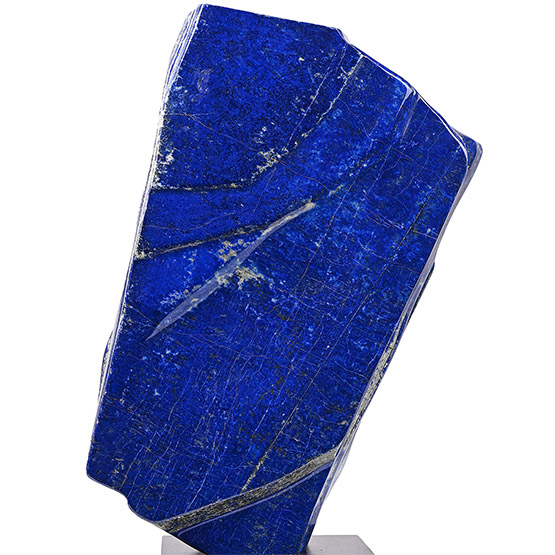
Large Freeform Lapis Lazuli Sculpture
Precambrian Period, circa 2.4 - 2.7 billion years B.P.Sold for (Inc. bp): £9,100
A thick, architectural slab of lapis lazuli with white calcite veins and pyrite flecks, polished to a high sheen and mounted on a custom-made display stand. 25.15 kg, 53 x 29 x 10 cm
From Afghanistan. Property of a London lady. -
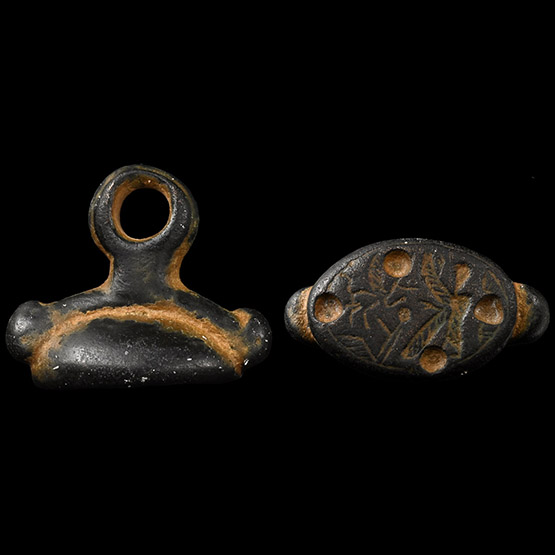
Phoenician Bronze Scarab Pendant
6th-4th century B.C.Sold for (Inc. bp): £293
With suspension loop and frame, intaglio figural scene including stylised birds and winged scarabs, with recesses; with museum-quality impression. 13.5 grams, 23 mm
Ex London, UK, gentleman 1980-2000s. -
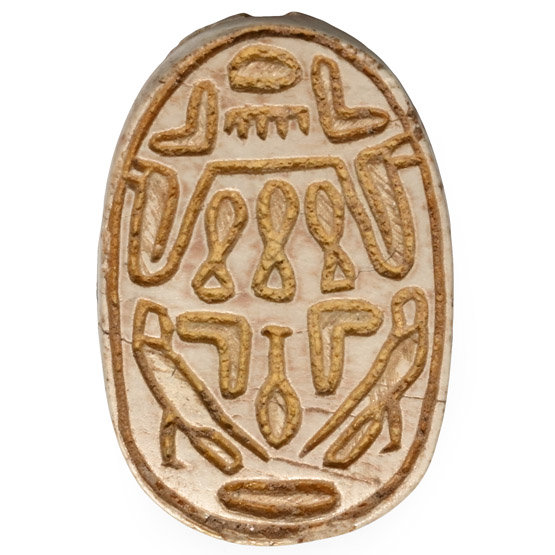
Egyptian White Stone Scarab with Hieroglyphs
Hyksos Period, 15th Dynasty, circa 1650-1550 B.C.Sold for (Inc. bp): £364
Scarab with incised detailing on the upper face; underside featuring incised hieroglyphs, including addorsed hawks and right-angled netjer signs; pierced longitudinally. 3.79 grams, 21 mm
Ex A. H. collection, 1990s. -
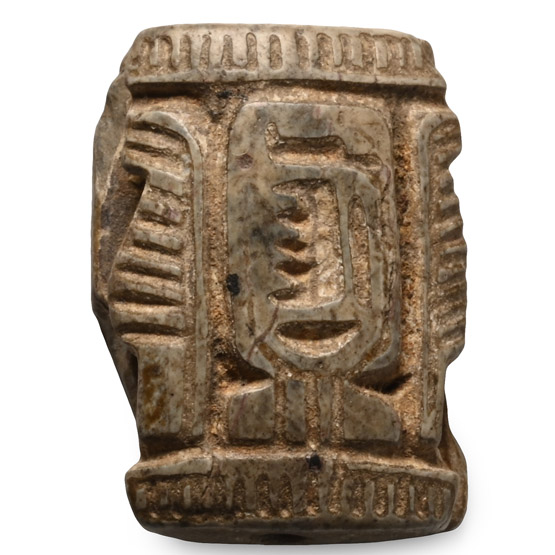
Egyptian Steatite Bifacial Amulet
Late Period, 664-332 B.C.Sold for (Inc. bp): £78
A double-sided rectangular amulet; one side features a central cartouche with the hieroglyphic name of the god “Amun” and a neb sign, flanked by two Maat feathers, all framed by a hatched border at the top and bottom; the other side depicts the reclining ram of Amun-Re with the seated figure of Maat in front, and the word "Amun" in hieroglyphs above the ram; drilled for suspension. 2.26 grams, 18 mm
Ex Constable collection, 1990s. Ex P. Morris collection.
An amulet with a similar overall design was discovered in a Ramesside-period tomb at Tell el-Retaba, an important production centre involved in trade with Syria-Palestine and protected by a fortress (Petrie, W.M.F., Duncan, J.G., Hyksos and Israelite Cities, London, 1906, pl. XXXIV, Tomb 8). -
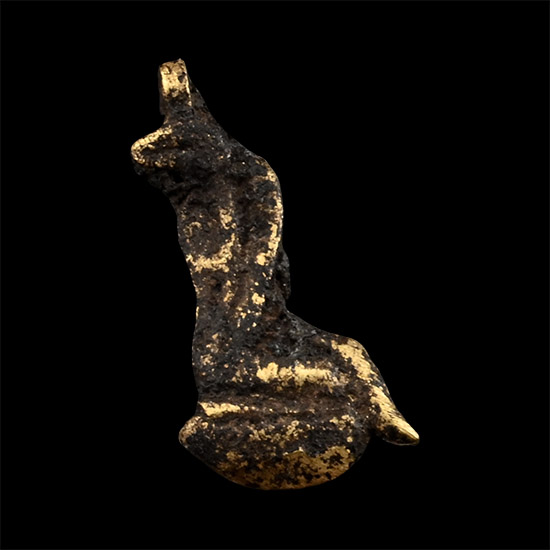
Egyptian Gold Uraeus Amulet
Late New Kingdom, 1279-1070 B.C.Sold for (Inc. bp): £338
Depicting a rearing cobra sporting a sun disc with its coiled body below resting on the hieroglyphic neb sign. 0.40 grams, 11 mm
Ex French collection, early 20th century. -
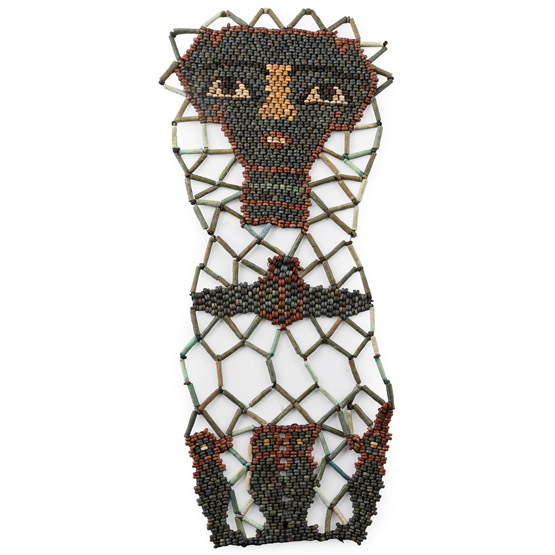
Egyptian Faience Mummy Bead Mask with Scarab and Four Sons of Horus
Ptolemaic Period, 332-30 B.C.Sold for (Inc. bp): £338
A restrung netted beadwork panel of annular and tubular glazed composition beads in blues, greens, black, cream and red-brown colours, depicting a mummy face mask with false beard, a scarab with extended wings below, the 'Four Sons of Horus’ beneath the scarab, joined together with areas of open netting of tubular beads. 63 grams, 28.2 cm
Ex Mariaud de Serres, Paris, 1990s. -
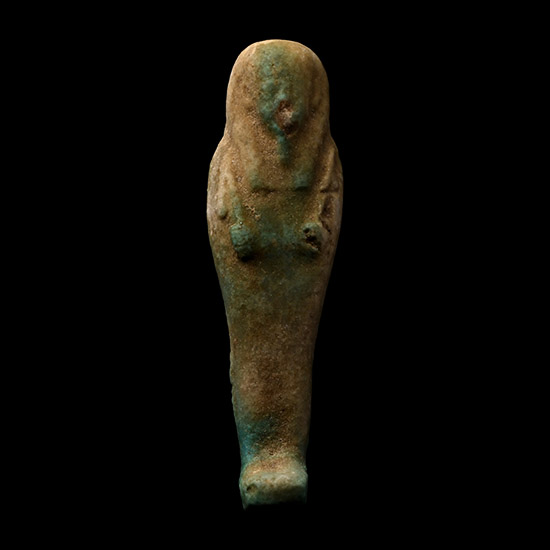
Egyptian Blue and Ochre Faience Shabti
Late Period, 4th century B.C.Sold for (Inc. bp): £72
Plano-convex in section with mould-formed facial detailing, crossed arms and agricultural tools. 12.9 grams, 67 mm
Ex private collection, London, UK, 1970s-1990s. -
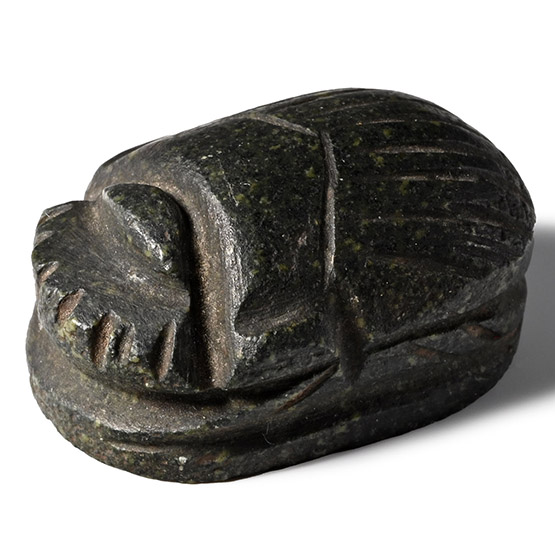
Egyptian Black Hardstone Scarab
Late Period, 664-332 B.C.Sold for (Inc. bp): £234
Dark green hardstone with paler speckles; with a boldly carved head, clypeus, prothorax and elytra, and legs indicated at the sides; plain underside. 17 grams, 29 mm
Ex Irene Newman, Birdham, Chichester, West Sussex, England. with Stride & Son Auctioneers, Chichester, West Sussex, England, 23 April 2015, no.1599 [Part]. Acquired by the present owner at the above sale.
The scarab, which represented the dung beetle, was the most popular amulet in ancient Egypt for approximately two thousand years until the Ptolemaic Period when it gradually fell out of favour. The popularity of scarabs extended beyond the borders of Egypt, and they were also distributed and produced in other regions, such as Phoenicia and Israel. The beetle is named khepri, derived from the verb 'to come into existence', and was considered the embodiment of the creator god Khepri, who was self-engendered. The ancient Egyptians mistakenly believed that the young beetle emerging from the dung ball was the result of an act of self-creation. -
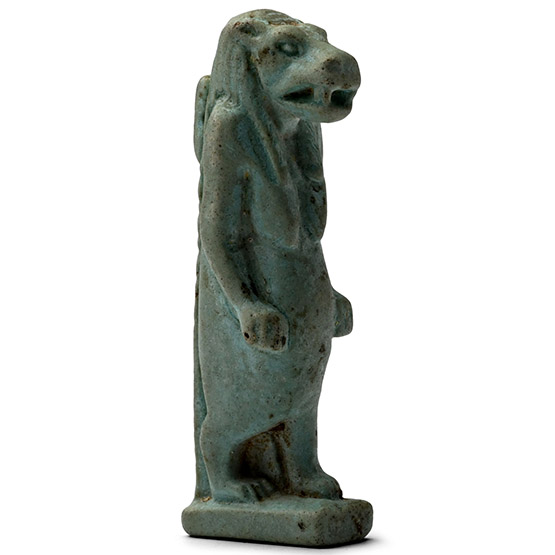
Egyptian Faience Amulet Representing Taweret
Late Period, 664-332 B.C.Sold for (Inc. bp): £286
Modelled in the round on a rectangular base and with a dorsal pillar pierced at the shoulder, the goddess is depicted in hippopotamus form with human arms. 10.3 grams, 52 mm
Private collection, Carouge, Switzerland, assembled in the 1980s-1990s. Thence by descent to the collection of Mr S.P., since 2020. -
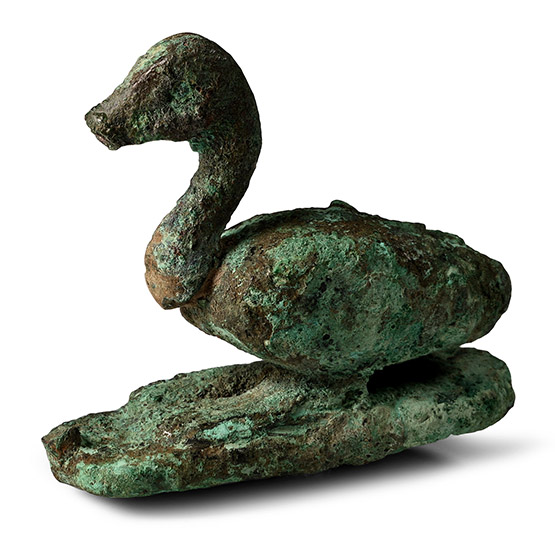
Egyptian Bronze Ibis Attachment
Late Period, 664-332 B.C. or laterSold for (Inc. bp): £156
Modelled in the round squatting on an ellipsoid base, lug to the underside, repaired. 114 grams, 60 mm
From the collection of a gentleman, acquired on the London art market in the 1990s.
The ibis, particularly the sacred species known as the Egyptian ibis (Threskiornis aethiopicus), held a prominent place in ancient Egyptian religion and culture as a manifestation of the god Thoth. Revered as the deity of wisdom, writing, and knowledge, Thoth was often depicted in human form with the head of an ibis. During the Late Period onwards, the practice of mummifying ibises became widespread, leading to the creation of vast necropolises dedicated to these sacred birds. In places like Saqqara and Hermopolis, thousands of ibis mummies have been discovered in specially constructed catacombs. The mummification of these birds was not merely a ritual act; it was seen as a sacred offering to Thoth, meant to honour the god and seek his favour. Egyptians believed that by preserving the ibis through mummification, they could ensure its safe passage to the afterlife, establishing a direct connection between the earthly realm and the divine. These mummies were often accompanied by votive offerings, like this bronze figurine, further emphasising the relationship between the ibises and Thoth. -
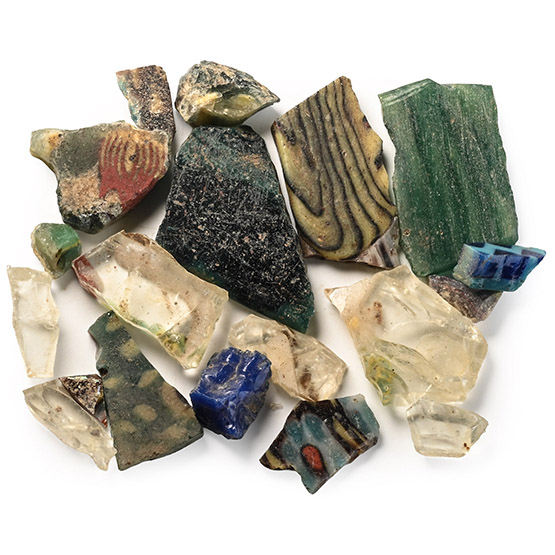
Romano-Egyptian Mosaic Glass Fragments
Circa 1st century A.D.Sold for (Inc. bp): £91
Including geometric and other patterns. 18 grams total, 5-30 mm
Ex Gallery Mikazuki prior to 1984. Propery of a London, UK, gentleman. -
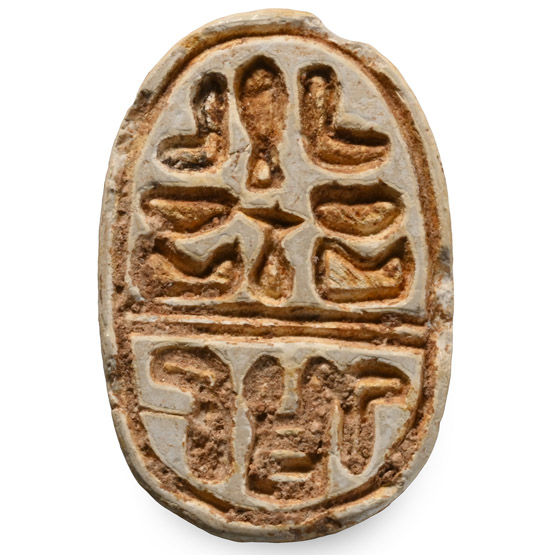
Egyptian White Stone Scarab with Hieroglyphs
Hyksos Period, 15th Dynasty, circa 1650-1550 B.C.Sold for (Inc. bp): £117
Plano-convex in section with scarab detailing to the upper face; underside featuring a hieroglyphic inscription, including addorsed stylised cobras, right-angled netjer and nefer signs; pierced longitudinally. 1.61 grams, 18 mm
Ex Constable collection, 1990s. Ex P. Morris collection.

