-
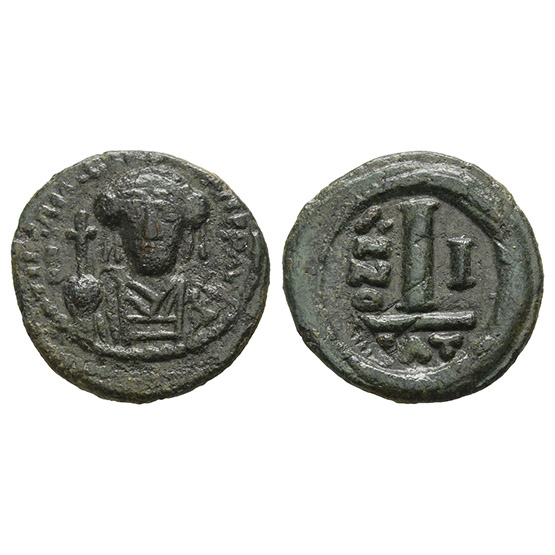
Maurice Tiberius AE 10 Nummi or Decanummium. Dated RY 1 (AD 582/3). Catania mint.
Sold for (Inc. bp): £39
[D N TIЬ MAV?]-RIC P P AVG. crowned and cuirassed bust facing, holding globus cruciger and shield / Large I; A N N O I (date) across field; CAT in exergue. DOC 264; MIBE 136B; Anastasi 4; SB 580. 3.15gr, 18mm, 5h.
Very Fine.
Ex Auktionshaus H. D. Rauch GmbH, E-Auction 18, 6 November 2015, lot 386. Property of a London antiquarian. -
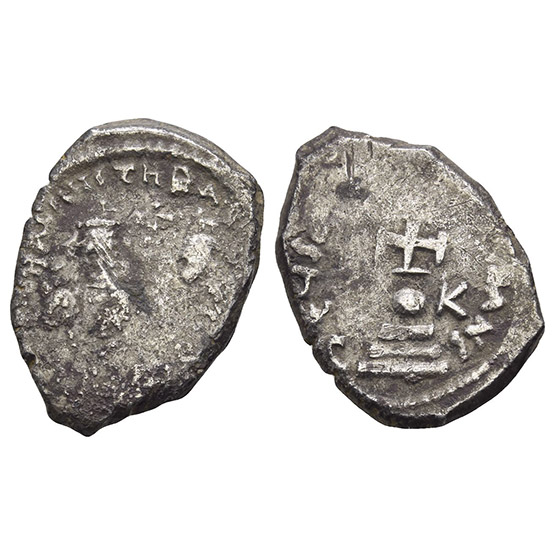
Heraclius, with Heraclius Constantine AR Hexagram. Struck AD 615-630. Constantinople mint.
Sold for (Inc. bp): £52
[∂∂ NN Һ]ЄRACLΙЧS Єτ ҺЄR[A CONSτ], Heraclius and Heraclius Constantine seated facing on double throne, each holding globus cruciger; cross between / ∂ЄЧS A[∂IЧτA ROM]ANI, cross potent set upon globus set upon three steps; K to right. DOC 64; MIBE 140; SB 798. 6.46gr, 23mm, 7h.
Good Fine.
From the collection of a gentleman, acquired on the London art market in the 1990s. -
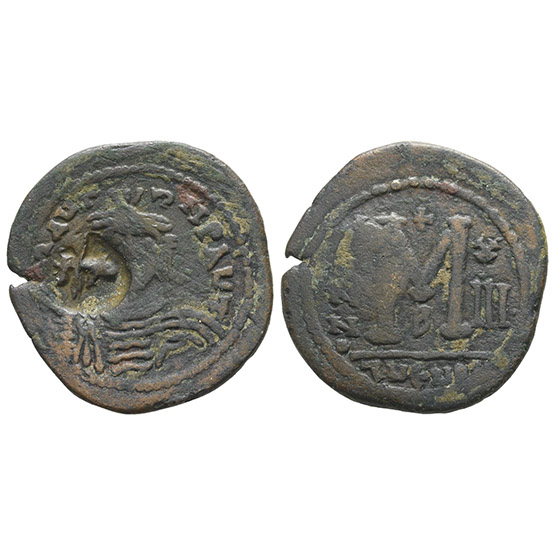
Heraclius AE 40 Nummi or Follis. Applied circa AD 633-636. Countermarked for re-evaluation in Syria and Palestine. Overstruck on a Maurice Tiberius Theoupolis (Antioch) mint AE 40 Nummi or Follis.
Sold for (Inc. bp): £156
[...]ᙏAUΓ C(?)N P AUτ, facing cuirassed bust, wearing crown with trefoil ornament, holding shield with left hand and globus cruciger(?) with right / Large M, cross above; [A] N N O X III [date; RY 13 (AD 594/5)] across fields, B below; τUЄUP in exergue. Not in list of Schulze et al, "Heraclian Countermarks on Byzantine Copper Coins in Seventh-Century Syria" in Byzantine and Modern Greek Studies Vol. 30, No 1 (2006). For host coin: DOC -; MIB 96 var. (bust type); SB 533 var. (same). 10.54gr, 31mm, 6h.
Very Fine. Unpublished and apparently a unique emission.
Property of a North London, UK, gentleman.
A highly collectable lot that combines historical and numismatic value. This countermarked Follis served as a kind of revaluation in relation to the monetary reforms of Heraclius, which was implemented between circa 633 and 636 on a 40 Nummi of Theoupolis (Antioch) during the reign of Maurice Tiberius. The revaluation of circulating bronze coins (old and new) through countermarking was a common practice during the struggles with the Arab invaders and due to the severe shortage of cash in Syria at that time. From a numismatic point of view, the most interesting thing is the type of host coin. The bust of Maurice Tiberius from the mint of Theoupolis depicts him wearing only consular robes, holding a globus cruciger in his right hand and an eagle-tipped sceptre in his left hand, while the crown is more elaborate (SB 533). The cuirassed bust of our coin with the shield and [the globus cruciger] is more consistent with the issues of other mints (and denominations) than with those of Antioch. Could this be a countermarked contemporary imitation? Or could it be that, due to a lack of local currency, dies from different mints were used interchangeably? More possible explanations could shed more light on the coinage of that sensitive period. -
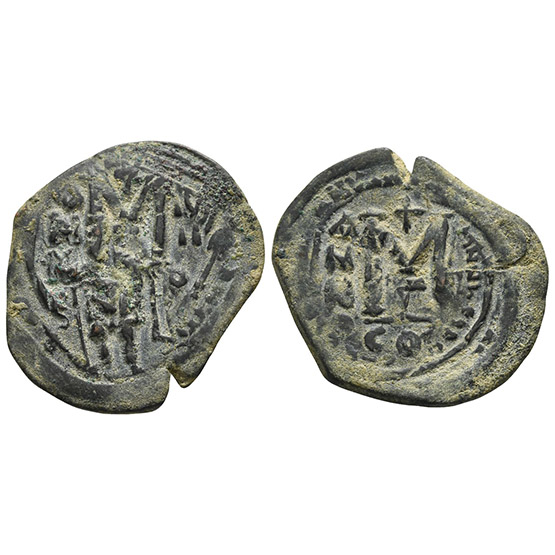
Heraclius and Heraclius Constantine AE 40 Nummi or Follis. AD 610-641. Constantinople mint.
Sold for (Inc. bp): £85
Crowned facing figures of Heraclius, wearing military attire, holding long cross and resting hand on hip, [and Heraclius Constantine, wearing chlamys, holding globus cruciger; cross above?] / Large M, cross above; A N N O [...] (date) across field; officina letter below, CO[N] in exergue. Cf. SB 810. 11.16gr, 35mm, 8h.
Near Very Fine. Overstruck on a Follis of Justinian I (traces of [...]ANV[...] on reverse).
From the collection of a gentleman, acquired on the London art market in the 1990s. -
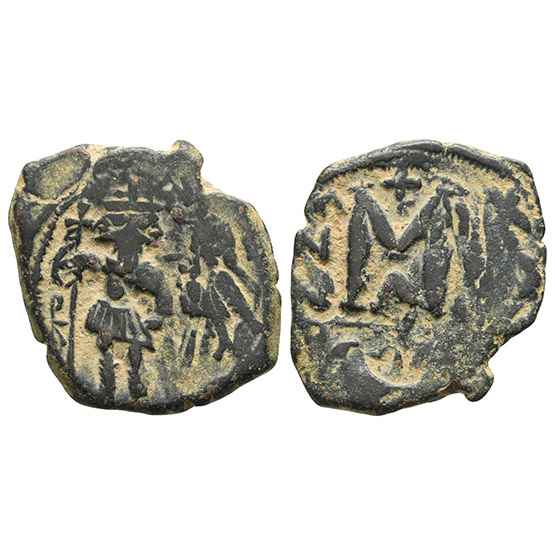
Heraclius, with Heraclius Constantine AE 40 Nummi or Follis. AD 610-641. Possibly Constantinople mint. Uncertain regnal year. 1st officina.
Sold for (Inc. bp): £13
Heraclius, holding long cross, and Heraclius Constantine, holding globus cruciger, standing facing; monogram to left / Large M; uncertain date across field; countermark in incuse circle below. Cf. SB 810. 7.60gr, 30mm, 7h.
Near Very Fine.
Acquired on the UK art market since the early 2000s. Property of a Lincolnshire gentleman, thence by descent. -
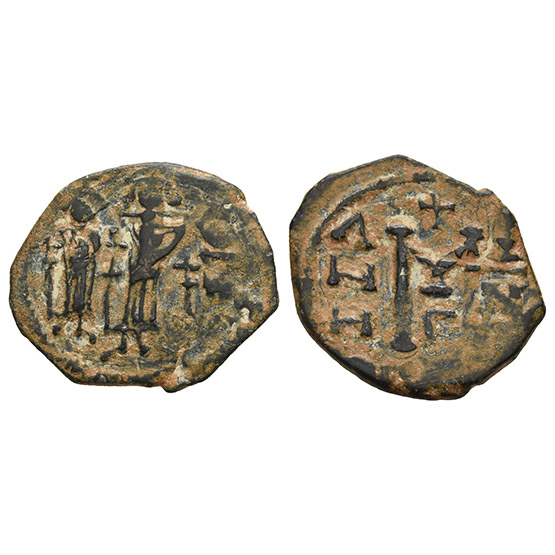
Heraclius, with Heraclius Constantine and Martina AE 40 Nummi of Follis. Probably struck late AD 630s-early AD 640s. Imitation copying a Cyprus(?) mint. Uncertain date. 3rd officina.
Sold for (Inc. bp): £39
Martina, Heraclius, and Heraclius Constantine standing facing, each wearing crown and chlamys and holding globus cruciger / Large M; cross above, date across field; Γ below, mintmark in exergue. Cf. DOC 185; cf. SB 849; cf. SICA I, 505. 3.59gr, 22mm, 5h.
Very Fine.
Property of a Cambridgeshire, UK, gentleman. -
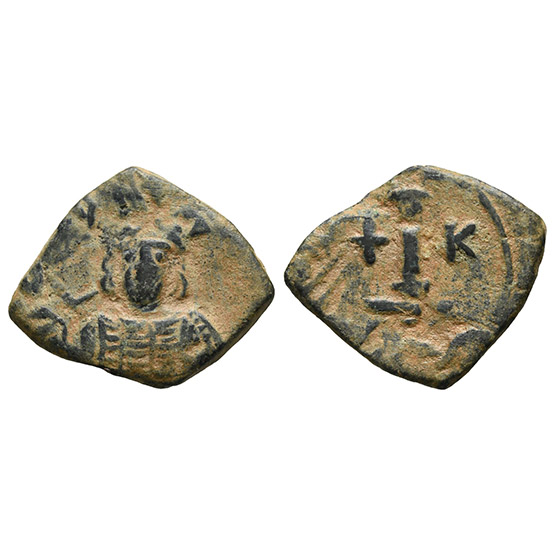
Constantine IV Pogonatus AE 10 Nummi or Decanummium. Struck circa AD 668-673. Constantinople mint.
Sold for (Inc. bp): £20
Beardless, helmeted and cuirassed bust of Constantine IV facing, holding globus cruciger in right hand / Large I between cross and K; [above, cross?]. Cf. DOC 38; cf. MIB 88; cf. SB 1182. 3.72gr, 24mm, 7h.
Very Fine. Overstruck on an uncertain type.
Acquired on the UK market. Property of a London antiquarian. -
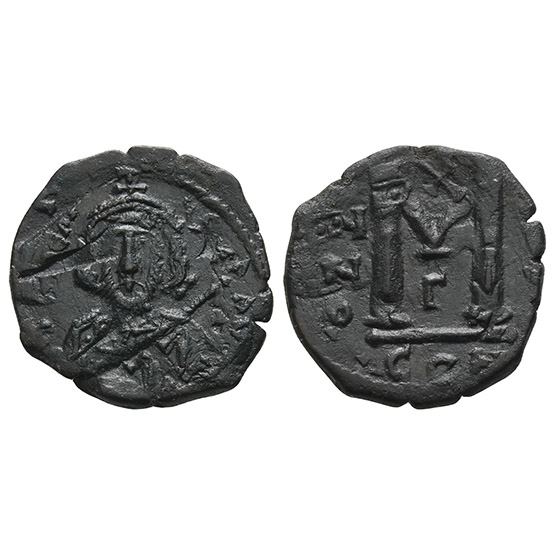
Tiberius III (Apsimar) AE 40 Nummi of Follis. Dated RY 1(?) (AD 698/9). Constantinople mint. 3rd officina.
Sold for (Inc. bp): £78
[...]τIBЄPI-ЧS P AV, crowned and cuirassed facing bust, holding transverse spear and shield / Large M, cross above; [A] N N O I(?) (date) across field; Γ below, CON in exergue. Cf. DOC 8c; cf. MIB 73; SB 1366. 4.56gr, 23mm, 6h.
Good Very Fine. Overstruck on uncertain type.
Ex Classical Numismatic Group. Property of a Middlesex, UK, antiquarian. -
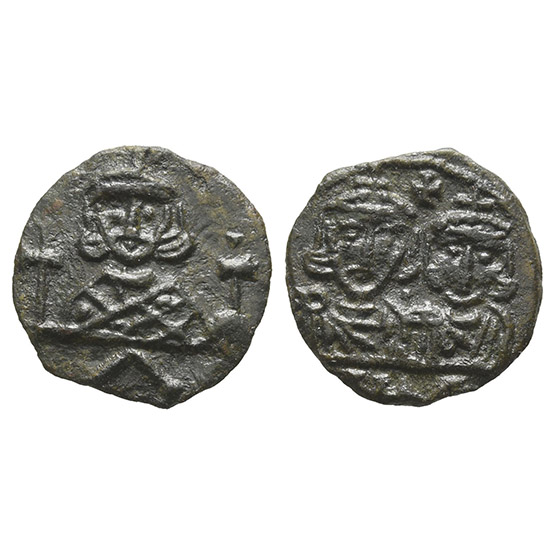
Constantine V, with Leo III and Leo IV AE Half Nummus. Struck AD 751-775. Syracuse mint.
Sold for (Inc. bp): £85
Crowned bust of Leo facing, wearing loros, holding cross potent on base, cross to left; Λ in exergue / Crowned and draped busts of Constantine and Leo IV facing, wearing chlamys, cross above, CIK´Λ (or NKA) in exergue. DOC 20 (cross not mentioned); SB 1569A (same). 1.76gr, 16mm, 6h.
Good Very Fine. Extremely rare.
Acquired on the UK market. Property of a London antiquarian. -
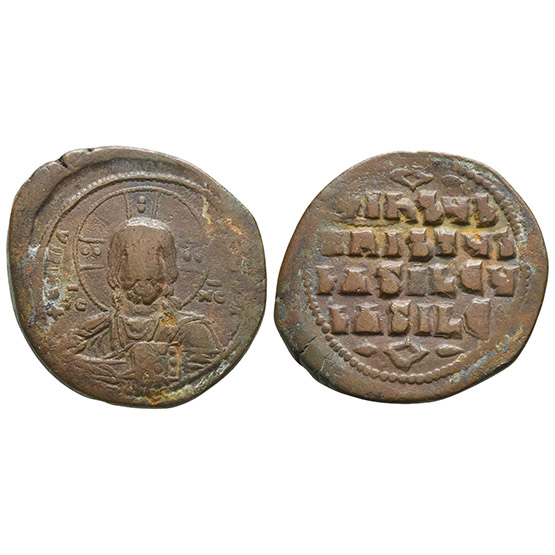
Byzantine AE Anonymous Follis. Time of Basil II and Constantine VIII, AD 976-1028. Constantinople mint. Class A2.
Sold for (Inc. bp): £39
✠ ЄMMA-NOVHΛ, nimbate bust of Christ Pantokrator facing, wearing tunic and himation, raising right hand in benediction and holding Book of Gospels in His left; two dots in each limb of the nimbate cross; IC XC in fields / ✠ IҺSЧS XRISTЧS ЬASILЄЧ ЬASILЄ, legend in four lines across field; ornament above and below. DOC A2.22; SB 1818 (Class A3). 16.68gr, 34mm, 6h.
Near Very Fine.
Acquired on the UK art market since the early 2000s. Property of a Lincolnshire gentleman, thence by descent. -
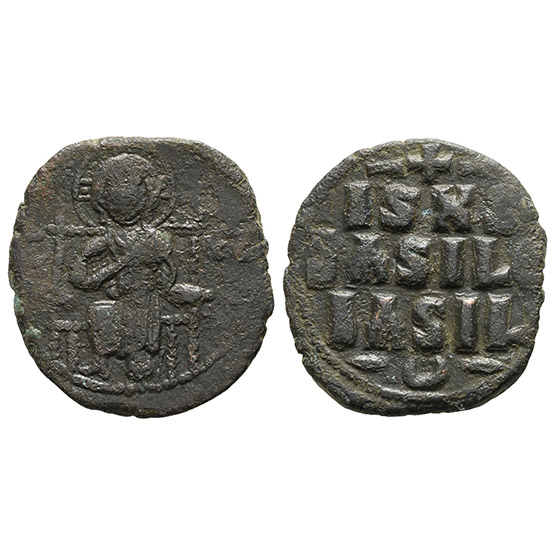
Anonymous AE Follis. Time of Constantine IX, circa AD 1042-1055. Constantinopolis mint. Class D.
Sold for (Inc. bp): £26
IC to left, XC to right of Christ, nimbate, seated facing on throne with back / IS XS bASILЄ bASIL in three lines, cross between two lines above, crescent between two lines below. DOC Class D; SB 1836. 8.34gr, 28mm, 6h.
Near Very Fine.
Property of a Cambridgeshire, UK, gentleman. -
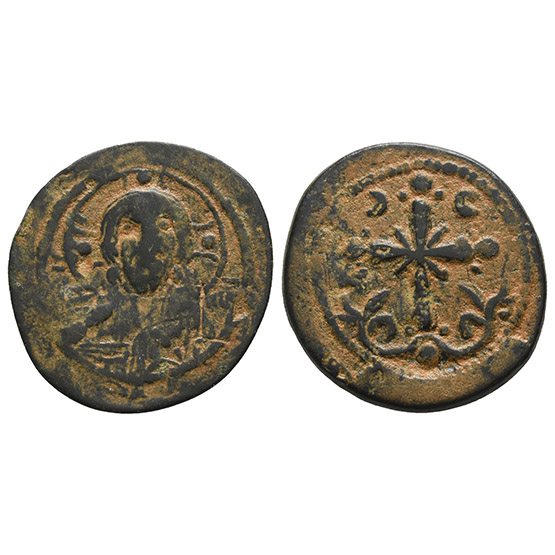
Byzantine AE Anonymous Follis. Time of Nicephorus III, AD 1078-1081. Constantinople mint. Class I.
Sold for (Inc. bp): £20
IC XC, bust of Christ, nimbate, facing; His right hand raised, book of gospels in His left / Latin cross with central saltire, globus and two pellets at the end of each extremity; crescents to upper left and right, floral scroll to lower left and right. DOC Class I; SB 1889. 5.49gr, 26mm, 6h.
Near Very Fine.
Property of a Cambridgeshire, UK, gentleman.

