-
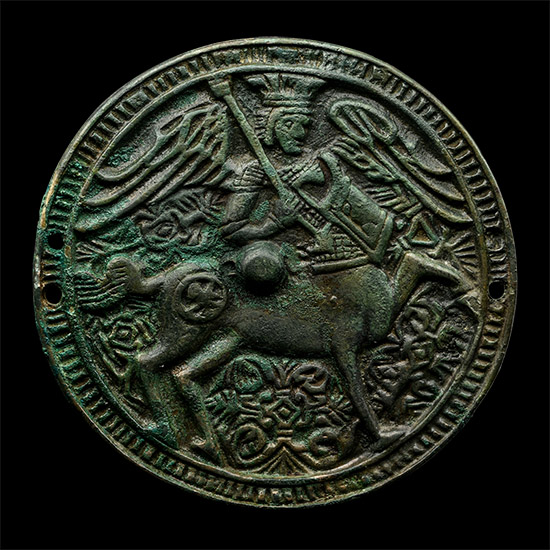
Post Medieval Mirror with Centaur 'Kitovras'
16th-17th century A.D.Sold for (Inc. bp): £910
Discoid with ribbed border and central raised pellet, motif of a winged centaur holding a square shield and a staff(?), foliage motif to the background; pierced three times to the rim. 153 grams, 10.1 cm
From the private collection of a London gentleman, from his grandfather's collection formed before the early 1970s.
This version of a centaur was known as ‘kitovras’, an old Russian version of the word ‘kentauros’. He is typically portrayed with the body of a horse and the torso and head of a man, often featuring prominent wings and wearing armour. Kitovras is best known from a legend, ‘The Tale of Solomon and Kitovras’, in which he is tricked into building the temple for King Solomon. While held in captivity, Kitovras tells Solomon how to obtain the stone needed to build the temple and stays with him through its completion. When Solomon doubts Kitovras’ strength, Kitovras throws him to the edge of the Promised Land, but the king eventually returns and takes back the throne. -
.jpg)
Renaissance Silver Interlinking Necklace
Germany, 16th century A.D.Sold for (Inc. bp): £2,340
Comprising interlinking flat loops with pierced spacers decorated with Renaissance motifs, winged telamon and ‘jewels’; sturdy hook-and-eye closure. 110 grams, 49 cm
Private collection, Europe. Acquired on the English art market. This lot has been checked against the Interpol Database of stolen works of art and is accompanied by search certificate number no.13154-248389.
Such chains were known as a 'Sivlonot' in German Jewish tradition dating from the 16th century, in a custom whereby silver or gold chains were sent as a gift by the bridegroom to his future bride. They were worn under the bridal canopy and throughout the following week, then often brought out again for holidays and ceremonial occasions. -
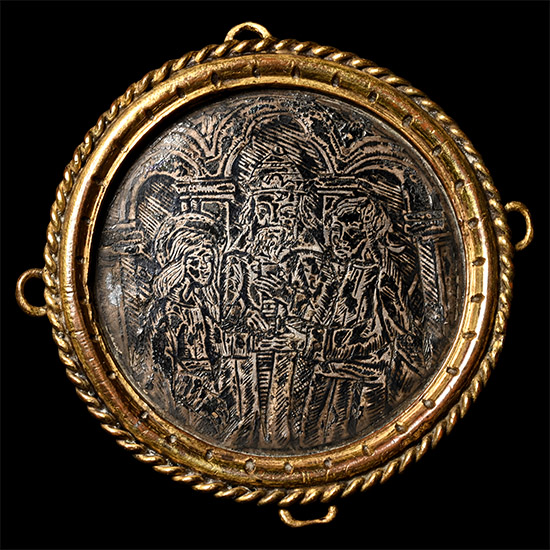
Medieval Gilt and Niello Hat Badge with Marriage of the Virgin
Italy, circa 1500 A.D.Sold for (Inc. bp): £1,430
Niello plaque depicting the marriage ceremony between Mary and Joseph, set in a gilt brass mount with a rope twist border, four loops for attachment. 10.8 grams, 46 mm
Private collection, Europe. Acquired on the Belgian art market.
Niello is a black mixture, usually of sulphur, copper, silver and lead. It is used as an inlay on engraved or etched metal, especially silver. It is added as a powder or paste, then fired until it melts or at least softens and flows or is pushed into the engraved lines in the metal. Men began wearing hat ornaments on their caps from the late fifteenth century, which could be either purely decorative or symbolic. Symbolic examples are traditionally known as enseignes, as they conveyed the wearer’s personal intent or a visible message. These jewels trace their origins to the medieval pilgrim badge, usually mass-produced in base metal. It is believed that this fashion shift to a stylish male accessory began when French king Charles VIII entered Naples in February 1495, wearing a gold circular jewel on his cap, while his men had similar, though not gold, jewels on their caps or sleeves. Italians quickly adopted this trend, which then spread to most European courts. However, this fashion declined in the late sixteenth to early seventeenth century, giving way to the popularity of aigrettes. -
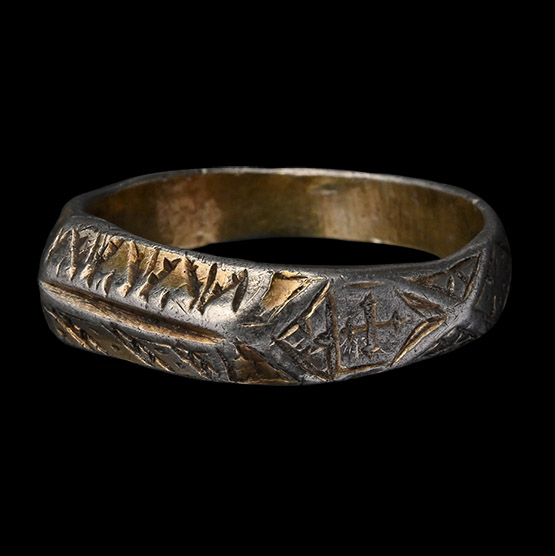
Medieval Silver Iconographic Type Ring with Heart and Cross
15th century A.D.Sold for (Inc. bp): £1,300
The lower shank with facets, each with a reserved cross pommee; the shoulders each with a heater-shaped panel, one with a cross moline and the other with a heart; the bezel in two panels, one with a row of hearts, the other with ropework; traces of gilding to the bezel. 4.13 grams, 22.85 mm overall, 19.78 mm internal diameter (approximate size British S 1/2, USA 9 1/4, Europe 20.63, Japan 19)
Acquired on the UK art market in the 1980s. From an East Anglian private collection. -
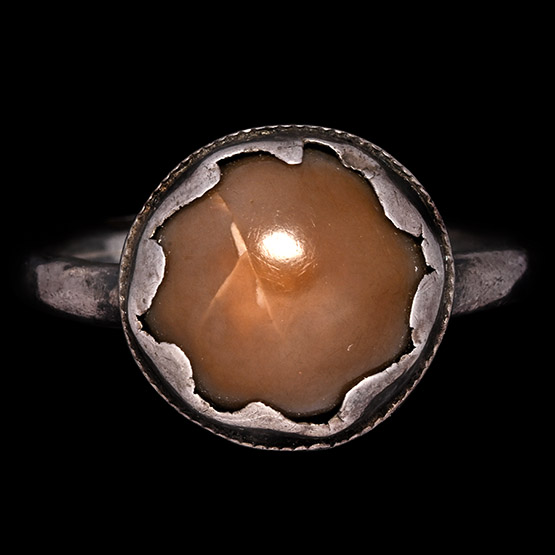
Tudor Period Silver Ring with 'Amuletic' Toad Stone
Western Europe, 16th century A.D.Sold for (Inc. bp): £5,720
Round-section hoop supporting a discoid bezel, claw setting with inset 'toadstone' amulet. 4.53 grams, 29.85 mm overall, 20.51 mm internal diameter (approximate size British T, USA 9 1/2, Europe 21.26, Japan 20)
Private collection, Europe. Acquired on the French art market. This lot has been checked against the Interpol Database of stolen works of art and is accompanied by search certificate no.13074-248390.
William Shakespeare’s As You Like It, circa. 1599; ‘Sweet are the uses of adversity, Which, like the toad, ugly and venomous, Wears a precious jewel in his head yet’. Toadstones are mythical stones that were thought to be found inside the head of a toad. They were believed to sweat, change colour or even heat up in the presence of poison. It was thought that a toadstone placed on bites from snakes, insects, spiders and shrews would extract poison from the wound. They were thought to bring good luck and ward off evil, whether in the present life or in the afterlife. The Book of Secrets from the 13th century recommends swallowing the stone to 'cleanse the bowels of filth and excrements'. The stone could then be retrieved and used again. They were often set as amulets and talismans, a practice that continued in Europe until the 18th century. Toadstones are actually the button-like fossilised teeth of Lepidotes, an extinct genus of fish common in the Jurassic and Cretaceous Periods, 200 to 100 million years ago. -
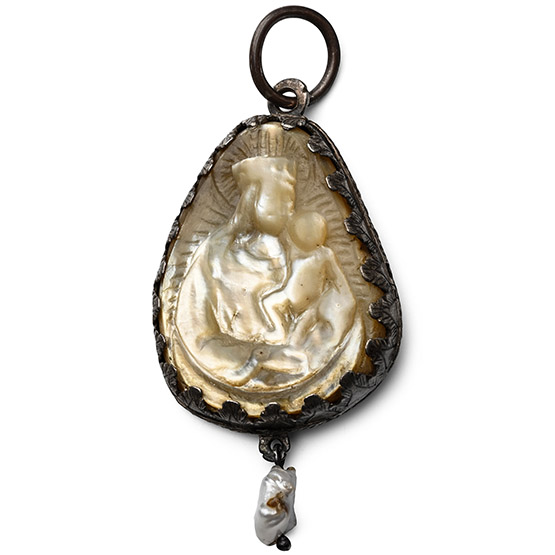
Medieval Silver Pendant with Mother-of-Pearl Scene of Virgin and Child
Germany, 15th century A.D.Sold for (Inc. bp): £2,210
Tear-shaped frame with loop and irregular dangle below; carved nacre relief of the Virgin and Child; Mother of God shown crowned and in profile, tenderly supporting the Christ Child on her lap; applied gold Corpus Christi to reverse. 20.5 grams, 70 mm
Private collection, Europe. Acquired on the German art market. This lot has been checked against the Interpol Database of stolen works of art and is accompanied by search certificate number no.13056-248332.
The carving, with its luminous iridescence and softly modelled planes, captures both the sacred intimacy of the subject and the shimmering qualities of the material. The mount is worked in silver with chased foliate detail and suspends a natural baroque pearl drop. The reverse is finely engraved with radiating rays, clouds, and the inscription INRI, centred by a parcel-gilt figure of the Crucified Christ affixed to the ground. This juxtaposition of the Virgin and Child with the Passion underscores the dual themes of Incarnation and Redemption, reflecting late medieval devotional practices. -
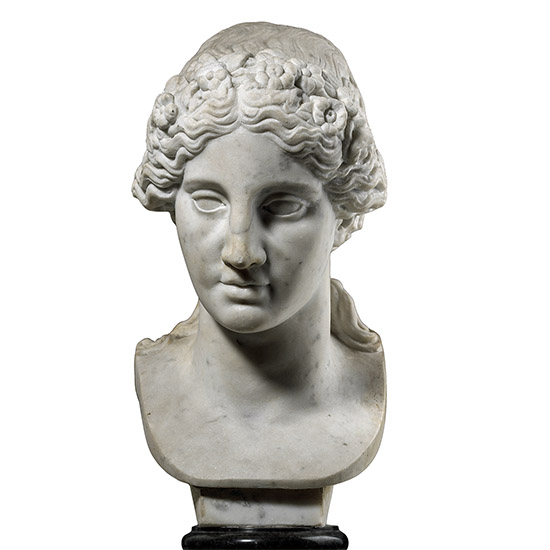
Marble Head of the Greek Goddess Aphrodite
18th-19th century A.D.Sold for (Inc. bp): £5,460
Modelled in the round as a bust of a youthful female, possibly Aphrodite with her hair bound by a narrow filet tied at the nape of the neck and the tails retained by a flat ribbon at the rear; the face perhaps modelled on the statue 'Aphrodite of Knidos' by Praxiteles; socket to crown of the head for attachment of a nimbus (now absent); mounted on a socle base. 12.6 kg, 40.5 cm
Acquired on the Los Angeles art market. Private collection, England. This lot has been checked against the Interpol Database of stolen works of art and is accompanied by search certificate number no.13095-249678.
This magnificent head of a woman with an elaborate hairstyle is in perfect harmony with the artistic works of several neo-classical sculptors of 18th century, yet subtly different from it in stylistic terms, like Giovanni Marchiori, and to the so-called stone Venus or Flora in the Museo Civico di Treviso. -
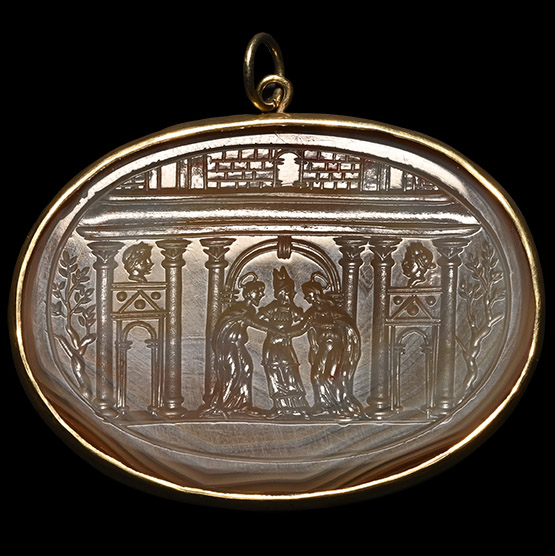
Large Agate Gemstone with the Marriage of the Virgin
Italy, Late 17th century A.D.Sold for (Inc. bp): £1,859
Plaque with narrow border enclosing a figural scene with a colonnade and façade flanked by olive trees; central arch with two nimbate and robed figures clasping hands with a third figure behind them wearing a headdress; set in a gold frame with suspension loop; supplied with a museum-quality impression. 19.61 grams, 54 mm
Private collection, Europe. Acquired on the French art market.
The subject is the marriage ceremony between Mary, 'the Virgin', and Joseph. -
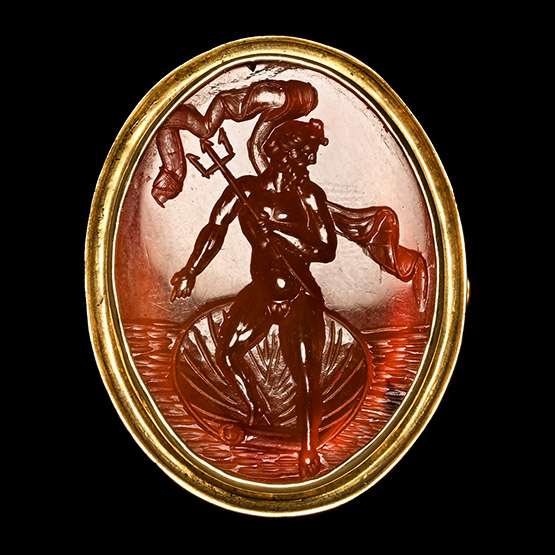
Post Medieval Gold Ring with Carnelian Gemstone Depicting the Roman God Neptune
Italy, 19th century A.D.Sold for (Inc. bp): £2,340
Depicting Neptune advancing nude from a scallop shell, holding a trident in one hand and pointing with the other; billowing banner to his rear; supplied with a museum-quality impression. 15.19 grams, 31.43 mm overall, 19.60 mm internal diameter (approximate size British R, USA 8 1/2, Europe 18 3/4, Japan 18)
Private collection, Europe. Acquired on the English art market. This lot has been checked against the Interpol Database of stolen works of art and is accompanied by search certificate number no.13053-248373.
Throughout Europe, and far beyond, talented gem-cutters were at work in the 19th century. Neptune was appreciated by Neoclassical cutters, as shown by a carnelian gemstone with the profile of Neptune, his face serene amidst a storm, by the American engraver George Hewitt Cushman (1814-1876). -
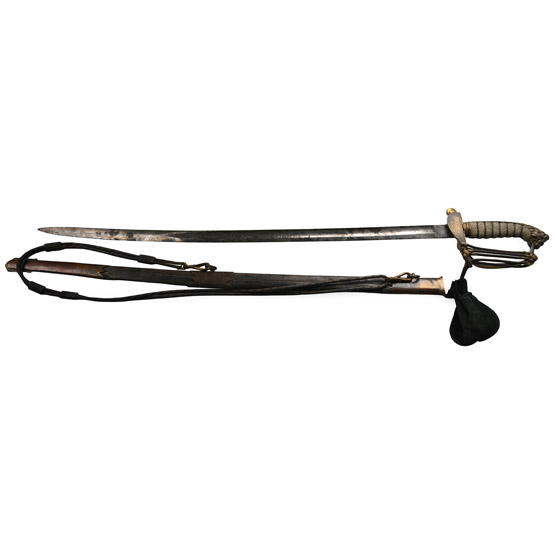
Royal Navy Officer’s Sword for Battle of Trafalgar Midshipman (Later Commander) James Eaton
1827 PatternSold for (Inc. bp): £4,680
A solid half-basket-hilt with folding guard, engraved 'J.S. Eaton, R.N.' in copperplate; lion-head pommel with knuckle-bow entering through the lion's mouth, 'ray-skin' grip and retaining wires; sword-knot tied through slot in the knuckle-bow (now in protective velvet pouch); pipe-backed single-edged blade with etched crown-and-anchor design to one face and heraldic helm to the other, ricasso with reserved six-pointed star and inset gold disc with blackletter 'D'; black leather scabbard with three brass fittings (locket, middle and chape) and two suspension rings; suspension cord with decorative braided banded keepers. 1.31 kg, 95 cm
Believed to have been owned by James Eaton, famed for serving at the battle of Trafalgar, and in later life, Commander. Ex Newbury antique emporium. Property of a Berkshire, UK, gentleman collector. Accompanied by copies of various online biographical research information. This lot has been checked against the Interpol Database of stolen works of art and is accompanied by search certificate number no.13157-246979.
The sword is believed to have belonged to Eaton in later life, when he had been promoted to the rank of Commander. The Trafalgar Roll (p.53) and other sources record his career in some detail. James Eaton was born in London in 1783 and entered service in the Royal Navy in 1799, aged 16, aboard the Quebec stationed in the West Indies, and in 1800 he was appointed Midshipman to the vessel La Prompte. He was in the mizentop of the Hannibal in the action off Algeciras, Spain, in 1801 when she was obliged to surrender, having sustained losses of 81 men killed and 62 wounded; he was then in an exchange of prisoners and returned to Britain aboard the San Antonio which had been captured from the Spanish in battle at Cadiz. As a midshipman in 1803, he served on the Atalante intercepting enemy smuggling and supply vessels near St. Gildas in the bay of Quiberon, Brittany. Eaton was the Signal Midshipman of the Téméraire at the battle of Trafalgar in 1805 and was the first signal officer to repeat Nelson's famous message 'England expects that every man will do his duty' to the rest of the fleet, an illustrious and important achievement: J.M.W. Turner created a magnificent painting of the Téméraire which is now featured on United Kingdom £20 notes. This ship took part in the thick of the action at Trafalgar - she came alongside and was lashed to the French ships Fougeux and Redoutable, the crew of which was about to board Nelson's flagship, HMS Victory until a broadside was delivered which caused a huge loss of life and saved Nelson's vessel from the hands of the French. He was promoted to lieutenant the following year and appointed to the Lion where he served for six years. He sustained wounds in an action aboard the Lion while escorting a convoy to China and took part in 1811 in the invasion of Java mounted against the Dutch East India Company. In 1813, he was aboard the Beaver when she rescued the crew of a Swedish merchant vessel and received a distinction for his part in the action. He retired in 1842 with the rank of Commander with the Naval General Service Medal and two clasps in recognition of his distinguished career. He finally settled in West Bromwich; he died fifteen years later. Less glorious, perhaps, is his nickname 'Snotty' Eaton - the normal term in those days used to describe any midshipman. The vendor has been told by Will Heppa, curator at the Royal Navy Museum, that there appears to be only one 'J Eaton' in the records of the appropriate period; there is thus every reason to accept that the sword did belong to the Eaton of Trafalgar fame. -
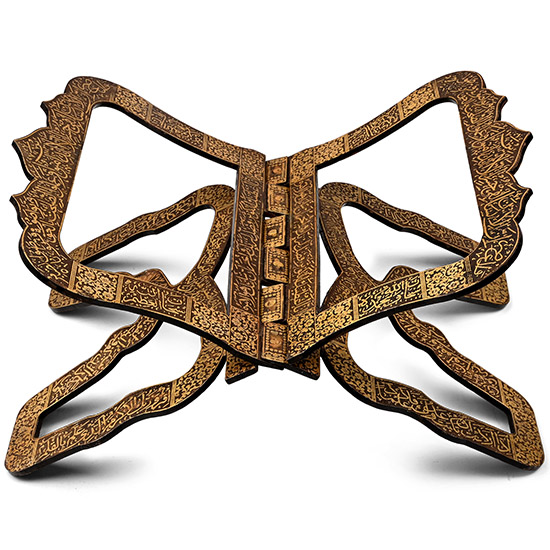
Koftgari Brass Inlaid Iron Quran Stand
Indian, 19th century A.D.Sold for (Inc. bp): £4,680
Formed as two hinged folding leaves, the lower sections pierced with rounded voids and the upper with a subrectangular slot; the entire surface decorated with inlaid floral panels and passages of calligraphic text. 3.3 kg, 37.5 cm
Private collection, London, UK. This lot has been checked against the Interpol Database of stolen works of art and is accompanied by search certificate number no.13160-248446. -
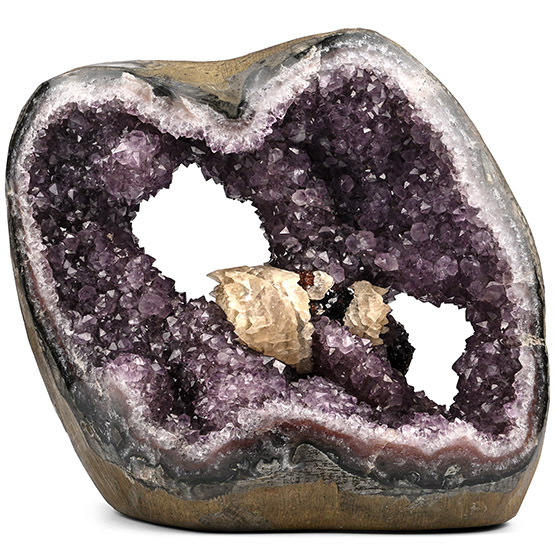
Amethyst Crystal Geode with Calcite Rosettes
Cretaceous Period, circa 120-140 million years B.P.Sold for (Inc. bp): £780
Beautifully prepared section with polished edges and two natural 'windows', a thick blanket of prismatic amethyst crystal lining the interior, two calcite rosettes at the centre and aggregates of darker crystals. 6.9 kg, 23 x 24 x 10 cm
From Artigas, Uruguay. Property of a London lady.

